Galactic Suburbia 89
 In which we recommend books to buy as presents, books we love, books we made, and basically BOOKS BOOKS BOOKS. You can get us from iTunes or at Galactic Suburbia.
Alisa’s picks: 2012; Trucksong; A Trifle Dead; Rosaleen Love’s Twelve Planets collection; the entire Twelve Planets suite (get them while they look the same! especially Love & Romanpunk)
Alex’s picks: Temeraire by Naomi Novik; Ocean at the End of the Lane by Neil Gaiman; Shades of Milk and Honey by Mary Robinette Kowal; Left Hand of Darkness by Ursula Le Guin; House of Suns by Alistair Reynolds
Tansy’s picks: Glitter and Mayhem; Chicks Unravel Time; The Wife in Space; The Worst Witch books by Jill Murphy; Creature Court trilogy (Power and Majesty)
Culture Consumed:
Alex: Reap the Wild Wind, Julie Czerneda; Ocean at the End of the Lane, Neil Gaiman
Tansy: Flying Higher eds by Michael Damian Thomas & Shira Lipkin [download free from Smashwords], Doctor Who: Prisoners of Time 1-4, Supurbia by Grace Randolph, Elizabeth Sladen the Autobiography, The She-Hulk Diaries by Marta Acosta
Alisa: Glamour in Glass, Mary Robinette Kowal
BLATANT PLUG: Songs For Europe, two short plays about Eurovision & war by John Richards of Splendid Chaps & Lee Zachariah of the Bazura Project on this week only as part of the Melbourne Fringe.
Please send feedback to us at galacticsuburbia@gmail.com, follow us on Twitter at @galacticsuburbs, check out Galactic Suburbia Podcast on Facebook and don’t forget to leave a review on iTunes if you love us!
Asymmetry: a review
I totally intended to read this slowly. Honestly I did. I meant to savour it, and contemplate each story.
Is it my fault that I ripped through each story, eager to know where it was going? It is my fault that each story is short enough that before I knew it I had finished one, turned the page, and started another?
I think not.
In the interests of, etc, I should point that I do know both Thoraiya Dyer, the author, and Alisa Krasnostein, the publisher. If I didn’t like what I had read, I just wouldn’t write anything… 😉
 So. Asymmetry. In each story, a lack of balance, especially in power; sometimes, also, a lack of balance in an individual’s life, making them particularly vulnerable to direct manipulation or simply life’s vicissitudes.
The first story is “After Hours,” and I’m so pleased to finally read something of Dyer’s that makes use of her veterinary skills! I’ve been wondering when they would find an outlet in her fiction. Didn’t necessarily expect to find it in a story about werewolves, but that’s fine. I do wonder whether there’s a little hint of Dyer’s own experiences here, or those of friends, with how one of the senior, rather unpleasant, men treats one of the women – commenting that women aren’t worth training because they just up and leave to have babies. Anyway, Jess is a new vet in a rural town, where the clinic’s biggest client is the local RAAF base with its patrol dogs. Werewolves are involved, but I won’t spoil how. The asymmetric power dynamic comes in its experience/newbie aspect, as well as in its gender aspect. Dyer hints at the difficulties of being new to a job as well as being new to a small town – actually I’m just presuming it’s a small town, but that’s definitely the vibe I got – very effectively. You probably don’t want to read this if you’re going to be squeamish about matter-of-fact descriptions of veterinary procedures.
In “Zadie, Scythe of the West,” Dyer wrenches us out of a relatively familiar world into one where only women are soldiers, and they’re only allowed to kill as many enemies as children they have borne. The tiny detail in this story that delighted me was the rather obvious point that, as a consequence of this prohibition, the women have developed great skills at harming rather than killing. The asymmetric power here is once again a gendered one, as women have power because of their martial position, and presumably also because of the worship of a goddess who orders society and doles out punishment as necessary. The focus is on someone with a skerrick of power – an artist – whose expertise gets abused by someone with more power, for her own ends. The world of this story totally fascinated me, because there is so little back story: why the fighting? is this a fantasy or a SF world? And the story, in skipping to vignettes within the artist’s and Zadie’s life, suggest interesting ways for men and women, state and individual, to relate.
Having interviewed Dyer before I read this, I already know that she’s working on a longer treatment of the world she depicts in “Wish me Luck,” which is intriguing all by itself. Here, somehow, luck is a form of currency: it can be transferred between individuals, and used to purchase goods. As with the previous story, it’s unclear whether this is more of a fantasy or SF conceptualisation, although the ending suggests SF – as does, now I think about it, the fact that Kvivik is expressly discussed as another planet, and our narrator has come from Earth. Still, the luck aspect suggests a blurring of genres. Anyway! Our narrator begins sympathetically enough, but it must be said that much of my sympathy had transmuted to distaste by the end of the story. He’s one of those unpleasant people who keeps making promises… for tomorrow. But the world – oh, the world. Kvivik is a water world, with a human colony that appears to exist solely to supply water to its waterless sister-planet. Why these planets are worth the effort is unclear, and will perhaps be revealed by Dyer in her longer work. The story is mostly set amongst the dregs of society on Kvivik, which of course is where most of the best stories are found, and there are some distinctly unpleasant people there – and robots, and possibly half-humans, and a thoroughly mysterious Lady Adelaide. The asymmetry is found in the haves vs the have-nots, and in intention vs action. I think this is probably my favourite story of the quartet.
Finally, “Seven Days in Paris” gives the cover its Eiffel Tower. We’re back on Earth, some time – but not too far? – into the future. The story comes from the perspective of Marwa B, who first appears to the reader while looking at someone identified as Marwa. Marwa B is taken out into Paris, to have experiences which her captors/handlers/users hope will stimulate dreams that in turn will help them to understand the original Marwa. Exactly who or what Marwa B is, or how her operators use her, is left opaque – what matters is that they do, and they believe it’s necessary to do so. The asymmetry is a riff, I think, on that philosophic conundrum of whether it is permissible to torture one to save many. There’s also a huge knowledge imbalance, with Marwa B having no real understanding of what she is being used for until right at the end; and of course it’s a state vs individual thing, too. I enjoyed the development of Marwa B over her seven days – she’s not an entirely clean slate, but she still gets to experience things relatively innocently – and Paris is a sensation-filled place to do that. I also really appreciated the point at which Dyer left this story.
This is an entirely worthy eighth volume in the Twelve Planets series. It’s different from the others (that I have read… still haven’t brought myself to read the Warren or the Lanagan…), as it should be, but fits in with the overall scope of the project – quality writing from Australian women. You can buy it from Twelfth Planet Press.
This review brought to you as part of the Australian Women’s Writing Challenge 2013.
An interview with Thoraiya Dyer
Thoraiya Dyer is an award-winning Australian writer based in the lush, sweeping NSW Hunter Valley. Her short fiction has appeared in Clarkesworld #75, Apex #35, Redstone SF and Nature; it is forthcoming in Cosmos #51 (full list). Her collection, Asymmetry, is out now from Twelfth Planet Press.
I’m holding off on reading Asymmetry until I have holidays, but I’m going to guess it’s a set of four stories, since the others have been… did you have a theme in mind when you started writing for your collection? Or particular stories that you’d been wanting to write?An interview with Livia Day
In just a few days, A Trifle Dead will be launched – a book I’ve been looking forward to reading for rather a long time. Livia Day is another name for Tansy Rayner Roberts, another voice of Galactic Suburbia and overall awesome author. I decided to throw some questions at her and see what happened…
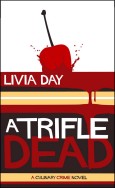 You’ve picked yourself a nom de plume for your first published crime novel. How did you pick it, why did you pick it, and have you been practising a Livia Day autograph?
OMG I hadn’t even thought of a Livia Day autograph. I only have a few days to figure that one out before the launch! Thanks for the head’s up.
I have actually just finished writing an article I was commissioned to do for Writing Queensland about this whole topic so I’ll keep it fairly brief this time: I wanted to differentiate between my crime writing and fantasy writing selves. Livia is after my favourite imperial Roman woman, the one I never managed to name one of my children after (believe me, I considered it!) and Day is from teenage newspaper editor Lynda Day in Press Gang, one of my first fictional heroes.
Given the title, and its setting in and around a cafe (I’ve read the first chapter thanks to Salvage), clearly food is going to play some role in the novel. How important is food, do you think, in setting up a world? I can think of lammas bread from Lord of the Rings, and vaguely remember exotic English teas from ancient kids’ books, but a lot of the time food doesn’t seem to get much of a look in.
Food is a great storytelling device! I do a lot of worldbuilding through social customs in my fantasy writing, and food is key to that – in A Trifle Dead food is certainly relevant to character traits. Almost everything in crime fiction comes down to the psychology of characters, the reason why people do what they do. My protagonist is a professional cook and cafe manager and she uses food in many ways – to heal, to nurture, to manipulate, to bribe, to cement friendships. In the opening chapters she is actually using food as a kind of anti-siege weapon, to rid herself of the over-protective men in her life.
I think part of the reason that culinary themes work so well with crime fiction is because it gives us something comforting to balance out the scary or more confronting themes to do with murder and darker psychologies. I love Kerry Greenwood’s Corinna Chapman and the baking she does in those books – and one of my favourite crime series of all time, the Roman historical mysteries about Falco the informer (by Lindsey Davis) uses food as worldbuilding as well as to express character.
Then there’s Agatha Christie, of course, herself an experienced chemist – every bite in those books could potentially kill you!
Why Hobart, aside from it being your home town?
Well you see, it’s my home town… but that doesn’t mean it was the default for these books. I actually found it quite confronting to write something set in my own home town, especially when I was much younger. One of the oddest things about doing that is how your own version of a place you know intimately can clash with other people’s perceptions – I think I’m going to have a much better time selling the idea of Hobart being a fun, arty and cosmopolitan centre than when I first started working on this manuscript years ago, because we’ve had a bit of a media renaissance around here in the last year or two thanks to MONA and other cultural events.
But of course the short answer is that Tabitha grew out of this city – her story couldn’t be told anywhere else.
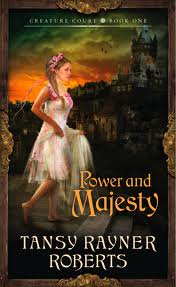 You’re most well known for your fantasy novels, The Creature Court trilogy, and by me originally for the Kassa Daggersharp pirate fantasies. Does crime writing require a different part of your brain?
It certainly has a different skillset – much tighter plotting is required! You can’t just take people off down a meandering path, or let your imagination run completely unfettered. It’s harder in some ways and easier in others – the biggest difference is not actually the genre aspect, but the difference between writing in an imaginary world and the current world. Being able to throw in pop culture or technology references, and so on. I had to think a lot more about the constraints because in all the crime fiction I grew up reading, no one had mobile phones or Twitter or DNA testing, and that sort of thing makes it kind of difficult to get away with a lot of the more traditional crime fiction twists. Sure you can have your character’s mobile phone get broken but that’s cheating…
Do you have further stories in mind for Tabitha Darling?
Oh, yes, I’m contracted for a sequel, Drowned Vanilla. Even more than A Trifle Dead it is about internet culture and creative culture and how these two things interact. The story is about a girl who goes missing from a house that’s full of webcams. But mostly it’s about ice cream. Oh my goodness I know so much about the history of vanilla that I didn’t know before writing this book!
After that, we’ll see – if the readership is there, I will happily continue with Tabitha’s adventures in catering and murder mystery solving – I’m deeply in love with the eccentric ensemble cast she has gathered around her, and any excuse to spend more time with them.
Is there anything else we should know? Like other exciting books?
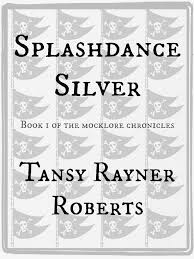 Just that my early fantasy books are being made available as e-books by Fablecroft – Splashdance Silver is up now on Kindle, Wizard’s Tower and Weightless Books, and the other two Mocklore Chronicles are shortly to follow. The third one was never officially published before so that’s quite exciting to people like yourself who had a fondness for my funny pirate witch explosive magic books…
You can read Tansy’s blog, and get to grips with her Doctor Who obsession, while Tabitha Darling has a tumblr (of course; she’s so hip). You can buy A Trifle Dead over here, at Twelfth Planet Press.
It’s Showtime (a review)
Disclaimer: I am friends with the publisher of this book, Alisa Krasnostein.
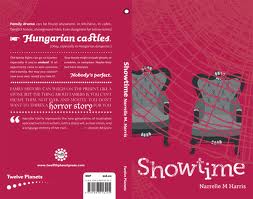
I’m not a big fan of horror, so I am not the ideal reader for this collection which, although not overwhelmingly scary, uses horror tropes to tell its stories. Nonetheless, it is a quite readable quartet.
The first story, “Stalemate,” is probably the scariest, and that’s because it is the most mundane. Which is saying something, because three out of four of these stories are defined by being set in domestic settings (by which I mean only non-exotic, like another planet or a medieval castle). It’s a suburban kitchen, with a mum and her grown-up daughter, arguing over all the tired old things that parents and grown-up kids argue over, with the added bitterness that Mum is there to help the daughter while she is sick. Of course, it turns out that things aren’t quite as mundane as they seem – and this revelation makes things all the more awful because of the very setting, and the consequences. It’s terrible.
My favourite story is “Thrall,” because it does the most clever things with the horror ideas it’s working with. It’s the story that is least obviously ‘domestic’, involving as it does a Hungarian castle; but even then, it opens in a dingy suburban cafe, and the castle is a tourist trap. Dragomir is a vampire, returned to Hungary to get a bit of rest. He has called a thrall to him – a woman whose ancestors pledged their allegiance to him many centuries before – to help him get ready. The narrative is fairly simple and straightforward. What really makes the story intriguing though is people’s reactions to Dragomir, and his reactions to them. Harris has gone with a much more ‘realistic’ vampire, in that he is very much a man of his times – his original times. He is shorter than the average 21st century man. He despises much of the modern world. And, in return, much of it despises him, too.
“The Truth about Brains” makes the reader into zombie territory, and the heady days of summer in the suburbs. Again the characters revolve around the family, this time an older sister impatient with her brother who, as the story opens, has kind-of sort-of accidentally been turned into a zombie. The narrative backtracks to explain how that happened, and then explores the consequences for the sister, the brother, and the other people involved. I think I found this the least convincing of the stories, mostly because the characters didn’t work for me. It could also be that I just don’t like zombie stories.
The last story is the longest, and relates to Harris’ novel The Opposite of Life, which I’ve not read. “Showtime” involves Gary – a not-that-happy-with-it vampire – and his friend Lissa, a librarian, heading to the Melbourne Show, location of rides, craft, wood-chopping exhibitions… and a haunted house. Harris does well to bring those unfamiliar with this version of Melbourne up to speed, with crafty hints at Gary and Lissa’s shared past of dealing with less-than-friendly vampires, and how this friendship manages to exist at all. It captures some of Gary’s angst and rue at not being alive, and suggests an interesting take on the implications of being undead (sunlight isn’t deadly but more like a beta-blocker; he has no adrenaline so rollercoasters are pointless). However, in the end the story fell a bit flat for me, and I think that was partly because I wasn’t as invested as I could have been in the lives of Gary and his vampire brethren existing (as it were) in the shadows of Melbourne.
Overall, this is generally an interesting look at how horror tropes can be used in familiar settings, and it’s certainly a neat addition to the Twelve Planets series.
Bad Power is so good

This fourth in the Twelve Planets series, from Alisa at Twelfth Planet Press, comes back to the idea presented by the first collection – that of an interconnected suite of stories, which build on and enhance one another but also stand by themselves. I think this comes second only to Love and Romanpunk for me, so far, and as I’ve already discussed, I’m in no way unbiased about that delightful little book.
The overarching idea here in Deborah Biancotti’s set is, as the title suggests, the use and abuse of power – especially when it is given to ordinary, or even undeserving people. The blurb asks “Hate superheroes? Yeah. They probably hate you, too.” It feels to me that the idea of ordinary people having powers and struggling with them is something that’s only become interesting in the last few years. Biancotti does not present unreservedly heroic or villainous people, in general, here. They do some stupid things… but they’re not out for world domination. They do some heroic things… but they have their struggles and failures, too.
The first story is “Shades of Grey,” in which Esser Grey confronts the idea of immortality and finds it not really to his liking. His reasons for not liking it involve some intriguing of character development, and the consequences should be ruinous for him but mostly end up being so for other people around him instead. I don’t think you can like Grey, exactly, but his story is an excellent introduction to the issues of power as Biancotti imagines them. And we are also introduced to the wonderful Detective Palmer, who keeps popping up throughout the rest of the sequence. Like in the second story.
“Palming the Lady” might be my favourite of the set. Not that it’s a pleasant story, by any stretch of the imagination. There’s a somewhat spoilt rich boy, son of a famous father, who claims to being stalked by a homeless woman; Detective Palmer, newly in the bad books at work, is assigned to look into it. Which means talking to said homeless woman at much closer quarters than she is comfortable with, and finding out more information than she is comfortable with. The ‘stalker’ is confronting on a number of levels: for her appearance, and her (lack of) status, and her talent. And for the conjunction, too, of a remarkable talent in an unremarkable woman. I did not like the rich boy, Matthew, but fortunately most of the story is actually about Palmer, who shows delightful tenacity as well as an endearing capacity for not understanding things immediately. Also, a weary love of humanity.
My dislike of Matthew made me slightly wary of “Web of Lies,” the third story, because it features him again. Fortunately, this is quite a different story, and quite a different Matthew too. It begins at his father’s funeral an unspecified amount of time after the second story,and – appropriately – features his mother to a much greater extent than “Palming the Lady.” There, Palmer met her once and dismissed her as having “a prescription problem.” This story delves into her life and shows it to be about far more than simply a bored housewife and overuse of valium. This one creeped me out quite a lot; somewhat sinister mothers will do that. Matthew is theoretically the centre of the story, with his problems in understanding the power that he is coming into, but the mother is where my interest really lay.
The fourth story is quite different, and it took me a while – in fact, until reading the next story – before I really understood how “Bad Power” really fit into the suite. I think it works overall, but certainly when I first started it I was a bit confused. Partly this is the difference in narrative voice: where the first three are third-person, modern Australia, and set in wealthy enough areas, this one is first-person, somewhere ill-defined, and very definitely not well-educated. It’s an unpleasant story (again). In this case the unpleasantness comes about because of other people’s reactions to our narrator’s power, which haven’t been explored on a medium-to-large scale in any of the other stories. And it definitely provides interesting context about how attitudes towards ‘power’ have changed, as well as attitudes towards individuals and, hmm, maybe social responsibility? After I got into the rhythm of the narrative style this was a really good story.
Exploding the Twelve Planets paradigm, this collection has FIVE stories, finishing off with “Cross That Bridge.” In many ways it ties together aspects of all four of the previous stories in nice, but not too neat, ways – ways that still leave me hungering for more story set in this world, for sure. We’re back with police work, this time with a Detective Ponti (heh, Latin joke!) at the helm, looking for a missing child. This is probably the most hopeful of all of the stories, where power is used largely for good – or at least mostly non-destructive – purposes, and where indeed an actual purpose for the powers exhibited so far can be imagined, and undertaken.
As should be obvious, all of these stories tie together, and I can see the reasoning behind the sequencing. However, I think you could probably read them in any order (hmm, except perhaps #2 and 3, which should be read in sequence) and enjoy the exploration of ideas they present. You could also, crucially, enjoy them completely independently – although I would imagine that that would leave you wanting more, to an even greater extent than I do at the moment. This collection really works.

 Randomly Yours, Alex