The Lathe of Heaven
And so my le Guin adventure continues…
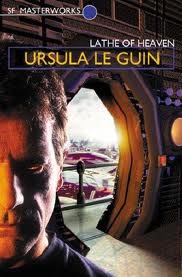 Sooo… not my favourite le Guin. Which is sad, which is itself silly, since I half expect every new le Guin to become my new favourite!
The premise here is that George, a remarkably ordinary man, has the ability to have what he terms effective dreams: dreams that alter reality. He doesn’t always dream effectively, but when he does he can’t control it. And it’s driving him mad, because he doesn’t want to have this ability. Thus, drugs, and then therapy. However, that’s when things go even less as George would want them to, because his psychiatrist Haber discovers the ability and… well. ‘Manipulation’ has such ominous overtones, but it’s appropriate here.
Objectively, there is little about this book that ought to work, in some senses. For a start, George Orr is a nobody. He doesn’t want to be a villain or a hero. In fact, there are several long sections of the book where the incredible normal-ness, average-ness, and boring-ness of George are analysed in depth, with some interesting discussion about whether his being so very very average is actually quite amazing. I really like George’s normality, and I can imagine that choosing to put this amazing ability into the hands of Mr Boring was actually quite a radical choice for le Guin (it also made me think of Deb Biancott’s Bad Power set of stories, where people get powers without having any desire to have them). Haber is another sort of character altogether, and a deeply unpleasant one at that. But still we don’t get very much insight into Haber – not whether his actions are motivated by greed or misguided altruism or what. We only see him through George, and George is a fairly ignorant observer.
Then there’s the narrative. There isn’t really very much plot, as such, for the simple reason that the world keeps changing. There can’t be much continuity, even in George’s own life, when he keeps changing fundamental aspects of the world itself. And this is disturbing and uncomfortable and a rather confronting narrative device. Of course, part of the point I suppose is to demonstrate that ‘changing the world’ isn’t as easy as it sounds; Haber thinks it will be simple to make things better, but chaos theory tells us that changing one thing can have immeasurable consequences… and when you throw in the added difficulties of everything being mediated through George’s unconscious mind, well. Hello havoc. Essentially the narrative consists of George and his quest to be normal, please.
I thought the explorations of George as Mr Average were a really interesting aspect of the novel, because in some ways it seemed to be interrogating the idea of the hero, in life as well as in literature, and also of course pointing out that the idea of ‘average’ is entirely a construction: no one should actually sit completely at the midpoint of any measures. I was absorbed by le Guin’s awfully relentless exploration of dream-logic and what it would do to the world next. But – apparently The Times declared this book should be “read again and again.” I’m not convinced it has that much re-readability, for me.
Rocannon’s World
 I believe this was le Guin’s first published novel, and I think it shows – it shares some themes with later novels, but the action is a bit jerky and occasionally confusing. (Also, the front cover makes it look a little bit too Masters of the Universe.) Nonetheless, it’s the first of the Hainish cycle which I generally adore, and I did enjoy it.
The book opens with the tale of Semley, who marries away from her family and comforts into an ancient but impoverished noble family. She determines to find an ancient necklace of the family, to restore some honour to them, and in doing so must have dealings with another, humanoid, race on her planet. To find the necklace they take her on a great adventure – to another world, although she doesn’t realise it – but her return is met with grief.
All of this is a prologue, and could easily pass as a short story in itself. Semley reminded me somewhat of Arwen, from LOTR, of what a continuation of Arwen’s story could have been. There’s certainly a LOTR/Celtic mythology feel to the different humanoid races on this world, and some of their interactions.
The rest of the story is about Rocannon, one of the people Semley met on her journey, and who is now directing an Ethnographic Survey on her home planet, many years later. Things go badly however when his ship is destroyed by unknown assailants, and all of a sudden he’s stuck on (to him) an exceedingly backward planet that might just have become the front line in a war the League has been anticipating for some time. He therefore has to deal with potential baddies being on this world as well as being cut off from all contact with his own people. This is, naturally, a difficult position to be in.
There’s action, there’s angst, there’s discoveries about some of the truths about the different humanoid races on the planet. Rocannon learns much about himself, as a leader and as a stranger and, most humbly, as a frail human who can actually learn things from seemingly backwards people.
It’s not as disturbing and earth-shattering as something like The Word for World is Forest, and I can imagine that an older le Guin might have added some more meaty stuff about gender or colonisation into the mix, which are just barely hinted at here. Still, like I said it’s an enjoyable enough story, and it’s largely very well written – there’s some beautiful prose. Interestingly this is one of the differences I noticed; this novel feels a bit more… poetic, perhaps, than many of her later novels, which while beautiful tend (to my mind) a bit more towards the sparse.
A Fisherman of the Inland Sea

Quite a disparate set of stories in this collection from Le Guin, and actually not what I had vaguely anticipated, which was stories connected to the Earthsea set – and why I thought that I have no idea.
Anyway.
One of the interesting parts about this collection is that it opens with an introduction by Le Guin herself, discussing her attitudes towards some of the stories and I think responding to some criticism from people when they originally appeared in magazines and the like. It also includes a robust defence of science fiction in terms of character (SF has them), ideas, and not always being heavy on the science (Egan, she didn’t know about you). In talking about technology, she has one of my now-favourite put-downs, regarding someone who said that Native Americans had no technology: “As we know, kiln-fired pottery is a naturally occurring substance, baskets ripen in the summer, and Machu Picchu just grew there.” She also rather defiantly claims BEAUTY as an aspect of science fictional writing, to which I say HELL YES.
Anyway. Again. The stories are a mixed bunch. The first, “The First Contact with the Gorgonids” is a weird one set in outback NT, with an unhappily married woman as the central character and (deliberately, I think) wince-worthy descriptions of Aborigines. “Newton’s Sleep” is about people who have managed to get themselves into orbit in a habitat to get away from the world, which is going to hell in a handcart; they’re mostly quite ordinary, although by necessity all skilled. Ike – Isaac – is a fairly unlikeable character, although I sympathised, especially when things appear to be going wrong. The third story is just odd, and not in an engaging way – “The Ascent of the North Face” does not refer to a mountain (nor an actual face).
“The Rock that Changed Things” is a story that I more easily associate with Le Guin’s style of writing. Based in an entirely non-human society, where there is a very strict hierarchy to the point of almost being separate species, the nurobls spend their time making sure that the obls can live lives in serenity without messy things like tidying or cleaning. They also help fix the rock patterns that are part of the very reason for being of many obls… and then one nurobls notices the colour of a particular pebble. This is a really delightful story. “The Kerastion” is not delightful, because it is more on the heart-wrenching side; it’s also less of a story and more of a vignette into a world where profession is caste and determines every single interaction.
The final three stories are all Hainish stories, like The Left Hand of Darkness and Rocannon’s World and so many others. In “The Shobies’ Story,” a crew is setting out to test the effects of fast-as-light travel on sentient beings. As Le Guin herself notes in her introduction, as well as playing with such physical ideas it’s also playing with metaphysical ideas, and the notion of creating reality through storytelling. So, too, is “Dancing to Ganam,” also looking at testing the new fast-as-light ‘drive’ (the Cetians are constantly reproving people for describing it as a drive). In this case, Commander Dalzul has decided that a small crew who are closer together than the Shobies might have a better chance at not having their realities warped. As well as looking at how we tell stories about our lives, I think there’s also a post/colonial message here, about the stories and political ideas etc that people bring with them when observing foreign cultures. And finally, there’s the paradoxical, sweet-bittersweet “Another Story,” whence comes the title of the collection: Hideo’s mother used to tell him the story of the fisherman of the Inland Sea, who went with a sea-princess and returned after one night to discover generations have passed. Hideo goes on to become a great physicist, and tries out fast-as-light travel…. This is definitely my favourite of the stories in this collection, and I love it dearly. It’s also set on O, a planet I’m sure I’ve read another short story about, perhaps in The Birthday of the World; here people have marriages involving four people, two men and two women, based around when they are born. It’s a fascinating view of society.
This has been part of my desire to read All The Le Guin, and it was overall a very satisfying one.
Galactic Suburbia 52
 In which we pop the cork on the champagne bottle to welcome in the beginning of the 9 month science fiction awards season – hooray! You can get us from iTunes or stream from Galactic Suburbia.
News
Responses to the Galactic Suburbia Award.
Crawford nominees and winner: Genevieve Valentine’s Mechanique.
BSFA nominees
SF Translation Awards Fundraiser – donate and win awesome books
The Kitschies: yes really, rum and tentacles.
LOCUS Recommended Reading List! [and Poll]
Young Australian of the Year who founded Robogals: Marita Cheng
Women of SF in their own words, reviewed by Brit Mandelo
Diana Peterfreund: following up on Brave New Love [and how the internet often fails to pick up the pieces after a controversy has died down]
Women Writing Horror (it’s new, who knew?)
[and the other Guardian article patronising genre readers, taken apart by Smart Bitches Trashy Books]
Creature Court trilogy giveaway – we’ll be drawing it next episode, email us to tell us about one book you read because of us & you’ll enter the draw to win all three books by Tansy
Creature Court Spoilerific Blog Post – only for those who have read Creature Court Book Three, Reign of Beasts, by Tansy Rayner Roberts
What Culture Have we Consumed?
Alisa: Juliet, Naked by Nick Hornby; The Last Little Blue Envelope by Maureen Johnson
Alex: Clockwork Rocket, Greg Egan; A Fisherman of the Inland Sea, Ursula le Guin; The Business of Death, Trent Jamieson; Skyrim
Tansy: Bad Power by Deborah Biancotti; Batgirl: the Lesson; Redwood & Wildfire by Andrea Hairston; Blake’s 7: The Turing Test [Big Finish], Doctor Who: Foe From the Future [Big Finish]
Please send feedback to us at galacticsuburbia@gmail.com, follow us on Twitter at @galacticsuburbs, check out Galactic Suburbia Podcast on Facebook and don’t forget to leave a review on iTunes if you love us!
Galactic Suburbia: now half a century old
 In which we leap happily back and forth (with occasional ranting) over those fine lines between feminist critique and anti-female assumptions, plus share our bumper collection of holiday culture consumed. Happy New Year from the Galactic Suburbia crew!
NEWS AND LINKS
Hugo nominations open and we’re gonna have our say
Aqueduct Press will be publishing Brit Mandelo’s thesis, “WE WUZ PUSHED: On Joanna Russ & Radical Truth-telling”!
Islamic superhero comic turned animated series The 99 to screen in Australia (ABC3)
Amanda Palmer’s wedding post
Great piece on how the very idea of ‘Mary Sue’ is sexist, ties into this episode’s theme about the criticism of female characters.
The wealth of powerful girl heroes in today’s YA
WHAT CULTURE HAVE WE CONSUMED?
Alisa: Shades of Milk and Honey, Mary Robinette Kowal; The Freedom Maze, Delia Sherman (with cover art by Kathleen Jennings); The Vampire Diaries; Primeval; The 99; Planetary; Homeland and Boxcutters.
Alex: The Double Life of Alice Sheldon, Julie Phillips; Changing Planes, Ursula le Guin; Perchance to Dream, Lisa Mantchev; Twilight Robbery, Frances Hardinge; Chronicles of Chrestomanci vol 1, Diana Wynne Jones. DOA and Going Postal.
Tansy: The Freedom Maze, Delia Sherman; Beauty Queens, Libba Bray; Snuff by Terry Pratchett, Going Postal (TV) – Batman (animated) & My First Batman Book by David Katz, David Tennant & Catherine Tate in Much Ado About Nothing (DIGITAL THEATRE DOWNLOAD AWW YEAH).
Please send feedback to us at galacticsuburbia@gmail.com, follow us on Twitter at @galacticsuburbs, check out Galactic Suburbia Podcast on Facebook and don’t forget to leave a review on iTunes if you love us!
Changing Planes: a Le Guin collection
 I am a big fan of le Guin, but this is definitely not a favourite collection. It’s amusing, but it’s not excellent (for me, anyway).
The conceit behind the collection I did really like: the idea that the boredom of sitting in an airport could trigger a visit to – wait for it – a different plane, as in of existence. It seems to be that the body itself does the travelling, because people come back with presents and sometimes arrive back on their own plane upside down. This is quite a fun take on the idea of alternate realities, since I think the idea also is that all of these planes are variations on Earth.
Each story in this collection is set in, or describes, a different plane, and many of them have little actual plot. It’s more like a travelogue, which makes sense and perhaps accounts for my less-than-in-love reaction. Some of them are very clever; some of them are quite clearly making a specific point about contemporary ideas, technology, or issues, or are presenting a topsy-turvy view to challenge and confront the reader. So there’s a plane where almost everyone is royalty; one where after about the age of 7, hardly anyone speaks; and one where people share their neighbours’ dreams. There’s a plane where two major cities fought for decades over a couple of acres of riverside property, and one where developing wings is a disability to be pitied. On another plane a scientific experiment attempted to develop children with no need of sleep, raising questions of the necessity of consciousness and sleep for sentience, and another where violence is a way of life.
I guess I expect le Guin to always turn out serious, hard-hitting and difficult fiction, which this is – largely – not. It’s a bit unreasonable of me, but there you go; I don’t expect light-hearted from her! It is a delightful collection, though, and of course all of the stories are very well written and there are some totally delightful descriptions.
Galactic Suburbia #44
I felt pretty off my game for this podcast, unfortunately; I think I burbled more than usual when talking about the books I read, and fear I even waded into incoherence. Tansy and Alisa are, as always, very interesting, though…
News
Our Sisters in Crime, Still Fighting
Wonder Woman gets a father (yesthisisnews)
Alisa’s news: Thief of Lives by Lucy Sussex now available as e-book
Tansy’s news: publishing date for Reign of Beasts and the Creature Court Fashion Challenge Contest
What Culture Have we Consumed?
Alex: The Fall of Hyperion, Dan Simmons; Yarn, Jon Armstrong; Thief of Lives, Lucy Sussex; Yellow Blue Tibia, Adam Roberts; The Word for World is Forest, Ursula le Guin; Eyes like Stars, Lisa Mantchev
Tansy: The Courier’s New Bicycle, Kim Westwood; Thief of Lives, Lucy Sussex; Catwoman: Crooked Little Town, by Ed Brubaker; Fablecroft blog series On Indie Press wraps up; Sofanauts interviews Paul Cornell; Two Minute Timelord round-table about Season 6 Doctor Who
Alisa: Doctor Who. Shorts: The Book of Phoenix (Excerpted from The Great Book) – Nnedi Okorafor (Clarkesworld March); Younger Women – Karen Fowler (Subterranean Summer), Valley of the Girls – Kelly Link (Subterranean Summer)
Please send feedback to us at galacticsuburbia@gmail.com, follow us on Twitter at @galacticsuburbs, check out Galactic Suburbia Podcast on Facebook and don’t forget to leave a review on iTunes if you love us!
Galactic Suburbia 26!
In which Tansy and Alex soldier on womanfully without their lost comrade, to catch up on three weeks of publishing news, the Nebulas, books, books, and more books, and tackle the crunchy pet subject of Australian SFF Publishing in its entirety: how do Australian specfic readers get their books? Who publishes them and how do we buy them? (Realised too late this is a pretty massive topic – please email us to tell us what we got wrong and what we left out!) We can be downloaded or streamed from Galactic Suburbia, or through iTunes.
News
Bitchgate round up; also a Scott Westerfeld interview on the topic.
LJ Smith, author of bestselling 20 year book series The Vampire Diaries fired by her publisher, who will hire a new writer to continue the books.
Interesting post by Tobias Buckell on ebooks (love the bit where he zooms out on the graph).
Borders and Angus and Robertson go into receivership.
RIP Nicholas Courtney!
What Culture Have we Consumed?
Alex: Life, Gwyneth Jones; The Dispossessed, Ursula K. Le Guin; Revelation Space, and Chasm City, Alastair Reynolds
Tansy: Debris (due Autumn (?) 2011) by Jo Anderton;
The Secret Files of the Diogenes Club, Kim Newman; Across the Universe, by Beth Revis.
Pet Subject: How do Australians Buy SpecFic Books?
This comes from a request by Niall Harrison to learn about the other side of Aussie specfic – the mainstream/Big Name Publishers, how Australians buy books, etc.
Big Name Australian Publishers (who handle SFF)
HarperCollins Voyager
Hachette Livre/Orbit (incl Gollancz, Picador, Little Brown etc)
Allen & Unwin
Random House
Pan Macmillan
The Cost of Australian Books/Australian editions – GST, the fight against parallel importation.
Chain Stores – Borders, Big W, Collins, ABC, Dymocks, Angus & Robertson (Borders & A&R now in receivership but not all shops company owned – many will close)
Online Shopping – local and overseas (Amazon, Book Depository, Fishpond, BetterWorldBooks)
Indie/SFF Specialist Bookshops
Hobart: Ellison Hawker
Melbourne: Minotaur and Swords and Sorcery (Reader’s Feast also has a well-picked if smallish selection).
Perth: Planet and Fantastic Planet, White Dwarf and a few more new and not so new
Sydney: Galaxy, Infinitas
Brisbane: Pulp Fiction Books
(who did we forget? Tell us!)
Feedback: Tehani from Perth, Cat from Wollongong & Shane from Redfern.
Please send feedback to us at galacticsuburbia@gmail.com, follow us on Twitter at @galacticsuburbs, check out Galactic Suburbia Podcast on Facebook and don’t forget to leave a review on iTunes if you love us!
The Dispossessed: An Ambiguous Utopia
 I have loved Ursula le Guin for a long time; I think we read A Wizard of Earthsea for school, and when I discovered there were sequels – many years later – I was very happy indeed. But it wasn’t until many years after that that I discovered she had written a lot of serious, awesome, adult work too. It took me ages to get to The Left Hand of Darkness, which now rates as one of the best SF books ever for me, and I have slowly been getting to her others. Happily, The Dispossessed is the February book for the Women of SF Book Club – a perfect opportunity.
A spoiler-filled, and whimsical, discussion
Narrative
The conceit of calling this post ‘spoilery’ makes me laugh, since the plot itself is so simple – and there’s really nothing to spoil. A man goes from one planet to another; learns some stuff; gets involved in some political stuff; goes home. Has flashbacks about meeting his partner and about his evil boss. That is, Shevek – a highly-regarded physicist – leaves his planet Anarres and goes to its sister-planet Urras to further his research. Anarres was colonised 170 years before by people fleeing Urras, determined to set a society with no property or ownership (a philosophy called Odonianism). In alternating chapters we get his experiences on Urras – learning what it is to be ‘propertarian’ and then getting involved in the beginnings of a revolution – and then his life to that point on Anarres, involving a stick-in-the-mud physicist, meeting his partner Takver, and Shevek coming to terms with his own attitude towards Odonianism. I was a bit sad that it ended with Shevek landing back on Anarres, though; I would have liked to see the reaction to his return. I guess leaving it ambiguous is part of the point.
I would not be surprised to find that a lot of people find this a very boring book, because the plot is indeed quite slow, and straightforward, and really almost nothing happens. But the point, of course, is that this is not a plot-driven book; while the plot itself is actually interesting and I enjoyed it, it’s there – I think – to enable the character-driven and politics-driven book.
I loved the past/future back and forth of the chapters. To see where Shevek ends up, while also seeing how he got there, is a fascinating narrative trick. It almost denies causality, in some way, which ties in very neatly with Shevek’s own thoughts and dealings with time and temporality: we know he got together with Takver before he meets her, we know he becomes an immensely important physicist before he becomes one. On p162 of my copy, he suggests that “The way to see how beautiful life is, is from the vantage point of death.” Although Shevek isn’t dead at the start of the book, I think we best appreciate his experiences on Uras by looking from the vantage point of Antarres… and vice versa.
Characters
Shevek is not entirely likeable, but almost always admirable – with one horrendous exception, where he possibly rapes Vea (I think it’s unclear whether he does or not). Interestingly, the fact that all we know of Vea’s behaviour is from Shevek’s point of view – coloured by his naivety – made me quite surprised when it appeared that Vea was not, actually, interested in ‘copulation’ there and then. Anyway, he has those outsider/loner characteristics that so often seem necessary for making an interesting character, even if ultimately he ends up appearing like the most ‘inside’ Odonian politics. Most of the other characters are mere sketches – even his partner Takver. This is not to say that they are caricatures or stereotypes; more, perhaps, that being entirely fleshed out is unnecessary for the story to take place.
Politics
Undoubtedly some readers will see this book as overly polemical. But tying it all in with the science, and some intense personal relationships, tempers the politics in my mind; and besides, when it’s as well-written as this, and as critical, passionate, and searing as this, polemical definitely has its place. I love that this was written in 1975 and it’s a critique – almost a damnation – of both capitalism (called propertarianism) and perhaps the ultimate expression of communism (Odonianism). USSR-type communism comes in for a brief condemnation, too, via a discussion Shevek has with the physicist from Thu, Chifoilisk. At times, both Anarres and Urras appear to be fine places to live: Urras is very familiar, while Anarres comes across as so worthy – or maybe that’s just me and my left-leaning sensibilities (it will be very interesting to see how the American readers in the book club respond…). Then on the other hand, Urras is so stifling, its attitudes towards women so 1950s-esque – and the government’s response to a mass, peaceful, demonstration is so extreme – that I shudder to think Australia could be like that. In turn, Anarres feels so poor, and has its own brand of stifling and unpleasant, that neither appears as a utopia; hence the subtitle given to the book, I guess. I think I would still opt for Anarres, given the opportunity to pick – despite le Guin warning that it too is imperfect, in its application of Odo’s philosophy.
Odonianism as a philosophy
I need to think more about what le Guin is suggesting here, I think. It has aspects of Marxism, especially of its Leninist interpretation; the ‘free love’ aspect (copulation brings no lasting attachment necessarily, has no moral component, sex is not dirty) was advocated to some extent by the Russian Alexandra Kollontai (a Bolshevik) and is also familiar from Brave New World…. Attempting to rid humans of all feelings of ownerships feels like a hopeless task to me, but it’s interesting to see how le Guin imagines it might be undertaken; her point that language itself would have to change is brilliant. On that note, the idea of making the word for work also the word for play is quite revolutionary and truly intriguing. It would have an enormous impact on people’s attitudes.
The science
I haven’t done physics in a very long time. I am sure that a physicist reading this could get frustrated by the vagueness of le Guin’s science if they wanted to, and no doubt pick holes in her ideas of simultaneity etc if they really wanted to. For me, it was techy enough that it gave Shevek and his friends the semblance of true science, without totally losing me. More interestingly, though, as a whole, is the fact that she ties the ideas of physics into ideas of morality and responsibility. How utterly awesome and mind-boggling. Too often ‘pure’ science is seen, and even sees itself, as devoid of political or moral connection. I don’t agree with that, and I’ve never seen it argued so well and passionately in fiction before.
What it made me think
Well, a lot of things, really. The sympathy I feel for Marxism is of course tempered by my knowledge of the USSR, China, etc. But Anarres shows a different way of how things could be. While things are not shown as perfect, by any means, and that the philosophy can be bent, there is still a feeling that it could work – with the will and intention of people who truly hold to Odonian philosophy, working in genuine solidarity. On a more personal level, the idea of working with time, rather than against it, was more provocative than almost anything else, given that I am already a sympathiser of the political ideas.
Overall
I got it from the library. I think I need to own it now. It ought to sit next to Naomi Klein’s No Logo.
Women of Other Worlds
Helen Merrick and Tess Williams had the chance to attend WisCon 20 in 1996. This book, which they co-edited, sprang directly from that experience. It’s a thick book – well over 400 pages – filled with fiction, poetry, and a variety of non-fiction pieces: some critical essays on authors or particular works, some collected correspondence, a few along the lines of memoirs. I haven’t read the whole lot yet, but the pieces I haven’t read are those that relate to work I’m unfamiliar with. So there are a couple relating to Lois McMaster Bujold, for example, which I’ll read when I’ve finally caught up with the world and read her stuff.
A complete review of the book would be… extensive, to say the least. But there are a few pieces that especially made me think. For a start, there were a few pieces of fiction that I didn’t really like. That’s an odd place to start a discussion of the collection, perhaps, but it was an important thing for me to realise and come to grips with. Part of me expects to always like everything in a particular set: all feminist SF, for example, or everything by Ursula le Guin… even everything SF, period. (This account for my dismay at not enjoying Terminal World by Alastair Reynolds as much as I had hoped, given my love of everything else he’s written.) So to discover that I didn’t like everything chosen by Merrick and Williams for inclusion was interesting, and gave me pause, and was ultimately quite useful in helping me think through my attitudes. There was much fiction I did like, of course, and one of those in particular was “Home by the Sea,” by Elisabeth Vonarburg. It’s a marvellous tale about struggling with identity, and family, and personal history, in the context of a vague environmental disaster. Kelley Eskridge’s “And Salome Danced” is also a brilliant piece, creepy and lush and subtle. Showing just how useful the internet has become in facilitating criticism, it’s followed by a essay comprising email correspondence from the Fem-SF list about that story, allowing for all sorts of interesting comparison and discussion.
As an anthology relating to WisCon, there are of course a couple of pieces relating to James Tiptree Jr, although – not unexpectedly – they’re neither straight biography nor criticism. There’s an excerpt from one of the cookbooks put out to raise money for the eponymous award, which is hilarious and sounds delicious and makes me want to buy the book, and Pat Murphy’s reminiscences about how the award got started. And Justine Larbalestier contributes an essay on “Alice James Raccoona Tiptree Davey Hastings Bradley Sheldon Jr”, and the stories told about that collection of identities, that makes me itch to go read the bio sitting on my shelf.
Judith Merrill, to whom the anthology is dedicated, finishes the anthology, with an excerpt from her memoirs, and a reflection on the compiling of the same. She had been a Guest of Honour at the con, and died before the anthology was completed. It’s another bio that I really must get my hands on, because she sounds like a most amazing woman, especially in the context of her time but really for all time. I’ve read hardly any of her work, and I’ve tried looking for one of her novels (Shadow on the Hearth), but she seems to be totally out print, which is tragic.
What Merrick and Williams show in this book is how different sorts of writing can work together to give an impression of a community, all its different aspects and ways of relating and divergences. It’s my sort of book; good fiction, good criticism, humour and an attempt to understand the world, or bits of it anyway.

 Randomly Yours, Alex