The Farseekers
 Well, it’s better than Obernewtyn, for sure.
*Spoilers for Obernewtyn, the first book*
Continuing my re-read of the Obernewtyn chronicles, I devoured most of this one in a night. Interestingly, it’s set some time after Obernewtyn ends, and therefore we don’t get most of the fight against Alexi and Madame Vega, nor Rushton’s work at being made legal owner of the place. Possibly because Elspeth is out of it for a while thanks to the burns to her legs? Anyway, we open here rather abruptly to discover that Rushton is in charge, and the Misfits have formed themselves rather (too) neatly into Guilds according to their mind powers. This was one thing that bugged me about the book – they all seemed to have come into their powers rather quickly, and easily, whereas I had the impression from the first book that many of them were uncomfortable and certainly not that good at using them because of the fear of being discovered. Perhaps Carmody imagines that once released from that fear, most young people would flourish in experimentation… and when I put it like that, perhaps she is not far wrong.
Anyway, the bulk of Farseekers is not actually set at Obernewtyn, but in the lowlands, as Elspeth and some others set out on a joint mission to find a library and a strong Talent they’ve sensed. Of course, things do not go easily, and they encounter most of the villains foreshadowed in Obernewtyn – Council, Herders, and the Druid himself – in various ways and with various consequences that I shan’t spoil. It is a more convincing narrative than the first book; while there are still happy coincidences and useful chance-meetings, well, that’s really the stock in trade of a fantasy, in some ways; and here it’s done more smoothly and with less jarring “oh hai, yr conveniently who i need” moments.
Characters are more interesting and well developed in this second novel, too. Elspeth is a bit more complicated and nuanced, conflicted between the desire for safety and an impatience with staying put. The characters she goes travelling with show hints of personality and individuality; the most developed and interesting are the animals, and particularly the arrogant stallion Gahltha. He’s way cool. Rushton continues to be gruff and remote but still appealing (to me, anyway!). The new people our Misfits meet on their travels are probably the most interesting characters aside from Elspeth, and although one of them gets a bit preachy and info-dumpy that’s hardly his fault, and I liked him for his rash-yet-considered ways.
Finally, the world is built up just that bit more in this novel, mostly thanks to the travels of our heroes. We learn more about the current society – which is complex enough to be not all bad, but simple enough that the reader knows (well, this one did) that they really wouldn’t want to live there. There’s more about the Beforetimes, too, and I seem to remember that it took me until this book to be absolutely sure that Carmody was envisioning this as OUR world after some sort of human-caused apocalypse. Which is a bit embarrassing frankly. Anyway – more Beforetimes things, and stories too. This sort of idea isn’t unique, but I like how Carmody runs with it.
Obernewtyn, again
 I first read this and the next three a number of years ago; I am re-reading them at the moment, in one hit (probably) because the sixth and final book is FINALLY! being published.
I remembered a fair bit about this story – bits and pieces of Elspeth’s story, like the cat, and Ariel, and aspects of life at Obernewtyn. I had forgotten – or didn’t notice the first time – that the quality is quite patchy. There are some bits that really ought to have been picked up by an editor, like the fact that Elspeth uses Ariel’s name without ever being told it (and with no indication that she had got it telepathically either). Some of the scenes are very rushed, and others are just oh-so-convenient. It reminded me, actually, of Harry Potter & the Philosopher’s Stone. I understand that bits of this were first written when Carmody was in high school, so perhaps this was her debut, which means I’ll give it some leeway. Because it really is a fascinating story, underneath it all. A world recovering from the Great White, which has poisoned significant portions of the land and caused various mutations; now-forbidden knowledge that perhaps humanity caused the Great White with very amazing weaponmachines; the society which has developed over hundreds of years initially to ensure survival and now, of course, ensuring that the social structure and power hierarchy is maintained. And in to the mix a secretive and fairly unpleasant religious group called the Herders (following the god Lud, which I presume is a corruption of Lord? and being Herders is a bastardising of the idea of priests as shepherds?), and then a group of Misfits with mental powers… and there’s a lot of potential for enthralling storytelling.
Elspeth, the main character and narrator, has her moments of awesomeness and her moments of not. She does develop nicely in terms of her sociability, over the course of the novel, and the conflict she feels over who to trust sometimes works and then at other times seems to melt away far too fast. Of the other characters, I always liked Rushton, the gruff farm overseer; the other Misfits Elspeth encounters are hardly developed at all, but have their flashes of brilliance.
If I were reading this for the first time today, I’m not sure I would continue reading it, which is a surprise to me and a sad one. I am going to keep reading, of course, because I know that the plot becomes ever more tricksy… and the incurable romantic in me remembers some of the emotional conniptions from the later books and desperately needs resolution.
Only Ever Always forever
 I’ve always been wary of reviewers who call authors ‘ambitious’. It seems like a potentially back-handed compliment; like, ambitious but didn’t succeed? Ambitious in the evil stab-you-in-the-back way?
I must call Only Ever Always ambitious. And I mean ambitious in try-anything, why-the-hell-not way. Because this is a novel that combines first, third, AND second-person narratives, and that’s pretty ambitious. And outrageous to even suggest. What’s awesome is that, although I found the first few shifts in perspectives a bit disconcerting, it most definitely works.
Russon gives us two different worlds, two sides of the same coin in many ways, where – to push the analogy perhaps too far – one side has been subjected to normal wear and tear, but the other side has been used much, much harder. In the first world is Claire, living a very recognisable life with recognisable griefs – no less grief for being recognisable, of course. In the second is Clara, living in a world where medicine is hard to find and four walls for one room is unusual, but still with its recognisable elements: powerful people pulling strings, and small people getting stuffed around. Somehow, Claire’s and Clara’s paths come within reach of each other… and things change.
The narrative structure is one of the most striking things about this book; it’s only 157 pages long, but those changes in POV are dramatic and confronting and, well, striking. And effective; to be in the position of a character and telling the story one moment, to having your story told at you, to then being only an observer – it works, at this length anyway, to make the characters and their stories all the more enticing and compelling. This would probably have been the case anyway, because setting Claire’s grief against Clara’s struggle to survive and the conjunctions between their worlds makes for a really engaging plot. And the character of the two girls – their similarities and differences – made them very engaging characters, too; Claire in particular was believable, with her attitudes towards her family and beloved objects.
Finally, let me say that this is a really interesting cross-over of fantasy and science fiction. The multiple-worlds thing can be either a fantasy or SF trope. The dystopic world that Clara inhabits makes this, I think, more of a science fiction than a fantasy, but really that’s splitting hairs. It could be read as either. And it’s brilliant either way.
Crossing the Universe: not as easy as it sounds

Girl. Boy. Spaceship. Murder. Deception. Totalitarian political system, manipulation, and art.
I loved this book a very, very great deal.
Like Leviathan Wakes (and it’s about the only thing the two books have in common, aside from the whole space thing), Across the Universe is a dual narrative, although here it’s two first-person voices. In this case, one POV is Amy: frozen in hibernation, accompanying her parents to a new planet to be amongst its first colonists. (Which may make you ask how she can be a narrator… just trust me on this one.) On the other hand is Elder, awake on the same ship Amy is sleeping on, part of the generation crew tasked with looking after the ship while it travels to the planet – a journey of some 300 years. The story revolves around Amy waking up ahead of time. Accidentally. And she’s cranky about it. As you would be. Amy’s awakening is a disruption on two significant levels: for Elder personally, because he finally has someone around of the same age but she’s like no one else he’s met; and for the ship, not least because it is mono-ethnic – an ethnicity that Amy quite clearly does not fit. Both Elder and the ship as a whole struggle to figure out how Amy can fit in. On a ship hurtling through space, with limited resources and no way to leave if you don’t like things, fitting in seems of paramount importance. So what does Amy do, what does Elder do, and why is Amy awake now anyway?
Along with a cracking pace and intriguing plot, there are some meaty issues to be dealt with. On the large scale, there’s the issue of how a generation ship could be made to work. This is a question that has frequently taxed SF; Elizabeth Bear’s Dust/Chill/Grail sequence is one example that goes in completely different directions from Revis. On the face of it life on the Godspeed looks like it works quite well, but very quickly it becomes obvious that perhaps there are cracks that have been papered over. Connected to this is the question of leadership, and what makes a good leader; Elder is learning from Eldest, and his reflections on what works and what does not are by no means trivial. On the more personal scale is how individuals deal with trauma, and expectations, and their own inner demons. Amy’s angst over whether to join her parents, and then how to cope with being woken early, is visceral and compelling. Elder’s disagreements with Eldest and how discoveries about the ship are in some ways less shattering, but have further-reaching consequences. And then there’s Harley, who I wish had had more of a presence in the novel. An artist, impacted by tragedy, and a better friend to both Elder and Amy than either to the other. His perspective, even though we get it solely through Amy and Elder, adds great richness. And poignancy.
Also, there is a love story. But not an easy one.
Plus, that cover! Beautiful!
There is some hand-wavey science-y stuff that doesn’t entirely make sense, and for the more technically-minded this may well be enough to throw you out of the story (Niall H!). I am not that person; I love my science but I am willing, for a good cause, to be very forgiving of hand-waving when it’s not too obvious (to me!) – and as you can see, this was a very good cause indeed (for me).
This is (of course) the first in a projected trilogy. I hope Revis can maintain the awesomeness.
(To make things even more fun, Beth Revis sounds like a totally awesome person. She was a teacher, who loved teaching! She likes Shakespeare for the dirty jokes and wrote her MA on CS Lewis’ Till We Have Faces (oh I must re-read that, I haven’t read it in such a long time). She is racing her mother to see which can get to the most (US) states! That says… quite a lot, really.)
Some slight spoilers in the comments.
Ship Breaker: not quite what I hoped for
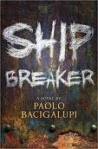
I really enjoyed The Wind Up Girl. I know there are problems with it, and a lot of people have taken it apart, and I agree with at least some of those points. But still, I thought it was a breathtaking view of the world in the not-quite-near future. So I was looking forward to seeing what Bacigalupi would do with YA, and a loooot of people have been raving about this book. I’m sad, then, to say that I was disappointed.
It begins well: Nailer, a boy of indeterminate age, clambering through the wreck of a ship and scrabbling for copper to salvage and make the quote required by his work crew. It’s dangerous, unpleasant work, and that is carried very effectively indeed in the opening pages. In fact, the opening is the most effective – and affective – section of the whole novel: it conveys the reality of life for Nailer and others like him in stark simplicity, complete with dangerous working conditions and the possibility of betrayal. I certainly felt for Nailer in his circumstances, and this sympathy was probably the only thing that kept me reading to the end.
Living on a beach with a crowd of similarly destitute and desperate types, Nailer’s life is of course no picnic. It’s made worse when a massive storm comes in and threatens the entire beach, but starts to look up when the storm proves to have driven a modern, very expensive, clipper ship onto the rocks nearby. Naturally, there are complications, and events proceed neither as he expected nor, entirely, as he hoped. There is fighting, betrayal, hope, and agonising decisions as the story plays out. Through all of this, Nailer is exposed to both the better and worse sides of humanity (and the not-quite-human). It’s not quite a coming-of-age story, although given this is (I think) the beginning of a trilogy, perhaps it will evolve as such. It is a discovery-of-the-world story, and Nailer’s eyes – until this point restricted to an unpleasant family and a little-hope life of scavenging and starvation – are the perfect vehicle for Bacigalupi’s exploration of a dystopia where oil is scarce, oceans have risen, and the divide between rich and poor is even more obvious, in the USA, than it is (believed to be) today.
The world created is a compelling one, as dystopias like this, set not-that-far-away, in a world both familiar and unrecognisable thanks to the changes wrought by climate change (readers of The Wind Up Girl will know this is something Bacigalupi is fascinated by), can be. How the world might manage still to transport goods over the globe when there is next to no oil left is one of the big questions addressed here, as is how society would cope with the changes forced on it – and his answer (“not very well, for the poor”) is all too realistic. Unfortunately, the world-building was also one of the aspects I had a problem with. Too often I felt that new aspects of the world were thrust onto the reader with little forewarning, leaving me disoriented. It may not have been so bad had Nailer, our eyes, been equally jarred. Much of the time, though, he appeared to be comfortable with these ‘new’ parts of his world, as though it was what he had expected all along. This discontinuity was disconcerting.
The other issue I had was with the characters. Nailer’s development is fairly consistent with what we learn of him early on, and there is some lovely characterisation and discussion of his decision-making which genuinely felt real. Many of the other characters, however, are too far in the shade – they get too little light cast on their motivations, leaving them at best two-dimensional and Nailer having to carry the entire story himself… which he’s not quite up to. Nailer’s work crew, for example – a hodgepodge of ethnicities, religions and outlooks on life – are described well early on and then become largely irrelevant. The one exception is Pima, the boss girl. Yet even here, with Pima getting into the action much more than the other crew, the reader learns next to nothing about her thoughts or views on life. The same goes for a few of the other characters (explaining who they are would be a terrible spoiler, though, so I won’t go into details). This lack of depth in the characters was another of the disappointments.
My disappointment overall probably stems from the book having been over-hyped, and my own expectations of Bacigalupi. It is a well-realised world, and one that I am pleased to see being examined in a YA context – the possible results of oil scarcity and changes to the weather are definitely worth exploring. The plot is interesting enough, and there’s certainly a lot of action; there is some variety in the characters and their situations, which breaks at least some of the monotony stemming from being Nailer-focussed. But I don’t think I will be hanging out for the sequel.
Red Gloves are a bit creepy
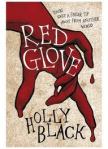
This is the second book in the Curse Workers series. As such, it almost certainly contains spoilers for the first, White Cat (which was awesome).
We left Cassel Sharpe having discovered that he is not only a worker – possessed of magic – but the mightiest of all workers, capable of transformation magic. He had also discovered that his brothers had been using him as a tool for murdering people, that he had turned his best friend into a cat (which is better than having killed her, which he had thought), that she has now been cursed to love him, and that life is not, actually, going to be easier now that he is really part of the family. I think it’s fair to say that White Cat was a moderately dark book. It’s also fair to say that Red Gloves is, too. It’s not like things really can improve when you’re regarded suspiciously by most people at school, you’re in love with someone who’s forced to love you, your mother encourages you to help her con people, and you can’t trust either of your brothers. Oh, and your grandfather is a death worker, magic is illegal, and the mob wants a piece of you.
Fun times.
This is definitely a sequel. You could probably get by without knowledge of White Cat, but it would likely drive you a bit nuts. And rightly so; the power dynamics of the Sharpe family, and interactions with the Zacharov family, were neatly set up there and carried through here. (Also, at under 300 pages and a ripping read, it’s not like it would be a chore.) Those dynamics are fundamental to the plot of this story because when Cassel’s oldest brother, Philip, is murdered, both the Feds and the mob (with magic being criminal, of course there’s an underworld) come calling, wanting Cassel’s help and/or connivance. Cassel has to figure out how to deal with both sides of the law, not get kicked out of school, not get his mother sent back to jail, and how exactly to cope with Lila-in-love. It would be nice to know who is actually responsible for Philip’s death, too. There are some amusing moments in this book, mostly thanks to the witty banter that Black pulls out, but it is no light-hearted romp. The problems Cassel faces cannot be dismissed with witty banter and a clever con, much as he might like to.
I saw someone describe this as a ‘slice of life’ narrative, and that’s pretty accurate. There’s a fair bit of what could be seen as downtime – it’s not an action-on-every-page thriller, by any means. There’s having dinner, and doing homework, and catching up with friends. But neither is that dead time, because it’s developing characters, and the characters are a large chunk of what is so appealing about this series. Cassel himself is a very believable teen. His angst is real and heartfelt but also not overwhelming – broody Cassel never lasts that long; his family and friend relationships are appropriately messy and difficult to navigate. His school friends, Sam and Daneca, continue to play a large part in his life – helping, hindering, comforting, playing fall-guy. Their relationship also changes, separate from Cassel’s traumas. And then there’s Lila, who although central to White Cat in so many ways – her ‘death’ obsessing Cassel no end – hardly developed as a character at all, for obvious reasons. She gets much more of a showing here. Her awareness of the love-curse and her struggles with it are fundamental to much of Cassel’s own experiences. She doesn’t have much of a life apart from him, which makes sense in context, although towards the end there are some intriguing indications of What Might Be. In terms of minor characters, we get much more Mother Sharpe, which is fun if at times rather disturbing – the opportunities for emotion workers to be seriously creepy are legion. There wasn’t enough Grandpa for my liking, but I guess you can’t have everything.
The wider world of magic prohibition is slightly expanded in this volume, although the focus is still fairly tightly on Cassel and his issues. The main problem facing workers in New Jersey is a new proposal that would see everyone tested to find out whether they are hyperbathygammic – magical. The question then of course is how, or whether, that information would be kept private – and the fear is that the government would use that knowledge for nefarious purposes. There are overtones of the concerns raised by comics such as X-Men, of course, as well as other more general concerns about what the government (and other agencies, hello Faceblah) might do with personal information. There’s a very pertinent discussion of politics within this riveting fantasy.
I can’t wait for the third book.
Genesis, by Bernard Beckett
 Oh. My.
A librarian friend shoved this into my hands when I mention enjoying science fiction, and to be honest I was a bit dubious – I’d never heard of Beckett, for a start. Anyway, I started reading it last night and… I couldn’t put it down. Quite seriously. I read it in one hit. Now, it’s YA, and it’s only 145 pages, but still – I considered going to sleep at one point, but I picked it right back up again and kept on reading. Totally addictive.
This review has some spoilers
In one sense, the book’s story happens over only five hours: the five hours of Anaximander’s examination to try and get into The Academy. Her special topic is the life of Adam Forde, on which she expects to get grilled by the three Examiners for the whole time. Her first surprise comes when they ask her about the early years of The Republic, and she has to scrabble for her memory of history. Then they finally come to Adam, and the formative moments of his life, and she is comfortable in what she knows – although she also knows that some of her theories are controversial. Things do not, of course, proceed exactly as she had anticipated…
On another level, the examination is a clever way of recounting a fairly large whack of the book’s immediate history, without it feeling overwhelmingly like an info-dump, and weaving a story through those events. Anax and her Examiners, it is revealed, live in almost a post-apocalyptic world. The setting, New Zealand, is apparently the only place to have survived a dreadful war and subsequent plagues, all thanks to a far-seeing and eventually quite ruthless business man, Plato. He insisted on NZ’s quarantine, enforced by a great sea fence. The society which eventually developed – or was designed – centres on people’s usefulness to society, and their talents as determined by genetic testing. Adam Forde had been tested as being a Philosopher – the highest grade possible. But when he acts against his training – allowing a refugee girl past the sea fence – things start to get out of control. And then he is asked to interact with an Artificial Intelligence, to help it learn.
On yet another level, of course, the book is a searching and illuminating examination of what it means to be human, what it means to construct a society and what things we are willing to give up to have a safe society, how important safety and comfort are and at what price they should be bought… you know, all the easy topics. It’s not done cavalierly; I am staggered by how much depth Beckett managed to cram into this little book.
Perhaps the most clever aspect of the book is that you could simply read the story, and it’s quite engaging. You could read it and understand some of what Beckett is discussing about society, and it’s riveting. And then, when you start understanding the classical allusions, things get really interesting: Anaximander was one of the earliest Greek philosophers, apparently teaching Pythagoras and getting all into the scientific mode of thought. Her teacher in the book is Pericles – he who led Athens during part of her Golden Age, fostering democracy, beginning the Parthenon, and involved with the war on Sparta. The society of The Republic (set up by Plato? this is one of the more blatant references, and perhaps it was done deliberately to trigger the classical connections) is a lot like Sparta, and like what the original Plato suggested too. This is a very, very clever set up – but not so clever as to be overwhelmed by smugness.
The conclusion is… well, I am still thinking about it. This is where it gets REALLY spoilery!
I began to guess at the twist when the Examiners were pushing Anax about the Final Dilemma, and the discussions between Art (the AI) and Adam. I realised there just had to be some great reveal coming up, and that Anax and the Examiners were actually descendants of Art simply made sense. It didn’t lessen the tension, though – and it in no way prepared me for Pericles’ actions in the very last paragraph. I can’t believe I managed to sleep after that; it was, truly, gut-wrenching. Also, having finally looked carefully at the front cover (above), I am saddened: there wouldn’t be nearly as much of a surprise if you noticed before reading that those are orang utan hands.
This is a magnificent book, and I can’t believe I had never heard about it. I think I may have to try and buy it so I can shove it into other, unsuspecting hands.
Such Aussie YA fiction goodness is mine
I splurged on the weekend and bought myself two books, despite having a stack of stuff to do:
Superior Saturday, by Garth Nix – which I’ve only been anticipating for, oh, a year. And I read it in a day… and there will be a review at ASif! mighty soon. As soon as I can get all that other stuff done…
Lamplighter, by DM Cornish – the sequel to Monster Blood Tattoo, which I adored. I’m currently reading this one; I’m not yet sure whether I love it as much as I loved MBT, but I probably haven’t read enough to judge yet. I’ve also forgotten a bit of what happened in the first, so I’m remembering that slowly.
Glorious! Fabulous! Calloo and callay! I must get my work done so I can properly enjoy them.
Fly by Night
I finally finished this today – it’s one of the books VATE sent me to review. It’s by Frances Hardinge; I think it may be a debut. It was brilliant! Highly original and interesting. The writing was very entertaining – the descriptions were original and evocative; the characters were fascinating and believable; and the world as a whole is one I would love to read more about. I’m really looking forward to writing the review, and I think I will probably donate the book to school – I can’t in good conscience have it sitting on my bookcase and not being read by other people who might enjoy it.
Guitar Highway Rose
GHR is the book I’m doing with my Yr9 class at the moment. I’d not read it before, but I was surprised and impressed when I read it – I like it a lot. Don’t know that much of the class does, at the moment, but that may be more of a factor that it’s a class text + they’re in Yr9 than a reflection on the book itself.
It’s Australian, which is nice – by a woman named Brigid Lowry – largely set in Perth. It’s written in a really interesting way, which I think is largely its appeal: you get the perspective of lots of different characters throughout the book; there are no chapters as such, just different sections with revealing titles. Asher, the main boy, writes his parts as a flow of consciousness; no punctuation, etc (much like an email, really…). The characters all go through interesting changes, and there are some rather interesting insights into teenage Aussie culture, I think (it was written almost a decade ago, so I wonder if it has lost/is losing some relevance?). Anyway – at the moment I’m trying to think of how to encourage the kids to engage with the themes etc, and I’m finding that particularly difficult

 Randomly Yours, Alex