Dungarees
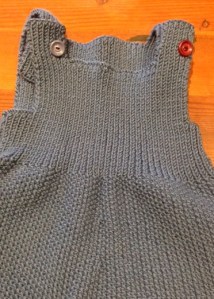
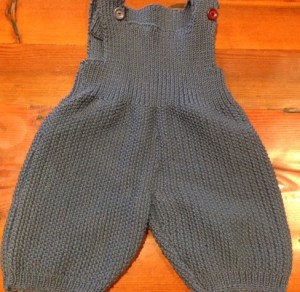
Yes, I knitted some.
These were… epic. For me. One of the more involved projects I’ve undertaken, because the legs are all moss stitch. It wasn’t actually hard (although some of the instructions didn’t make that much sense), but – yeh. They took a while. Not sure I’ll make them again unless someone very, VERY dear to me has a toddler. And even then they better be pretty darn cute.
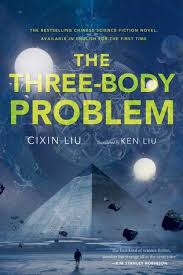
The Three-Body Problem
What on earth can I say? If I said “Liu Cixin is like a Chinese Greg Egan” that gives some idea of the complexity of the science… and I cannot imagine what it must have been like for Ken Liu to translate those sections.
 The focus of the novel is split over a few characters and periods:
Some of it is set in the Cultural Revolution of the 60s, and explores some of the consequences of this for academics in particular, via one woman and her family. I have taught this era (only once, but that’s better than naught), so I have no idea what the average reader would bring to this – and especially not what an average American reader would think. Ken Liu has done a good job of providing some footnotes with explanations, without (I thought) interrupting the flow of the narrative too much. A young woman, Ye, whose family was targeted ends up working at a mysterious scientific/military outpost…
Some is set in a ‘present’ that I don’t remember being identified, but is not one of William Gibson’s ‘tomorrows’ – it felt perfectly normal. Here, a scientist starts encountering weird things and gets drawn into an investigation that turns out to be even weirder than expected, and involves the whole world (there are scenes involving the Chinese military brass and NATO officers which had me shaking my head at the possible ramifications).
Some it is set in-game: the scientist, Wang, starts playing a game called Three-Body Problem – which it took me ages to realise is the conundrum of how to figure out the physics of three bodies interacting with each other gravitationally (it’s been a while since I thought physics, ok?). The game is connected to the investigation and also allows Liu to write THE most hilarious description of people physically being a computer ever, and this from someone whose knowledge of computational logic is non-existant (NAND and NOR gates? I admit my eyes glazed over somewhat…).
Some of it is set… elsewhere… not telling where.
I liked Ye a lot; the complexities of being first condemned, and then being considered useful but still politically unreliable, then rehabilitated into society – it’s done very nicely. I didn’t like Wang as much, which I think was mostly to do with his attitude towards his wife and son: basically he ignored them, and I found this quite unpleasant. Da Shi, a policeman involved in the investigation, is magnificent and is the character I would most like to see in a mini-series version of the book.
I had heard that some people thought there was a lot of emphasis on the Cultural Revolution, so I was surprised to find that for me, at least, it’s not actually a very big part of the story – page-wise anyway. It’s certainly of fundamental importance in Ye’s development, don’t get me wrong, but there’s definitely far more time spent in the present (and probably more time spent in-game by one of the characters, although I haven’t checked the page numbers to confirm that).
I am beyond impressed that this made it on to the Hugo ballot (yes yes after one of the Rabid nominees pulled out). I’m really glad it did, since it made me read it sooner than I otherwise would have. I really enjoyed it. There are some parts where, as with a Greg Egan novel, I skimmed over some science because I just can’t come at the physics anymore. But that wasn’t a problem with understanding the plot or the characters, and actually – especially considering this is a translation – much of the science-speak was quite accessible. (Ken Liu has an interesting discussion of the issues of translation at the end of the version I read, which was in the Hugo packet; it’s a very thoughtful essay about staying true to the vibe of the thing as well as/instead of staying true to the actual words and phrases used.) I discovered only when I got to the end that this is the first in a trilogy… I believe I may well be reading the rest.
But who am I going to put first on my Hugo ballot?!?
Beauty, by Sheri Tepper
Sheri Tepper looked at a map showing the boundaries of different genres and, taking a fine black marker, drew her own shape instead.
 Fantasy: there’s magic and faeries and they’re a real part of the world.
Science fiction: time travel and a dystopian future are integral to the plot.
Fairy tale retelling: the titular character is meant to be Sleeping Beauty (… and that phrase should be understood in a couple of different ways).
Horror: a couple of sections, for my tastes anyway.
Christian allegory: tied in with the Faery aspects, they work quite nicely.
Bildungsroman: the novel covers pretty much the entirety of Beauty’s life.
Environmental cry for help: the future is a horrible place unless we get on with changing things NOW.
Family drama: oh yes. Oh my yes.
I know there are other authors who do similar things, but it’s rare to find such a magnificent combination of elements that are traditionally ‘fantasy’ (faery, fairy tales, etc) with those that are science fiction (time travel in particular). I can absolutely see why Tepper is being honoured with the World Fantasy Lifetime Achievement Award, and this is the first of her books I’ve read (… I’m pretty sure…). There is just no question for her that of course a dystopia can coexist with the concept of magic, that fairy tales can be reworked together with time travel.
14th-century Beauty lives with maiden aunts and her father, when he’s not off crusading. Her mother died in childbirth, or so she’s been told, but when her father intends to marry again, she discovers that maybe things are weirder than expected. And then things get really weird when she encounters people from the future and she is whisked away with them, to a decidedly brutal and unpleasant future of billions of people, little room to move and less food. She doesn’t stay there, but ends up travelling… elsewhere…
Look, I can’t say too much else about this book because finding all the amazing twists and turns is an absolute joy. Tepper writes beautifully, at times grimly; she constructs a complex character in Beauty and surrounds her with genuinely varied friends and foes and family. SO MUCH happens in fewer than 500 pages. It’s magnificent.
Galactic Suburbia 122
You can get us from iTunes or at Galactic Suburbia.
Continuum 11 debrief: panels and programme stuff we loved.
Tansy’s Guest of Honour speech: Fantasy, Female Authors & the Politics of Influence.
FictionMachine announcement: Something New Can Come Into This World, a book of film essays by Grant Watson.
Discussion piece: “Stop Asking Is This Feminist” at the Mary Sue.
What Culture Have we Consumed?
Alisa: Prep for the Alice Sheldon’s 100th Birthday Spoilerific episode in August: James Tiptree Jr: The Double Life of Alice Sheldon, Julie Phillips; Tiptree’s short stories – read “Houston, Houston Do You Read?”, “Your Faces, O my Sisters, your Faces filled of Light!”; Call the Midwife S1 -3
Alex: All Men of Genius, Lev AC Rosen; Prudence, Gail Carriger; Aurora, Kim Stanley Robinson; Jurassic World
Tansy: Lois Lane: Fallout, by Gwenda Bond; Uprooted, by Naomi Novik, “Waters of Versailles” by Kelly Robson, illustrated by Kathleen Jennings; Once Upon A Time Seasons 1 & 2
Alex is reading fiction for Hugo voting next episode!
Please send feedback to us at galacticsuburbia@gmail.com, follow us on Twitter at @galacticsuburbs, check out Galactic Suburbia Podcast on Facebook, support us at Patreon (http://www.patreon.com/galacticsuburbia) and don’t forget to leave a review on iTunes if you love us!
The Duke and I
Or, I read a (…nother…) Julia Quinn novel and quite liked it.
I am not a connoisseur of Regency romance (having only read… one? maybe two?) before this, so I have no idea what conventions Quinn might be playing, breaking, or taking outrageous advantage of. So I can only comment on the book itself, not its place in the genre.
 Did I know basically what was going to happen within the first chapter?
Yup.
Did the book still serve up a few surprises?
Yes, a couple. They were quite fun, actually, since most of the plot was predictable.
Did I enjoy reading it?
I read it in a sitting. So, yes. The writing is light and witty, winsome and undemanding. I liked the alternating perspective between Our Romantic Heroes. I liked (sorry Gail Carriger) that there wasn’t a big emphasis on the clothes, nor the food. I like banter, and this has quite a lot.
What about the characters?
Daphne is a forthright, sensible woman who holds out little hope of romance but would at least like to like her husband. She comes from a big, loving family. I liked her, overall; I was a bit disappointed by her eagerness to marry and have children as the be-all, but: a) why not? She’s allowed to desire that; b) as we’re reminded early on, she’s not allowed to go to university if she wants to, and she can’t aim for an awesome career – partly because she’s female, and partly because she’s gentry and they just… don’t work.
Simon had a damaged childhood. Now he’s the duke. He’s been a rake, has no intention of marrying… etc. While I sympathised with his experiences, he was certainly less interesting to me than Daphne.
Are there problematic bits?
Sure. I am always uncomfortable with the Mrs Bennett-ing of all mothers. Quinn turns the tables somewhat with Violet, and gives a marvellous hint at her actually being a very smart woman, but it wasn’t quite enough to stop me from sighing a few times at the ‘must catch the daughter a husband’ thing. Maybe it’s historical verisimilitude, but that doesn’t make it pleasant to read about.
There’s also an instance of maybe-taking-advantage-of-someone that made me uncomfortable, which then did get explored for ‘who did what’ but it still made me sad.
Will I read more?
Daphne is one of eight children. I did wonder why Quinn was ravishing so much attention on the beauty and allure of Daphne’s brothers… and then I discovered that there are, of course, eight novels in this series. Marrying off each of the children, one by one. I must admit to being somewhat intrigued, not least because I really want to find out who the gossip columnist, Lady Whistledown, is. Two of my candidates got blown out of the water by the last page, but I still have one possibility in mind…. So, maybe.

 Randomly Yours, Alex