The Quiet Revolution of Caroline Herschel

I’ve read a bit about Caroline Herschel, often in the context of “here are women who did important things in science who don’t get enough recognition.” She was one of those women who helped a man get lots of science done – in her case, her brother William: she was his assistant for much of his observing life, writing down his observations and helping with his frankly unwieldy telescopes, as well as keeping house for him for many years until he married – and then his wife had money so they had more servants. All of those things are immensely important and often get overlooked; no one is able to do science on the scale of William Herschel, or Robert Boyle, or Charles Darwin, without an immense amount of assistance: usually either female, lower class, or both. Hence why that assistance is often overlooked, because the European narrative in particular is much happier with the ‘great man’ theory.
To leave Caroline’s story at that, though, is to do her an immense disservice. She was an astronomer in her own right, discovering eight comets (two of which she wasn’t the official discoverer, because someone else got there first, but she didn’t know about that when she found them). She also contributed observations to William’s immense catalogue of the ‘nebulous’ stars. In the late 1700s, most people assumed that that ‘cloudy’ or nebulous patches in the sky were simply stars that contemporary telescopes couldn’t resolve. William used the largest telescopes of the time to realise that actually, some of those areas actually couldn’t be resolved – they really did look cloudy – and suggested that maybe some of those areas were where stars were born. (He also discovered Uranus – the first planet to have been discovered by a human, rather than seen naked-eye, which is what shot him to fame.) Caroline personally observed and described some of the Herschel catalogue.
And then there’s the other scientific tasks she undertook, which might be easy to skim over because they don’t seem that sexy. She worked for years on a massive index and catalogue of stars, using the main one available in English: double checking for errors, making it systematic, and so on. Not glamorous, requiring hours of probably boring labour, required a great deal of knowledge – what an amazing contribution to astronomy.
Anyway, the biography: is not entirely what I was expecting! It focuses largely on a decade in the middle of Caroline’s life, her most scientifically productive – and a decade for which she destroyed her dairy entires and never discussed in either of the two memoirs she produced later in life. There’s a lot of speculation for why this might be; most people conclude that it’s because she wrote some bitchy stuff about her new sister-in-law and that this didn’t fit her self-image as meek, self-effacing, and doing everything for family. It’s a fascinating question and one that will almost certainly never be resolved. So Winterburn has used letters, information from journals, and references in other places to reconstruct those lost years, and in doing so to highlight just how phenomenal Caroline was as a scientist. While she wasn’t the first women to be paid to do science – lots of other women were doing ‘science’, it just wasn’t usually called that – she was the first English woman to have a royal pension for doing science, and that’s very damn impressive.
There are oddly repetitive bits throughout the book, where Winterburn repeats ideas or phrases that have just been laid out a paragraph or two earlier; and the book can’t solely concentrate on the one decade, because the reader needs greater context for Caroline’s life – so it’s not without flaws. There’s also a frankly odd emphasis on the events of the French Revolution; while it certainly had a huge impact on some of the people Caroline and her brother corresponded with, it didn’t actually seem to have a direct impact of Caroline, living in England – she wasn’t obviously a supporter of either Burke or Paine (anti or pro the revolution), so I was confused by how many ink was spent discussing those foreign events. Nevertheless, overall I really enjoyed this, and am immensely pleased to know more about Caroline. To the point where I’m considering the so-called Herschel 400 as an observing list.
Flavour, by Sabrina Ghayour
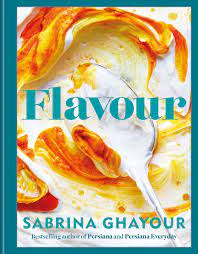
This book was sent to me by the publisher, Hachette, at no cost. It’s out now, RRP $45.
I have reviewed three of Ghayour’s previous cookbooks, and own all of them. I am confident to say that if I was only allowed to own one writer’s cookbooks, I would be incredibly sad AND I would choose Sabrina Ghayour.
As with all of her books, this one is laid out beautifully and the accompanying pictures are appropriately mouth-watering. Few of the recipes have really extensive ingredient lists; Ghayour is definitely in favour of simplicity and being straightforward. Where there is a longer list, it’s generally herbs and spices, most of which I would regard as accessible in Australia. There are a few points where there’s a translation necessary for Australian audiences – I believe pul biber is usually sold as Aleppo pepper here; and when Ghayour calls for “four preserved lemons”, she does not mean four of the my one-doesn’t-fit-in-your-palm homemade preserved lemons. Ghayour has continued here something I’ve loved from the last couple of books: a suggestion or two of what you might serve with the present recipe – a salad to go with a meat dish, for instance. I love that she has given thought to which flavours complement one another.
The chapters include Salads; Little bites and Savoury treats; Meat, poultry, Fish and Seafood; Vegetables and Pulses; Pasta, Noodles and Grains; and Sweet. Recipes are clearly marked Vegetarian and Vegan.
Things I have made:
- Dried Lime and Spice Marinated Lamb chops – I used steak, because I just cannot be having with chops. I had never blitzed dried limes before but they are a flavour BOMB and this was absolutely delicious.
- Lamb, Dried Fig and Preserved Lemon Tagine – going on high rotation. Love a good casserole, and the flavours are fresh and unctuous.
- Crispy Sticky Harissa Lamb – also delicious. Honey, rose harissa (I bought some because of Ghayour, and it’s great!), rice vinegar, soy and cornflour for the sauce.
- Pan-fried Salmon with Barberry Butter – I have barberries because of a meatball recipe or two, but this is another excellent way to use them.
- Root Vegetable, Chickpea, Feta and Barberry Tart – O.M.G. This was amazing. I think we ate it for three? four? meals in the week. Filo pastry, parsnip, carrot (I didn’t use celeriac – I don’t think it’s that accessible here). This is AMAZING and I LOVED IT. SO EASY.
- Creamy Spiced Sausage Pasta – the creaminess is from mascarpone, which I was surprised by and it was really good. You get the sausage out of its casing, which is always the best way to use it, and then it’s tomato and spice and the mascarpone.
- Harissa, Tahini and Lamb Spaghetti – another to go in high rotation. I was surprised by the harissa and tahini together, but it was brilliant.
- Mushroom Spaghetti with Creamy Pistachio and Garlic Sauce – yes, I know, it’s boring but this is another banger. The creaminess is from tahini again, and it works amazingly with the pistachio. I added some snow peas and asparagus, because I have an abundance, and used noodles instead of spaghetti because I had none.
I haven’t made any of the sweets yet, but I am eyeing off a few; and there are several other recipes that I already know I want to make. This is a great cookbook.
84K, by Claire North

I thought that, because I had read the first two books in Claire North’s Songs of Penelope series, that I had a handle on what Claire North’s writing was like.
Ha ha ha.
Ha ha.
Yeah no, turns out. 84K has been on my TBR list for a long time, and I was killing time in the library recently when I saw it just sitting there. So, fate dictated that I must pick it up. And I started reading it, and … oh my.
This is completely different from Songs of Penelope, is the first thing to say. People who go from this to ancient mythological Greece must have their heads spin, because doing it in the reverse did so to me.
This is not-too-far future England; this is nightmarish capitalism, business and government together, with basically no difference between them, and the literal end-point of the idea of human resources. Justice is privatised beyond even what the USA currently does; every crime has a cost, determined by accountants based on the societal worth of the victim (she was trash) and the perpetrator (he has a very promising swimming career ahead of him). This is people refusing to see what has been done to their society, in their name, while they get some personal gain from it; and just occasionally someone saying Enough.
This was a hard book to read, mostly for the subject matter. It’s not entirely unrelenting but it’s pretty close. North is doing a lot here, and really, really wants you to think about what’s happening. I can imagine this being compared to The Handmaid’s Tale and other stories that project from current events, and take political horror to its grim logical conclusion. It’s a totalitarian society where most people don’t realise it; it’s business being far more important than humans; it’s the personal cost of defying a society where most members don’t see a problem. And those things just don’t feel that far away anymore.
It’s also occasionally hard to read from a structural point of view; again, Songs of Penelope did not prepare me for a non-linear narrative structure. There, it really wouldn’t have worked; here… well. North is a poet; she is a skilled weaver of stories; she layers meaning on meaning and idea on idea so that by the time the story brings you back to the starting point, you’ve got so much knowledge and awareness of what’s going on that you’re close to bursting.
This is a phenomenal book. It deserved all of the accolades. (I’m still glad I read Songs of Penelope first.)
Multispecies Cities: Solarpunk Urban Futures
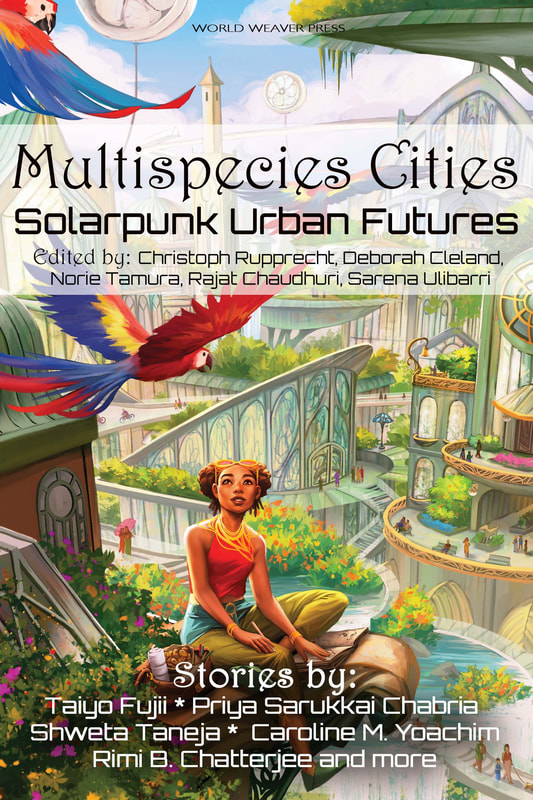
Yup, this one was also on special at World Weaver Press, so I grabbed it as well. I was completely intrigued by the idea of an urban focus for this sort of science fiction – that humans won’t have to abandon living in cities to survive the impacts of climate change, but they also don’t have to be the technological nightmarish warrens of Bladerunner etc. At the same time, they can’t be the same as they generally are now: where we restrict greenery to a few parks, loathe pigeons and rats as the carriers of disease, and so on. There are a few apartment buildings in my city that are starting to introduce the idea of green walls… that just needs to be taken much, much further. Which is part of what this anthology envisions.
As always, didn’t love every story, but as with Glass and Gardens there was no story that I thought was out of place. There’s a big variety in what the stories focus on – human stories that happen to intersect with animals, stories of the city itself, stories of animals and humans together. Where I said that previous anthology felt North-American heavy, this one has consciously set out to be different: there are, deliberately, a range of stories that explore the Asia-Pacific. I LOVE this.
There are a few stories where animals interact, in a deliberate way, with humans. Meyari McFarland’s “Old Man’s Sea” has orcas that have been modified for war, and how they might relate to the humans they now come across. Joel R Hunt has people whoa re able to jack into the minds of animals, in “In Two Minds,” and it’s about as horrific as you might imagine. “The Mammoth Steps” by Andrew Dana Hudson is along similar lines as Ray Nayler’s “The Tusks of Extinction,” with mammoths having been brought back and humans interacting with them… although Hudson’s version is a bit more hopeful. E.-H Nießler also has an orca-human interaction story, in “Crew;” he adds in a chatty octopus as well.
Shout out to Amen Chehelnabi and DK Mok, too: Aussies represent! Chehelnabi’s “Wandjina” is one of the grimmer stories, set basically in the middle of a bushfire, but manages to have hope in there too. Mok’s story “The Birdsong Fossil” is SO Australian, and also on the grimmer end, connecting visions of how science might be/is viewed with the de-extinction fascination; like Chehelnabi, it also ends hopefully, and is a fascinating way to conclude the entire anthology. (And Octavia Cade; NZ is totally Aussie-adjacent… plus her story “The Streams are Paved with Fish Traps” is brilliant.)
A really interesting, varied, anthology.
Glass and Gardens: Solarpunk Winters
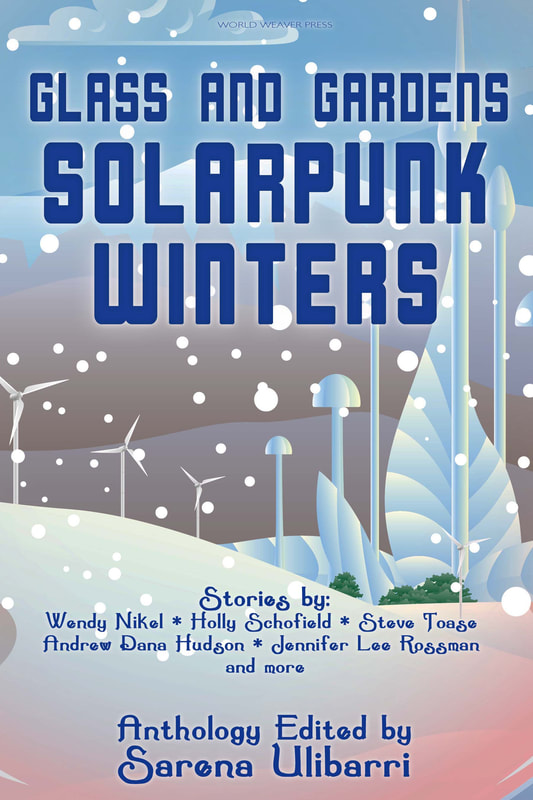
I’ve only recently come across the idea of ‘solarpunk’ – basically a hopeful take on humans living in a post-climate change world, as far as I can tell. I guess this is what ‘hopepunk’ also aims to be? maybe solarpunk is a bit more about the actual mechanics… I don’t know, I’m not going to claim the ability to set genre boundaries. ANYWAY, World Weaver Press has done a bunch of solarpunk anthologies, and a couple of them were on special the other day so I got them.
The first one I read was this, Glass and Gardens. Turns out I was in the right zone for some hopeful SF. As with all anthologies, I didn’t love every story – but also, there were no stories that left me wondering what the editor was thinking. They all fit the overall theme – how to be hopeful when winters have got more extreme or, in a couple of cases, the world has warmed so much that winter no longer happens, with equally disastrous consequences for the environment. It is heavily North American-focused, but honestly as an Australian this is just something I pretty much take for granted.
One thing I particularly liked was that while all of the stories were focused on humans, and what they are doing to live with/ mitigate/ work around climate change, there’s also a focus on how the climatic changes have affected the rest of the species on the planet. It’s s refreshing change and something that seems to be a trope within solarpunk from what I can tell – an acknowledgement that humans aren’t alone on the planet. So there’s Jennifer Lee Rossman’s “Oil and Ivory”, about narwhals and whether they’ll be able to travel underneath pack ice in the Arctic; bears and several other animals in “Set the Ice Free,” from Shel Graves; and several stories that have cities encouraging a lot more greenery and what could be called extreme eco-living compared to today.
An aspect that connects to the idea of hope is the prominence of art in these stories. Your dire post-apocalyptic world has no room for art and beauty. But Sandra Ulbrich Almazan has characters making clothes in a variety of ways in “A Shawl for Janice;” “On the Contrary, Yes” from Catherine F King is entirely focused on art and making art across multiple genres; Andrew Dana Hudson imagines ice-architecture as its own art form in “Black Ice City.”
This is a great anthology, and I look forward to reading more solarpunk.

 Randomly Yours, Alex