The Seven Wonders of the Ancient World

I received this book to review at no cost, from the publisher Hachette. It’s out now (trade paperback, $34.99).
As someone who has been keen on ancient history since forever, of course I was intrigued by a new book on the seven ancient wonders. And I’ve also read other work by Hughes, and enjoyed it, so that made me doubly intrigued.
Before I get into the book: of course there is controversy over this list. Hughes acknowledges that, and goes into quite a lot of detail about how the ‘canonical’ list came about – the first surviving mention of such a list, why lists were made, what other ‘wonders’ appeared on such lists in the ancient world of Greece and Rome, as well as what other monuments could be put on such a list were it made today. I appreciated this aspect a lot: it would have been easy to simply run with “the list everyone knows” (where ‘everyone’ is… you know), but she doesn’t. She puts it in context, and that’s an excellent thing.
In fact, context is the aspect of this book that I enjoyed the most. For each of the Wonders, Hughes discusses the geographical context – then and now; and the political, social, and religious contexts that enabled them to be made. This is pretty much what I was hoping for without realising it. And then she also talks about how people have reacted to, and riffed on, each of the Wonders since their construction, which is also a hugely important aspect of their continuing existence on the list.
- The Pyramids: the discussion of the exploration inside, by modern archaeologists, was particularly fascinating.
- The Hanging Gardens of Babylon: the discussion of whether they even existed, and if so where, and what ‘hanging’ actually meant, was intriguing.
- Temple of Artemis: I had no idea how big the structure was.
- Statue of Olympia: I had NO idea how big this allegedly was.
- Mausoleum of Halikarnassos: NOT HELLENIC! Did not know that.
- Colossus of Rhodes: also had no idea how big it allegedly was, nor the discussion around its placement.
The Practice, the Horizon, and the Chain
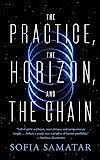
Read via NetGalley and the publisher, Tordotcom. It’s out in April 2024.
To be honest I don’t even know where to start with reviewing this novella.
To say that it’s breathtaking is insufficient. I can say that it should be on every single award ballot for this year, but that only tells you how much I admired it.
I could try and explain how it explores ideas of slavery, and the experience of the enslaved; ideas of control, and social hierarchy; about human resilience and human evil. Draw connections with Ursula K Le Guin’s “The Ones who Walk Away from Omelas,” and probably a slew of stories that connect to the Atlantic slave trade and which I haven’t read (mostly because I’m Australian).
There are odes to be written to the lyricism of Samatar’s prose, but I don’t myself have the words to express that. Entire creative writing classes would benefit from reading this, and sitting with it, and gently prying at why it works the way it does.
I could give you an outline? There’s a fleet of space ships, and they’re mining asteroids, and mining is dreadful work so you know who you get to do the dreadful work? People that you don’t call enslaved but who are indeed enslaved. There’s an entire hierarchy around who’s doing the mining in the hold, and who’s a guard and who’s not a guard, and the people at the top have convinced themselves there’s not REALLY a hierarchy it’s just the way things need to be. Sometimes someone from the Hold is brought out of the Hold, and then has to learn how to be outside of the Hold… and then someone starts to see through the system, and maybe has a way to change things.
The outline doesn’t convey how powerful the story is.
I should add: the main characters are never named.
Just… everyone should read this. It’s not long, so there’s no excuse! But it will stay in your head, and it will punch you in the guts. In the good way.
These Fragile Graces, This Fugitive Heart

Read via NetGalley and the publisher, Tachyon. Out in March 2024.
A completely believable, dystopic Kansas City where the police and everything else are basically run by corporations and only for the rich (cue an Australian rant about modern USA, if you please).
An anarchic commune that’s attempting to be a place where people feel safe, and are allowed to be what and who they want – and which really gets up the nose some rich people.
A trans woman, Dora, who used to live in said commune, and left over differences of opinion about security, and has been making her way for the last few years as a security consultant.
And Dora’s ex-girlfriend, still living in the commune, who is found dead – allegedly of an overdose, but Dora discovers evidence of foul play.
This is a fast-paced thriller novella (novelette? not sure) that I devoured very quickly. Dora is complex, driven, committed, sometimes bitter, and absolutely determined to get answers, even when that might hurt herself or other people. The setting is believable and horrifying, drawn with broad strokes but enough detail that you can see Wasserstein has put a lot of thought into it; and it makes me wonder what modern KC-dwellers think of it, and if they can see the places she describes. It works as a thriller – there are twists and reveals – and just overall it’s very clever. Hugely enjoyable, and I look forward to seeing what else Wasserstein has up her sleeve.

 Randomly Yours, Alex