Four Points of the Compass
Read via NetGalley and the publisher; it’s out in November 2024.

This is a really neat idea for a book. So much of the “western” world (an idea that Brotton interrogates fairly well) simply assumes that north should be the default direction at the ‘top’ of the map, and that’s how it always has been. AS someone who has deliberately put maps “upside down” and challenged students to think about why – and as someone living in Australia – book that shows exactly how and north doesn’t HAVE to be the default top, and that historically it hasn’t been, is a wonderful thing.
Brotton mingles a lot of different ways of thinking about the world in this book. There’s linguistics – the ways in which different languages’ words for the cardinal directions reflect ideas about the sun, rising and leaving, and other culturally important ideas. Like ‘Orient’: it comes from the Latin for ‘rising’, as in the sun, and came to mean ‘east’… and of course ‘oriental’ has had a long and difficult career. But in English we still orient ourselves in space. Then there’s the connections with various types of weather, in various parts of the world, something I had not considered; and of course there’s an enormous amount of association with mythology from all over the world, often privileging the east and rarely making the west somewhere to be revered. (Three out of four cardinal directions have been regarded as most important over time and space; not the west, though.) Then of course there’s history, as humans learned what was actually out there in various directions, and associated people and places with specific directions (hello, Orient). And the act of cartography itself has had an impact on how people think about direction and the appearance of the world – Mercator, obviously, and the consequences of his projection particularly on Greenland, but even how vellum (real vellum, ie made from calfskin) was shaped and therefore impacted on how things were drawn on it.
Is the book perfect? No, of course not; it’s under 200 pages, it can’t account for every culture and language. But I do think it’s done a pretty good job of NOT privileging European languages; there’s an Indigenous Australian language referenced, which is rare. (I should note that anyone who thinks they can do any sort of navigation by the ‘south polar star’ like you can with the northern one is in for a very, very rude shock.) There is some reference to South American cultures, and I think passing reference to North American ones; some African cultures are also referenced. China and some other Asian societies get more space.
This is a really good introduction to the idea of the four directions having an actual history that is worth exploring for its consequences in our language and our history. The one thing that disappointed me is that there’s no reference to Treebeard’s comment about travelling south feeling like you’re walking downhill, which seems like a missed opportunity.
Cruel Nights, Jason Nahrung
There’s a lot going on in this novella, and all of it is good.
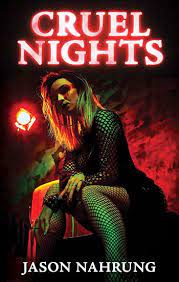
In the first place, there’s been a lot said about the problematic nature of ancient male vampires having a thing for the young ladies. Twilight took the idea of vampires not ageing and made them students (I have no idea how old Edward was when he turned; I watched the first film from a cultural studies perspective… anyway), so the lovers didn’t LOOK that different in age which I guess was meant to make it less squicky? Nahrung approaches the whole question of age and appearance from a different angle. I won’t say his focus is unique – vampires do not tend to be my thing, so maybe it’s been done a lot (see how I avoided ‘done to death’?). But it’s something that’s obvious, once it’s pointed out: what happens for someone who doesn’t seem to age if they’re in a relationship with someone who does age? How will the partner be perceived? The way the key relationship here is approached is the reason I read this in under a day.
Second, I like to think I would have picked up the Heart inspiration based on some of the chapter titles (Magic Man, in particular), if I didn’t already know, but certainly once I got to… well. A particular scene. If you know any of the more iconic Heart songs, you can probably guess what I’m referring to. (No, I am not talking about a big-toothed fish, or any metaphor along those lines.) I’ve read a lot of books that use music in various ways, and Nahrung’s done it very nicely.
Finally, in under 150 pages Nahrung manages to evoke the experience of growing up in Seattle in the 1990s, needing to move for work and love and all the hardship that entails, family love and drama, AS WELL AS the whole vampire aspect. It’s a compact story, tightly written – I can imagine this being turned into a massive novel or duology by another author, but it doesn’t need to be: the novella perfectly conveys Charlie and Corey’s experiences.
Highly enjoyable. Get it from Brain Jar Press.
Anna Karenina Isn’t Dead (anthology)
Take examples of literary women who were, generally for stupid reasons, or otherwise treated very poorly.
Give each a new story. Either still largely within the framework of their original existence, or in a completely new story.

Bring those stories together, and create an anthology. That’s what you have here.
I actually haven’t read Anna Karenina, although I knew that she died (spoilers!). There were several other examples in the anthology where I also didn’t know the source material. Fortunately, the editor and authors have considered this, and give a short introduction to each story so that they’re all as accessible as possible. Doesn’t matter if you don’t know Madame Bovary, or the story of Lady Trieu; you can still appreciate what the authors are doing for those women who have been treated so very badly.
Wendy gets to have adventures. Pandora defies the story set for her. Miss Havisham runs a bridal boutique. Mostly, though, the women live. And thrive. They may not all end up happy, but they do at least get a real story. It’s the least they deserve. Buy it from Clan Destine Press.
Long Live Evil: Sarah Rees Brennan
I read this courtesy of NetGalley. It’s out at the end of July.

This book is for everyone who ever day-dreamed self-insert-fic, and didn’t really think through the consequences. (How distracting would I really have been to Biggles and Algie and Ginger? I don’t care about Bertie.) It’s also for those people who connect with the line “always rooting for the anti-hero” (omg turns out I like a Taylor Swift song??).
This book is amazing and wonderful and didn’t do what I expected except insofar as I was, indeed, constantly surprised by events and personalities. Surprised and delighted and absorbed and, not going to lie, a bit stressed out.
At 20, Rae is dying from cancer. Her sister keeps sharing their favourite books with her, to keep her company and to have some joy in her life. Rae didn’t pay much attention to the first book, but then things got interesting in the second. Why does that matter? Because when Rae finds herself in the world of those books, early in the timeline of the first book – in the body of a significant character – trying to figure out what’s going on, and how to fit herself in, is going to be crucial. And, well. As you can probably expect, it doesn’t entirely go to plan. Oops?
Brennan is doing A LOT here. Rae’s experience with cancer – the disease and other people’s reactions, and everything else lost because of it – reads very, very real (turns out Brennan has had very serious cancer recently; I am highly averse to reading authorial experience into books, but sometimes it’s real). So there’s that. And when Rae wakes up in her new body, she needs to figure out what she’s meant to know (and not know), and how she’s meant to act. The decision to embrace the (supposed) villainy of the character she’s inhabiting is a fascinating one with all sorts of consequences, and allows Brennan to comment on all of those Villain Tropes – and especially Lady Villain Tropes – that authors and films have loved to rely on. My particular favourites are the critiques about gravity and balance if you’ve got the boobs of the Classic Evil Seductress.
Sure, it’s got a character dying of cancer, and the fictional world she spends most of her time in is actually not a very pleasant place at all with deeply problematic characters and a dreadful social structure; people die needlessly, and the class structure is appalling. However, it’s Sarah Rees Brennan: this book is also FUN. It’s fast-paced, it loves life, it gets into tricky situations and tries to talk its way out of them, it has people trying to introduce house music where it really doesn’t belong. I consumed this novel and now I’m pining for the sequel and I don’t even know when it will be released.
Highly, highly recommended.
Embroidered Worlds anthology
I read this courtesy of NetGalley and Atthis Arts; it’s out now.
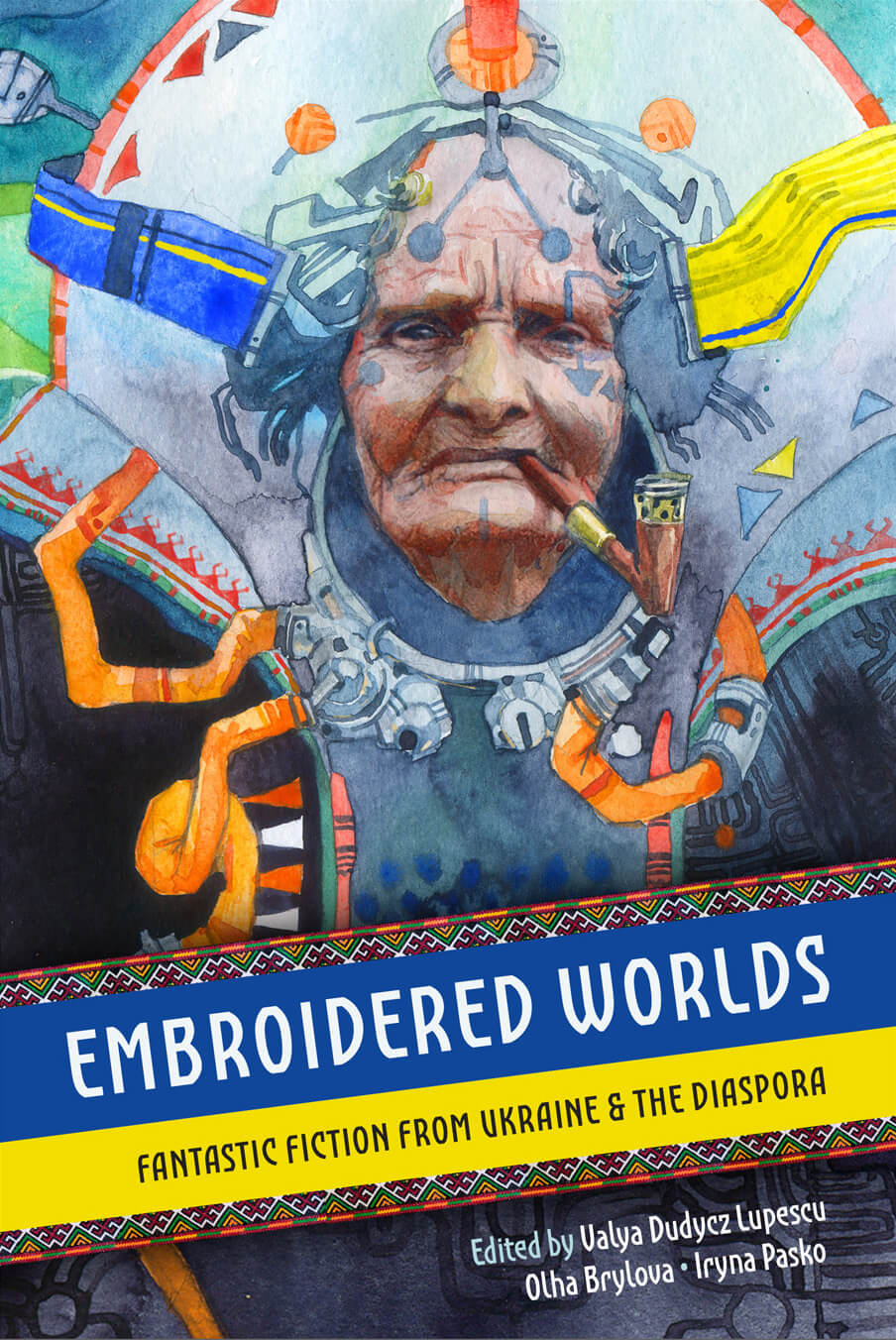
“Fantastic Fiction from Ukraine and the Diaspora”: what a brilliant anthology.
The only theme uniting this anthology is that the authors are from Ukraine, or part of its diaspora. That means that there’s a huge range of types of stories: those that are clearly rooted in folklore (even if I wasn’t familiar with the original); those that are ‘classically’ science fiction; some that are slipstream, some that slide into horror, and a few where the fantastical aspect was very subtle. Some of the stories are very much ABOUT Ukraine, as it is now and as it has been and how it might be; other stories, as you would expect, are not.
One of my favourite stories is “Big Nose and the Faun,” by Mykhailo Nazarenko, because I’m a total sucker for retellings of Roman history (Big Nose is the poet Ovid; it starts from the moment (based on the story in Plutarch, I think) of the death of Pan and just… well. The story does wonderful things with poetry and “civilisation” and nature, and I loved it.
I loved a lot of other stories here, too. There was only one story that I ended up skipping – which is pretty good for me, with such a long anthology – and that was because it was written in a style that I basically never enjoy (kind of Waiting for Godot, ish). RM Lemberg’s “Geddarien” was magic and intense and heartbreaking – set during the Holocaust, cities will sometimes dance, and for that they need musicians. Olha Brylova’s “Iron Goddess of Compassion” is set a few years in the future, and the gradual revelation of who the characters are and why they’re doing what they’re doing is some brilliant storytelling. “The Last of the Beads” by Halyna Lipatova is a story of revenge and desperation, with moments of heartbreak and others that I can only describe as “grim fascination”.
I’m enormously impressed by Attis Arts for the effort that’s gone into this – many of the stories are translated, which brings with it its own considerations and difficulties. This book is absolutely worth picking up. If you’re interested in fantasy and science fiction anthologies, this is one that you really need to read.

 Randomly Yours, Alex