The Return
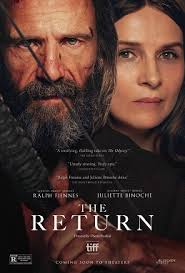
I am a complete sucker for Greek myth films. And even more, I am an utter sucker for films that take bits that have been done less often, and which do so with nuance and a modern sensibility while still keeping true to the original. Nearly impossible? For sure.
The Return manages this with aplomb.
(Spoilers, I guess? If you can spoil a 3000 year old story? Although there are some changes to the ‘original’, which I will discuss.)
The film doesn’t try to cover all of Odysseus’ wanderings – and Troy is covered in a single sentence in the brief introduction. Instead, it opens with Odysseus washed ashore on Ithaka, and Penelope besieged by the suitors. It really only covers a few days – exactly how long is unclear, because Odysseus may have spent a few days in Eummaeus’ cottage, recovering his strength. The narrative moves between several strands. There’s Odysseus, coming to understand what has happened to his island, and Penelope, often at her loom, agonising over what to do and how to look after her sons. Interestingly, there’s quite a focus on the suitors, especially Antinous (the least objectionable on the surface, but shown to be very complex and with a horrible side) and a couple of others, like Pisander (who I spent the whole film trying to place – he was Ricky September in that weird episode of Doctor Who, “Dot and Bubble”). And there’s also Telemachus… and, look. He’s never been a favourite. Ever. I was terrified we’d be subjected to a whole section of him going off and visiting Helen and Menelaus, but thankfully we’re spared that.
This is not an action film. There is action: suitors chasing Telemachus, a couple of fights, and a particularly brutal killing of the suitors. The film is far more interested in conversation, though: discussing what happened at Troy – and whether the Greeks were heroes or not; discussing what Penelope should do; discussing what Telemachus should do; mourning the events on Ithaka.
This is a film that takes Odysseus’ experiences at war seriously, and the reality that a decade of fighting will change a man – and that two decades away from his wife and son will change their relationship. It asks very honestly whether Odysseus can ever truly come home, and how his family can now relate to him. It does not paint Odysseus as a hero, nor laud his accomplishments at Troy. Overwhelmingly, he is tired. He mourns the last two decades; he is remorseful of some of his actions, and fears the future. He’s not yet bitter and angry but you can see it’s a possible outcome.
One of the really interesting changes is that of the “maids” – and I find this particularly intriguing in light of the discussion around them over the last few years, with Emily Wilson’s translation finally making it painfully clear that these women are slaves, not just servants. The choice is to make them almost absent. A few are shown sleeping with (literally and, er, metaphorically) some suitors, but that’s all: no sense of whether they are being compelled, and also no sense of whether all of the women shown are actually members of the household. I guess this is one way to avoid the ‘necessity’ of killing them all at the end.
This is a great film. I appreciate the way it takes Odysseus’ agony seriously. It doesn’t do quite as well with Penelope – it’s not particularly informed by Atwood’s Penelopiad or Claire North’s Songs of Penelope series – but it does give her some agency. Overall, it is an excellent entrant into the halls of Greek myth-inspired films.
City of Dancing Gargoyles

I read this because Ian Mond told me to. I mean, not personally or directly, but he definitely recommended it within my hearing, and I took that to heart. I am very, very glad that I did.
This is not a linear narrative. As I was reading, I was trying to figure out what it reminded me of, and I finally realised: it’s Christopher Priest’s The Islanders. It’s not identical, but there’s a similarity in the way it tells a story through vignettes and moments. It’s got a bit more traditional story-telling thrown in there than the Priest, I’ll admit, but the comparison is still valid. Especially since I loved both.
The book is set at some point in the future – not too far future, there are no galactic empires; but also not quite tomorrow (sometime early in the 2100s-ish). Something… odd… has happened in the USA (insert joke here and then move on); something alchemical, perhaps. Previously inert things have been affected – built things, and natural things. The title gives you a suggestion of one way things have been changed. There are also towns where trees shoot guns, and a city where chocolates glare at you, where books fret, where blankets cringe and candles sob. Why? Absolutely no idea. Part of the story is told in communications between Meena Gupta and Joseph Evans to their boss, Manfred Himmelblau, as they go exploring and reporting on these places. Part of it is the experience of M and E – two gargoyles searching for their place in this new world. And part of it is about Dolores and her mother Rose, who are likewise looking for safety and community.
It’s a beautiful book. It’s about identity, and dealing with change and opposition and the weird, and finding community. It’s somehow also about the things that are already remarkable in our world by imagining how things might go really (really weird). An utter delight.
You can get it from the publisher.
Macbeth: McKellen and Dench

Via YouTube: The Royal Shakespeare Company in Trevor Nunn’s Production of. A 1979 filming of an RSC production. (First post in this series.)
The weird sisters:
- First appearance:
- Witches are together while simultaneously Duncan is – praying?
- Maiden/mother/crone, basically. Maiden is played “simple-minded”.
- The witches disappear – I wonder how it was done on stage?
- Second appearance:
- Putting ingredients together by candlelight before Macbeth arrives.
- They take off Macbeth’s shirt and make him drink a potion; then wave puppet-things above his head to tell him about Macduff and Birnham Wood, etc.
Macbeth:
- First appearance: slicked-back hair, blood on face, excellent greatcoat.
- Speaks directly to the camera, rather than vaguely musing.
- Haughty and dismissive of Lady Macbeth immediately after his coronation/ before speaking to the murderers.
- No Banquo at the feast – just Macbeth hallucinating. McKellen plays him very manic in this scene – frothing at the mouth, hair wild.
- Hair still a bit wild when he goes to the witches.
Lady Macbeth:
- First appearance: cap covering hair; simple diamond stud earrings; plain black dress with long sleeves.
- Macbeth is clearly in love (and in lust) with her.
- Already starting to be worried while the murder is happening – starts at the owl. Rallies when Macbeth comes out with the knives, although is distressed by Macbeth’s ranting.
- Loses emotional control at the end of the feast/Banquo’s ghost scene.
“Unsex me here”:
- Spoken directly to the camera.
- Speaks quietly. almost whispering, crouching down – then briefly up, crying out, as if something has happened to her.
- Finishes with arms out-stretched, and a light shines on her face – as Macbeth arrives. At which point they smooch.
“Is this a dagger”:
- No dagger seen by audience.
- Speaks very quietly, and with a lot of fear at the start. As the speech goes on, he is convincing himself to do the deed.
- Murder is not shown.
“Out, damned spot”:
- Brilliantly acted. Weeping; carrying and looking at a candle.
- Heartbreaking wail.
“Tomorrow and tomorrow and tomorrow”:
- Not really that affecting, sadly.
- Sitting down, half clothed in armour; speaks to the camera.
Violence:
- Murder of Banquo is the first violence shown, and even then it’s just the indication of knives being used; Banquo not shown until the end, with blood on his face.
- Killing of Macduff’s family also relatively demure.
- Brief fight scene between Macbeth and Macduff, but nothing dramatic.
Setting:
- On stage: basically no furniture at all bar a few chairs. Very few props, even – a few candles, daggers, the shared cup at the feast, some paper. The puppets.
- Entirely dark background: faces stand out starkly. It’s almost black and white.
- Costuming: modern; very plain. Duncan in a white robe; Malcolm in a turtleneck white sweater; basically all other men in suits, mostly black. No one changes clothes throughout the play.
- Lady Macduff also in complete white.
Dialogue:
- Spoken clearly – as you would expect from an RSC production.
Other things:
- Starts with all actors sitting around in a circle, watching one another.
- Lots of very tight shots of faces – almost never see people full-length. People stand very close together.
- Duncan is frail, and looks saintly.
- It’s very distracting seeing well-known famous when they’re a lot younger. One thane (and the Porter?!) is played by Emperor Palpatine; Malcolm is played by Lord John Marbury (West Wing); Macduff is played by Robert Muldoon (Jurassic Park).
- The Porter has a neck kerchief, braces, no shirt, and the front of his trousers open; also a tattered flat cap. Winks at the camera at his most outrageous puns.

 Randomly Yours, Alex