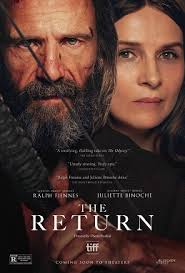
I am a complete sucker for Greek myth films. And even more, I am an utter sucker for films that take bits that have been done less often, and which do so with nuance and a modern sensibility while still keeping true to the original. Nearly impossible? For sure.
The Return manages this with aplomb.
(Spoilers, I guess? If you can spoil a 3000 year old story? Although there are some changes to the ‘original’, which I will discuss.)
The film doesn’t try to cover all of Odysseus’ wanderings – and Troy is covered in a single sentence in the brief introduction. Instead, it opens with Odysseus washed ashore on Ithaka, and Penelope besieged by the suitors. It really only covers a few days – exactly how long is unclear, because Odysseus may have spent a few days in Eummaeus’ cottage, recovering his strength. The narrative moves between several strands. There’s Odysseus, coming to understand what has happened to his island, and Penelope, often at her loom, agonising over what to do and how to look after her sons. Interestingly, there’s quite a focus on the suitors, especially Antinous (the least objectionable on the surface, but shown to be very complex and with a horrible side) and a couple of others, like Pisander (who I spent the whole film trying to place – he was Ricky September in that weird episode of Doctor Who, “Dot and Bubble”). And there’s also Telemachus… and, look. He’s never been a favourite. Ever. I was terrified we’d be subjected to a whole section of him going off and visiting Helen and Menelaus, but thankfully we’re spared that.
This is not an action film. There is action: suitors chasing Telemachus, a couple of fights, and a particularly brutal killing of the suitors. The film is far more interested in conversation, though: discussing what happened at Troy – and whether the Greeks were heroes or not; discussing what Penelope should do; discussing what Telemachus should do; mourning the events on Ithaka.
This is a film that takes Odysseus’ experiences at war seriously, and the reality that a decade of fighting will change a man – and that two decades away from his wife and son will change their relationship. It asks very honestly whether Odysseus can ever truly come home, and how his family can now relate to him. It does not paint Odysseus as a hero, nor laud his accomplishments at Troy. Overwhelmingly, he is tired. He mourns the last two decades; he is remorseful of some of his actions, and fears the future. He’s not yet bitter and angry but you can see it’s a possible outcome.
One of the really interesting changes is that of the “maids” – and I find this particularly intriguing in light of the discussion around them over the last few years, with Emily Wilson’s translation finally making it painfully clear that these women are slaves, not just servants. The choice is to make them almost absent. A few are shown sleeping with (literally and, er, metaphorically) some suitors, but that’s all: no sense of whether they are being compelled, and also no sense of whether all of the women shown are actually members of the household. I guess this is one way to avoid the ‘necessity’ of killing them all at the end.
This is a great film. I appreciate the way it takes Odysseus’ agony seriously. It doesn’t do quite as well with Penelope – it’s not particularly informed by Atwood’s Penelopiad or Claire North’s Songs of Penelope series – but it does give her some agency. Overall, it is an excellent entrant into the halls of Greek myth-inspired films.

 Randomly Yours, Alex