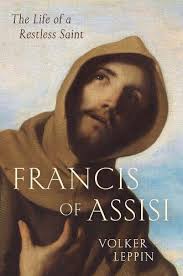
I came to this book because I am friends with the translator. This does not guarantee that I was going to love it.
I am not Catholic. I have zero fascination with the idea of ‘saints’ in and of themselves; my primary interest is in how the women and men who get that title existed in their world. I also tend to have more interest in those who were regarded in some way as odd or outsiders in their time, or who lived in interesting places and times. So Francis is interesting, and also has the added dimension of being amongst the most well-known of all the Catholic saints. So I was fascinated to learn about this book being translated from the German. Having read it, I’m very glad it has been.
I was particularly fascinated by the book as an historian because Leppin spends a great deal of time reflecting on the primary sources available about Francis’ life: both the paucity of sources in general, and the intensely problematic nature of what does exist. Because Francis was canonised so quickly, and because his order already existed when he died – there are so many reasons to want to portray Francis in very particular ways, and reading through/around those to get to a ‘real’ Francis is always going to be challenging. So I deeply appreciated Leppin’s honesty around that, and his acknowledgement that ‘the truth’ is always going to be a challenge.
Nonetheless, I think Leppin does a good job of excavating Francis’ life, and presenting what we can reasonably understand about the man. I appreciated that Leppin isn’t interested in yet more hagiography, but in actually understanding a person – who wasn’t perfect, and made some odd choices, and whose heart we can’t fully understand, but who was nonetheless making some radical choices for his time.
And of course I need to mention the translation: and as with the best translations, you wouldn’t know that this is translated. It just… reads like a book. I can only imagine just how much work went into choosing the right words to both capture Leppin’s meaning and make the book itself work.
So, for those interested in Francis as a human, and how the Catholic church worked in the 13th century, this is a great book.

 Randomly Yours, Alex