Incorrigible Optimist: Gareth Evans’ Political Memoir
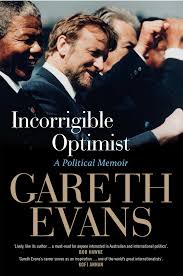
Look. I’m a history teacher, and a cynic. I understand the point of a political memoir. So on the one hand, reading this was amusing because for all the self-deprecating humour and the admission of bad decisions and poor choices, it’s still an exercise in ego to write memoir.
And on the other hand: I just want more politicians to be like this. To be passionate about things that will actually make a positive difference. To be self-aware. To be willing to make hard, necessary decisions. I was a child of the 80s and 90s – at the back of my mind, “the Australian government” is Bob Hawke and Paul Keating and, yes, Gareth Evans.
I don’t read modern biographies, as a rule, and I really don’t read autobiographies. They hold zero fascination for me. I can probably remember every 20th century biography I’ve read: the Dirk Bogarde one my mother gave me (I went through a serious Bogarde phase), and Julie Phillips’ Alice Sheldon/James Tiptree Jr one; ones about Vida Goldstein and Emmeline Pankhurst; and one about Alexander Kerensky. Oh and Gertrude Bell! That’s literally the list – and given the number I’ve read about people who died before 1800 (and it’s only that late because of the French Revolution – oh Danton, you’ll always live in my heart), six is nothing. But now we can add this to the list, which I read for Reasons that may eventually become clear (not in this review).
This is, of course, not really an autobiography. It’s a political memoir – I think Evan mentions his wife twice? maybe doesn’t mention his kids at all? – so there’s no discussion, really, of anything outside of what has shaped his attitude to policies and ideas. It’s also not just focused on himself acting, but also on his ideas. There is an entire section where he’s outlining the pillars of the “responsibility to protect” concept that I had no idea about, but which he was fundamental in drawing up for the international community; sections where he talks about how universities (and especially chancellors) should function, why nuclear weapons should be utterly eliminated, the importance of international cooperation… this is not just a memoir: it’s a manifesto. Honestly, it’s a bit swoon-worthy.
Realise when this was published, though, and it feels like a dream of a half-forgotten world. Because it was mid-2017. Trump was just elected for the first time; Brexit was relatively new. Dreadful things had happened in Syria and Libya, and Russia was making its first forays around Ukraine. Scotty wasn’t even being joked about as PM. So when Evans discusses his hope that Trump might eventually “submit to adult supervision;” when he talks about his hope that “responsibility to protect” might be a real factor in international discussions when populations are at risk of war crimes and genocide… well. There’s a part of me that wishes I could go back to that time, and live it again, knowing how good it was.
This book probably doesn’t have that much appeal beyond Australia’s borders – unless you want to just read it for the foreign policy aspect, and for Evans’ involvement with Crisis Group and various UN and regional Asian events, all of which are quite fascinating. But if you’re like me – with a vague interest in Australian and international politics, and especially with a memory of those Labor glory days – this may well be of interest.

 Randomly Yours, Alex