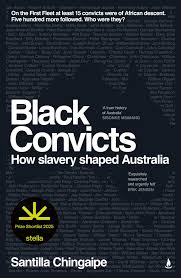
I came across this book because I heard Chingaipe at the Melbourne Writers’ Festival. She was personally compelling, and the story she told of learning about the Black convicts who came to the east coast of Australia over the first few decades of “white” settlement was intriguing. So I picked it up, and have finally got around to reading it. To be honest I was putting it off because I knew it was going to have some harrowing bits – and I was right – although I also expected it to be gripping, and rewarding. On those counts it was more than I expected, because Chingaipe is an excellent author.
Chingaipe is doing two things here. On the one hand, she is writing about the Black people who were brought, or in a couple of instances came under their own steam, to the country we now call Australia (which wasn’t a country during this period and wasn’t always known as Australia). Often she’s talking about people whose names have never been mentioned in histories before, which is amazing in its own right. Some of these people were part of the standard “convict comes to Australia” story that tends to be discussed – do some minor crime in England, get sent to the colony for 7 or 14 years, live life here after. Many of the others, though, did their “crime” (a category explored extensively) in one of Britain’s other colonies – various sites in the Caribbean, or Mauritius, for instance – who then got shipped to England and then to these shores. Which I had no idea about.
On the other hand, she is also exploring the links between slavery, its systems and language and attitudes, and the convict system. What she points out are some things that I had previously considered, especially with the language, but a whole bunch of things that I was completely unaware of. She makes a compelling case for the convict system in Australia owing a great deal to the structures developed for and around slavery in North Americas and the Caribbean by the British. Which shouldn’t be that much of a surprise, when it’s laid out… but that’s often the way with a history like this.
One of the things that I really enjoyed about Chingaipe’s style is her presence within the book. I have noticed this happening more frequently in history books, especially with very deliberately and self-consciously political books: a refusal to pretend that the historian is objective, or even absent from the story they’re telling. So we get the story of Chingaipe visiting Hobart and Barbados, Zooming with historians around the world, her own emotional reaction to various stories. Far from detracting from the history, as would have been suggested decades ago (and probably still is by some today), this highlights the importance of the topic being discussed, and the fact that history is not/never is “past.”
I really think that anyone interested in Australian history, and probably also African diaspora history, would benefit from reading this.

 Randomly Yours, Alex