Fulvia: The Woman who Broke all the Rules in Ancient Rome
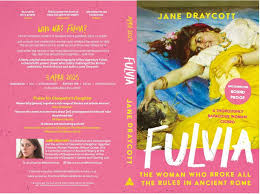
THIS BOOK.
Argh, this book. I have been waiting to get my hands on this book for… I dunno, a year or something? And now I have read it and it was wonderful.
I have enjoyed Jane Draycott’s work since reading Cleopatra’s Daughter: she has a wonderfully engaging style, she makes it clear when she’s making educated guesses but doesn’t shy away from them, and she’s determined to excavate interesting women out of either being completely ignored (Cleopatra Selene), or mostly ignored except when they’re excoriated (Fulvia).
Had I completely forgotten that Fulvia was married to Marc Antony? Uh, oops. I KNEW there was another reason that I was dead keen on learning more about her.
So little is known about Fulvia as a person that Draycott has to spend quite a lot of time going over what is known about OTHER Roman women in order to a) have a stab at discussing what most of Fulvia’s life was like, and b) putting her in context for both why some of the things she did were so unusual, and why some of the things she did were NOT unusual but still got maligned. While I already knew a lot of these things it was still great to see it all put together like this, and particularly in conversation with the life of one particular woman – for someone coming to the book with zero knowledge of Rome, I think it would be pretty accessible. The main thing that isn’t all that accessible, and which there is no getting away from, is the names. My goodness, Romans, could you not have had more imagination in your nomenclature? Gets me every single time.
Anyway. This book is a delight. It’s the best sort of revisionist history: not just accepting what ancient sources say, but examining their reasons for doing so; adding in the archeological evidence, as well as other source material; and bringing a trained feminist idea to persuasively make the case for how misogyny has worked over the centuries to write Fulvia’s story.
Look, it’s just really good. Highly recommended for anyone interested in late Republican Rome, and/or women’s history in general.
The Greatest Fight of Sunny Granada, and other stories

This is another of the book sent by a Filipino friend. You can buy it over here.
I’d not come across Kenneth Yu’s work before, but apparently this is his second collection of short stories. There’s a really interesting variety in the stories presented here.
The eponymous story is very clearly science fiction, and told non-linearly, about a man who starts off as a boxer/MMA etc on Earth and then leaves the planet to find more career options fighting aliens in the arena. Certainly on one level it’s about fighting as a sport and sport for money, but of course it’s also about family and inheritance and Place as home.
Then there’s “Spider Hunt,” which feels more like fantasy; “The Probe” is maybe SF, maybe fantasy, and works by muddying the lines. “Beats” is also genre-defying, intriguing and mysterious.
While I can see, and appreciate, what “Operation: Bleach” is doing, I’m as white as they come; I suspect it hits far harder for folks with browner skin than mine and who live in a society that upholds my sort of skin as somehow preferable. It’s another story told inventively – a series of newspaper articles and comments – and it’s probably my favourite story of the collection.
I found “Lost for Words” a bit confusing, to be honest – it’s very short, and I don’t think entirely works as a story. Then “All That We May See” tips into horror, “One Morning at the Bank” is a superhero story, and “Blending In” feels basically like realism.
And then “For Sale: Big Ass Sword” is told entirely as an ad on Talipapa, which I understand to be an online trading site for the Philippines; the story leans into folktales/fairy tales, and is a really solid conclusion.
It was never predictable what the next story would be like, and I really enjoyed that aspect, as well as the stories themselves.
Olympus Inc novels

Kate Healey says that the Olympus Inc books are finished (for now??) so I felt I should write a brief note about them.
Take Greek mythology. Bring it into the modern world. Remove the supernatural. And remove all of the coercion and ick-ness from the love stories, while keeping (and often revealing) the ick-ness of many of the other relationships. This gives you the basic premise of the Olympus Inc stories.
The first set revolve around Olympus Inc, a publishing powerhouse, and the people who work there. The very first novel makes the Hades/Persephone story an actual delight, and you may be able to imagine just how very weird that is. It also shows up Demeter as basically a monster, and as far as I’m concerned this is now canon. We then get Aphrodite and Hephaestus, and Hera and… well. Spoilers. Around them are Odysseus and Penelope (who actually appear in an adorable prequel novella), Hermes, Hestia, and a bunch of other hilarious nods that you will get if you’re deep into the mythology and otherwise work perfectly well as side characters. You can read these novels as pure (adorable) romance novels, of course, but being able to shriek “I see what you did there, Healey!!” was a large part of the joy for me.

The second set of stories are, I think, a taller order: Healey takes three of the Trojan women and gives them happily ever afters. Which is honestly a big call, and it works incredibly well. Cassie, Xena, and Laodice all famously came to bad ends in the myths, but Healey takes their stories and writes wonderful romances.
All of these books are very, very readable. The characters are a delight and the romances make sense. They do all include some distressing things – mention of abuse, for instance, and disability-shaming, and so on. Healey deals with all of these with compassion and makes it very clear that they are Not OK.
You can find information about the books over at Kate Healey’s website.
Brigands & Breadknives
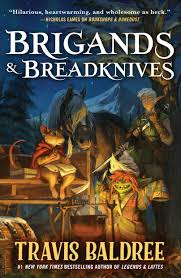
I received a copy of this book from the publisher, Tor Books, in exchange for a review. It’s out in November.
I was a few months late to the Legends & Lattes party, but I don’t regret getting there; sometimes, what I need is exactly that sort of low-stakes cosy fantasy. If you are of similar mind and want a near repetition but with different characters, this book… is not quite that. Note: you can read this without having read Legends, I promise!
Where Legends was about knowing both that you want to change career and how you will go about doing that, Brigands & Breadknives is the opposite: thinking that you’re content with your career and then realising how terribly wrong you are – but having no idea what to do instead. And that, too, can be okay.
The rattkin Fern thinks she is perfectly happy as a bookseller; she’s had a small adventure by moving cities to set up a new shop, and when she arrives it all seems very promising. But she realises she isn’t happy at all. Then, she gets drunk one night, falls asleep in a wagon, and ends up in a completely unexpected adventure: Astryx the mighty elf warrior and bounty hunter, is travelling across the Territories to collect the bounty on Zyll, a goblin with a remarkable talent for chaos. Numerous adventures ensue, some because of other bounty hunters and some not. And throughout it all, Fern is struggling with her own sense of purpose and self – and guilt, since she left her friends with no warning.
The comparison with Legends is, of course, inevitable. The stakes are higher here: many more sword- and knife-fights, people actually getting hurt, the moral quandary of a bounty when you’re not sure it’s valid. And arguably the stakes are personally higher for Fern, too, as she struggles with her own identity and purpose in life. (I’m not saying Viv doesn’t struggle with this, but it’s different when it’s something you’ve chosen, I think.) Plus, where Legends is set entirely within one town – in fact almost entirely on one street – Brigands ranges over a broad swathe of the Territories.
The book doesn’t need these comparisons, though. You can come to Brigands & Breadknives without having read Legends (or the prequel, where Viv meets Fern). All you need is an interest in a world with a huge variety of sentient races all living together (companionably, for the most part), grace for the occasional pun, and a desire to read about characters who have both fights and personal conversations. It’s a fast read, I enjoyed the characters a lot (Zyll is glorious), and this is going straight to my Comfort Reading Pile.

 Randomly Yours, Alex