A Forest, Darkly, by A.G Slatter
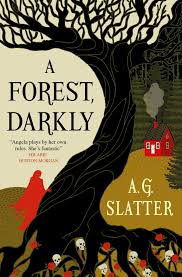
Read courtesy of NetGalley and the publisher, Titan. It’s out in February 2026.
The short version is that I like everything Slatter writes, and this was no exception. If you’re interested in reading complex characters, fascinating worldbuilding and plots that feel familiar and then go in entirely unexpected directions, with a “this feels like a fairytale but WOAH” vibe, then she is definitely one for you to look out for.
This is very loosely a version of Red Riding Hood, but I promise you have absolutely no idea what’s going on with any of the characters from my having said that. The central figure is a witch – I could say she’s a good witch, but that’s way too patronising and shallow and, well, inaccurate. She’s trying, ok? She’s not a witch who’s looking to eat children. There are, though, a significant number of children in the book, to whom some unpleasant things do happen. There’s also a blacksmith, and some non-humans, and a forest.
Mehrab, the witch, has been getting on well enough in her little cottage in the forest, far away from any signifiant towns. The nearest village is also far enough away that getting there requires a conscious choice, and anyone coming to her is doing so deliberately. One day, Fenna – the woman who brought Mehrab herself to this cottage, and who has brought other girls to stay there over the years – brings Rhea to her: the girl is a witch, and is on the run. Part of the novel is about Mehrab and Rhea figuring out how to be around each other.
A mother and father arrive at the cottage soon after Rhea; their little girl went missing a few days ago, and they ask for Mehrab’s help to find her – but she has no luck. And then the girl arrives home some weeks later… but seems to be different. Part of the novel is about figuring out what’s going on with Ari, and other children too.
Mehrab’s past is very mysterious; she gives little away to Rhea, or the reader. The gradual revelation of why she was herself on the run when Fenna brought her to this forest, and why she makes the particular choices she does, is a thread running through the entire novel.
I loved everything about this novel.
The novel is within Slatter’s Sourdough universe, but there is absolutely no need to have read anything that comes before; there’s reference to a couple of characters from other novels but they’re very much just as background, in the way that a complex world will always have background. However, if you’re already a fan, REJOICE! It’s always good when there’s a new one.
Flight&Anchor, Nicole Kornher-Stace

Reasons to read the Acknowledgments at the end of the book: you find out that the brilliant book you just read is a prequel written some years after two other instalments.
Cue happy dancing.
In some medium-term future, America has gone entirely corporate, and there’s wars between the main ones (I mean…). This is, however, not the focus of this story at all (but possibly is of the main novel, Firebreak?). Instead, the focus is on 06 and 22 – two children who are no longer children in many ways, but still have some child-like aspects. They have been changed by a corporation, and I don’t really want to go into exactly how or why because discovering that was part of the absolute joy in reading this book. It’s not exactly pleasant, so maybe don’t read it if you’re feeling particularly attuned to nasty things happening to kids, but there’s not a lot of terrible detail, so there’s that.
The story is basically split in two. The main bits are focused on 06 and 22 – biologically 12, kept in a secret facility for four years – having broken out and now trying to find food and survive in what is basically a foreign environment. There’s an intense focus on the relationship between the two (don’t be gross, not like that), which is clearly a huge aspect of the later books but still works without knowing anything of their futures. It’s beautiful and sometimes funny and also quite affecting.
The other, smaller part of the story is the experience of the Director, as she tries to figure out how to get the pair back. For someone who is quite clearly reprehensible, Kornher-Stace does a good job of both humanising her and never minimising how awful she is. It’s an admirable presentation and again, makes me very keen to read more about her, even though I do now know some of what will happen to her in the future: Kornher-Stace is clearly writing this for people who’ve read the other stories, and yet the future-reflections actually still work for someone like me.
I enjoyed everything about this story and have every intention of going to find the rest.
The Iron Garden Sutra, A.D Sui
Um. Wow. This is absolutely brilliant.
I read this courtesy of NetGalley and the publisher; it’s out in February 2026.

Humans have spread through the stars. People die on spaceships, and in accidents, and sometimes lost slow-traveling generation spaceships are found with all crew dead. In those instances, monks of the Starlit Order are often called on, to lay the dead to rest, and to remind the dead that they are one with the Infinite Light. Not everyone believes in the Infinite Light (and the Infinite Light doesn’t care about your belief), but the monks seem to carry out a role that people need. People have always needed closure with death.
Iris is a Starlit monk, and as such has a personal AI in their head – not something that is very well regarded any more. Iris isn’t sure that he’s a very good monk, but he wants to be good at it. He is sent to a newly ‘arrived’ generation ship – sent many generations ago, just now arriving in populated space, and all crew dead. When Iris arrives onboard, however, he is not alone: there’s an archaeological team onboard as well, which just makes everything more difficult. And then things get even MORE difficult, but it’s not the fault of the humans…
I’m tempted to say that this is a little bit gothic – a giant spaceship is kind of like a house, right? I’m not sure whether or not it’s horror; I did not find it scary, although I imagine that if it were a film I would have found it so. Guess it’s a good thing I’m not doing the genre marketing.
No matter the genre, I absolutely adored this book. I love Iris and his inner conflict, although I definitely wanted to scold him at several (many) points and urge him to take better care of himself. I was deeply amused by Iris’ relationship with his AI (VIFAI), as well as occasionally troubled. The archaeologists and engineers are characterised swiftly and beautifully – even the ones who don’t live all that long (spoiler!). The arguments between the different groups were all too believable. And I was utterly intrigued by the eventual reveal of what was going on; it may not be an entirely unique take, but it’s incredibly well done and feels like a really fascinating direction for further exploration.
AND THEN I got to the end and discovered there’s another book in the offing! Truly a wonderful surprise. A.D Sui keeps being one to watch.
Margaret Beaufort: Survivor, Rebel, Kingmaker
I read this courtesy of NetGalley and the publisher. It’s out in November.
Absolutely fantastic biography, and also introduction to the entire period.
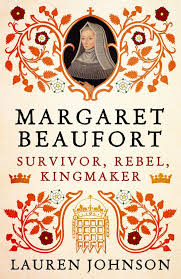
I love a biography that (re-)examines a woman in her context. Johnson is clear that she’s not the first to write a biography of Margaret Beaufort, but that one of the new things she’s doing is putting her very much in the context of women – the women she interacts with over her life: her mother and half-sisters, mothers-in-law and friends and servants and rivals, daughter-in-law and granddaughters. This gives a fantastic insight into what’s going on for noblewomen at this time in England, Wales, and even Scotland.
Of course, an enormous amount of the book is about Margaret’s interactions with men, too: husbands, mostly, but then eventually her son, as well as various half-brothers and stepchildren, not to mention cousins. My goodness, the cousins: when you’re a noble with a long lineage, you are related to EVERYONE of any importance. And, apparently, you knew them, or could at least call on them in times of need / just for the heck of it. Which really puts the War of the Roses in context, because it’s all about brothers and cousins fighting amongst themselves and devastating the countryside in the process.
Margaret Beaufort had a remarkable life. Terrible, at some points – pregnant and widowed at 13 – but also long, with many healthy and loving relationships (as far as we can tell), and eventually a son and then grandson on the throne. Not a terrible ending, one suspects. Lauren Johnson does an excellent job of making Margaret as human and relatable as feasible, while still reminding us that her life 500 years ago was very, very different from what we experience today. She does a very good job of trying to make the names easy to process (TOO MANY HENRYS and JOHNS), and the politicking easy (ish) to follow. This is a really great book.
Into the Mainstream, by Tom O’Lincoln

This is not the book I thought it would be. Which isn’t the book’s fault, but does affect how I think about it.
I thought I was getting a … straightforward history of the Communist Party of Australia. And that’s certainly a significant part of this book. But what the book is ultimately focussed on is the way Communism, and Marxist ideas, has often been done badly in Australia. O’Lincoln is very upfront about the fact that he is very unimpressed by most of the leadership of the CPA, especially from the 1970s onwards. Of note: the book was published in this format in 2009 but was actually written in 1985, which itself definitely and necessarily has an impact.
The other problem is that the book presupposes quite a lot of knowledge – both philosophical and historical – that I don’t really have. Again, that’s partly a factor of it having been written 30 years ago, so the intended audience would have had more immediate knowledge of things that I just don’t. But there’s also no interest in defining “left” and “right”, assuming that the reader will have a shared understanding of what that means – and I have to tell you, reading about a Communist party veering to the right is always weird (yes, I do understand how that works). There’s no attempt here at leading the reader into understanding the various issues (like the difference between socialism and communism, and why you would regard liberal reformism as bad) – because the reader is assumed to already be on O’Lincoln’s wavelength. Again, not necessarily bad, but does suggest a very specific audience.
Worth reading? If you’re interested in the development of the CPA over time, probably yes. But prepare yourself for some pretty heavy philosophical lifting.

 Randomly Yours, Alex