New Philippine Speculative Fiction 1
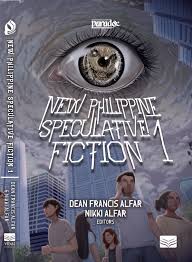
And another book sent by Charles! You can buy it from the publisher.
This anthology is both a mixed bag and a diverse collection – ah English, you are hilarious.
Some of the stories brought together here are absolutely brilliant. There are very few names that I recognised, and many that I hope will have their work picked up by and read further afield.
Of course, any anthology is going to struggle to please a reader with every story. So as expected, there were stories that really did not resonate with me here. Most of those were the horror stories – which is entirely to be expected, since that is not my vibe at all. In particular some of them leaned far too heavily on body horror for my tastes, so I simply skipped them. If that’s your vibe, then I’m glad for you that they’re included here. There were plenty of other stories here that did work for me: there are 35 stories included!
Some stories were clearly and obviously leaning into Filipino places, ideas, history, and language; I definitely didn’t get all of the references in those, but I got enough that I could appreciate the story. Others were, I guess, more “universal” – whatever that means, given the stories are presented largely in English. One of the fun things about an anthology like this is that the only connective tissue is the identity of the authors: there are no themes or ideas tying the stories together, so you have absolutely no idea what you’re going to read next.
Some favourites:
- Jose Elvin Bueno, “Cadena de Amor” – the narrator’s perspective here was intriguing, and the story tantalising
- Vida Cruz-Borja, “Call of the Rimefolk” – art, space, aliens, love, family. This story is magnificent.
- Exie Abola, “Shadow Sisters” – difficult to characterise, gut-wrenching if you’ve got siblings.
- Ian Rosales Casocot, “The Apologist” – I don’t like this story. It made me angry and feel powerless. It’s very well written and it reflects modern media too well for my liking – how rich people can get away with anything, and how PR works. More people should read it.
- Kate Osias, “The James Machine” – AI stories are still very Now. This is a simple story, in the sense that the narrative is straightforward and it doesn’t dive deep into philosophy; it’s also poignant and lovely, and the subtitles throughout are a masterstroke.
Highly recommended for getting a taste of what the Philippines is producing.
Cinder House, Freya Marske
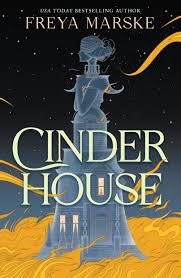
My main take away from this novella is “do not come at me with your ‘fairy tales are dead’ takes.”
This is probably the most imaginative reworking of Cinderella I’ve ever come across. Not least because it starts with the death of Ella’s father… and of Ella herself.
Yes, Ella is a ghost. No, that doesn’t stop her from having the traditional Cinderella adventures. Yes, it makes it more complicated; yes, it makes it absolutely intriguing.
Honestly, don’t even keep reading this review. Just go read it. It’s that good. (Also, novella! I basically read the whole thing while donating plasma!)
If you want more detail: Ella dies at 16. She becomes a ghost and haunts her house. The only people who can see her are her stepmother and stepsisters, and she can’t leave the house… until she finds a way to do so, temporarily.
This is a world with magic and fairies; the fairies are treated much like exotic humans (I choose the term advisedly), and magic has a difficult place in the world. Ghosts are not unknown. Ella’s tie to the house is used brilliantly – I think it’s one of the more clever explorations of that idea that I’ve come across, too, although given my general avoidance of haunted-house-stories (because I’m a wuss), maybe it’s not as novel as I think. At any rate, in not very many pages Marske creates (for me) a whole new way of thinking about hauntings, and I bought it completely.
Marske also manages to make the prince complex and interesting, with – again – a really brilliant take on his character.
Also also: a queered fairytale.
And finally also: gorgeous prose.
I loved this book a lot.
Every Day I Read, Hwang Bo-reum
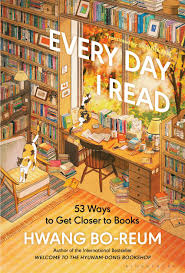
I received this book from the publisher, Bloomsbury, at no cost. It’s out now.
(Translated from Korean by Shanna Tan.)
I am not the audience for this book. That’s the main thing I took away from reading it. Perhaps as importantly, I don’t know – and I’m not sure the book itself knows – who the audience actually would be.
Sometimes the book’s purpose seems to be to give readers a way into, or back to, sharing the author’s love of reading. A worthy goal, of course – but I question whether most people who are struggling to find time to read (or to see it as a worthwhile activity) would pick up a book about that activity. So I was confused by that aspect – and also, that is not a problem for me, thus: I am not the audience for this book.
Sometimes the book’s purpose seems to be celebrating the joy that is reading, and this is one that I fully get behind (obviously). But the slides into didacticism – here are reasons for why reading is good for you! – felt very off-putting in that context.
The book is at its best when the author presents a sort of book biography. The books that have made an impact on her life, the times reading has helped her cope with difficult times in her life, and so on. I did also like the way she points out what reading a variety of books – bestsellers and not, short and long, staying within your preferred topics and venturing further afield – can be like. And yet… it also felt a bit pretentious. Again, maybe that’s me and my personal hang-ups, and maybe I still feel defensive about my preferred genres. But almost every book mentioned was a “classic” and there aren’t many books that could be called recent (aside from Murakami… and see “classic”). Pretty much all of the fiction is realist. And then there’s the dismissal of ebooks, conflating “reading online” with “reading electronic books”. And yes, perhaps many people do consume ebooks differently from how they read paper books. But many of us don’t.
Anyway. As noted, this is not a book for me. I hope it finds an English-language audience; I just don’t know who they will be.
Frostbite, by Nicola Twilley
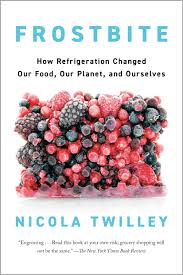
I came to this book because I am a fan of the podcast Gastropod, and Twilley is one of the hosts. She’s an immensely engaging host there, and she’s also an immensely engaging author. Her interest in and passion for “food through the lens of science and history” (the podcast’s tagline) comes through here: the history, present, and future of refrigeration and its connection to food is told thoughtfully, clearly, and with honest acknowledgement of the issues as well as the benefits.
One of the things I hadn’t really expected, but should have given the podcast, is just how much time Twilley spent actually experiencing the things that she discusses. She works some shifts in cold storage warehouses! She visits farms and factories! She goes to China and Rwanda as well as all over the US! And she has clearly talked to A LOT of people about all of the issues.
A fairly big focus of the book is the development of artificial refrigeration for food: the reasons for its necessity and the various people who were involved in trying to do so, the things they tried and how often they failed. I had no idea that people thought it would be ear impossible, but Twilley lays out the reasons for why it was so very hard and honestly I ended up surprised that it happened at all.
The bit that I found quite distressing was the reality of how much space is used for cold storage, and its environmental impact. But Twilley also points out how important refrigeration can be for things like reducing food wastage – one of the things I like about her reporting is that it’s not just two-sides-ing for the sake of it, but is looking at the issues very clearly and thoughtfully.
It’s a great book. Definitely one for people who are interested in how processes that we absolutely take for granted actually work.
(One thing to note, for those of us not in the USA: the book does use Fahrenheit throughout, which meant for me that I have no idea what the temperatures she’s referring to actually feel like.)

 Randomly Yours, Alex