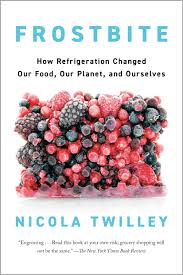
I came to this book because I am a fan of the podcast Gastropod, and Twilley is one of the hosts. She’s an immensely engaging host there, and she’s also an immensely engaging author. Her interest in and passion for “food through the lens of science and history” (the podcast’s tagline) comes through here: the history, present, and future of refrigeration and its connection to food is told thoughtfully, clearly, and with honest acknowledgement of the issues as well as the benefits.
One of the things I hadn’t really expected, but should have given the podcast, is just how much time Twilley spent actually experiencing the things that she discusses. She works some shifts in cold storage warehouses! She visits farms and factories! She goes to China and Rwanda as well as all over the US! And she has clearly talked to A LOT of people about all of the issues.
A fairly big focus of the book is the development of artificial refrigeration for food: the reasons for its necessity and the various people who were involved in trying to do so, the things they tried and how often they failed. I had no idea that people thought it would be ear impossible, but Twilley lays out the reasons for why it was so very hard and honestly I ended up surprised that it happened at all.
The bit that I found quite distressing was the reality of how much space is used for cold storage, and its environmental impact. But Twilley also points out how important refrigeration can be for things like reducing food wastage – one of the things I like about her reporting is that it’s not just two-sides-ing for the sake of it, but is looking at the issues very clearly and thoughtfully.
It’s a great book. Definitely one for people who are interested in how processes that we absolutely take for granted actually work.
(One thing to note, for those of us not in the USA: the book does use Fahrenheit throughout, which meant for me that I have no idea what the temperatures she’s referring to actually feel like.)

 Randomly Yours, Alex