The Man Who Stopped the Sultan
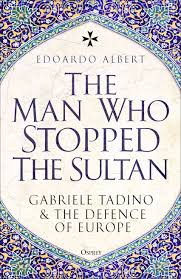
Read courtesy of the publisher and NetGalley. It’s out at the end of January, 2026.
This book is pretty great. For a reader even vaguely interested in the Europe and Ottoman Empires of the 1400 and 1500s, it provides a brilliant perspective that is often missing from other, entirely Euro-centric accounts I’ve read.
Did I know Henry VIII, Frances I. Suleiman, and Charles V were all around the same age?? No I did not. Doesn’t that give the 1500s a slightly different complexion. (Also I love the dismissal of Henry VIII and England as not particularly relevant to the happenings on the Continent at this point….)
This is larger than JUST a biography of Gabriele Tadino, although it is also that. Tadino is himself a fascinating figure – an engineer when military engineering is completely changing in reaction to technology, basically in the centre of things because of birth (living near Venice when shit is getting real, thanks very much not-so-Holy, definitely-not-Roman Emperor) and then being persuaded to join in with the Knights of St John over on Rhodes when Suleiman and his crew are laying siege. Tadino is not perfect, and there’s also bits of his life where the records completely dry up – but Albert has done a convincing job of recreating a lot of his experiences, and suggesting the whys and wherefores around them.
Alongside the Tadino exploits, though, this is also a magnificent examination of European and Ottoman relations in this key period. I don’t know all that much about Suleiman, nor the Ottomans at this time more broadly – but I know more now, and my disgruntlement at writing European history of the 16th century without reference to what was going on over East, and indeed well into central Europe, is Large.
Well written and accessible for the generally historically intelligent reader – no need to have very specific knowledge of people or places – this is a really great book.
The Everlasting, by Alix E. Harrow
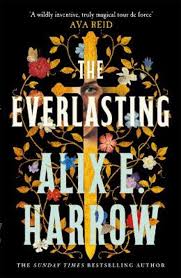
I keep not reading books by Alix E. Harrow as soon as I should, but at least this time I didn’t leave it a couple of years. Which means really I’m fairly up to date, right?
TL;DR this book is simply superb and if you have any interest in knights and adventure and time travel and stories that do very clever things with stories, this needs to be at the top of your To Be Read pile.
My thoughts on this magnificent novel are split into two bits: thoughts for readers with extensive (some might say tragic) Arthuriana knowledge, and thoughts for everyone else.
For everyone else: truly this is a beautiful novel of love and determination and the power of story. It can and should be read as a romping adventure story across time, with its share of heartbreak and despair but also a great deal of hope and bloody-minded teeth-gritting stubbornness. It can and should also be read as a dissection of the uses to which Story and History can be put, at a personal and a national level, which has a significant element of caution as well as its own element of hope. This is also a novel with fantastically well-developed characters: Sir Una, the knight whose image is used Kitchener-ly for Dominion wars (and I was also put in mind of Emily Blunt’s character in Edge of Tomorrow), whose devotion to her queen a thousand years ago is literally the stuff of legends. Owen Mallory, a nearly-failed historian with an alcoholic deserter father, struggling with his own demons, unexpectedly flung into Una’s story. The queen herself, Owen’s academic supervisor, the murderous horse – there’s not a misstep throughout.
… for the Arthuriana tragic, there’s even more going on here. The historian is Owen Mallory. Dominion is playing on the idea of England; the Arthur story is (or perhaps was) after all England’s national myth, in many ways, as Una’s is. There’s a wonderful interplay between Owen and his academic mentor about the Everlasting stories as a palimpsest, and stories being changed to fit a national moment, and irritation at audiences who think the later stories are the authentic ones – all of which applies to Arthuriana, in amusing and sometimes heated ways. There’s the idea of a knight being undying, the reference to a grail, most of the other knights’ names are plays on names from the various cycles – there are so many moments at which I just flailed at Harrow’s cleverness.
I adored this novel. And I read it just a few weeks after reading Tasha Suri’s The Isle in the Silver Sea; these ideas about stories and nations, their use and abuse, are clearly floating around in the zeitgeist. But I hasted to add that having read one does not detract from reading the other – the opposite is true: reading both (maybe not one after the other) is more like… some clever analogy with structures supporting one another. I’m sure you get the idea.

 Randomly Yours, Alex