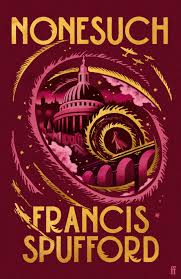
Read courtesy of the publisher and NetGalley. It’s out at the start of March.
Firstly: be aware that this is the first of a duology. Did I know this going in? No. Did I think it would have an amazing conclusion? Yes. Did it have a great conclusion? Yes. Did I then turn the page to discover “To be concluded”? What do you think.
So it’s the eve of World War 2, as the novel opens. Iris works in London, for a stockbroker; what she really wants is to be the stockbroker, but that’s not happening for a woman in England in 1939. She’s also a self-identified ‘bad girl’: she has relationships with men that are largely transactional – not strictly in the sex-work sense, but in the sense that she’s definitely looking to get something out of it. Mostly she’s looking to move up in the world, away from her suburban roots (it is England in 1939).
Then she meets Geoff, and then a weird Watcher follows her home, and then World War 2 starts, and then the Blitz begins. It’s a lot.
This is most definitely a fantasy novel. There are “angelic beings” – for want of a better term (they’re definitely not angelic in the sense of perfectly good, because I’m pretty sure that would rule out being sarcastic); there’s a shadowy occult society, and magic is real if hard to access, and eventually there is Nonesuch – a place where, if you can access it, you might change history.
And yet. The fantastical elements are a surprisingly small part of the story. An enormous amount of the book is actually about surviving in London in 1939 and 1940. Everyone surviving – the descriptions of bomb shelters, and the lack of supplies, and general atmosphere of fear are exquisitely drawn. And Iris surviving – how she has lived up til now (perfectly well, if sometimes precarious), how that changes when she meets Geoff (much more complicated), various real and important moral quandaries. It’s not that the fantastical elements were extraneous – I was always itching to go back to them – but the mundane sections didn’t bore or worry me, or make me impatient. They’re necessary and they’re amazing.
I have never read anything by Spufford, and I was actually quite surprised to discover he’s a he. Iris is drawn so convincingly, and sympathetically, with determination and ambition and unwelcome vulnerability; she’s so angry when she’s vulnerable but never made to seem lesser to the reader when she is – I just assumed it was a woman writing her. So that was a shock, but takes nothing away from Iris. She’s vital and alive, she makes bad decisions and sometimes she makes them right, she’s brave and she has to make real decisions about morality, and living with her brain and ambition in 1939 must have truly sucked.
If I could hold my breath until the sequel arrives I would consider it, but that would be stupid. I’m so excited that I am really quite nervous to see where it goes.

 Randomly Yours, Alex