The Brilliant Boy, Gideon Haigh
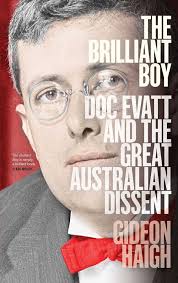
Doc Evatt and the Great Australian Dissent
Ok. So. Firstly, this is not the book I thought it was going to be. Partly that’s on me – I didn’t read the blurb carefully. So that’s a lesson. It’s also on the person who recommended it to me, because he led me to believe it was a proper – that is, complete – biography of Doc Evatt. And it’s not.
So, actually, possibly firstly: did you know that Gideon Haigh wrote full-on proper history, and not just cricket?? Me neither, until I was recommended this book.
Maybe this is first: until last year, I really didn’t read modern biographies, and I certainly didn’t read modern Australian biographies, let alone modern Australian political biographies. And now I’ve read two, arguably three, and I am having a minor (very, very minor) identity crisis.
All of that out of the way:
I know of Doc Evatt for having been instrumental in setting up the Universal Declaration of Human Rights, doing other important work at the UN, and then being shuffled off and ignored by the Labor Party and Australian politics more broadly. I had absolutely no idea about his early life, how he got into politics, or what he was like as a human – except that he’s generally regarded as “brilliant and/but mad.” This book is almost entirely about Evatt’s early life, focused on his career as a lawyer and then as an exceptionally young High Court judge.
Do I care much about the law, the legal profession, or even much about how the Constitution is interpreted? No I really do not. Were there bits – large chunks excerpted from lawyers’ speeches, and bits from judgements – where my eyes glazed over? What do you think. Did I nonetheless find this a fascinating biography? I am almost embarrassed to admit that I really did. And that’s partly because Haigh is a really great writer, and partly because of the actual point of the book. Yes, it’s about Evatt. But it’s also about the idea that someone should be recompensed for the suffering they experience – not just physical injury – when someone has done them wrong.
The book opens not with Evatt, but with the death of a young boy – “the brilliant boy” – a child of Polish Jewish migrants who drowned in water collected in a hole in a road thanks to roadworks, in the early 1930s. The council hadn’t put up much in the way of protection. The mother suffered enormously from what was then termed “nervous shock” in the months and years after his body was found. And that was the focus of many court cases. Were the council liable for the mother’s suffering?
Warning: there’s a lot of callous and misogynist language in the judgements handed down.
I did, indeed, learn a lot about Evatt. I have much greater respect for his intellect and achievements – as well as some appreciation for why he was and is regarded as a bit mad. There have been two full biographies written of the man, but they’re both quite old and I don’t feel like I can go read them now. Along with all of that, I also learned a great deal about the development of how pain and suffering are viewed in the law, and – knowing that our current system is very, very far from perfect – feel very thankful that I live now, rather than a century ago.

 Randomly Yours, Alex