The Old Drift
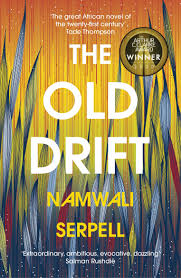
I believe I bought this when it won the Clarke Award, so late 2020. I didn’t read it then – I think I assumed it would be too heavy for that particular year, and then that assumption has coloured my way of thinking about it ever since. I finally picked it up this week: partly gesturing to my endeavour to at least read the oldest books in my TBR pile.
This is not the book I expected it to be, given the Clarke Award. It definitely has SF elements towards the end, when it’s projecting into the future – and goodness it’s weird, in 2026, reading a book that was published in 2019, therefore written the few years before that, and/but has significant things happening in 2020 that are not Covid.
Rather than feeling like “a science fiction novel,” the connections I more strongly made for The Old Drift are the works of Edward Rutherford – his place-based historical novels that followed a few of families through many, many generations. Serpell does that here, following three main families as they interact across four generations. The central location is (what is today known as) Zambia, and in particular Lusaka. As befits modern Zambia, some characters are descended from pre-colonial inhabitants of the area; some are descended from British migrants, some Italian, and some Indian. Some of the actions happens in England, some in Italy, and some in India, as well as a couple of other sites in Zambia.
Across the novel – around 550 pages – Serpell traces the fortunes and misfortunes of the families. Marriages and births, infidelities, education, employment, tragedy – and only rarely triumph; illness (the last third or so revolves significantly around “The Virus”) and cleverness and revolution. Some of what Serpell portrays is based in truth: Edward Nkoloso plays a role – a real figure in Zambian independence, who proclaimed the country would send “Afronauts” to the moon and Mars; and one of the characters is Matha Mwamba, one of those Afronauts. Percy Clark, one of the progenitors and an early British colonialist, was real; and the fictional characters interact with some other historical figures. I don’t know much about modern Zambian history, but I know that a lot of the moments that appear in the background – like the issues around Northern Rhodesia becoming part of the Federation and then eventually getting independence; “Rhodes Must Fall,” the fight to remove the statue of Cecil Rhodes at Cape Town University – are real.
What Serpell does in this novel is show both how individuals can be deeply affected by larger historical moments, and how sometimes personal issues are far, far more important. And neither of those experiences de-legitimises the other.
It’s fair to say that this isn’t an easy read. None of the characters do not spend their lives in comfort and ease, with no problems beyond what to have for dinner. They experience heartbreak and personal tragedy; families are difficult, opportunities are lost, life simply doesn’t go the way they hoped. Racism and misogyny play enormous roles – unsurprisingly. While there are moments of triumph, and doggedly continuing despite setbacks, Serpell has not set out to write inspiration porn. It’s much more real than that.
A connecting thread across the generations is a plural first-person narrator: mosquitos. Which, of course, have an important role to play in disease transmission; I’m fairly sure characters comment on their pesky existence in every section of the novel. Precisely why mosquitos are used as an almost Greek chorus isn’t entirely obvious, except for the fact that they’re ubiquitous – which I guess is enough.
The Old Drift is by turns bawdy, clinical, grim, lighthearted (occasionally), earnest, and reflective. It’s also beautifully written – while I wouldn’t say easy to read, it doesn’t require a quiet room and intense concentration to follow. I’m glad I bought it and have finally read it.


