Wind of Earth, Wind of Tau Ceti
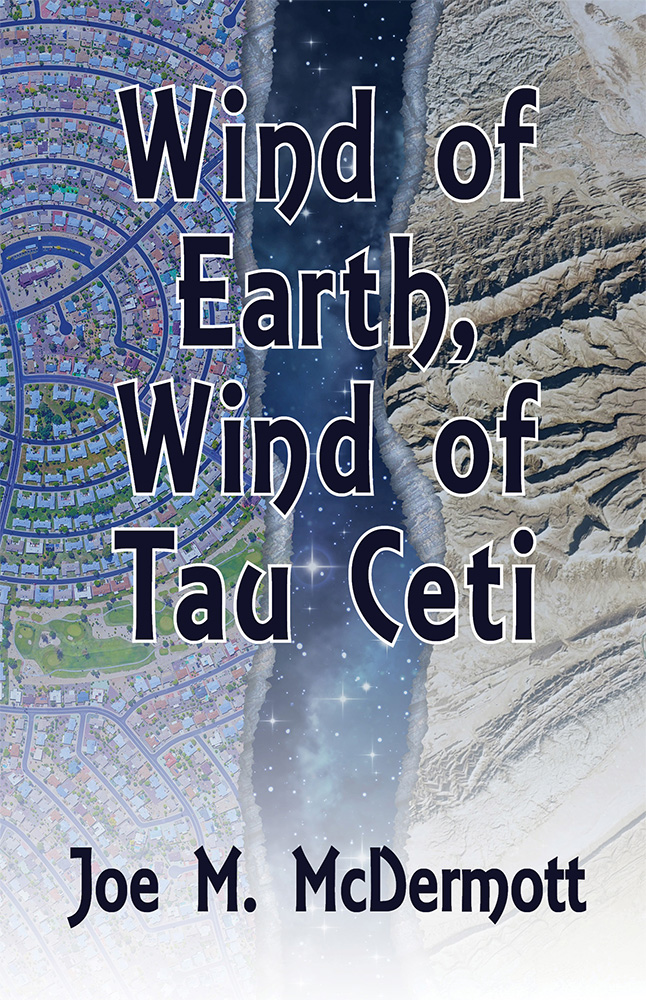
I read this thanks to the publisher, Aqueduct Press. It’s out in December, and can be preordered from their website.
This is a “fix-up” novel, comprised in part of stories published elsewhere. I hadn’t read any of those, so this was entirely new to me – I therefore don’t know whether McDermott has made any changes to the originals. Additionally, I would describe it as more like a mosaic novel than a traditional narrative. It doesn’t follow linear time, it doesn’t follow all the same characters – but, as a mosaic, it builds up a picture of a time, a society, and a person.
The novel opens with the titular Wind as a grandmother on Tau Ceti. Her daughter-in-law has died; Wind is trying to help her son and granddaughter. Humans are still living under domes as they terraform the planet, and while the planet isn’t quite as inimical as it could be, it’s still not easy. There is a shift, then, too Wind as an adolescent on Earth: her parents are divorcing, the custody battle is bitter – and neither parent is great. Wind’s relationship with her father and grandmother are central, as is the slowly decaying social and physical infrastructure around her.
The rest of the novel follows Wind initially to the moon, to live with her mother, and then eventually to Tau Ceti. Different chapters follow a school friend of Wind’s, techs who work on the stasis chambers, Wind’s eventual husband and child. It means we get a broader understanding of the problems confronting different parts of society, and how different folks are coping with it, than would be possible just through following Wind – who isn’t privileged, far from it, but still has a particular experience.
Something I can’t figure out is whether some of the discrepancies across the novel are deliberate – perhaps to reflect how memory works; or whether they’re an artefact of coming from various original stories. They’re not massive discrepancies – what Wind was like as a child, mostly; I choose to read them as deliberate, and see them as adding to the mosaic-ness.
One thing I will note: sometimes it’s remarkable what small thing stands out as an indicator of how an author’s background is different from a reader’s. There’s a moment when one of the characters is bemoaning their lack of a water ration and begs access to Wind’s so he can have a shower. Wind agrees but says he can only have a really short one. Just three minutes. As someone who lived through a prolonged drought, for whom a three-minute standard is entirely standard (and entirely sufficient)… well. Lol, I guess.
I really, really enjoyed this. It’s science fiction interested in social development and social issues. Wind is entirely believable, and her Earth society is – sadly – too. McDermott’s style is engaging and immersive. I’m glad this exists.


