The Starry Rift
My copy claims that Sheldon died shortly after completion of this book. WOE.
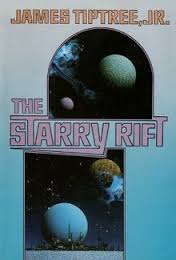 Confusingly, the quote on the front of my copy calls this a science fiction novel, which confused me immensely since I thought Tiptree only wrote two, and I have read them both. Anyway, it became a bit clearer as I read: this is three short stories linked together by the idea of two students asking a librarian at the Great Central Library of Deneb University, for help in their research on humans. So you could tenuously see this as one, 1001 Arabian Nights-style narrative, but I think that’s stretching it a bit..
Anyway, the three stories do all centre on humans; in the first and third, it’s humans in conflict with aliens – new aliens – and in the second it’s human on human violence. They are, despite the conflict, surprisingly positive stories about humans overcoming difficulties. All of the stories take place in or around a place called the Rift: an area of space that is relatively empty of stars, and therefore planets – which, pre-FTL, makes it hard to navigate through (something about needing landmarks, I think).
The first story is definitely my devastating favourite. “The Only Neat Thing To Do” got a number of accolades when it was published, and they are well deserved. Coati Cass is 16, space-mad, and has just been given “a sturdy little space-coupe” for her birthday. So off she goes exploring… and of course, runs into something unexpected. The nobility that Tiptree imagines for Coati, and the realism of her voice, are both just wonderful.
“Good night, Sweethearts” is an interesting story of identity, celebrity, loss and starting over. It’s a good story but it doesn’t really stand out for me.
Lastly, and longest, is “Collision”. This story is told both by humans and by the aliens with whom they are coming into contact; the conceit is that this story has been constructed through interviews with participants. There’s a human exploration team, and there’s bad humans called Black Worlders who have been doing some nasty things, and there are aliens who are getting angry at humans… The blurb says that “explorers cross impassable chasms of language, biology and hallucination to prevent a new age of war,” which about sums it up. Like I said before: surprisingly positive.
Overall this may not be quite the strongest of Tiptree’s work, but it’s still damn fine and should be read for “The Only Neat Thing To Do” anyway.
Bonus note: referencing your own work (Brightness Falls from the Air) to make sure it’s clear these stories are in the same world. Good work, Tip!
Clay’s Ark
 Having read Wild Seed and Mind of My Mind, this was not at all what I expected of a book set in the Patternmaster series. It seems only peripherally attached to the Patternmaster series courtesy of something Clay, whom we meet in Mind of My Mind, developed.
Still, the book deals with some of the same preoccupations as are developed in the first two books, in particular how people manage go live under compulsions and especially how that impacts on sex and relationships and children. It was interesting to see Butler explore similar issues coming about from different motivations.
In itself, this is a very different sort of contact story from what is more commonly written. The contact is almost just a macgyver to allow the exploration of how confinement and externally imposed obsessions might play out.
Not Butler’s strongest work, but intriguing and enjoyable (well… within the bounds of devastating sf…) nonetheless.
Later: having now read Patternmaster, this book makes a bit more sense. Interestingly, I think this is the stronger.
Mind of My Mind
 Just go read it. Seriously.
As I mentioned in Wild Seed, I am glad I read that novel first – the background it provides for Doro, and Emma, is devastatingly important. Of course you could read this first – publication order – and then have the background filled in… but this order definitely worked for me.
This book is very focussed on Doro and the people he manipulates people to his own ends. Even when other characters – Emma (Anwanyu), and especially Mary – get to tell their own story, it’s always connected to Doro: against or in favour, in reaction somehow, trying to figure out how to circumvent or please him. He is the Patternmaster. He is the puppetmaster.
This book takes place over a much shorter timeframe than Wild Seed – just a few decades. In the prologue, Mary is a small child in an abusive home; the narrative picks up with Mary, one of Doro’s many children and an important part of his experimentation, in her late teens. Mary becomes the focus of the story as she seems to be the fulfilment of Doro’s plans, and it basically follows her development and discovery of her powers.
Unsurprisingly, Mind follows some of the same themes as Wild Seed. Why humans acts they way they do, how compulsions can work and why we act in our own worst interests; what slavery can look like. It develops the discussion of the difference between haves and have-nots to a greater extent, and the consequences of power. The idea of family and its power as well as its destructiveness. Humanity at its best and worst.
This book isn’t always pleasant to read, but it is always powerful and it’s always well written and I will definitely be reading it again.
FarScape rewatch: s1e16
Each week on a Sunday afternoon, join Alex (of Randomly Yours, Alex) and Katharine (of the unpronounceable Ventureadlaxre), as they re-watch the Australian-American sci-fi show Farscape, notable for the Jim Henson animatronic puppets, the excellent mish-mash of accents, and the best OTP ship of all time.
Season One, Episode Sixteen: A Human Reaction
A: Aw, John is still talking to his dad… and then Pilot sees a wormhole! With Earth at the end!!
K: I wonder if I’d be like that. I get along great with my mum, but… I don’t think I’m hopeful enough to think there’d be any point? He’s quite a good age to only be starting to get grey hairs, isn’t he? I do like how dismissive they all are about us though – no red moons indeed.
A: I like my grey hair.
Oh Aeryn. She’s clearly so torn about not going with John… and possibly about John leaving…
K: Go on, Aeryn! An adventure is an adventure, right?
Bridging Infinity
This book was sent to me by the editor, at no cost.
 I have loved the Infinity series so far. I like that the focus is on science fiction, that it’s often a focus on the engineering side of the future but that that doesn’t preclude fascinating characters and intriguing worlds. I am consistently impressed by the variety of worlds presented and the writing talent included.
The anthology opens with a series of stories focused on the solar system. Alastair Reynolds gives us a problem with the sun where the narrative jumps tantalisingly between now and later, while Pat Cadigan provides what might be a prequel story for her “The Girl-Thing who went out for Sushi” in a story set on Earth but focused on colonising near Jupiter. Stephen Baxter goes to Venus with a sweeping story about human hubris and the problem of families. Charlie Jane Anders totally mocks the whole idea of going to space in a hilarious story of being, like, an adolescent in space? Tobias S Buckell and Karen Lord also take the long view, temporally speaking, about what it might mean to undertake engineering projects within the asteroid belt and elsewhere, given the distances (and therefore time) involved. Plus Calypso.
Naturally, there are some stories in the anthology that confront climate change – it’s understandably becoming a go-to theme. Cadigan’s story references the issues in passing; stories by Pamela Sargent, and Pat Murphy & Paul Doherty, suggest possible ways of dealing with the problem – the latter is one of my favourites, being both optimistic and pessimistic, and largely set in the Arctic. Ken Liu writes over an extremely long period of time in posing the idea that the coming of the singularity might solve climate change in a rather radical manner. And Thoraiya Dyer posits a rather intriguing solution to the loss of island real estate while also dealing with the problems of family.
There are also several stories with extra-solar settings. Kristine Kathryn Rusch combines desert urban planning on alien planets with a devastating mystery to great effect; Robert Reed writes a Great Ship story about how the materials you use (and the tools) can impact on the thing you’re making. Allen M Steele’s story sounds like it might be from a pre-existing set of stories, like the Great Ship suite, in that it’s focused on a group of wanderers in what is effectively a Dyson sphere called Hex. It’s less focused on the engineering and more focused on human exploration of alien tech.
A few stories didn’t especially work for me. Karin Lowachee’s story of a contractor alone on a supply depot installation didn’t have enough character development for me to get my teeth into, while Gregory Benford and Larry Niven made my teeth ache with their extra-heavy serves of techno speak and missing out on character or plot. An Owomoyela’s narrative didn’t quite seem to go anywhere… which given the narrative itself is kind of funny, but it still didn’t work for me.
Highly recommending this anthology for lovers of science fiction.
Goldenhand
This book was sent to me by the publisher, Allen and Unwin, at no cost. It’s out now; RRP $24.99.
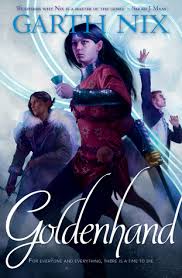 This BOOK! I’m so happy to have read this book! I’m so happy this book exists! (Spoilers for the other Old Kingdom books. Just go read them.)
I’ve been a fan of the Old Kingdom books for a long time. Not as long as they’ve existed – Sabriel came out about 20 years ago and I didn’t read it then – but long enough ago that when the prequel, Clariel, came out in 2014 I was a bit over the moon. So with Goldenhand being a direct sequel to Abhorsen, I’ve been pining for this book for a good while.
This is most definitely a sequel. I’m not sure how it would stand by itself – there’s not a lot of explanation of the whole necromancy by bells thing, nor of the Charter, and there’s a moment where Lirael is required to use her mirror and I was like wait, what? because it’s been a while since I read the other books. But really that’s all right because just READ ALL THE OTHERS ANYWAY.
Lirael is pining the loss of the Disreputable Dog, and trying to fit in with her newly discovered much older half-sister Sabriel and her family, and learning to be the Abhorsen. Something I loved about Lirael was how she always struggled to fit in as a Clayr, and I like that Nix hasn’t just made her magically (heh) well-adjusted. Meanwhile, of course, things aren’t entirely hunky dory in the rest of the kingdom: a nomad appears unexpectedly at the Greenwash Bridge, and even more unexpectedly proceeds to be attacked by other nomads and their awesomely freaky magical constructs. Cue mad flight down the river…
The book follows two tracks: Lirael, taking charge of Abhorsen business while Sabriel has a holiday (heh so cute), which means investigating a message about Nicholas Sayre and there being a magical creature on the wrong side of the Wall… and Ferin, the nomad messenger, whose endurance makes all the other characters look a bit weak and who just occasionally has a wicked sense of humour.
I love Ferin.
Nix’s writing is incredibly easy to read: it’s fast-paced, and it has lovely descriptions that allow you to imagine the place but not get bogged down in detail. I love the idea of the Charter and the additional development that the magic system gets here. In the interview with Nix that’s included in the book, he seems a bit bemused by how many people mention the gender balance in his books. But here’s the thing: when you’re reading about some guards being awesome in fighting and realise that any number of them are women, and that’s just so not a thing for this world, it still blows my mind. Multiple women in multiple sorts of roles: it can be done.
This is a wonderful addition to the Old Kingdom world and I’m so happy that it exists.
Great Scott presents: Crimson Tide
 Crimson Tide
Tony: 1995
Every fortnight (ish)* my beloved and I are watching a film by either Ridley or Tony Scott. We’re watching in chronological order. There are, of course, spoilers.
A: The captain of a US nuclear missile sub is as powerful as the president of the US or Russia? Really?
J: Ok – A proper movie tonight – Simpson / Scott.
A: the setting: a Chechen ‘rebellion’ and Russian government has been suspended… civil war in Russia, basically. OOH Cuban missile crisis analogy. And starting with a kids’ birthday party is NEVER a good sign, man. Never.
J: Dramatic opening, rain, political intrigue … heavily armoured base…
A: The CO (Cranky Gene Hackman) interviewing a new XO (Serious Denzel)… already possible cracks appearing (former raising an eyebrow at the year at Harvard…) – and then jokes from other officers about the captain going through XO. That’s what we call BODING. Continue reading →
Grass
A lot of people write stories with disparate threads – multiple narratives – that then end up all coming together somehow.
 If you want to know how to do it really well, you need to read this book.
It’s set on the eponymous planet, where ‘the bons’ – noble families who left Earth generations ago, probably because people weren’t giving them the forelock-tugging they thought they deserved – have set up extended-family estancia, and their lives basically revolve around the Hunt. Right from the start you get the inkling that something isn’t quite right here, but it’s not clear why.
Meanwhile, in the rest of the galaxy, Sanctity is having a red-hot go at trying to control everyone’s lives. They’re doing a pretty good job on Earth, and having varying success on other planets. Sanctity is, I think, meant to hark back to age-of-exploration Christianity and the way Christian ideas and Christian leaders were used to excuse and, sadly, encourage European colonisation and exploitation. I also suspect it’s meant to be a far-future evolution of Mormonism: there are enormous heraldic angels in the architecture, as well as some other bits and pieces that sound like it.
And there’s a plague. It’s popping up all over the place, no one has any idea why, no one has any idea how to stop it… except that it doesn’t seem to have occurred on Grass. Guess we better send someone to investigate… but Grass people don’t want Sanctity on the planet… those bons are all about the Hunt… so hey, send non-Sanctity horsey people!
Enter Marjorie Westriding Yrarier: Old Catholic, doing charitable works, rocky marriage, painful children, Olympic equestrian. You know, all-round interesting person and key to the narrative.
There are many things to love about this novel. The way that Tepper brings together such different people and their problems and achievements into one magnificent cohesive whole. The planet Grass itself, with almost no trees and an enormous variety of grasses and what that might be like as an ecology and for humans. Complicated families and the difficulties of living with them. The existence of religion and that, while the institution of Sanctity is clearly problematic, the religion itself (and Catholicism) are not. Aliens. The beautiful and evocative prose that’s just so easy to read, so enchanting, and conveys emotion brilliantly.
I love Sheri S Tepper.
Previously, in Sheri S Tepper: Beauty, and The Companions.
Wild Seed
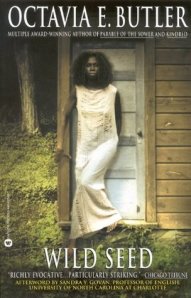 It’s brilliant and you should just go ahead and read it and you don’t need to know anything else … unless incest (at a distance from the reader) really, really squicks you out (it happens but it’s not a huge focus and it’s not dwelt on greatly).
I know Butler didn’t write this as the first in the Patternmaster series but I am so glad I read it first, because Butler sets up the world of Doro and Anyanwu brilliantly; I can’t imagine coming to read this after already having been introduced to Doro, especially, in a different context.
There’s an enormous amount going on in this book. Doro and Anyanwu are very different from those around them: both seem to be immortal and both have talents that set them apart. Doro moves from body to body at will; Anyanwu can heal and change herself. Anyanwu has been living with her extended family and caring for them for generations; Doro has been building himself a people, gathering together individuals with some sort of psychic talent. One day Doro feels Anyanwu and goes to meet her, and Anyanwu’s life in particular changes. She hasn’t ever moved far from her birthplace, while Doro has been setting up colonies in America – this is the 17th century, and Doro and Anyanwu are both African (Anyanwu is Ibo, I believe; Doro… is something else altogether). So this means he’s trafficking in slaves, and working with slave traders. So that’s a whole thing: how people react and feel when they are enslaved, how the trading works and can be used, and so on. And somehow the fact that this is written by an African-American makes a difference. The very question about what makes someone a slave is key to the story, actually; how chains aren’t necessarily visible, how someone can become accustomed to the state – and asking the question about whether, if you don’t mind it, how bad slavery is. I think Butler firmly comes down on the side of it still being an evil, but she’s sure not making it an easy discussion.
Having two central characters who appear to be immortal means that Butler gets to write a story that goes over a couple of centuries. This allows her to explore the development of both individuals and communities, which she does really well. In some ways the people that Doro is developing are like a generation ship: they don’t know where they’re going, and it’s temporal rather than spatial, but they’re definitely on a journey. They just need to keep following orders and keeping the place running. The focus is really always on the relationship between Doro and Anyanwu, because their fraught relationship stands for everyone else: love and hate and need and resentment. Acceptance and rejection. Anyanwu is the one who changes and develops and grows, while Doro is largely static. There’s a variety of reasons for this – he’s that much older and has a very set purpose where Anyanwu is in some regards more passive (and in others really not) – but his lack of growth and change isn’t entirely presented as a positive.
It’s the complexity of Doro and Anyanwu, as individuals and in relationship, that makes this novel an absolute stand out. It bemused me somewhat when I finished reading that, really, very little actually happens: there are few really “significant” events like battles. Instead it’s a steady stream of small events. It’s a surprisingly domestic novel, in that much of it is focused on family and family relationships, centred around the home and small communities. But don’t be fooled – never has the idea of ‘domestic’ equaling ‘unimportant’ been less true.
I read this as part of “Seed to Harvest”, the compilation of Patternmaster novels. I was so engaged and intrigued that I moved straight on to reading the next novel (in internal chronology), because I couldn’t bear to leave the story.
Courtney Milan and romances
I was one of those girls – women – who was pretty down on romance as a genre. There are lots of complicated reasons for this. Partly it was a woman thing; I wanted to not be that sort of woman (what sort? I don’t know. I guess I associated liking romances with weakness or something?). Partly it was a genre thing: over here in the disregarded spec fic corner, it’s nice to disregard someone else.
But of course this was always both a) a completely stupid attitude for a multitude of reasons and b) hypocritical. Because I do like reading romances in the stories I’m reading.
 I think I’ve finally figured out what doesn’t usually appeal: romances that exist purely by themselves. I’m certainly not saying that they are bad or stupid, but that as a rule they don’t appeal to me (like I don’t love vampire stories as a rule, although I do enjoy the Blade films). What helped me finally articulate this is having read three of Courtney Milan’s Brothers Sinister series. (There is a fourth but I don’t plan to read it, partly because the main character doesn’t appeal and partly for Historical Snobbish reasons.) This is mostly because of Tansy.
 These are Victorian romances, which means Milan gets to take advantage of some of the interesting social and political and scientific changes happening in the mid-19th century in England (and across Europe). The main point is always about a girl and a boy and how of course they ought to be together but there are all of these problems that might prevent their happiness: scandals in the past, problems in the present, nasty people, social expectations, etc. Some of these relationship problems ring a bit more true than others: I didn’t find Minnie’s ‘scandal’, in the first book, all that convincing, while the problems of the third book were magnificent. Overall, though, the characters are treated sympathetically and the problems carefully – no one of consequence dismisses anyone’s fears without regard, which I found quite a relief. I especially liked that both female and male protagonists get to tell the narrative from their point of view, making the stories much more rounded and feel more genuine than might otherwise be the case.
 And around these relationship issues are the social and political themes that Milan uses to flesh out the world. In the first book it’s class relationships and working conditions and rape and marrying for money. In the second book it’s about race and political representation and social expectations and marrying for money and child guardianship and medical ethics and mental health. In the third it’s mostly about science (oh my, seduction by science I LOVED it) and gender expectations. Some of these issues play into the romance, and some of these issues are things that the characters are dealing with quite apart from their romance because of course life exists outside of does-she-love-me and Milan knows that very well. Milan is presenting complex and complicated individuals and worlds.
Of course, this is all within a fairly constrained society: the focus is on the wealthy, with a few not-nobles thrown in (not just as window-dressing but still, they have to meet the expectations of the Haves), almost everyone is white, and so on. There’s a lot of pretty dresses and balls and large houses. But… that’s the sort of book that Milan is writing. A romance set in the middle-class or working-class echelons would be very different and deal with different issues. And wouldn’t have the foofy dresses, which are – as you can see from the covers – important to the story.
I am not going to start reading nothing but romances (historical or otherwise), because I am still mostly interested in space ships and explosions and the odd dragon, and there are so MANY of those I haven’t read yet. But I am very glad I have grown up enough to acknowledge Old Me’s appalling attitude, and I’m very glad to have read and enjoyed these books.

 Randomly Yours, Alex