Devour
 Set your level of disbelief suspension to Sky High and you might enjoy this thriller. Published by Hachette, it was sent to me at no cost (RRP$29.99 pb, $16.99 eb); it comes out in July.
Olivia Wolfe is an investigative journalist (of course) who gets into some hot water trying to get a story in Afghanistan (of course). To give her some time away from pushy police and terrorists who might want to harm her, her newspaper sends her to Antarctica where a British science team is trying to drill down to Lake Ellsworth (which really happened a few years ago) in an effort to discover whether there’s life in the ancient, ice-locked lake. While there, she discovers possible murder and possible sabotage. There’s also Russians involved (which surprised me a bit because I thought we were beyond Russians as Generic Bad Guys).
There’s intrigue, there’s action, there’s death and some destruction; as the title suggests there’s something dangerous that might be unleashed that would be bad for the whole world. It’s fast-paced… in fact, sometimes too fast-paced, in that I nearly got whip-lash as people’s motives changed or allegiances swapped. And there’s a fairly explicit and unexpected sex scene that seemed quite out of place.
This is probably good airplane-fodder. It doesn’t require a whole lot of thinking, and in fact I’ll admit that I started skimming the exposition in the last third because I was only interested in the action, not the details. (Larking seems very intent of giving minute details about equipment and such – I’m not sure whether she thinks it makes the story more grounded, or well-researched, or what. I just found it boring.) I still managed to follow the story without paying too much attention.
One thing to be aware of: if stalkers squick you out, avoid this book. There’s a stalker who gets the occasional point-of-view section (which also felt out of place) that was generally unpleasant to read.
Cyteen: abandoned
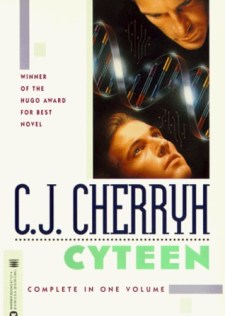 “Finished” does not describe what I did. “Abandoned”, sadly, does. I have simply not been able to get into this book at all. I find the Jordan/Justin naming confusing; I’ve been confused about what an ‘azi’ actually is; I don’t understand what these people are doing and whether I shoulda actually care. Since I started this book I’ve read about six others, which is a really bad sign.
My big question now is whether to actually abandon the book – physically remove it from the house – or whether to put it back on the shelf and think that I might actually get to it Some Other Time.
I’m really sad about this. I’ve always assumed that I would like CJ Cherryh; she’s been upheld as such a great part of sf history – and female, of course, as well. But at the 100-page mark I feel zero enthusiasm for nearly another 600 pages.
Music and Freedom
TL;DR: the fine print says that one of the classifications for this book is ‘psychologically abused women’. Yup. If that’s not your thing, do not read this book.
 This book was sent to me by the publisher, Penguin Random House, at no cost (RRP $32.99, out 27 June).
This is definitely not the sort of book I generally read. Partly because it’s mainstream ‘literature’ – I have nothing against it but there’s so much speculative fiction to get to! – and partly because the whole point of the story is about a woman whose life has been appalling. And I just don’t enjoy reading those sorts of stories.
My main take-away from this novel is: I am so glad that my husband is loving and encouraging. The most annoying thing he does is encourage me too much (ok, slight exaggeration there, but I’m still feeling intensely grateful). Continue reading →
Illume
 I have known Kate Smith for a very long time, and I’ve been reading bits of her fiction for nearly that long. The thing about Smith’s writing is that she is often quite opaque – if you don’t get her song lyric references or her film references, you might be a bit lost. But she writes with a lot of passion and a lot of quirky description – which sometimes gets away from her but sometimes really works nicely.
Illume is set in Paris, and focusses on Thane, who works for the equivalent of UNIT or Shadow Unit or all the other not-really-police-branches who deal with the things that go bump in the night. This time, it’s about lovers who think they can make their love immortal, dangerous mirrors, and vampires. You never really get to the bottom of the characters who make the narrative tick; they’re surface, trading witty repartee and dangerous allusions and making intuitive links. That’s not to say they’re superficial – I don’t think they are – but Smith doesn’t really show us what makes even Thane tick, let alone his partner Mal or his crime-partner Genetta or any of the other odd bods who rock up. And I don’t think this is an oversight on Smith’s part; I think it’s quite deliberate. She seems more interested in the glitz and suggestive shadows than in deep psychological questions. So if you’re up for something light-hearted and fast-paced and quirky – definitely quirky – in the urban fantasy vein, this is your thing.
Galactic Suburbia 145
In which we all had a very exciting weekend. You can get us from iTunes or at Galactic Suburbia.
Launched & pre-launched at Continuum: Defying Doomsday and Something New Can Come Into This World
Tansy & the Silent Producer totally got married!
British Fantasy Award shortlist
CULTURE CONSUMED:
Alisa: The Martian, Trepalium
Tansy: The Geek Feminist Revolution by Kameron Hurley, Cleverman, UnReal, Which Witch by Eva Ibbotson
Alex: Angela Slatter binge: Vigil, Bitterwood Bible and Other Recountings, Sourdough and Other Stories, Black-Winged Angels. Also Revolution School (ep 1 until July 6)
Alex’s new podcast! Acts of Kitchen
Tansy’s new superhero story at The Book Smugglers: Kid Dark Against the Machine
On superheroes, kids, gender and role models: Tansy’s Inspiration & Influences
Please send feedback to us at galacticsuburbia@gmail.com, follow us on Twitter at @galacticsuburbs, check out Galactic Suburbia Podcast on Facebook, support us at Patreon and don’t forget to leave a review on iTunes if you love us!
Kid Dark Against the Machine
 Another short story from Roberts set in the world of “Cookie Cutter Superhero”, from the anthology Kaleidoscope. It’s a world where there’s a machine that makes people superheroes… for a time. Where the first story looked at what might happen when a girl with a physical disability got to the machine, this one looks at the aftermath for one person – what’s it like when you didn’t choose to be a superhero and then you have to go back to being ‘normal’?
I love this story, and I love this world. I love Griff, struggling to deal with the ordinary world and how to fit in to it after a period of fame. I love how Roberts imagines super villains. And I love the hints at what it’s like to have a sidekick thrust on you when you really don’t want one.
You can read it over here. Free!
Gertrude Bell
 Every now and then I come across a new historical figure and I think
HOW IS IT POSSIBLE THAT I HAVE NEVER HEARD OF THIS PERSON WHAT HAS THE WORLD BEEN DOING THIS JUST SHOWS HOW MUCH STUFF GETS LOST
Usually that person is a woman, although not always. Gertrude Bell is the most recent of these people. I don’t even remember how I heard about her – it might have been in passing in a podcast or something? – at any rate the moment I heard about her I went online to see if there was a biography about her. There are two, I think, modern biogs; this seemed to be the better rated, and so I immediately bought it. Since then my mother has read it, since I always have too many books to be read, and she loved it; then we spent some time together which just happened to coincide with Nicole Kidman’s movie about Bell being at the cinema, so we went to see it and I was pushed to move my reading of this bio to the front of the reading queue.
Gertrude Bell might be described as the ‘female Lawrence of Arabia’, but really it would be more accurate to say that he was the male Gertrude Bell, since I think she had more adventures and was more involved in the immediate post-WW1 decisions regarding Mesopotamia.
Galactic Suburbia 144
In which books take longer to make than they do to read. You can get us from iTunes or at Galactic Suburbia.
What’s New on the Internet?
CJ CHerryh named SFWA grandmaster
SF Signal closing – farewell to our friends and thanks for all the links!
Get in your nominations to us for the GS AWard: for activism and/ or communication that advances the feminist conversation in the field of speculative fiction in 2015.
CULTURE CONSUMED
Alex: The Expanse Season 1; The Medusa Chronicles, Stephen Baxter and Alastair Reynolds; The Philosopher Kings, Jo Walton
Alisa: books released & in progress: Defying Doomsday, Sharp Shooter, Grant Watson’s upcoming collection of film essays – see her Friday night at Continuum!
Tansy: Finished writing a book! My research reading list over the last several years includes: Orlando Furioso (Ludovico Ariosto/Slavitt translation), Thomas Bulfinch’s The Age of Chivalry & Charlemagne, E Nesbit’s entire backlist, Christina Rossetti, George McDonald, etc.
Also: Tansy’s serial Glass Slipper Scandal is now complete at the Sheep Might Fly podcast.
Skype number: 03 90164171 (within Australia) +613 90164171 (from overseas)
Please send feedback to us at galacticsuburbia@gmail.com, follow us on Twitter at @galacticsuburbs, check out Galactic Suburbia Podcast on Facebook, support us at Patreon and don’t forget to leave a review on iTunes if you love us!
The Philosopher Kings
 This was really quite different from The Just City. Where I felt that the first book was incredibly focussed on dialogue and discussion about what excellence is, what makes a just city, and how to live out Plato’s ideals – and I don’t mean any of that in a bad way, I adored it – this had a lot more action. What discussion there was often didn’t feel as grounded in philosophy because it was moving away from classical sources and into more personal, I think, reflections on being and existing. This is not necessarily a bad thing, but it is a difference.
There are spoilers below for The Just City.
This is taking place twenty years after the events of the first book. Apollo is still there but Athene is still off in a huff. The place has fractured even further than it looked like it would when Kebes and his crew left; now there are several different cities on the island, all claiming to be Doing Plato in the Right Way – and all looking quite different. I LOVE this idea and wish there had been a bit more about how and why the cities were different. There is some, and it was enough for a taste, but I wanted extra.
Anyway the focus is still on Apollo and his family, so it’s still focussed on the original city. The narrators are Apollo, again, and Maia, again – and I liked keeping these original two because they have changed so much in some ways, and not in others. Maia especially has of course moved further away from the 18th-century girl she used to be. The additional narrator in the book is Arete (which means excellence), daughter of Apollo and Simmea. Yup. She’s quite young and very different in perspective compared to Apollo (natch) or Simmea when she was young because she’s had such a different experience – no being a slave for her, as for her mother, but instead a loving family environment.
The action is mostly spurred by one tragic act which has repercussions for a number of people although not for the entire city necessarily, which is another difference between this and the first; another way that it’s more personal, rather than society-wide. It does lead Apollo to consider more about the realities of being human and all, of course.
I enjoyed it, although not quite as much as The Just City. I cannot wait for the next book because WHOA what an ending.
Black-Winged Angels
Continuing my Angela Slatter kick…
 “Baba Yaga is a woman who cannot be bound. She will bear no more children, she bow to the wishes of no man; she is independent, adrift from the world and its demands. The world, in ceasing to recognise her value, has granted her a freedom unknown to maids and mothers. Only the crone may stand alone.” (p135)
Angela Slatter’s exploration of the different ways women can be is one of the things I love most about her work, and it’s evident in this reprint collection. Most of the stories build on European fairytales or characters – Bluebeard, the Snow Queen, Melusine, the Little Match Girl. But the focus is different from the familiar story, because Slatter changes or explains the motivation, or centres on a different protagonist, or moves the setting and therefore the entire context… and she forces the reader to reconsider the telling of those stories, and what we can or should get out of them.
The quote above is one of my favourite parts of the whole collection, putting me immediately in mind of Ursula Le Guin’s reflections on being a ‘crone’, especially the essay “The Space Crone.” How often is old age meant to be something women should fear? And while Slatter’s Baba Yaga is by no means always happy with her status, she lives it.
This book is also a beautiful object. I have a hardback copy; the cover is black with a white cut-out illustration by Kathleen Jennings. Jennings’ artwork appears throughout the book, with each story having a dedicated picture – some quite simple, some incredibly complex. I love Jennings’ work and she beautifully complements Slatter’s ideas.

 Randomly Yours, Alex