Black Convicts, Santilla Chingaipe
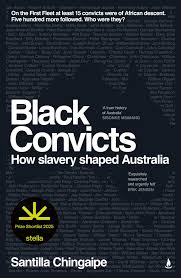
I came across this book because I heard Chingaipe at the Melbourne Writers’ Festival. She was personally compelling, and the story she told of learning about the Black convicts who came to the east coast of Australia over the first few decades of “white” settlement was intriguing. So I picked it up, and have finally got around to reading it. To be honest I was putting it off because I knew it was going to have some harrowing bits – and I was right – although I also expected it to be gripping, and rewarding. On those counts it was more than I expected, because Chingaipe is an excellent author.
Chingaipe is doing two things here. On the one hand, she is writing about the Black people who were brought, or in a couple of instances came under their own steam, to the country we now call Australia (which wasn’t a country during this period and wasn’t always known as Australia). Often she’s talking about people whose names have never been mentioned in histories before, which is amazing in its own right. Some of these people were part of the standard “convict comes to Australia” story that tends to be discussed – do some minor crime in England, get sent to the colony for 7 or 14 years, live life here after. Many of the others, though, did their “crime” (a category explored extensively) in one of Britain’s other colonies – various sites in the Caribbean, or Mauritius, for instance – who then got shipped to England and then to these shores. Which I had no idea about.
On the other hand, she is also exploring the links between slavery, its systems and language and attitudes, and the convict system. What she points out are some things that I had previously considered, especially with the language, but a whole bunch of things that I was completely unaware of. She makes a compelling case for the convict system in Australia owing a great deal to the structures developed for and around slavery in North Americas and the Caribbean by the British. Which shouldn’t be that much of a surprise, when it’s laid out… but that’s often the way with a history like this.
One of the things that I really enjoyed about Chingaipe’s style is her presence within the book. I have noticed this happening more frequently in history books, especially with very deliberately and self-consciously political books: a refusal to pretend that the historian is objective, or even absent from the story they’re telling. So we get the story of Chingaipe visiting Hobart and Barbados, Zooming with historians around the world, her own emotional reaction to various stories. Far from detracting from the history, as would have been suggested decades ago (and probably still is by some today), this highlights the importance of the topic being discussed, and the fact that history is not/never is “past.”
I really think that anyone interested in Australian history, and probably also African diaspora history, would benefit from reading this.
Doomsday Dance Party, Nikki Alfar
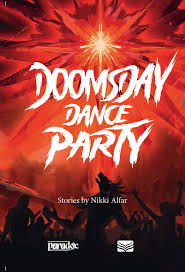
A friend in the Phillipines sent me a copy of this, thinking I would like it. They were, of course, correct; you can get it from the publisher.
I’m not sure if I’ve come across Alfar’s work before – possibly in anthologies? – so it was intriguing to see the variety of short stories she presents here. Some are realist fiction; more are science fiction or fantastical. Most have clear Filipino connections – set in the ‘real’ Philippines or an alternative version – with a couple of exceptions, most notably “The Riddle of the Great Khan’s Great-Great-Granddaughter,” which I loved and is not connected to the Philippines at all. As well, many have elements of Filipino mythology, like the tikbalang and ‘fey folk’ (in English) at the wedding in “Destination: Wedding,” which was absolutely one of my favourite stories. Sometimes, as with that one, it’s because the story is specifically about an experience in the Philippines; other times the Philippines is the setting because it’s the setting, not because Alfar is making a specifically Filipino point (I hope that makes sense). Styles changes across the stories, from relatively straightforward to the more lyrical styling of stories like “El Legado de Lana (Lana’s Legacy)”.
It’s a compact collection, at 155 pages of story. I’m glad it exists and that I got to read it: the stories are a delight and I hope Alfar gets ever more notice, both at home and abroad.
Incorrigible Optimist: Gareth Evans’ Political Memoir
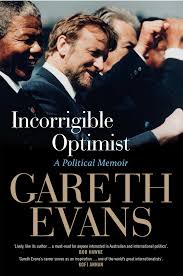
Look. I’m a history teacher, and a cynic. I understand the point of a political memoir. So on the one hand, reading this was amusing because for all the self-deprecating humour and the admission of bad decisions and poor choices, it’s still an exercise in ego to write memoir.
And on the other hand: I just want more politicians to be like this. To be passionate about things that will actually make a positive difference. To be self-aware. To be willing to make hard, necessary decisions. I was a child of the 80s and 90s – at the back of my mind, “the Australian government” is Bob Hawke and Paul Keating and, yes, Gareth Evans.
I don’t read modern biographies, as a rule, and I really don’t read autobiographies. They hold zero fascination for me. I can probably remember every 20th century biography I’ve read: the Dirk Bogarde one my mother gave me (I went through a serious Bogarde phase), and Julie Phillips’ Alice Sheldon/James Tiptree Jr one; ones about Vida Goldstein and Emmeline Pankhurst; and one about Alexander Kerensky. Oh and Gertrude Bell! That’s literally the list – and given the number I’ve read about people who died before 1800 (and it’s only that late because of the French Revolution – oh Danton, you’ll always live in my heart), six is nothing. But now we can add this to the list, which I read for Reasons that may eventually become clear (not in this review).
This is, of course, not really an autobiography. It’s a political memoir – I think Evan mentions his wife twice? maybe doesn’t mention his kids at all? – so there’s no discussion, really, of anything outside of what has shaped his attitude to policies and ideas. It’s also not just focused on himself acting, but also on his ideas. There is an entire section where he’s outlining the pillars of the “responsibility to protect” concept that I had no idea about, but which he was fundamental in drawing up for the international community; sections where he talks about how universities (and especially chancellors) should function, why nuclear weapons should be utterly eliminated, the importance of international cooperation… this is not just a memoir: it’s a manifesto. Honestly, it’s a bit swoon-worthy.
Realise when this was published, though, and it feels like a dream of a half-forgotten world. Because it was mid-2017. Trump was just elected for the first time; Brexit was relatively new. Dreadful things had happened in Syria and Libya, and Russia was making its first forays around Ukraine. Scotty wasn’t even being joked about as PM. So when Evans discusses his hope that Trump might eventually “submit to adult supervision;” when he talks about his hope that “responsibility to protect” might be a real factor in international discussions when populations are at risk of war crimes and genocide… well. There’s a part of me that wishes I could go back to that time, and live it again, knowing how good it was.
This book probably doesn’t have that much appeal beyond Australia’s borders – unless you want to just read it for the foreign policy aspect, and for Evans’ involvement with Crisis Group and various UN and regional Asian events, all of which are quite fascinating. But if you’re like me – with a vague interest in Australian and international politics, and especially with a memory of those Labor glory days – this may well be of interest.
The Bright Sword

You could say that I’m an Arthuriana tragic, but I would snootily say that I am a discerning Arthuriana tragic. I will not read/watch just every version of Camelot that comes along, these days; I got that out of my system a long time ago. These days what I’m after is something that does Arthuriana differently, cleverly, and/or insightfully. And preferably does it with a knowledge of the enormous weight of history that it carries. Which is why Lavie Tidhar’s By Force Alone knocked me over; Tidhar faces not only TH White and Malory but also the very earliest Celtic stuff, and includes some super deep cuts that made me intensely happy (why yes, I did do a semester-long subject about King Arthur as part of my undergrad).
Lev Grossman was a guest at the Melbourne Writers’ Festival this year. I actually had no idea this book existed until I saw it in the programme, so of course I went along to hear what he had to say. He and CS Pacat had a very engaging and lively conversation, which led to me buying the book right after. One of the most interesting things Grossman said is that he thinks the whole Arthur story can be re-imagined for each generation to basically reflect current issues and ideas. So from this perspective White, in the aftermath of WW2, is writing about the impact of violence on society. Grossman sees himself writing around the idea of what it means to be part of a people, a nation, and how that works. He also deliberately set out to write a gender and sexuality-inclusive narrative. (Which is great, but I sat there wondering whether he or Pacat had read the Tidhar…).
The most intriguing thing about The Bright Sword is when it’s set, which is in the weeks after Arthur has been struck down, as have most of the knights of the Round Table. A new, bright-eyed young knight arrives at Camelot to find in disarray and the remaining knights utterly disillusioned. The story goes from there: what happens next? Woven around that is the backstory of those knights who are left, as well as Nimue, and their reflections on Arthur and Guinevere and Merlin and “England” and everything that happened with Camelot.
This was not a saintly, perfect, Camelot – although not as rugged as Tidhar’s. It’s good to see the problem of Uther’s rape of Ygraine properly acknowledged, for example. It touches on the Christianity/old religion issue, and some of the other things that have come up in Arthur reworkings over the last several decades. And because of where the story starts – with Arthur already gone – the end of the story feels genuinely innovative and unexpected.
This is a worthy entry into the Arthuriana landscape. Centring Sir Palomides, the Saracen knight, and Sir Bedievere, let alone Sir Dagonet or Sir Dinadan or Sir Constantine – these make for a fascinating story, and one that points out that side characters can be real characters. I have to confess, though, that I still think Tidhar’s book is a more challenging and clever one.
Francis of Assisi
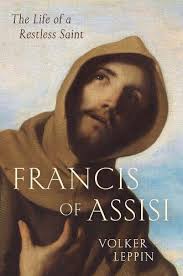
I came to this book because I am friends with the translator. This does not guarantee that I was going to love it.
I am not Catholic. I have zero fascination with the idea of ‘saints’ in and of themselves; my primary interest is in how the women and men who get that title existed in their world. I also tend to have more interest in those who were regarded in some way as odd or outsiders in their time, or who lived in interesting places and times. So Francis is interesting, and also has the added dimension of being amongst the most well-known of all the Catholic saints. So I was fascinated to learn about this book being translated from the German. Having read it, I’m very glad it has been.
I was particularly fascinated by the book as an historian because Leppin spends a great deal of time reflecting on the primary sources available about Francis’ life: both the paucity of sources in general, and the intensely problematic nature of what does exist. Because Francis was canonised so quickly, and because his order already existed when he died – there are so many reasons to want to portray Francis in very particular ways, and reading through/around those to get to a ‘real’ Francis is always going to be challenging. So I deeply appreciated Leppin’s honesty around that, and his acknowledgement that ‘the truth’ is always going to be a challenge.
Nonetheless, I think Leppin does a good job of excavating Francis’ life, and presenting what we can reasonably understand about the man. I appreciated that Leppin isn’t interested in yet more hagiography, but in actually understanding a person – who wasn’t perfect, and made some odd choices, and whose heart we can’t fully understand, but who was nonetheless making some radical choices for his time.
And of course I need to mention the translation: and as with the best translations, you wouldn’t know that this is translated. It just… reads like a book. I can only imagine just how much work went into choosing the right words to both capture Leppin’s meaning and make the book itself work.
So, for those interested in Francis as a human, and how the Catholic church worked in the 13th century, this is a great book.
The Tainted Cup & A Drop of Corruption
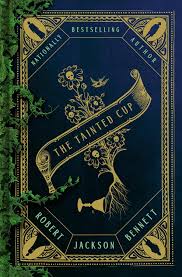
I have not read much Arthur Conan Doyle. I’m pretty sure I read Hound of the Baskervilles when I was a teen, and maybe A Study in Scarlet? But I’ve never been an aficionado.
Which makes it all the stranger that I have consumed a lot of Holmes adaptations. The Downey Jr films; the Cumberbatch show; Enola Holmes, The Irregulars, and even the not-very-good Holmes & Daughter. And then there’s the books. I have read many of the Laurie R King Mary Russell & Sherlock Holmes books; I pine for the next in Malka Older’s Mossa & Pleiti series. Which brings me to Robert Jackson Bennett.
I had not heard of these books until the Hugo packet this year. And when I started The Tainted Cup I was a bit dubious, because I really haven’t been in the mood for gung-ho fantasy complete with made-up words for quite a while. But I persisted, because the characters were intriguing enough that I wanted to see what they were up to. And then the world grew on me – an empire shoring itself up against incursions from mindless oceanic leviathans (one assumes? I can’t tell whether that is going to get undercut later in the series), and one key way they do that is by changing some of its citizens: to have better reflexes, or more acute senses, or… other things.
And it didn’t take long for me to realise that Din and Ana are Watson and Holmes analogues. He is new to the justice job, struggling to find his place. She is weird, with bursts of manic energy and a delight in music and a desire of illegal drugs and an astonishing ability to put clues together. I mean, it’s not exactly subtle. And it’s an absolute delight. And you don’t need to know about Holmes and Watson to enjoy their interplay – it’s just an added amusement – because Bennett writes compelling characters and intriguing mysteries, and develops a world that stands by itself.

In fact I enjoyed The Tainted Cup enough that then I went and found A Drop of Corruption at the library, and I read it in a day and I have no regrets about that. Interestingly, the library has catalogued it as a mystery – I can only imagine what someone would think if they picked it up expecting something like Thursday Murder Club or a James Patterson. Anyway, it’s another gripping mystery in another part of the empire, and we learn more about how the empire works (and it’s not completely a “we love empire” story, either), and – happily – we finally learn a bit more about Ana, whose role and being are themselves mysterious. I assume Bennett has plans for more Din and Ana; certainly I will continue to read them.
The Crimson Road, A. G Slatter
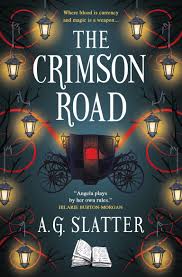
A.G Slatter is an author that I pretty much insta-buy these days. Especially when I know that the story is in her Sourdough universe. Even when the story is about vampires, which I am usually suspicious of – I do not love horror, as a rule; but I trusted that Slatter would not make the story too scary, and that those bits that make it horror would be worth me persevering through.
All of which was true of this novel. It’s yet another fantastic story. Which is not to suggest that I am getting complacent! I guess there’s a possibility that at some point Slatter’s imagination could go off the boil? Today is not that day, though, and may it be kept far, far away.
So: Slatter’s vampires are Leech Lords, and they have bee largely contained by an uneasy alliance of church and Briar Witches (whose story came out a year or two ago). It will not surprise you to learn that this containment is under threat.
Our point of view is Violet; we begin the story with her father having died, and she is hoping that she might now finally be free of his relentless tyranny and insistence that she train as fighter all day every day. Again, no surprise to learn that life is not actually going to turn into eating-chocolates-on-the-chaise-longe, although how all of that transpires is a wonderfully involved and intricate and devastating series of events.
That pretty much sums up the whole novel, really. There’s a quest; there are friends made and abandoned and fretted over; there’s fighting and surprises and hard choices.
I read this novel very, very fast because putting it down was anguish. Highly rated for anyone who wants more Sourdough universe; and if you haven’t read any Slatter yet, this would make an excellent entry point.
The Ministry of Time

What is there to say that hasn’t already? I read this because it’s on the Hugo shortlist this year, so that was already (likely to be) a good sign.
- Time travel done quite cleverly – excellent.
- Super slow-burn romance that basically makes sense – very nice.
- Politics that develop and get more and more tricksy as the novel progresses, in ways that I actually didn’t expect and was deeply impressed by as the book went on – magnificent.
- Pointed, thoughtful, and clever commentary about race, ethnicity, passing, immigration, assimilation – very, very nicely done.
This was another book that I had deliberately not read anything about before going in – the name told me all I needed to know, especially once it got on the Hugos list and friends started raving about having enjoyed it. So I went in with no expectations. (If you want to be like me, just stop reading now!)
I really didn’t expect that the idea was that people were being brought into the 21st century. I think the initial explanation of that is perhaps the weakest part of the story: why do this? I don’t think the “for science!” explanation is pushed enough to be convincing. And yes maybe that’s part of the point, but… on reflection, I do think that’s the one bit that’s too vague.
I really, really didn’t expect the whole explorers-lost-in-the-frozen-wilds chapters. They make a lot of sense in terms of elaborating Graham’s character. And it’s only in hindsight that I can see that they’re also doing some interesting work in terms of showing two groups, coming into contact, who find one another unintelligible.
One of the twists I picked up early – I think at the point where the author was starting to really flag it, so I won’t take any credit for being particularly clever. I did not pick up one of the other twists until it was presented to me, which was a highly enjoyable experience.
This is a debut, so I am left with “I hope Bradley has a lot more ideas left in her head.”
The Fortunate Isles, Lisa L. Hannett

What an amazing, intriguing, occasionally distressing, emotional and beautiful set of stories.
Everything I’ve read by Hannett, I have loved. This is not to say I’ve read everything of hers – some of her work has tended a little too horror, for my delicate reading sensibilities, or at least the descriptions of them have deterred me. But the collections and novel that I have read… I never regret it. And that goes for this, too.
By the way, you can buy it right now!
It’s a set of short stories, but it’s pretty close to being a mosaic novel. The key tying everything together isn’t a person, but the place: the Isles themselves. They’re not a “real” place in that you won’t find them on a map. But once you remember Hannett’s love of, and knowledge about, Viking history, it’s not hard to see how inspired this place (and some events) are by that northern part of Europe. I got to visit Orkney last year, and I could feel resonances with that place as I read. Everything about these stories is connected to the idea of the islands: the people being insular; the space being liminal; whether characters look to land or water as home, inspiration, solace, threat, provider or destroyer.
There are a few characters, and families, who reappear over the course of the stories, reminding the reader that the Isles are a small place and that while some people leave, most don’t – or if they do, they usually come back. Most of the characters are human – usually, mostly – but several of them aren’t, and a few are liminal. There’s magic, but it’s not easy or familiar or common. What there is mostly is humanity. Love and hatred, jealousy, fear and despair, joy and determination. Hannett is really, really good at people. She’s also very good at narrative, don’t get me wrong: the amount of twistiness she can get into just a few pages is remarkable. Mostly, though, I read these stories for the people.
This is a splendid collection and I am delighted it’s been republished.
The Incandescent, Emily Tesh

I had absolutely no idea what this book was about before I started reading it. I had pre-ordered it months ago purely on the basis of “Emily Tesh”. That’s how much I loved Some Desperate Glory: Tesh has become an insta-buy.
So then I discovered that it’s a school story, with the focus on one of the teachers; and that it’s modern, and a fantasy. Very different from Some Desperate Glory! Which is not a problem – but intriguing.
TL;DR I adored this book. Like, a lot.
The school bit: I was a teacher for a fair while. Not in a private school, not in a private boarding school, and not in a British private boarding school. And yet, this book was so clearly written by someone who was a teacher. The notes about no one getting on the wrong side of the office staff. About respecting the groundskeepers. About how experienced teachers view new teachers, and why teachers even do the job… and that’s all before the actual teaching, and the teacher-student interactions. I loved it. And it’s all necessary and appropriate for the story, too.
The fantasy side: this is a world where magic-users can access the demonic plane and make use of their power to do… well, magic. There’s also other ways of doing magic but that’s the focus here. The main character teaches invocation, and is an acknowledged expert in her field. Some of her students are remarkably strong and intuitive. You can probably start to anticipate some of the ways things might go wrong.
There’s also romance: it’s a significant thread throughout, although more along Han-Leia lines (important but not actually driving the narrative) than Wesley-Buttercup lines. It’s real and powerful and deeply believable.
Tesh writes beautifully, I wouldn’t change a thing, and I know that I’ll be re-reading this novel. And I’m sorry if you’ve got a lot on your plate, Emily, but please can you write more novels?

 Randomly Yours, Alex