Uncanny #1
 Space unicorns, they did it! Uncanny was Kickstarted earlier this year.
The opening story is by Maria Dahvana Headley – “If You were a Tiger, I’d have to Wear White” – and I thought it was weird and clever and, indeed, uncanny while reading it and then I discovered just how much of it is true. It’s a reporter going to Jungleland (real) to interview the MGM lion (who really lived there, but probably not in a smoking jacket) and who ends up talking to Mabel Stark, the tiger tamer (real). Love and loss and memory; commercialism, culture and the crass.
Ken Liu’s “Presence” is sad and sweet and uncomfortable-making. One of those lovely sf pieces that brings together awesome tech with very real human stories.
“Late Nights at the Cape and Cane,” from Max Gladstone, isn’t really my thing. Nor was “Celia and the Conservation of Entropy” by Amelia Beamer.
Kat Howard’s “Migration” takes a quirky look at the idea of death and rebirth, while Christopher Barzak takes a Peter Pan story I had never heard of and updates it somewhat in “The Boy Who Grew Up.” And the fiction is rounded out by a reprint of a Jay Lake story, “Her Fingers like Whips, her Eyes like Razors” which also does interesting things with death – this time, challenging it, which I can’t help but imagine was inspired by Lake’s own cancer.
There are three poems included – from Neil Gaiman, Amal El-Mohtar, and Sonya Taaffe. I am not a connoisseur of poetry.
Then there’s the non-fiction. I have to say that my one disappointment with this first issue of the magazine is that there wasn’t more non-fiction, which I thought was going to be a bit of a Thing. Anyway, Sarah Kuhn talks by way of cosplaying as Sailor Mars about the reception of geeky women in fan spaces over the last few years, which felt like a round-up of some of the issues for people who haven’t been following it all closely. I did enjoy the discussion of becoming more and more involved in the Sailor fandom. Tansy Rayner Roberts’ “Does Sex mark Science Fiction ‘Soft’?” never answers its own question but does discuss the ways in which some in the sf scene have tried to banish stories with Too Much Sex/Kissing/Whatever out of sf… although they wouldn’t be accepted by romance immediately anyway. And Christopher J Garcia’s “The Ten Best Science Fiction and Fantasy Shorts on the Web” is a really great sort of article to include in a magazine like this and indeed makes its online nature an absolute positive. So too does the fact that the interview with Headley (there are interviews with Barzak and about Lake too) contains links to pictures of Stark. Overall this is a positive start to the magazine and I look forward to more.
Mitosis
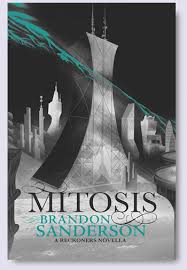 I haven’t read Steelheart so the characters and the problems in this short story didn’t mean as much to me as they would to someone who has read it. And it turns out that the story is actually half of this cute little number’s pages; the other half is a teaser for the second book in the series.
Still, I read it, and I think it does actually work as a stand-alone. There’s obviously a lot that’s gone on in the past, but that’s often true of a good short story. The one thing that could have been cleared up by a single additional sentence is the nature of the ‘Epics’, who are clearly the villains (usually) and clearly some sort of humans but… that’s all a bit obscure.
Anyway, it’s got a good pace and the setting – Newcago – is nicely set out. The narrator, David, is a bit of a nothing character to be honest; this is more about action than it is about character, but that’s not necessarily a bad thing. The villain was quite fun and I enjoyed Sanderson’s take on his particular ability.
This book was provided to me by the publisher.
Troll: A Love Story
 I am torn.
On the one hand, this is a beautifully written story that deals with some fascinating issues. And trolls are real.
On the other hand, I was uncomfortable with the implications of some of the relationships.
So, the first hand: it is lovely, and made all the more impressive by the fact that it’s translated – that can never be an easy task. I love the fact that it alternates story with ‘non-fiction’ grabs from pseudo-websites, dusty old tomes, poems and mythology – some of those are real, I’m pretty sure – and newspaper reports. I know that some people find this annoying; don’t read the book if that’s you. And I know that sometimes it really doesn’t work. But here I lay claim that it adds wonderfully to the depth surrounding the central idea of trolls being a real animal, known to science for the last century or so, and that this story is seeking to add to what humanity knows about Felipithecus trollius. Additionally, although there is a central narrator – Angel – as the story proceeds more of the incidental characters get to add their own perspectives, also in the first person. I know some people have found this changing around to be irritating or confusing, but at least in my edition each chapter clearly labels who is speaking, so rather than confusing I found that it added to the richness of the novel.
Sinisalo raises a diverse range of issues in her story, some more central than others. Trust and love and manipulation; ethics in art and journalism and business; the relationship between humanity and the natural world; mail-order brides, sex as power, desire as all-consuming. Angel, the central narrator, finds a wounded young troll and decides to care for it… which leads to encounters with a neighbour, an ex-lover, a would-be lover, and an object of his affection. Plus a business opportunity.
Which leads me to the other hand. And from this point on, SPOILERS.
Firstly, I know Angel ended up feeling ashamed of taking advantage of the troll, but it was still an unpleasant thing to do – taking advantage of Pessi’s trust in him for entirely mercantile purposes. Given how much Sinisalo works to make Pessi seem if not human then certainly above the animal, I really didn’t like it. Again, I’m sure that was the point, but it doesn’t matter; I still read it, and felt uncomfortable.
And then there’s the implications of the relationship between Pessi and Angel. Perhaps it’s prudish but I was very uncomfortable by Angel’s sexual reaction to Pessi. This is partly because Pessi is coded as being quite young, so the power differential of age exists; partly that Pessi is clearly in a submissive position with regard to Angel in tribal terms, so again the power differential; partly, hello different species – where Pessi is <i>not</i>, especially at first, coded as being as capable/sentient as a human. I know that Sinisalo is trying to problematise issues of desire and sexuality – Palomita’s experience as a mail-order bride is certainly not meant to be endorsed but is still far more socially acceptable – but… it was a problem for me.
Lastly, the ending. I knew it was coming – that Sinisalo was working up to the idea that trolls were either evolving, and catching up with humanity, or that they had always been that clever and were now coming out of the forest and starting to demonstrate it. I really liked it, and but for the sexual relationship stuff I really liked the ambiguity of what was going to happen to Angel, too.
I think, on balance, that I really liked this book. Sinisalo is certainly doing intriguing things, and she does write beautifully.
You can get Troll from Fishpond.
Galactic Suburbia 111
In which we try to fix the world and don’t even fix ourselves, but progress is being made (we hope). You can get us from iTunes or at Galactic Suburbia.
On the World Fantasy Awards
A couple of links to the big recent internet discussion we didn’t want to try to explain via podcast:
Laura J Mixon
Tessa of Silence Without
What we talk about instead: general issues arising from recent controversies & discussions
Industry bullying & threatening – why people who threaten to blacklist you probably can’t.
On Being Complicit
On Back Channels & the Broken Step
Do We Do Enough & What Else Can Be Done?
What Culture Have we Consumed?
Tansy: Sleepy Hollow #1 (Noelle Stevenson), Gotham Academy #1, Batgirl 35, Young Avengers: Sidekicks
Alex: Interstellar; Haven season 3; the Great Rosetta and Philae saga.
Alisa: We’re not even going to tell you, you have to listen. But it is pretty out there.
Please send feedback to us at galacticsuburbia@gmail.com, follow us on Twitter at @galacticsuburbs, check out Galactic Suburbia Podcast on Facebook, support us at Patreon (http://www.patreon.com/galacticsuburbia) and don’t forget to leave a review on iTunes if you love us!
Galactic Suburbia 110
In which culture, we consume it. Over at iTunes or at Galactic Suburbia.
What Culture Have we Consumed?
Alisa: Landline by Rainbow Rowell; Coode St Podcast Ep 207: Kameron Hurley; The Wheeler Centre: Books, Writing, Ideas Podcast – Quarterly Essay: On Women Freedom and Misogyny : Anna Goldsworthy; … AND PHd Check in!
Tansy: Rachel & Miles X-plain the X-Men, Battle Scars, Uncanny, Cranky Ladies, Nanowrimo
Alex: Haven seasons 1 and 2; Upgraded, ed Neil Clarke (NB available from Fishpond, for Austraian listeners!); Journeys, Jan Morris; The Book of Life, Deborah Harkness
Orphan Black cat cosplay
Anthony Mackie shouts out to little Falcons & Falconettes.
Sean Pertwee cosplays his Dad for Halloween.
Please send feedback to us at galacticsuburbia@gmail.com, follow us on Twitter at @galacticsuburbs, check out Galactic Suburbia Podcast on Facebook, support us at Patreon (http://www.patreon.com/galacticsuburbia) and don’t forget to leave a review on iTunes if you love us!
The Slow Regard of Silent Things
 In his Foreword, Rothfuss points that that people may not want to read this book. It’s not an ordinary book; there’s no plot. There’s no explanation of who Auri is, who she is anticipating, or even where she is. It’s probably not the first thing by Rothfuss that you want to read.
But.
But it is a beautiful object, but it’s a haunting chronicle of six days, but Auri is indeed a bit of the sun.
It’s a beautiful object: I have a hardcover version, and the cover picture is all shadows and moonlight and flowers and Auri’s silhouette. Nate Taylor’s black and white pictures are strewn throughout like the objects that Auri finds, and the text makes way for them so they work together companionably. I’d like to see more books with pictures in them, like this.
It’s not a novel, or a novella (150 pages in this wee format); it’s a chronicle. It outlines Auri’s actions and thoughts for six days. Some days are good, some days are bad. Some days Auri manages to fix rooms and objects so that they are just so and some days she doesn’t have anything to eat. Some days she makes soap. Some days she weeps.
Auri is the only character in this chronicle. In watching her for six days, the reader learns only fragments of her past and nothing of her future. We learn that she is a joyful creature – she grins all the time, and that mostly didn’t get annoying – but she is also deeply broken, and she knows she is broken and feels it keenly. And she knows that the world is broken, too, and she wants desperately to put it to rights, one little bit at a time – finding a place for a bottle, feeding another’s imagination, making soap properly. Anticipating a visitor and fretting about having the right gift.
Auri’s entire life revolves around doing things properly, and making the world right, and not wanting things for herself. I was at points humbled by her, and her willing and joyful self-sacrifice; at times enraged on her behalf, because clearly something has happened to make her so completely self-effacing. At times I was horrified – she has so little to eat – and at time intrigued, as when she contemplates her soap and knows that while it would be perfectly serviceable without perfume and other additions, how joyless to live in a world that was simply <i>enough</i>.
There’s something like 16 pages of making soap. Sounds crazy, I know. Trust me, it works. Or, you know, don’t trust me, because this isn’t your sort of book anyway. That’s fine. I really liked it. (I really liked the first two of Kingkiller Chronicles: The Name of the Wind, then The Wise Man’s Fear.)
This book was provided to me by the publisher at no cost. You can get it from Fishpond.
Jan Morris’ Journeys
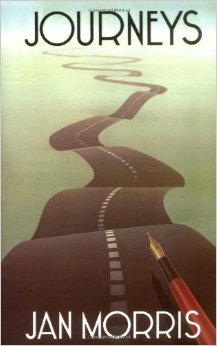 Reading a collection of travel essays written in the early 1980s is a surreal experience. So I’ll break this discussion into two parts: by golly I love Morris’ writing, and the essays themselves.
By golly I love the way Jan Morris writes. She constructs beautiful, evocative sentences. Describing the approach to Wells: “As one descends from the spooky heights of Mendip, haunted by speleologists and Roman snails, it lies there in the lee of the hills infinitely snug and wholesome.” On travelling to China for the first time: “Of course, wherever you are in the world, China stands figuratively there, a dim tremendous presence somewhere across the horizon, sending out its coded messages, exerting its ancient magnetism over the continents.” I’m no writer; I don’t have the ability to assess what makes great prose great. (There’s a great piece of graffiti near my house that says “I know art, but I don’t know what I like.”) I do know that I enjoy Morris’ writing, that I find her descriptions absorbing and sometimes moving, and that some of the books I read would be improved by their authors having read and considered Morris’ style.
Separating the form from the content should not be read as a negative about the content, don’t worry.
The first essay is about Sydney, and as an Australian this was really, really interesting. I felt there were parts that Morris exaggerated, and I was a bit uncomfortable with “Kev,” the white-collar worker standing in for Everyday Aussie, and she pokes a bit of fun at Sydney attitudes and expectations. Now, all of these are standard in a travel essay, sure. But I’ve never read a travel essay by a professional like Morris about somewhere that I kind of know – I don’t actually know Sydney very well, but Morris writes about Sydney as representative of the entire country (to which true Melbournians recoil in horror…). So I enjoyed the essay – she says some very true things, very appropriate things, and of course it’s well written. But it also meant that when I read her other essays, of places I have never been (of every other place she mentions, I’ve only been to Wells), I was aware that a native of those places may well have the same reaction as I did to the Sydney essay. Which made for an intriguing experience: not completely immersed in the narrative or the description, but interrogating her assumptions and elisions and emphases. For this sort of writing, I think my experience was actually enhanced.
This is Morris’ fourth book of essays. None of them have dates attached; the publication details simply explain that most appeared in Rolling Stone, a few in other publications. It came out in 1984 and there’a reference somewhere to 1977, so I presume they all date to that general time; the historian in me really wants dates on each one! There are several essays on parts of the US: my zero interest in Las Vegas succeeded in plummeting even lower, although Santa Fe intrigues; a few on Europe – she’s not a huge fan of Stockholm yet somehow I am now more interested in going, and Cetinje in Yugoslavia (now Montenegro) absolutely fascinates. And the Indian and Chinese essays are probably the most intriguing, and most problematic, in terms of how people and places are viewed.
I love Morris’ work and may well make it an ambition to collect most of what she has written.
The Book of Life
 1. I received this as a review copy from the publisher.
2. I have not read the previous two books in the trilogy. As well as impacting on my understanding of relationships, it’s possible this review will therefore have spoilers for the first two books.
Vampires are not, in general, my thing. Yes I have read an enjoyed a number of books that include vampires, but I do not go out of my way to read them. And I don’t especially like vampires for their own sake; I have enjoyed books they’re in when the story itself is great. (Cyborgs, though? I like cyborgs. Sometimes I don’t even care about the plot.) So The Book of Life is not inherently my thing – so if you love vampires, this review probably isn’t going to be useful to you.
The main characters are a witch/historian, Diana, and her vampire/scientist husband, Matthew. They’ve just got back to the 21st century from Elizabethan England and things are messy, not least because there’s not meant to be such mix-marriages and it’s compounded by Diana being pregnant. Also there’s a threat a brewing both to their family and to the supernatural species in general – which also includes daemons but they hardly feature at all in the book – AND they have to continue their search for the titular Book of Life for reasons that are never clearly explained. This involves Science, and History, and the occasional It’s Not Really a Significant Crime, right? Also getting humans involved in their work, travelling across Europe, family arguments, snark, more snark, the odd bit of sex and being a bit creepy.
Pretty standard stuff really.
I was dubious when I received this from the publisher, having not read the others. But I decided to give it a go and I was impressed by how well Harkness managed to basically catch me up. For those completing the trilogy this may well have been annoying info-dump, of course. There were random characters who appeared that had no impact on me but were clearly significant, and call-backs to previous events that I just shrugged past, but I certainly never felt like I was being left behind. So that’s a positive. As well, this is the epitome of page-turning-ness. I read the whole thing on a public holiday (580 pages). I didn’t give it the world’s greatest amount of attention (it’s not like reading Ann Leckie), but I also didn’t skip pages searching for dialogue (um, a few books I won’t mention). Thus, highly readable.
At times I almost forgot that this was meant to be a supernatural kinda book, and read it as a family drama – and it works exceptionally well as such. Every now and then there were odd, jarring notes (yes, I’ve been mourning for five centuries…), but really most of it works on ‘you can’t marry him’/’I just did’ – ‘what do you MEAN you’ve got a [insert unknown family member here]’ – ‘I hate you but I’ll work with you anyway’ interactions. Which can be quite fun when they’re written with enough snark. (Harkness could have added a little more snark, and I wouldn’t have minded.) In this way, it reminds me a bit of the Gail Carriger books – the Parasol Protectorate, while having awesome stuff about tech etc, boils down to relationships and how to negotiate them ((maybe everything does ultimately…).
Harkness touches on some interesting issues, too. I quite liked that Diana and Matthew at least in theory had jobs – they didn’t do much for their employers in this novel, too busy being Indiana Joneseque, but they DID use their professional skills. And Diana is absolutely expected to use hers, because why not? That was nice. Also that Diana keeps working right up til she hatches. And the discussion around why witches and vampires and daemons aren’t allowed to congregate, while a little heavy handed at times, was yet another example of exploring racial separation/ ‘purity’ issues. Aided by the appearance of Diana’s best friend Chris, ‘a black man from Alabama’.
Problems? I don’t like Matthew’s possessiveness. There’s at least one jab aimed at Twilight (‘no, I don’t sparkle’), and maybe others – I haven’t read it so I’m not sure. But I do know from reading some discussions that the possessiveness is present there, as it is here, and I don’t like it. Explain it by saying he’s got a great sense of smell if you like; I don’t care. Plus I am SO BORED by love triangles. Also, on the narrative, there are some holes and a few bits that are just left hanging. Which was annoying. And finally, not something that’s unique to this story but something I’m getting a little weary of: all of the main characters are exceptional. They’re world renowned in their fields. No one is just average. Which, sure, I guess it helps the narrative, but ‘oh I’ve read your work!’ got a bit eye-rolly.
Overall I was pleasantly surprised, because I really didn’t think – when I picked it up – that I’d end up finishing it, let alone in a day. If vampires and witches and love and mystery are your thing, don’t start here – I imagine you want to go back and start with A Discovery of Witches. But anyway, you can get The Book of Life from Fishpond (and Discovery of Witches too).
Upgrade me now

What do you do when you have a major heart attack and you’re also creator/sustainer of Clarkesworld? You decide to edit an anthology. Natch. (Read an interview with Neil Clarke here.) And you decide to make the theme of that anthology cyborgs, because you are now one yourself. Thus, Upgraded.
Now, before you go all ‘hmm, themed anthology’ side-eye on me, just steady on. In some stories, being a cyborg is the point; in others it is incidental. Sometimes being a cyborg is a good thing, a positive addition, welcomed. Others, it is something to be dreaded, confronted, Dealt With. Sometimes being a cyborg makes you better, and sometimes it seems to make you less. Cyborg-ness ranges from fully integrated and augmented body modifications to one seemingly small addition. Augmentation might be for aesthetics, or employment; for someone else’s sake or your own. It ranges from being socially acceptable to being almost beyond the pale.
Some stories happen tomorrow, here; some of them are way over there, temporally and physically. Sometimes there are aliens. Sometimes there are robots. Sometimes they are in love stories, detective stories, war stories, family stories. Not all the cyborgs are attractive characters. Sometimes they become cyborgs before our very eyes, and sometimes they’ve been cyborg so long it’s just what they are. Sometimes they were actually made that way from the start.
These stories feature men, and women, and sometimes genders are unstated. There are white characters and black characters and a variety of ethnicities. One of the central issues is that of disability, dealing with it and changing it and how those around you react to it. There’s queer and straight and none-of-your-business. Authors are from a variety of backgrounds, too.
So sure, it’s a themed anthology. But this is no Drunk Zombie Raccoons in Upstate New York. This is a vibrant, fun, intriguing and varied set of stories that have a basic concept in common.
The stories. Well, let me say upfront that I was so destroyed by Rachel Swirsky’s “Tender” that I had to put the book down and go to sleep. No more reading for me that night. As for the rest, here’s a sampler: Yoon Ha Lee’s “Always the Harvest” is creepy and disconcerting and sets a really great tone for the anthology – it’s the opening story – by being completely unlike any of the others. Ken Liu’s story is also deeply disconcerting because (very mild spoiler here) it is absolutely not the story you think it is. Alex Dally McFarlane does wonderful things with maps, while Peter Watts taps into the zeitgeist to suggest uncomfortable things about the military. And I have a feeling I know something Greg Egan might have read before writing “Seventh Sight” but I’m not going to mention it here because that would be way too much of a spoiler.
This is a really great anthology, with stories that absolutely stand as marvellous science fiction quite apart from their brethren. You can get it from Fishpond!
Galactic Suburbia 109
In which we solemnly swear we will repeat the title of our culture consumed after discussing it. Pinkie promise. You can get us from iTunes or at Galactic Suburbia.
Update on Gamergate with particular focus on Brianna Wu AKA @spacekatgal
(This episode was recorded before the Felicia Day incident)
Alisa’s con report – Conflux
Tansy’s con report – CrimesceneWA
Strange Horizons fundraising
We read and appreciate all your Twitter comments and emails, even if we don’t reply. We love your feedback!
It’s time to start thinking about the GS Award, yes already, WTF 2014 why are you moving so fast?
What Culture Have we Consumed?
Alisa: Landline, Rainbow Rowell (NB since recording, Alisa actually finished this book YES SHE DID); Night Terrace S1 1- 5
Alex: Sarkeesian’s XOXO talk; Garth Nix’s Abhorsen trilogy (Sabriel, Lirael, Abhorsen); Mothership: Tales of Afrofuturism and Beyond; Indistinguishable from Magic, Catherynne Valente; Bitterwood Bible and other Recountings, Angela Slatter; The Dish.
Tansy: Unmade, Sarah Rees Brennan; Night Terrace S1, Agents of SHIELD S1, The Flash S1 Ep 1-2
Please send feedback to us at galacticsuburbia@gmail.com, follow us on Twitter at @galacticsuburbs, check out Galactic Suburbia Podcast on Facebook, support us at Patreon (http://www.patreon.com/galacticsuburbia) and don’t forget to leave a review on iTunes if you love us!


