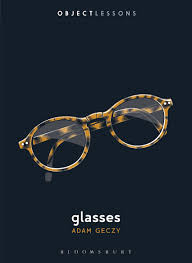
Glasses (Object Lessons)
I read this courtesy of the publisher, Bloomsbury Academic, and NetGalley. It’s out in July.
Firstly, I know this is an ARC but I really hope that the publishers deal with the editing issues. Eyes described as “shouldering blue”? There are a few points with very silly typos, and a couple of sections where sentences have clearly been rewritten but the original not removed.
Overall I enjoyed this book, if not quite as much as others in the series. The history of lenses used to either improve eyesight or shade the eyes from bright light is genuinely fascinating – I had no idea about the use of emeralds and green-tinted glass by Venetian nobles, nor the use of visors by artists. I was a little perturbed by the discussion of how kids with glasses are viewed: not the repeating of stereotypes so much as that it didn’t feel like there was enough reminder of the fact that these ARE stereotypes. There’s also a weird tendency across the book to suggest that in some cases the assumption of genius in the glasses-wearer is born out by some individuals, which feels like making assumptions about cause and effect – and individuals don’t make stereotypes real – etc etc. There’s also a discussion about the aesthetics of facial shape and what glasses work with what shape, which also honestly just felt weird, when there was no “or you just pick the glasses you like!”
I liked that the book included exploration of sunglasses and their use by celebrities – and also what wearing corrective glasses does for celebrities, and that this included extended discussion of Clark Kent. The section on sunglasses included mention of blind people like Stevie Wonder and Ray Charles, which was great – but the omission of Roy Orbison felt egregious, given how his use of sunglasses was counter to basically every example provided in the book.
All up, an interesting overview, but not as insightful or engaging as others.
A Bite-Sized History of Italy
Read courtesy of NetGalley and the publisher. It’s out at the start of June.
This book was an absolute delight.
The ‘bite-sized’ is an important part of the title, and the point is reiterated in the introduction: Callegari isn’t claiming this as a definitive look at Italian food, Italian culture, Italian identity, or their connections. What it is is a starting point, a set of vignettes (appetisers?) pointing to important moments and aspects of food and culture and identity, which are starting points for a deeper investigation – if you want to. If you just want an overview, that’s what this is!
Starting from Roman history and coming through to today, touching on many geographical areas and many Significant Italian Foods, Callegari touches on how certain things became ‘Italian” – tomatoes are not even European, let alone originally Italian! – as well as what it means for certain foods to exist in very specific regions. And beyond that, she touches on what it even means to be “Italian,” how that has changed / is changing, how food has influenced it, and also how talking about food (looking at you, Dante) has been a factor in this.
Not only is this a really great overview of a lot of interesting topics, it’s incredibly engaging. Chapters are short – like I said: appetisers – but they usually don’t feel too superficial because Callegari is very clear about the purpose of the book.
If you’re interested in food history but not looking for an encyclopaedia, this is an excellent starting point on Italy. Also: what a brilliant bibliography.
LOTR: Book 2
Here are my thoughts on Book 1. Note again that I am not being anywhere near as thorough as Nick and Abigail, who are linked there!
Well, as something of a reward for finishing several review books, I finally got around to reading Book 2 of The Lord of the Rings. And it was a reward, because Book 2 is a delight. Everyone is still together, there are some really interesting interactions and lovely descriptions, we get Galadriel… there’s hope and horror and excitement and the exquisite pain that isn’t quite nostalgia but something like.
So, some thoughts:
- The stay in Rivendell is much more extended than I recalled. Like their stay in Lothlorien, it’s such an interesting way of showing how the Elves are slightly removed from the rest of the world – that time doesn’t quite work for them as it does for mortals. 100% I would want to stay there rather than going on. I had also forgotten how little we get of Arwen here. But we do get further glimpses of Impressive Aragorn. I am endlessly fascinated by the different perspectives we are shown of him.
- As noted last time, I was 12 and relatively sheltered when I first read this (in the mid 90s). But my readings from at least late adolescence, and definitely in my 20s, absolutely noted the queer under (over) tones of Sam towards Frodo.
- Once again I enjoyed the travel story. Maybe I just impressed on it at a young age – although I do still enjoy a travel story in other contexts too. Tolkien both gives us the details of their travails, and the difficult terrain – but it doesn’t go on for chapters, so it’s still a fair pace so it doesn’t bore me.
- I do think the films captured Moria beautifully, and also the Balrog.
- It’s interesting that for all the Nine Walkers are officially an ensemble cast, actually we don’t see the actions of most of the characters across this particular book. Pippin gets scolded for checking the depth of the well, but otherwise he and Merry have little to do. Sam is scared of heights. Boromir gets to be large in the snow, and concerned about Galadriel, and of course is under the ring’s ‘fluence at the end. But otherwise… it’s Gandalf and Frodo and Aragorn. Gimli is literally to the fore in Moria, Legolas a bit in Lothlorien. I think it’s different from how writers tend to approach it these days.
- I will always love the chapters in Lothlorien. But that moment when it says that Aragorn never returned to Cerin Amroth as living man? That’s the moment that pierces my heart. It’s future-oriented – well, not nostalgia, which tends to be seen as more sentimental. Anyway: Aragorn will die. He is mortal. There are things he has done that he will never do again, even if he survives the coming war. And this knowledge is present throughout these chapters in particular – Galadriel even says it out loud: even destroying the ring, which is good for the world, will have negative consequences for the elves. This sort of complex approach to the task, and the world, is definitely not something I understood as a kid and am only grasping more fully as I age.
- I simply cannot imagine reading The Fellowship of the Ring and having to leave the crew as a) Sam and Frodo head east, and b) there might be sounds of battle but we’re not sure?? To Everyone who read this as it was published: I see you.
Lords of the Salt Road
I read this courtesy of the publisher, Osprey, and NetGalley. It’s out at the start of June.
Overall I enjoyed this book very much. I have a couple of caveats, which I’ll get to, but in general it has expanded my understanding of the role “the Norse” played in the history of the British Isles, as well as what it meant to be Norse / a Viking.
I came to this book with some knowledge already of “the Viking Age” – and I use those quote marks advisedly, since it’s a term that many historians aren’t happy about and is anyway incredibly vague (after all, what is “viking”?). Still, this is my context: I have a decent understanding of British history between when the Romans nicked off and the Normans stomped in; I have slightly less, but still some, knowledge of what was going on with that area now called Scandinavia. Would this book be as accessible to someone with zero knowledge of those things? It’s hard to say. Perhaps not, not least because one of the very difficult things is all of the Hara/olds, and there are a couple of other names that pop up repeatedly too; it’s hard to keep track of who’s who, even if you have a basic grasp of who should be when.
So, the book: a history of the Earls of Orkney (who also had control of the Shetlands, for most of their existence, as well as parts of northern Scotland for a fair chunk of time). It uses as its base a Norse saga about the earls, along with some other bits and pieces. Konstam makes a good argument for seeing the earls as a really important part of understanding the history of both Scotland, and Britain more broadly, and Norway in particular. It has been very easy for a very long time to insist on a French/maybe also Spanish tilt to British history, but the truth is that the Norse played much more of a role than just occasionally burning some monasteries down. And this book goes a ways to showing how that was true. I learned a great deal that I had no idea about, and some things I did already know got a lot more context.
Now, the caveats.
- The treatment of women. There’s one woman in particle, Ragnhild the daughter of Queen Gunnhild, whose role in various terrible events is taken with basically no hesitation straight from the sagas – that she was responsible for the deaths of “four notable men”, was evil, nearly destroyed the earldom, blah blah. I honestly can’t believe that this got past the editors: that there was no discussion about “maybe something else was going on here?”
- The first irked me. The second is actually more of a problem: there are a couple of things that I know for sure are actually errors. Harald Hardrada is described as having founded the Varangian Guard – nope. And a couple of the earls had to do with Macbethad ac Findleach – Macbeth. Konstam says that “Shakespeare followed the right historical script” in terms of murdering Duncan; again, nope, it seems to have been in battle. Both of these things do trouble me as to the veracity of other parts.
- Linked to the above: there’s not quite as much external verification of the Orkney saga as I might hope. The author brings in points from other sagas, and I get that there’s not many other sources, but the book also doesn’t caveat a lot of the ideas quite as much as I might have liked.
- Finally, a stylistic choice that drove me spare. Most of the Earls and other significant men have nicknames, like Harald Hardrada and Magnus Barelegs. Throughout the book, Konstam writes this as Harald ‘Hardrada’. And I can’t help but read these as ironic quote marks, as if the author is having a little joke or something. I’m sure that’s not true, but it did make for a frustrating reading experience.
Do I regret reading the book? Not in the slightest. It’s definitely made my knowledge of the late 800s-1200s in northern Scotland and Norway much more expansive. It’s not perfect, but that’s why multiple books should be written about similar topics.
Moon Over Brendle
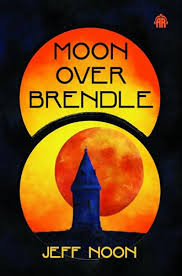
Read c/ the publisher, Angry Robot, and NetGalley. It’s out now.
This is one of the most remarkable books I’ve read in a long time.
It’s 1968, and Joe is 11. It’s the summer holidays, which means hanging out with best friend Denny, and generally exploring his small town. One day, the pair stumble across the dying body of the local drunk, Tom Halfpenny. Then Eileen starts turning up to hang around with Denny; then Joe sneaks into a weird, semi-neglected house, getting caught by the elderly inhabitant. The old man is a science fiction writer, and for a period of 1968 he and Joe form a strange, important relationship.
Those three things sound like they should be given very different values. But when you’re eleven, they might have fairly similar weight. Indeed, Eileen maybe stealing your best friend may have the greatest import.
In terms of the book, there’s one significant point I haven’t noted yet. This is not our world. Joe is a witness: he can see the Greot, the colourful dust that flows over everything in the world, in varying hues and in different densities according to its own rules. Only witnesses can see Greot all the time – except at 3.06am, when everyone can – and an even fewer number of people can see what Greot sees; and there’s even fewer who can manipulate Greot.
The novel is written as a memoir: a man looking back over his life, the paths he followed from 1968, how the events of that year had an impact on him. It could very easily have been written in a realist style: young boy influenced by slightly mysterious older mentor. It could have been magical realism, too – did the young boy really experience something magical? Instead, Noon commits fully to the novel as fantasy. and it’s richer for it. Joe’s experiences with the Greot, understanding what it is (and is not), what it can (and can’t) do, how it impacts on other people; all of these are significant factors in his growing up. The fact that the Greot is never explained, and that otherwise this is recognisably our world, add to the beauty and delight and captivating-ness of the novel.
This novel is just stunning. I hope many people find it.


