Lords of the Salt Road
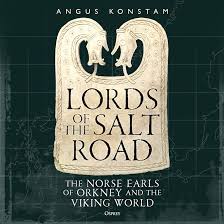
I read this courtesy of the publisher, Osprey, and NetGalley. It’s out at the start of June.
Overall I enjoyed this book very much. I have a couple of caveats, which I’ll get to, but in general it has expanded my understanding of the role “the Norse” played in the history of the British Isles, as well as what it meant to be Norse / a Viking.
I came to this book with some knowledge already of “the Viking Age” – and I use those quote marks advisedly, since it’s a term that many historians aren’t happy about and is anyway incredibly vague (after all, what is “viking”?). Still, this is my context: I have a decent understanding of British history between when the Romans nicked off and the Normans stomped in; I have slightly less, but still some, knowledge of what was going on with that area now called Scandinavia. Would this book be as accessible to someone with zero knowledge of those things? It’s hard to say. Perhaps not, not least because one of the very difficult things is all of the Hara/olds, and there are a couple of other names that pop up repeatedly too; it’s hard to keep track of who’s who, even if you have a basic grasp of who should be when.
So, the book: a history of the Earls of Orkney (who also had control of the Shetlands, for most of their existence, as well as parts of northern Scotland for a fair chunk of time). It uses as its base a Norse saga about the earls, along with some other bits and pieces. Konstam makes a good argument for seeing the earls as a really important part of understanding the history of both Scotland, and Britain more broadly, and Norway in particular. It has been very easy for a very long time to insist on a French/maybe also Spanish tilt to British history, but the truth is that the Norse played much more of a role than just occasionally burning some monasteries down. And this book goes a ways to showing how that was true. I learned a great deal that I had no idea about, and some things I did already know got a lot more context.
Now, the caveats.
- The treatment of women. There’s one woman in particle, Ragnhild the daughter of Queen Gunnhild, whose role in various terrible events is taken with basically no hesitation straight from the sagas – that she was responsible for the deaths of “four notable men”, was evil, nearly destroyed the earldom, blah blah. I honestly can’t believe that this got past the editors: that there was no discussion about “maybe something else was going on here?”
- The first irked me. The second is actually more of a problem: there are a couple of things that I know for sure are actually errors. Harald Hardrada is described as having founded the Varangian Guard – nope. And a couple of the earls had to do with Macbethad ac Findleach – Macbeth. Konstam says that “Shakespeare followed the right historical script” in terms of murdering Duncan; again, nope, it seems to have been in battle. Both of these things do trouble me as to the veracity of other parts.
- Linked to the above: there’s not quite as much external verification of the Orkney saga as I might hope. The author brings in points from other sagas, and I get that there’s not many other sources, but the book also doesn’t caveat a lot of the ideas quite as much as I might have liked.
- Finally, a stylistic choice that drove me spare. Most of the Earls and other significant men have nicknames, like Harald Hardrada and Magnus Barelegs. Throughout the book, Konstam writes this as Harald ‘Hardrada’. And I can’t help but read these as ironic quote marks, as if the author is having a little joke or something. I’m sure that’s not true, but it did make for a frustrating reading experience.
Do I regret reading the book? Not in the slightest. It’s definitely made my knowledge of the late 800s-1200s in northern Scotland and Norway much more expansive. It’s not perfect, but that’s why multiple books should be written about similar topics.


