Pure, by Julianna Baggot
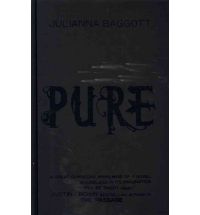
The cover is as difficult to look at IRL as it is here. I like it, it’s clever, but I do wonder whether it will be detrimental to the cause.
This is unashamedly a dystopia – an post-apocalyptic one even – set in the not-too-distant future. Pressia lives with her grandfather in the ruins of (I think) America, where day to day life is a struggle: for food, for shelter, and not unnaturally for any sort of meaning to life. Not only has infrastructure been destroyed and food contaminated, but the people themselves have been intimately changed by the probably-nuclear destruction a decade or so before. Pressia was holding a doll at the time of the detonations; along with scars and other injuries, its head is now her hand. And she could be said to have got off lightly: consider those who were walking a dog. Or holding another person.
This is the truly breathtaking, and the truly frightening, part of Baggott’s worldbuilding. Her conception of how people might learn to cope with surprising, disfiguring and debilitating changes to their bodies is clever and largely sympathetic. Of course, it’s not like there isn’t precedence for this, since people in our world do exactly the same. There are some people that she imagines as pretty awful, but being part of a ‘Groupie’ – an amalgam of multiple people – would likely send anyone mad, so it’s not surprising that they would be vicious. I was especially fascinated by the Dusts, people who have melded with the ground in some way; it’s a horrifying thought and Baggott fortunately does not overuse them, keeping them instead for relevant moments in the story. The question of how these melds could possibly function is only lightly touched on in the story, but I didn’t find that detrimental; it’s a bizarre concept but it’s become such a normal one for Pressia and the others that I, at least, got swept along by that acceptance.
Pressia’s point of view is countered by that of Partridge, who lives inside the Dome: a place of refuge which protected some lucky people from the detonations, and where they continue to live without fear – of the environment anyway. These are the ‘Pure’, because they are still pure human beings, unlike those on the outside. The different reactions of people on the outside looking at the Dome, and vice versa, is nicely captured by Baggott: the variation of adoration to hatred seems quite plausible. It’s not an original idea, and reminded me particularly of some of Sara Genge’s stories from a few years ago (“Shoes to Run,” especially, if memory serves (which it may not)), because of its depiction of the people outside wondering about the people inside. Anyway, Partridge may have a life of food and education but of course not everything is hunky dory. His family life especially is a mess, for a variety of reasons, and he is growing restless – something living in a Dome can’t really cope with. Interestingly, there’s not really one major crisis that makes Partridge finally act, but a series of small ones, like pebbles leading to an avalanche. And an avalanche there is, and Partridge ends up outside the Dome.
Pure could be split roughly into thirds: the first third, worldbuilding and characters; the second, bickering and a few new characters; the last third (actually a bit less) crazy crazy action. I really enjoyed the first part, because the world is intriguing and horrifying and different (at least outside the Dome) and Baggott realises the daily routine stuff quite nicely. I wasn’t especially fond of either Pressia or Partridge, but that didn’t stop me from enjoying their adventures and interactions with others. The second third, however, definitely dragged. There is some action, and some fascinating new characters such as El Capitan, who even gets his own point-of-view chapters. However in general it felt like a lot of to-ing and fro-ing that didn’t advance the story sufficiently for the space it was given. There are some interesting character moments, especially for Pressia, regarding temptation and the easy way out, but they weren’t sufficiently capitalised on. Finally, the last 100 or so pages (of 434) rushed by seemingly at light speed, as revelations were made and discoveries unveiled and yet more characters came on the scene to have a Really Big Impact. While this was an improvement over the middle, it left me with a rather unpleasant sense of confusion, and of being rushed.
I definitely enjoyed this novel, almost exclusively for the worldbuilding; however I don’t think I will be rushing out to buy the sequel, should it be published (this is the first of a ‘projected’ trilogy).
Solaris Rising: an anthology

I will admit that I am enough of a pathetic die-hard fan that I got this anthology off the back of its inclusion of an Alastair Reynolds story; others in the contents page also grabbed my attention, of course, so it wasn’t a completely ridiculous buy. Since saying farewell to Last Short Story I have got interested in reading anthologies again – well, actually, I was never very interested in anthologies before LSS introduced them to me, and then a few years of that burnt me out. Anyway, I was dead keen about giving this one a go.
Unsurprisingly, but unfortunately, it’s quite a mixed bag. Let me go through the stories. (The short version: there are some good, and a couple of very good, stories; plus a whack of indifferent ones.)
The good:
Ian McDonald’s “A Smart Well-Mannered Uprising of the Dead” is a delightful take on how social media might interact with local culture in order to impact on the political arena. With the events of the last 18 months this isn’t a radical notion at all, but McDonald here imagines a company offering virtual space for the dead – spirit-houses created by the bereaved for the recently departed. And what’s a virtual space like that without forums, and interaction? It’s really just the next step for the departed themselves to take part in those discussions, and to be commenting on contemporary affairs. I really enjoyed the style of this story as well as the content, although it was a bit confusing to begin with; it jumps from posts written by the dead, to interviews with the website’s creator, to discussions between the relatives of the talking dead. And gradually a picture builds up of what is going on in this country (which I think is never named, but seems to neighbour Mali), and the impact of the dead speaking out. It’s a really great opening to the anthology.
On a completely different wavelength is “The Incredible Exploding Man,” by Dave Hutchinson. Rather than jumping around points of view, as with the McDonald, this story jumps around chronologically but centres on one main event: an accident at a Collider somewhere in the US, and its effects on the people in the room. There’s no black hole as some of the more hysterical media suggested when the LHC was turned on at CERN, but a more subtle impact on the physiology and very existence of the people. It’s fast-paced and features some nicely differentiated characters to bring out some of the ramifications of the event.
Paul di Filippo’s contribution, “Sweet Spots,” is similar to the McDonald in that it involves an individual having an impact on society, but different because it has nothing to do with social media: instead, here an adolescent boy discovers that he can see how to influence events by a word, a nudge, an appropriately directed foot… and of course, there are ramifications, some unforeseen. The story harks to some superhero ideas of great responsibility with great power, and it is interesting to watch Arp (the protagonist) come to certain conclusions himself. I can’t say I particularly liked Arp; he was too genuine an adolescent for that! But again it’s a well-paced story with a clever premise.
With Stephen Baxter’s “Rock Day,” the anthology goes rather melancholy, being about a boy and his dog and a world that is not quite right. Baxter draws out the boy’s curiosity and confusion gently and sympathetically, and although the scenario of the ‘Rock Day’ discussed seems too farfetched (I know, crazy thing to say about a science fiction anthology), the consequences fit all too well into a science fictional universe. All of the stories to this point have been recognisably set on Earth. Stephen Palmer takes us away from that – if not spatially then certainly temporally. “Eluna” imagines a society with what at first looks like a radically different way of doing things, which on closer inspection may not be as different as readers might like. It’s about individuality and curiosity, innovation and tradition and sacrifice. And machines.
Adam Roberts begins his story with a disaster, which might be seen as a bold move. But pretty much all of “Shall I Tell you the Problem with Time Travel?” is concerned with disasters of one sort or another, usually of the fairly significant variety, and it does indeed suggest a potential problem with time travel, which I can’t possibly even allude to here without spoiling what is quite nicely revealed as it progresses. Going forwards and then backwards in time as the story unfolds, this is a very enjoyable if quite horrifying little story about one of science fiction’s more beloved tropes. And taking as his inspiration the revolutionary Che Guevara, Lavie Tidhar imagines a world in which that soldier-cum-poet-cum-politician did not die when he did. There’s only one science fictional element to “The Lives and Deaths of Che Guevara,” and although it’s a crucial one the story could be read as a commentary on the politics of the last forty years or so just as much as science fiction. It ranges across numerous countries and contexts, using interviews and magazine excerpts to break up the plot, and is a quirky and entertaining piece.
Steve Rasnic Tem, in “At Play in the Fields,” offers one of the few stories involving non-human characters. He wonders what it would be like to wake up one day and discover that the world has not only been discovered by aliens, but that it’s also a whole lot later – in years – than when you went to sleep. This is a story about a man and an alien, but also about a man coming to terms with these sorts of profound changes through the mundane objects around him. It’s a quite tactile story, and one to make the reader wonder which of the objects around them might survive long into the future – and what this will say about us as individuals and as a culture. On the other hand, “Yestermorrow” by Richard Salter is concerned with time rather than objects; specifically, what it would be like to always wake up not knowing which part of your life today is, because you are living quite literally from day to day – one day waking up as a baby, the next at forty, but you don’t take that knowledge with you. Which of course means you know when, calendrically speaking, you will die. Certainly presents some interesting problems for the police.
Jaine Fenn’s story is one of exploration that initially seems like it could almost be straight out of Star Trek or StarGate SG1 – a gate to another world, can’t get back through, whatever will we do?! However it is saved from falling into tired tropes thanks to engaging characters and a nicely intriguing twist that suggests some rather interesting things about those characters. In style, it mixes up transmission reports with conventional third-person narrative.
There’s a suggestion of postcolonial ideas about “Eternity’s Children,” from Keith Brooke and Eric Brown. A world that is both a long-term killer of human visitors and the long-term ensurer of their longevity is visited by a representative of the company responsible for it; naturally things do not progress in a straightforward manner. It would have been possible for this story to follow the old idea of white-man-seduced-by-exotic-place, but I think it mostly avoids that by the awareness of the main character, Loftus, of what he is about, and his willingness to think beyond his task.
The penultimate story of the anthology is actually the one I read first and may or may not be the main reason I bought the anthology… “For the Ages,” by Alastair Reynolds, is a wonderful far-future story about the big things – the entirety of cosmology and leaving a message for the ages – and the small things – messy human relationships and just how messy they can get. The characters are finely drawn and utterly believable, the task preposterous and glorious and utterly fitting for the hubris of the human race. It’s easily my favourite story of the entire set.
The indifferent:
In “The Best Science Fiction of the Year Three,” Ken Mcleod combines lack of interesting plot (editor searching for stories, French government launches a curious balloon) with lacklustre characters, resulting in a story that utterly fails to compel. The next story was also a disappointment, because although there is a potentially intriguing idea in “The One That Got Away” – ocean creatures are washing up onto the beach in vast quantities, and something might be found within their bodies – Tricia Sullivan does not provide enough political or historical background to explain what is being searched for or why. That could be forgiven if the characters were compelling enough that their quest was an end in itself, but sadly this is not the case.
Looking at a broken father-son relationship, Jack Skillingstead’s “Steel Lake” has both Too Much and Too Little: too much sentimentality, and too much wrong with the father for him to be at all approachable or sympathetic; too little overall point, either in plot or characterisation. Being overly sentimental also characterises “Mooncakes,” a collaboration between Mike Resnick and Laurie Tom. I like stories about spaceships heading out into the unknown and how people cope with the stress of leaving family, but this one left me cold. The ‘all cultures are precious’ line (which I agree with already) was hammered out without a care for subtlety – too much telling, not enough showing – and the family relationship depicted was boring and predictable.
Ian Watson’s “How We Came Back from Mars (A Story that Cannot be Told)” is (maybe) an alien contact story, with a team of explorer (maybe) on Mars managing to get back to Earth a whole lot faster than expected, who then have to deal with the ramifications of people not believing their story, made particularly problematic by the place they arrive back at. It’s an interesting enough premise, but the story tries too hard to be conspiratorial and suggestive without having the atmosphere or characters to pull it off. Sadly, Pat Cadigan’s “You Never Know” also failed to grab me – sad because I usually love Cadigan’s work, and because it means I disliked two out of the three works by women (the third, by Jaine Fenn, is discussed above). The atmosphere – a secondhand shop – and premise – the shop assistant and his experience with a new security system – are approachable and familiar-seeming. The denouement, however, left me confused and grasping for understanding, and not in a positive way.
Sadly, the last story of the anthology definitely falls into the ‘indifferent’ camp. When a writer writes about a writer, it’s hard for me at least not to wonder about the level of congruency going on. For Peter Hamilton’s sake, I hope there is no congruence between the writer in “Return of the Mutant Worms” and himself, because the thought of having an editor bring up an unpublished 21-year-old story and offer to publish it must be nightmarish to many successful authors. Anyway, this is ultimately a smug and unsatisfying little story that does little good for the memory of the anthology as a whole.
One last thing to mention: I found the author notes preceding each story generally a bit tawdry. They seemed to be trying for a mix of bibliography + interesting factoid, and did not often hit the right note; there was too much effort at sounding quirky for it to be genuinely appealing.
Galactic Suburbia 54
 In which we keep it short (truly) through restraint and perseverance, despite setting Tansy off on a tangent about Lego and lots of crunchy gender bias stuff to chew through. Um, yes, we might have misnumbered somewhere along the way. This really is 54, apparently. You can get us from iTunes or Galactic Suburbia. Also, yes we already know we made a mistake in talking about what Genevieve Valentine has won. Oops.
News
Stoker shortlist
Paul Cornell on Panel Parity
Elizabeth L Huede on National Year of (Gender Biased) Reading
Tansy’s thing: new feminist Doctor Who blog Doctor Her
Can princesses play with Lego? (Lego friends petition at Change.org)
What Culture Have we Consumed?
Alisa: Vorkosigan – Shards of Honor, Barrayar by Lois McMaster Bujold
Alex: The Islanders, Christopher Priest
Tansy: After the Apocalypse, by Maureen McHugh (collection)
Feedback episode coming too!
Please send feedback to us at galacticsuburbia@gmail.com, follow us on Twitter at @galacticsuburbs, check out Galactic Suburbia Podcast on Facebook and don’t forget to leave a review on iTunes if you love us!
The Islanders: a review
Some advice on reading The Islanders, by Christopher Priest.

1. Read the introduction.
No, really. Even if you’re an “I never read the introduction” kinda person, read this introduction. It’s part of the story, and without it you are likely to be terrible confused, because…
2. Don’t think this is a novel.
At least, not in the conventional, linear (or even non-linear) plot sense. Things happen, but not in any sort of chronological order. This is, as the introduction suggests, more of a gazette: an introduction to a few dozen of the islands which make up the Dream Archipelago. It’s a mixture of straight Lonely Planet-style description and suggestions for tourists, along with police investigations, letters, wills, and a couple of short story narratives that appear to have snuck in under the radar.
3. You don’t have to have read the short story “The Dream Archipelago.”
I haven’t.
4. Pay close attention to the names of characters.
Seriously. Really close attention. Because while there is not exactly a narrative as such, there are several recurring characters who build up around themselves quite the biography as they visit and interact with different islands; and one fairly substantial murder mystery, which also keeps getting mentioned in relation to different people and different islands. If you don’t keep track of names you won’t experience the maddening joy of getting another jigsaw piece that may or may not fit into one of the several puzzles you have on the go.
5. Be prepared for a lot of wind.
Breezes, zephyrs, howling gales; humid, dry, grit- or snow-filled; wind plays a really significant part in many of the descriptions of the islands. They all have their own names, often different ones from island to island.
6. Accept that each island has its own language (or several).
And before you dismiss this as ridiculous, remember that it is estimated that Papua New Guinea – a country of just some 462, 840km2 – has “over 850 indigenous languages” (I’m not afraid to use Wikipedia when it’s expedient and unlikely to be controversial). So why shouldn’t separate islands have different languages and cultures?
7. Take nothing for granted.
Not even time and space. The Dream Archipelago isn’t a dream – there’s no waking up – but there are definitely hints that time, especially, is something that might just happen to other people. Just go with it. Enjoy the maddeningly slippery way in which Priest suggests new information that may or may not fit in with other information given earlier in the gazette.
8. People who should avoid this book include:
Those who are easily confused by occasional and slight reference to probably important characters; people just turn up when they are relevant to the island under discussion. They might have been born there, died there, visited there, made art there, been arrested there. And it might only be one sentence in the island’s entry.
Readers who really prefer a linear plot; because as mentioned above, there isn’t one. There was a murder once, on the island Cheoner, whose investigation and subsequent surrounding mystery provides the only thing close to a plot you’ll find; there are references to the people involved in the entries for maybe another six or seven islands, spread out over the course of the whole book. There are also biographical notes for four or five main characters also spread throughout the book, and they are sometimes contradictory but always interesting.
People who get seasick just by reading about the ocean: there are islands. There is island hopping. Some important things happen at sea.
The extremely insect-averse, because the thryme – a really, really nasty critter – has basically a whole entry about itself, and it keeps getting mentioned throughout.
9. People who may enjoy this book include:
Those who enjoy discussions about what actually constitutes art. Does boring a tunnel through a mountain count? Is there a point in creating art that no one, not even the artist, will ever see?
Readers who enjoy a good puzzle; because the whole book is a puzzle. Putting the pieces together about (for example) Dryd Bathurst’s life is a great deal of (sometimes conflicting) fun.
People who like islands. There are islands.
The seeker of innovation. I wouldn’t want to read book after book constructed in this manner, but it was certainly enthralling and intriguing to read this one.
10. Read this book.
Unless you’re completely and irreparably put off by the notion of the non-linear/possibly non-present plot, read this book. It’s a delight to read, the prose is enjoyable and varied from island to island, the ideas are stimulating, and the people as engaging and different as excellent pen-sketches can be. Read this book.
A Fisherman of the Inland Sea

Quite a disparate set of stories in this collection from Le Guin, and actually not what I had vaguely anticipated, which was stories connected to the Earthsea set – and why I thought that I have no idea.
Anyway.
One of the interesting parts about this collection is that it opens with an introduction by Le Guin herself, discussing her attitudes towards some of the stories and I think responding to some criticism from people when they originally appeared in magazines and the like. It also includes a robust defence of science fiction in terms of character (SF has them), ideas, and not always being heavy on the science (Egan, she didn’t know about you). In talking about technology, she has one of my now-favourite put-downs, regarding someone who said that Native Americans had no technology: “As we know, kiln-fired pottery is a naturally occurring substance, baskets ripen in the summer, and Machu Picchu just grew there.” She also rather defiantly claims BEAUTY as an aspect of science fictional writing, to which I say HELL YES.
Anyway. Again. The stories are a mixed bunch. The first, “The First Contact with the Gorgonids” is a weird one set in outback NT, with an unhappily married woman as the central character and (deliberately, I think) wince-worthy descriptions of Aborigines. “Newton’s Sleep” is about people who have managed to get themselves into orbit in a habitat to get away from the world, which is going to hell in a handcart; they’re mostly quite ordinary, although by necessity all skilled. Ike – Isaac – is a fairly unlikeable character, although I sympathised, especially when things appear to be going wrong. The third story is just odd, and not in an engaging way – “The Ascent of the North Face” does not refer to a mountain (nor an actual face).
“The Rock that Changed Things” is a story that I more easily associate with Le Guin’s style of writing. Based in an entirely non-human society, where there is a very strict hierarchy to the point of almost being separate species, the nurobls spend their time making sure that the obls can live lives in serenity without messy things like tidying or cleaning. They also help fix the rock patterns that are part of the very reason for being of many obls… and then one nurobls notices the colour of a particular pebble. This is a really delightful story. “The Kerastion” is not delightful, because it is more on the heart-wrenching side; it’s also less of a story and more of a vignette into a world where profession is caste and determines every single interaction.
The final three stories are all Hainish stories, like The Left Hand of Darkness and Rocannon’s World and so many others. In “The Shobies’ Story,” a crew is setting out to test the effects of fast-as-light travel on sentient beings. As Le Guin herself notes in her introduction, as well as playing with such physical ideas it’s also playing with metaphysical ideas, and the notion of creating reality through storytelling. So, too, is “Dancing to Ganam,” also looking at testing the new fast-as-light ‘drive’ (the Cetians are constantly reproving people for describing it as a drive). In this case, Commander Dalzul has decided that a small crew who are closer together than the Shobies might have a better chance at not having their realities warped. As well as looking at how we tell stories about our lives, I think there’s also a post/colonial message here, about the stories and political ideas etc that people bring with them when observing foreign cultures. And finally, there’s the paradoxical, sweet-bittersweet “Another Story,” whence comes the title of the collection: Hideo’s mother used to tell him the story of the fisherman of the Inland Sea, who went with a sea-princess and returned after one night to discover generations have passed. Hideo goes on to become a great physicist, and tries out fast-as-light travel…. This is definitely my favourite of the stories in this collection, and I love it dearly. It’s also set on O, a planet I’m sure I’ve read another short story about, perhaps in The Birthday of the World; here people have marriages involving four people, two men and two women, based around when they are born. It’s a fascinating view of society.
This has been part of my desire to read All The Le Guin, and it was overall a very satisfying one.
Flatland: A Romance of Many Dimensions

By Edwin A. Abbott (originally pseudonymously as “A. Square”)
This is not what I expected! I don’t honestly know WHAT I expected, but it wasn’t this. For a start, it is way older than I had thought – 1884! And for another, there is almost no plot. It’s sort of a memoir, sort of a philosophical treatise, about Flatland: a land that exists in only two dimensions. Our interlocutor is a Square – in Flatland’s hierarchy, solidly middle class (Isosceles Triangles are working class, the most-sided Polygons the highest class. Women are Straight Lines). The first chunk is Square explaining how life and society can function in just two dimensions, with a great discussion about how you can tell the difference between triangles and polygons either thanks to their voices (a method only for the lower classes), feeling (slightly more respectable) or sigh (only for the upper classes because it takes years to perfect). After all of that he comes to the point (heh), which is experience of meeting a Solid – a Sphere – who informs him that there is <i>another dimension</i>, and proceeds to prove it. Sadly, this is heresy in Flatland…
This little book – 82 pages! – operates on many levels. On one, it’s an amusing intellectual conceit, to consider how life would be different in two dimensions (there’s also brief discussion of Lineland and Points). Thanks to this, it’s also an intellectual challenge, because as Square himself says to Sphere: if you’re telling me there’s another dimension that I can’t perceive but need to accept basically on faith, is there then a fourth…? Quite apart from the mathematical side, this is a biting satire of Victorian society and manner, in the way that undesirable elements amongst the lower (Isosceles) triangles are described and in how manners and attitudes of exalted Polygons are portrayed.
The question of the women is one I haven’t quite worked out for myself. If I can accept that Abbott is being satirical about the lower classes then I am hoping that he is being satirical about the women, too, because they really don’t come off very well. They are Straight Lines, therefore no angles, therefore… no brains? They’re certainly treated as emotional not rational, to the point of there being basically two languages – how men speak to themselves and how they speak to their wives. I suspect he may indeed be ironic, because in the introduction to the 1884 edition (reprinted here) “Square” responds to some alleged criticism from Spaceland, about being a woman-hater, in which he admits that he is similar to our Historians, to whom until recently “the destinies of Women and of the masses of mankind have seldom been deemed worthy of mention and never of careful consideration.”
An amusing book, and a quick read.
Galactic Suburbia 52
 In which we pop the cork on the champagne bottle to welcome in the beginning of the 9 month science fiction awards season – hooray! You can get us from iTunes or stream from Galactic Suburbia.
News
Responses to the Galactic Suburbia Award.
Crawford nominees and winner: Genevieve Valentine’s Mechanique.
BSFA nominees
SF Translation Awards Fundraiser – donate and win awesome books
The Kitschies: yes really, rum and tentacles.
LOCUS Recommended Reading List! [and Poll]
Young Australian of the Year who founded Robogals: Marita Cheng
Women of SF in their own words, reviewed by Brit Mandelo
Diana Peterfreund: following up on Brave New Love [and how the internet often fails to pick up the pieces after a controversy has died down]
Women Writing Horror (it’s new, who knew?)
[and the other Guardian article patronising genre readers, taken apart by Smart Bitches Trashy Books]
Creature Court trilogy giveaway – we’ll be drawing it next episode, email us to tell us about one book you read because of us & you’ll enter the draw to win all three books by Tansy
Creature Court Spoilerific Blog Post – only for those who have read Creature Court Book Three, Reign of Beasts, by Tansy Rayner Roberts
What Culture Have we Consumed?
Alisa: Juliet, Naked by Nick Hornby; The Last Little Blue Envelope by Maureen Johnson
Alex: Clockwork Rocket, Greg Egan; A Fisherman of the Inland Sea, Ursula le Guin; The Business of Death, Trent Jamieson; Skyrim
Tansy: Bad Power by Deborah Biancotti; Batgirl: the Lesson; Redwood & Wildfire by Andrea Hairston; Blake’s 7: The Turing Test [Big Finish], Doctor Who: Foe From the Future [Big Finish]
Please send feedback to us at galacticsuburbia@gmail.com, follow us on Twitter at @galacticsuburbs, check out Galactic Suburbia Podcast on Facebook and don’t forget to leave a review on iTunes if you love us!
Galactic Suburbia: the awards edition
I meant to post this yesterday and totally forgot! If you want to listen to the podcast – from iTunes or via the website – without being spoiled as to the Honours List and the winner, stop reading now! Alternatively, below is the TL;DL version.

The GS Team: Alex, Alisa, Tansy and our Producer (AKA Gentlemen’s Auxilary)
Yesterday Galactic Suburbia put up a Very Special podcast, announcing the honours list and winner of the inaugural Galactic Suburbia Award.
After much discussion, and wanting in particular to create something that wasn’t already out there in the multitudinous world of spec fic awards, we came up with this definition:
The Galactic Suburbia Award: for activism and/ or communication that advances the feminist conversation in the field of speculative fiction in 2011
Honours List
Carrie Goldman and her daughter Katie, for sharing their story about how Katie was bullied at school for liking Star Wars, and opening up a massive worldwide conversation about gender binaries and gender-related bullying among very young children.
Cheryl Morgan for Female Invisibility Bingo, associated blogging and podcasting, and basically fighting the good fight
Helen Merrick, for the Feminism article on the SF Encyclopedia
Jim C Hines for “Jane C Hines” and associated blogging, raising awareness of feminist issues in the SF/Fantasy publishing field.
Julia Rios, Kirstyn McDermott and Ian Mond for Episode 11 of the Outer Alliance podcast (The Writer and the Critic special episode)
L. Timmel Duchamp – for continuing to raise issues of importance on the Ambling Down the Aqueduct blog and various Aqueduct Press projects
Michelle Lee for the blog post “A 7-year-old girl responds to DC Comics’ sexed-up reboot of Starfire”
 Winner
Nicola Griffith – for the Russ Pledge, and associated blogging
The winner will receive a Deepings Doll hand-painted figurine of a suffragette with a Galactic Suburbia placard, hand-painted by Jilli Roberts of Pendlerook Designs. (Tansy’s very talented mother!) Each Deepings Doll is individual, so the one each winner will receive (we do plan to make this an annual tradition) will be unique.
If you have ideas for our Honours list for 2012, please email us at galacticsuburbia@gmail.com or tweet @galacticsuburbs
=====
It’s been lovely to see such a positive response from our honourees and winner. Already, Nicola Griffith, Cheryl Morgan and Timmi Duchamp have posted the award details on their blogs with gracious commentary. We at Galactic Suburbia had a great time chewing over what our award should be, and what we wanted to celebrate in the SF community.
===============
The Clockwork Rocket

One thing must be noted about Greg Egan’s fiction in general, and this book in particular. He, and it, are uncompromising. In reading it the audience must be one of two things: able and willing to understand complex physics, or willing to accept that they do not understand those physics and carry on with the story regardless. If you are not in either of those two camps, The Clockwork Rocket is most definitely not for you and Egan makes no apology for that. This is a book that comes with diagrams. (For reference, I fall into the second camp. It’s a long time since I did any physics seriously.)
This is a story set in a universe different from ours in one very crucial aspect: the speed of light is not a constant. In many respects, this book (the first of a trilogy) represents the working out of the consequences inherent in that seemingly simple fact – to the point where a large chunk of the book is actually just that: a physics student exploring the ramifications of observed phenomena on the possibilities of time and space.However, were this novel merely an amusing exercise for the physics lover, I would not have persevered. Along with the physics, Egan has incorporated some rather profound discussion of gender and reproduction, all within a quite compelling story about saving the world.
Why does the world require saving? Egan takes the ancient fear that comets herald the end of the world and makes it true (…maybe). At the start of the story, the occasional streaking light is seen in the night sky; over time, with more appearing, these streaks come to be called Hurtlers. This increase in number, and in brightness, leads some people to wonder about exactly what is causing them, and whether it might lead to problems for the world in the future. The protagonist, Yalda, is the one to realise that yes, these Hurtlers may actually represent her world’s doom, and she and others start work on an audacious plan to attempt that doom’s subversion. The plot follows Yalda’s initial experience of education, her move to university, and on into theoretical physics and astronomical research, for roughly the first half of the book. The second half is concerned with Yalda and friends convincing people of the truth of the problem, and of their proposed solution: build a rocket, send it out, and have it return in a few years of world time. Because of the non-constant speed of light, if the rocket is accelerated to a sufficiently high speed many generations will pass on the rocket – and those generations will have the time to do the necessary research to avert disaster planet-side. (If it sounds like I’m spoiling a major plot point, occurring late as it does in the book, fear not: this is all mentioned in the book’s blurb. My guess is that it was put there to encourage readers to push on through the theoretical physics in the knowledge that honestly, there really is a plot here, too. Also, if you’re about to raise issues with the physics – don’t. I’m just telling you what Egan sets out in the book, and I do not have enough physics myself to be able to point out possible flaws in his logic.) Naturally, the course of research never does run smooth, so Yalda and friends experience problems – deliberate and accidental – as well as the frustrations familiar to any scientific pioneers. They do eventually get off the ground, and I think it’s fair to say that much of the most interesting plot occurs onboard the titular rocket.
Egan has not transplanted Earth to his new universe. The world of the story, and the people, are just different enough to be disquietingly alien. Plants emit light at night. People have variable morphologies: if an extra pair of hands is needed for a task, it can be extruded. And, most profoundly, children are formed directly from the mother’s body: she becomes essentially a cocoon, and then splits into four, to create new beings. Ideally, she produces two sets of male and female pairs. When each of these females in turn is ready, she and her co (male partner) meld and she likewise splits into four – and the children will then be raised by her co. Like me, perhaps one of your first reactions is to cry ‘incest’. However, there is no sexuality on this planet, so it’s quite a different situation; our ideas of sexual and familial separation are irrelevant. There are a lot of interesting repercussions of this form of procreation. For me, the most intriguing issue raised is the issue of gender. Children are born from one half of the pair, and that one is called the mother; this is similar to humanity, and perhaps warrants Egan’s use of the feminine pronoun. However, the co raises the children – generally also seen as primarily a mother’s job in humanity – and the suggestion that females could take on this role is seen as entirely unnatural. There is also little suggestion throughout the book that there is anything other than this reproductive role to distinguish between male and female; females do not seem to be subordinated in terms of schooling, for example, simply because they are female, although they may be subject to harsh penalties if they appear to be rejecting their biological destiny. This may be similar to some extremist views today about women being fit only to bear children, but here it’s not the only thing they are capable of doing but rather the genuinely last thing they ever will – and in some sense what they are intended, ultimately, to do. It doesn’t need to be explained, I imagine, that the existence of a drug that can stall their reproductive splitting (there needs to be a word like bifurcate – quartofurcate?) is contentious to the point of immorality or illegality (it’s a bit blurry which). Egan is setting some very provocative questions here about the nature of gender and reproduction and parenting (single parents are the norm!). This is not to say that his ideas and choices are always unproblematic; the very nature of reproduction was troubling, for me, although Egan makes it clear there is no pain involved. And all of this, all of this normal way of being, is off balance right from the start by the main character Yalda, because she is a single: when her mother split, only three children were created. She has no co, and is therefore alternately pitied and reviled. Partly as a consequence of this, she gets the opportunity for a more advanced education than might otherwise have been possible – a bit like having an independent income and a room of one’s own. As often happens, the slightly-outsider character allows for a more interesting perception on the society.
Overall, I really loved this novel. Yes, there were pages where I skimmed the intense physics discussions, because vector diagrams just don’t do it for me. But the character of Yalda, and a desire to find out exactly where all of this was heading, kept me reading – and will make me get the second book as soon as humanly possible.
The Cold Commands
I’d like to say that The Cold Commands is a satisfactory or entertaining sequel to Richard Morgan’s The Steel Remains, but those who have read the latter would know that I was lying through my teeth; it couldn’t be either. So I will go with ‘appropriate.’ Other adjectives to describe it as a novel include ‘enthralling,’ ‘chilling’, and ‘relentless’.
You could probably read this without having read the first book, but personally I wouldn’t recommend it; partly because things make more sense in context, and partly because The Steel Remains is excellent.

The enthralling part comes largely from the characters: the situations they find themselves in and their development as people. As with the first book, the story is largely told from the perspective of Ringil, Egar and Archeth. Ringil is recovering – slowly – from his time with the dwenda Seethlaw, but he has changed: not only older, maybe wiser, definitely sorer, but in some even more intangible ways also involving blue fire and interest from the dark gods themselves. Ringil is a delightfully ironic take on the stereotypical fantasy hero; he’s a warrior, wields a sword gifted to him by non-humans, and has a strong sense of justice… but he’s also homosexual in a world that doesn’t accept that, has been disowned by his family and forgotten by most of the world, and doesn’t particularly want to fight most of the time. On the other hand, Egar Dragonbane quite likes fighting, almost as much as he likes having sex. Exiled from his home on the barren steppes, Egar is struggling to come to terms again with city living and his one-time mistress. Egar is definitely more in the Conan tradition, and provides an interesting contrast to Ringil, with the added benefit of more brains that nomadic barbarians have classically been awarded. Also, more humour. Rounding out a truly unlikely trio is Archeth, I think the most interesting of the three. She’s a half-breed – half human, half Kiriath, the now-absent one-time allies of the humans – which means she has access to and some control over what might be magic or might be highly advanced technology (there’s definitely some playing with the old Clarke adage here). She too is homosexual, leading to some difficulties, which combined with the fact that she is female and has the ear of the emperor – sometimes – leads to clashes with religious authorities. On top of all of this is her continuing anguish at having been left behind by the Kiriath, which she feels both as a betrayal, and as a failure on her part, of not being good enough to accompany them. These three came together many years before the events in even The Steel Remains, to deal with the threat posed by the Dragons. The Steel Remains was mostly about their individual adventures and problems, with those issues coming together towards the end to reveal the beginnings of a very interesting pattern. Here, they have their own chapters, but the links between them are more obvious and their private fights and confrontations more definitely, if still obscurely, connected.
Chilling and relentless describe the overall plot; both are to be expected in a novel by Richard Morgan. The Steel Remains left our (anti)heroes having defeated a possible dwenda invasion, and feeling slightly uncomfortable about what that might mean for their world. Dwenda are still something of an issue in this sequel, but there are other maybe-threats too, such as the Dark Court, the gods worshipped by some, who are paying an disturbing level of interest to the goings-on of individuals like Ringil; and something, or possibly someone, that appears to have newly come from the absent Kiriath but without a user’s manual. Plus there’s the everyday, run of the mill threats like a mildly crazy emperor (who might feed you to the octopus), unpleasantly near-crazy religious zealots, and inter-city strife over trade and slavery. The relentless part comes from the steady pace of things going wrong or new problems being discovered. It’s not frenetic, in that the characters are not running from one thing to the other unless they’re being chased; instead it’s like a normal few months where almost nothing goes to plan, and problems pile up on top of each other slowly and steadily. Ringil, Egar and Archeth find themselves involved in problems they would actually rather not have anything to do with, thanks all the same, but don’t seem to have a choice about. All of that is chilling, too, as is the uncomfortable knowledge that while there are some happy times for the three protagonists, this is unlikely to all end well. And then there’s the deft and clever world and secondary characters created by Morgan; that’s chilling too, because they are so very real. For example, the various cities and their politicking, internal and external, are intricate and recognisable, and quite clearly keep going about their business without much concern for the events being portrayed in the novel. Then there’s the slavery, newly legalised in a number of states. Slavery, and the treatment of slaves, is often portrayed in an unemotional way – as a business opportunity. It’s clearly not because Morgan approves of slavery; Ringil in particular works rather hard to stamp it out. But the presentation of how it could become normal very quickly is indeed chilling because of its plausibility. And the way that people appear to have forgotten recent history, too, is both plausible and recognisable.
Overall this is an enthralling piece of fiction, ticking a lot of boxes for me: quirky and original characters; action that’s well-described and gritty without being in love with gore; deft world building that doesn’t swamp the story; and a story that leaves me desperate for more. I am fairly sure that there should be a third book about Ringil and his grim band (not that I’ve seen anything official about that), which makes me very happy indeed.


