Manners and Mutiny
 This book was provided to me by the publisher at no cost.
Firstly? I do not love this cover. It’s far too old to be Sophronia, which I don’t remember being a problem with the other covers. The crossbow is appropriate, at least. I am also not wild about the yellow.
Fortunately I do not tend to judge books by covers; at least, not books in a series I have been enjoying and whose author I tend to trust.
Sorcerer of the Wildeeps
This was provided to me by the publisher.
 This is not a straightforward novel. The plot is not linear, the characters are slippery, and so is the language sometimes. But it is engaging and haunting and (much as its trite to say) challenging.
1. The plot is not linear. The focal character, Demane, sometimes has flashbacks to his past experiences – and sometimes to the experiences of other people, and sometimes he’s simply reflecting on history. It’s not always clear when this is happening, which I think is a stylistic choice; it took me a little while to understand when that was happening, but once I left myself go with the flow it usually made sense. The only frustrating thing by the end of it was that I really, really wanted to know more about Demane’s history and that of the world he lives in, with its Towers and demigods gods who have gone back to the stars…
2. The characters are slippery: this is somewhat related to the lack of narrative linearity (did I mention this isn’t a problem? It’s not a problem, as long as you don’t mind having to work a bit). Demane is definitely not straightforward – he’s got one mammoth backstory that only gets revealed in dribs and drabs, and that’s nothing on Captain, whose life is like a picture that’s entirely in shadow except for one tiny bit where one spotlight hits. Again, not a problem, but it does make it hard to explain what you’ve just read: “There’s this guy who works with a merchant caravan at the moment but he’s had this amazing life in the past, where he was kinda taught magic except it’s not magic, and in the present he’s trying to keep everyone around him alive…”
3. The language is slippery too. I’m not referring to the dialogue here, which is written very much in a spoken style (I know nothing about Wilson but I presume he’s thought long and hard about the use of the n-word; I can’t imagine Tor leaving that in a book without it being very deliberate and considered, either); dialogue doesn’t bother me. I think the elusiveness of the language often related to the non-linearity of the narrative actually. It took me a few pages to get the hang of it anyway, and once I was properly immersed it flowed beautifully.
I will look out for more work by Kai Ashante Wilson. Well recommended.
Defying Doomsday
From Twelfth Planet Press:
Disabled characters are rarely seen in apocalypse stories, but Defying Doomsday is an anthology set to explore the tales of those usually left for dead.
While other apocalypse stories focus on the survival of the fittest, Defying Doomsday is an anthology placing disabled characters at the forefront of the narrative. Set for release in mid 2016, the anthology will be edited by two Australian women and will include stories from science fiction authors around the world.
Disability and chronic illnesses are not uncommon in society, yet the role they play in popular culture is limited and often depressing. Characters in apocalypse fiction often die early or are presented as burdens to the other characters. Defying Doomsday will be a collection of stories proving that disabled characters have more interesting stories to tell, even as the rest of the world is ending.
The anthology was conceived by Tsana Dolichva after she read a novel set in the Ravensbrück Nazi concentration camp. The story included a group of women who were used for medical experiments and mostly ended up disabled because of it. However, remarkably, most of those women survived the war thanks to the help of other inmates. The stark contrast with the usual “survival of the fittest” narratives got her thinking, and Defying Doomsday was born.
Defying Doomsday will be edited by Tsana Dolichva and Holly Kench, and published by Twelfth Planet Press.
Defying Doomsday will be an anthology showing that disabled characters have far more interesting stories to tell in post-apocalyptic/dystopian fiction. The anthology will be varied, with characters experiencing all kinds of disability from physical impairments, chronic illnesses, mental illnesses and/or neurodiverse characters. There will also be a variety of stories, including those that are fun, sad, adventurous and horrific.
The stories in Defying Doomsday will look at periods of upheaval from new and interesting perspectives. The anthology will share narratives about characters with disability, characters with chronic illnesses and other impairments, surviving the apocalypse and contending with the collapse of life as they know it.
Defying Doomsday will be seeking crowdfunding via a Pozible campaign, with the assistance of a Crowbar grant from Arts Tasmania (of $2000 for a successfully funded campaign). The campaign will run from April 1 2015 to May 1 2015, with a funding goal of US$13,000 to cover production costs, reward items, and the funds to pay authors the professional market rate. More information will be available here: http://pozi.be/defyingdoomsday
What are you waiting for?? Go support it! The only way you can get a hardback version is by backing it this month!
Night Terrace: promo!
The cast list for the second season is just as remarkable, with current confirmations including actor and Doctor Who writer Gary Russell (Big Finish, The Famous Five, Octopussy), Dave Callan (Rove, JJJ) and Lawrence Leung (Unbelievable, Maximum Choppage). Returning from season one are Dave Lamb (Bell Shakespeare), Amanda Buckley (Impro Melbourne), Jane Badler (V, Mission: Impossible) and Virginia Gay (Winners and Losers, All Saints).
As well as a great cast, both seasons of Night Terrace involve members of the audience, who interact with the show through rewards in the Kickstarter campaign. You can choose to have your name incorporated into an episode; an “audio walk-on part” where you record a line of dialogue; or even an individualised mini-story (released on one-off 7″ record) in which your name and details are included in a standalone adventure with Anastasia and the crew.
Naturally, Night Terrace has a website – and you can download the first episode for free!
If you want to see (hear) season two, go throw them some money!
Tales from Earthsea
The joy of being able to read a new (for me) Ursula le Guin is hard to describe. It’s like reading a new Tolkien…
 Although this is a set of short stories (and maybe a novella?), it’s described as the fifth book of the Earthsea set. This is certainly appropriate; the first four stories give more context for Earthsea as a whole, and the last story – which I think I’d read before? – is definitely a bridge between Tehanu and The Other Wind. And I loved it.
“The Finder” deals with the setting up of the school for wizards on Roke, and while it’s a lovely and intriguing story it ultimately made me really sad. Because men and women set it up together, and then at some point (not in this story) it becomes just men.
(I think it’s really interesting, actually, that across all of these stories (except perhaps “On the High Marsh”) the difficulties of wizards-as-men and women-with-magic is pretty much central. And it hasn’t been, until now. Tehanu starts to touch on it, but it’s not yet central.)
Anyway, I love the context provided by “The Finder,” as a prequel to everything that goes on in the rest of the set.
“Darkrose and Diamond” really surprised me. It’s a conventional enough love story, at the start; girl and boy, boy’s family doesn’t approve, etc. It was the conclusion that surprised, because it’s so different from everything else that happens in the Earthsea stories. It gives, I think, a useful reminder that individuals don’t have to follow what seems to be the obvious or apparently best path before them.
“The Bones of the Earth” gives us Ogion, Sparrowhawk’s original master, in a story that somewhat matches Sparrowhawk’s own early story. I have a fierce love for this silent man: so strong, so fragile, so loving and generous. And that was from just a few pages in two books before this. Now that I know his own learning-to-be-a-wizard story, and what he did with his master to hold the earthquake on Gont… well. Also: that particular event, with its connection to the old powers: oh. my. goodness. Le Guin manages epic in just a few short paragraphs and totally blows me away. Such profundity.
“On the High Marsh” brings us closer to ‘now’ – it’s set during Sparrowhawk’s time as Archmage, and although he turns up he’s not the focus. This time it’s a man whose magic is awry, and the impact on him – I guess this is a bit like what might have happened to Sparrowhawk if he hadn’t had compassionate teachers early on. I liked here the focus on other people’s reactions to wizardry; the kindness of Gift, the fear of other townspeople. It’s a useful reminder that Earthsea isn’t just about wizards.
Finally, “Dragonfly.” It’s hard to talk about this story without spoiling it – even saying that there are strong and important connection to Tehanu is something of a spoiler. It’s very definitely set now; indeed, the ending makes it clear that it’s happening while the events of Tehanu are occurring. It forms a really great bookend with “The Finder,” I think, dealing with the issue of men and women and wizardry. And it forms a most excellent springboard from Tehanu – the changes that are beginning to occur in the world – to The Other Wind, which brings these to crisis.
Such, such joy in reading these stories.
Snapshot: Ian Mond
Ian Mond is the co-host of the Hugo nominated podcast Writer and The Critic (with Kirstyn McDermott) and the very rude but sometimes informative podcast Shooting the Poo (with Dave Hoskin and Anthony Mitchell). Now that his two children sleep through the night he’s been able to carve out enough time to read stuff. Sometimes he will even blog about what he reads at his blog – The Hysterical Hamster.
1. Your podcast The Writer and the Critic was nominated for a Hugo Award for Best Fancast this year – congratulations! It’s continued to be popular here in Australia and obviously overseas as well; what do you think it is that makes it appealing to listeners? And why do you keep doing it?
At first it was the definitely the pointy stick. But now I think it’s the unflinching criticism. I don’t believe there are many – if any – genre podcasts out there that specifically provide in-depth criticism of genre books. And I think people enjoy it when both of us get passionate about a work. Not just the snark, but the genuine appreciation we have for good writing.
We still do it because we love it. Yeah, we’ve had to go bi-monthly, but even with everything going on in our lives Kirstyn and I have never discussed putting the podcast to bed. We definitely want to reach episode 50 and I’m sure we will go beyond that. For all the rubbish that’s published on a minute by minute basis, there’s great stuff out there that we can’t wait to pick apart.
2. Your other podcast is the, ah, delicately named Shooting the Poo. What’s the inspiration behind that podcast?
Dave, Mitch and I would often catch up and shoot the shit for hours on end. Arrogantly we always thought it was a great shame that no-one was recording these significant discussions. They were lost to the ages. And so we decided to podcast – knowing that civilisation would thank us.
The title is all my fault. No-one likes it. Seriously. Not a person. We only went with it because “Dave, Ian and Mitch speak shit for 90 minutes” sounded worse.
As with Writer and The Critic, in spite of two of the hosts becoming fathers very recently we intend to continue. Expect future podcasts to discuss issues ranging from erotic fiction to Spielberg Movies.
3. Do you see yourself still doing podcasts over the next, say, five years? Do you think The Writer and the Critic can maintain its appeal?
Five years… yes… I can see it… though I’m not sure Kirstyn would agree. If we keep to a bi monthly schedule that would be 30 episodes.
Because we’re not podcasting every week, and because we try and choose interesting and varied books, and because we’re always looking at ways of tweaking the podcast without ever changing the basic core elements of what the podcast is about, then yes I think we can remain appealing.
At the very least people seem to like to come and hear us rant and bitch at each other and I can’t see that changing anytime soon.
4. What Australian works have you loved recently?
It’s terrible to say but I haven’t loved any Australian work recently. I liked Rupetta by Nike Sulway, and reviewed it on my blog, but never engaged with the characters. Max Barry’s Lexicon is fun but as Kirstyn and I pointed out on W&C it’s also a flawed book. I did get a kick out of Twinmaker by Sean Williams. It’s about time someone blew off the dust on teleportation. But I’m not sure, given the amount of stuff I have banked up to read, that I’ll be reading the sequels.
Actually, yes there was something I loved. It was Kirstyn McDermott’s small collection for Twelve Planets Press, “Caution: Contains Small Parts”. I know Kirstyn is a close friend, etc, etc, etc. But seriously these four stories are astonishing and it’s a tragedy that Kirstyn isn’t a household name – or at the least someone who is being published across the world.
5. Have recent changes in the publishing industry influenced the way you work? What do you think you will be reading in five years from now?
The only thing that’s changed is how I read. 85% of the books I’ve read this year have been electronic, not hard copy. This is major shift for me considering the thousands of hard copy books I own. But I find reading on phone or iPad to be easy and it’s resulted in me reading more.
I’m not interested in trawling through self published work. I’m happy to have gatekeepers – whether they be the big five publishers or small presses that care about the quality of the work – to determine the sort of fiction I read. The fact is, I’ll read about 80 novels this years. About 32,000 pages of fiction (yes, I keep track) and even with all that I’m not scratching the surface of the genuinely good stuff that’s published each year.
In five years I believe I’ll be doing the same thing. Reading on my tablet books that have been professionally edited and gone through some sort of quality assurance. Maybe that makes me a snob. Fine. And I’m willing to accept that there are outliers out there – self published books that are amazing. But for me, I’ll let others square that circle.
 This interview was conducted as part of the 2014 Snapshot of Australian Speculative Fiction. We’ll be blogging interviews from 28 July to 10 August and archiving them at SF Signal. You can read interviews at:
Essays, jellyfish, and the multiverse
A while back a colleague introduced me to Arts and Letters. This is a wonderful site that collects essays from around the web, most of them free to read, and – in my case – delivers them to my blog feed for idle consumption. There are a lot that come through that I just don’t care much about, but that’s ok; it’s easy enough to swipe them away as read. But sometimes there are some absolute joys in the mix. Some essays and some reviews that I know I would never have come across otherwise.
Tim Flannery’s “They’re taking over!” about jellyfish, for example. I remember reading a while back that Japan was having serious jellyfish issues, to the point where chefs were making serious attempts at turning them into delicacies so that the population could try and eat their way through them… or something… Anyway, this essay is actually a review of Stung! On Jellyfish Blooms and the Future of the Ocean
Over at Aeon, Andrew Crumey explores the idea of the multiverse through both physics and literature, showing how the former has sometimes followed the latter in positing and explaining the idea of multiple, parallel, divergent universes. Someone who references Borges and Feynman, Baudelaire and Everett in the same 2,600 words was pretty much always going to be writing an interesting essay, and that is indeed the case. The idea of the multiverse is a confronting one for a Christian, but that’s fine; it’s not like I’m not used to that. I enjoyed how Crumey meandered around ancient Greek and Roman philosophy through to 19th century literature, and tied together 20th and 21st century physics. Not being as au fait with the physics as I might like (nor, honestly, the philosophy), I can’t say whether it’s entirely trustworthy in the connections it draws – and I refuse to read the comments, because I just bet they range from ‘multiverse?? You loony!’ through to other unsavoury comments (but hey, at least it wasn’t written by a woman pretending like she understood the science, right?) – but as a keen general reader, it was certainly absorbing and persuasive.
NatCon/Conflux 9
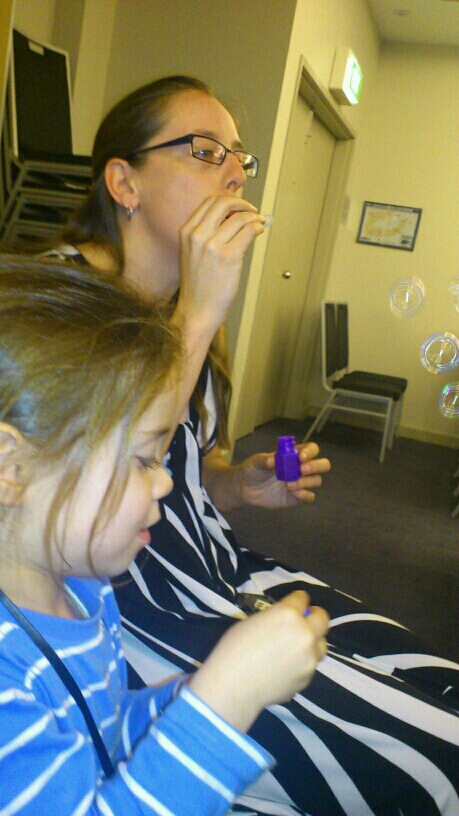 This photo pretty much sums up my Nat Con experience: blowing bubbles, with a friend, at the Ditmars ceremony, onto another friend’s head… and his rather nice shiny suit…
I also attended Sean Williams’ presentation on his PhD work – about MT/demat/”beam me up Scotty” technology and how it’s been presented in SF literature for the last 140 or so years, and that was awesome, even though it meant sitting on the floor behind Sean because the room was so full (and getting a hand up from Scott Westerfeld, and I didn’t know it was him because he wasn’t wearing a name badge NO FAIR). And I went to the Ditmars ceremony which was awesome because Deb Biancotti ran it like a drill sergeant, and because I got to applaud a lot of friends getting very nice shiny awards.
And there was also a rather large amount of talking.
Snapshot 2012 is HERE!
The Australian Speculative Fiction Snapshot has taken place three times over the past eight years. In 2005, Ben Peek spent a frantic week interviewing 43 people in the Australian spec fic scene, and since then it’s grown every time, now taking a team of interviewers working together to accomplish! In the lead up to Continuum 8 in Melbourne, we will be blogging interviews for Snapshot 2012 conducted by Alisa Krasnostein, Kathryn Linge, David McDonald, Helen Merrick, Ian Mond, Jason Nahrung, Alex Pierce, Tansy Rayner Roberts, Tehani Wessely and Sean Wright. To read the interviews hot off the press, check these blogs daily from June 1 to June 7, 2012.
As we celebrate the breadth and depth of the Australian spec fic scene, 2012 Snapshot is also a bittersweet time and we take the opportunity to remember two well-loved members of the community who sadly passed away in the past year: Paul Haines and Sara Douglass.
You can find the past three Snapshots at the following links: 2005, 2007 and 2010.
Let the stories begin…


 Randomly Yours, Alex