Tiptree Award Anthology #2
 For those just joining us, James Tiptree Jr was a magnificent SF writer whose work Robert Silverberg once described as “ineluctably masculine.” Which is amusing because she was actually Alice B Sheldon. Anyway, in 1991 some people decided there should be an award named for a woman, and that it should be given to works that “explore and expand gender”. So, to be quirky, they named it for Sheldon/Tiptree. And the award has been going since then, and there are now a number of anthologies that reflect it: excerpts from novels, complete short stories, but also other work that reflects the issues that the award desires to highlight. Which is awesome.
Debbie Notkin’s introduction does a marvellous job of discussing the very first award and how it was decided on, as well as – most interestingly – pointing out that each jury has been forced to decide all over again what it means to “explore and expand gender.” Which is good to be reminded of, because there are definitely stories in the anthology whose inclusion I was a little confused by. And this, Notkin says, is totally fine.
In honour of Tiptree/Sheldon, the anthology opens with a short essay from Julie Phillips, the biographer of Tiptree/Sheldon (which I reviewed here, and as I write I am listening to The Writer and the Critic discuss it), about talking and talking too much which is completely fascinating (and somewhat connected to the current furore over Hilary Mantel’s words about the media representation of royalty?). It’s matched with a letter from Sheldon herself, to the psychologist Rudolf Arnheim, talking about identity and science fiction and science and friendship, which is such a nice touch. And then the anthology jumps straight into Raphael Carter’s “Congenital Agenesis of Gender Ideation by KN Sirsi and Sandra Botkin,” which can only be read by itself, must be read in a single sitting, and may then require that you sit staring at a wall for a few minutes. Because it is mind blowing. It’s written as a thoroughly researched scientific article, where two scientists from different backgrounds come to a startling discovery about how gender is perceived and what that means for identity and… that doesn’t really explain it at all. It’s very accessible as well as challenging and I can absolutely understand why it won.
L Timmel Duchamp’s collection Love’s Body, Dancing in Time was shortlisted in 2004, and from it this anthology includes “The Gift.” For all that it’s set in a distant future where the narrator is a travel writer who discusses other planets rather than other countries, there’s something rather medieval in its suggestion that there is more to an understanding of gender than a basic dichotomy. And I don’t mean ‘medieval’ in a pejorative sense, but in the sense that some medieval thinkers seemed to be groping towards a similar sense – and for similar reasons as suggested here. That aside, one of my favourite parts of this story is the description of the meal composed around the ideas of Matrix Aesthetics. And made me wish that something similar could possibly exist, that combined visual, aural, and taste sensations all designed to complement one another.
The next two parts of the anthology are again from 2004, this time excerpts from the winning novels. The Tiptree Award is an interesting one in that it seems to me one of the few really big-name awards that considers all work for one award (shorts and novels), and which is not afraid of having a tie (which has happened a few times). Firstly here, Joe Haldemann’s Camouflage – the first four chapters and “and two from a little further along,” according to the reading notes. I HAVE to read this novel. It’s utterly gripping, right from the start: an alien comes to earth millennia ago, and is capable of changing its outward appearance to be… whatever it likes. Imagine the consequences of that on ideas of gender and identity. This is complemented by an excerpt from Johanna Sinisalo’s Troll: A Love Story, which I imagine I will also get around to reading. Translated from the Finnish, it does indeed involve a troll, as well as (again according to the reading notes) mail-order bride slavery and Finnish folklore and homoerotic imagery. In this excerpt, the narrator’s night has started badly, with a failed date, and gets worse when she finds a bunch of boys attacking an animal. Things get weirder after that.
“Looking for Clues” is Nalo Hopkinson’s guest of Honour speech from WisCon (the convention where the Tiptree is announced) in 2002. As a woman of colour, as she explains in her speech, finding people “like her” was one of the aims of her extensive early reading – because there weren’t that many. She takes a winding road through various media and her experiences to look at the different sorts of role models (and not) available through her childhood and teenaged years, as well as making pointed remarks about people who insist on remaining ignorant about the issues. It would have been a brilliant speech to hear in person.
Eileen Gunn’s collection Stable Strategies is another one that got shortlisted in 2004, and as a representative this anthology chose “Nirvana High,” co-written with Leslie What. This is one of the inclusions that I simply do not get. It’s a clever story and it says interesting things about difference, and about growing up as ‘different’, but I don’t see that it says things about gender that connect it to the Tiptree. But I’m sure Notkin would say “and?”
From 1996 comes Jonathan Lethem’s “Five F***s” (sorry, I would like to keep this profanity free!). It’s a series of six vignettes, and in all of them there is a woman whose life appears to be different each time she has sex with a particular man. Indeed, it’s not just her life, but the world around her; in this sense it reminds me a bit of Lathe of Heaven. The lover does not appear in every story; in all but the first, there is a different man – Pupkiss, a policeman (mostly). So there are elements of the procedural to some of the sections, but not really. It’s one of those stories, as you may be able to guess, that is particularly hard to explain. It should just be read.
Carol Emshwiller’s “All of Us Can Almost…” is another story in the I don’t entirely get it pile. Shortlisted in 2004, it’s about desire and lying and determination, and while I think it’s a very good story and fascinating in what it says about interactions between people and expectations, I don’t entirely see that the gender aspects – which I can see – are an interesting enough or explored enough aspect to get it shortlisted. Again, refer to Notkin’s advice.

Gwyneth Jones is rapidly becoming one of my favourite authors, so I was pleased to see an entry from her here. Rather than a piece of fiction, it’s a paper she gave called “The Brains of Female Hyena Twins: On the Future of Gender,” presented at the Academic Fantastic Fiction Network conference in 1994. In it, she ranges far and wide over scientific papers that discuss aspects of gender and biological sex in animals (those hyenas, peacocks, lizards and fish…), as well as gender and sex in humans and their malleability, as well as some frightening aspects of the battle of the sexes. It’s erudite and occasionally witty (insofar as such a topic ought to be), and outright challenging to biological determinists.
The penultimate place belongs to Ursula le Guin, for Another Story, or A Fisherman of the Inland Sea which I have read before but fell in love with all over again, reading it here. The planet of O is such a richly realised place – their marriage customs so breathtakingly original – and they’re not even the centre of the story, which is I think mostly about scientific research and its impact on individuals, as well as the impact of family, and the choices that we make… It’s wonderful.
Finally, Jaye Lawrence’s “Kissing Frogs” is described as “a pleasing after-dinner mint of a story” by the reading notes, and I think that’s about right. It’s a retelling of the fairy story, of course; it’s amusing and sweet and I can’t go into any details because the point of it is the little twists Lawrence weaves in. A highly enjoyable way to complete the anthology, anyway.
What this anthology does, and I presume what it set out to do, is give a broad overview of the point of the Tiptree Award – showcasing works that various juries have thought worth honouring, as well as including work that must help to inform the juries, and authors, and readers about the ideas of gender that the award wants to recognise. It succeeds in this aim, and no doubt in a secondary aim as well – of publicising those names whose work has been recognised, so that they get more recognition, and more people are challenged and inspired by their words.
You can get this anthology from Fishpond.
Zendegi: a Greg Egan novel
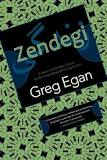
My e-copy of this book categorises it as “Fantasy; short stories.” It is neither. Rather, it is a near-future novel about politics, virtual reality, religion, family relationships, and death.
No, it is not a Patrick Rothfuss or George RR Martin-style tome. It is elegant.
Two strands: Nasim is an Iranian woman living in America, working on the mapping of individual finch brains to try and create a generic brain map. Martin is an Australian journalist working in Iran, who gets to cover escalating political unrest. (This book was published in 2010….) Flick forward several years, and Nasim is living in Iran and now working on Zendegi, a virtual-reality platform used by millions of people, mostly for entertainment. Martin is still in Iran, married with a son. I trusted that the two strands would eventually cross, but I really couldn’t figure out how. The answer is both ‘cleverly’ and ‘via tragedy’ (Egan, you are nasty).
I am in serious danger of becoming quite the Egan fangirl. Just so you all know.
Egan does a marvellous job here of entwining the intimate and domestic with large-scale societal issues. Personal tragedies are neither hyped up to become world-ending nor elided as insignificant. The plot moves carefully between, for example, Zendegi as entertainment for a six year old and Zendegi as bleeding-edge technology – and how the company can deal with competitors. Egan portrays politics as they are seen by a slightly-above-average interested citizen, rather than focussing on politicians; he touches on religion as it might be experienced, rather than trying to show rights and wrongs. He’s a sensitive and compassionate author, but did I mention nasty? Also, I think he writes women well, which is something I’m coming to appreciate more and more. Nasim’s feelings of anxiety over having left Iran, and wanting to return, read realistically. In fact, overall human attitudes and relationships read as believable: complex and contradictory and frustrating and glorious.
In a more classically cyberpunk novel, Zendegi would get far more of the focus that it does here; characters don’t actually spend that much time in the virtual world, for example. It is incredibly significant for both Martin and Nasim by the end, but still I am a little surprised by its use as the title. I think Egan has hit on a more likely way for virtual entertainment to encroach on our lives than most early cyberpunkers did – more subtle, and perhaps more insidious for the fact. It’s really nicely presented.
This is a novel brimful of complex and challenging ideas that is an absolute, pretty much effortless, delight to read.
You can buy Zendegi from Fishpond.
Scorched Supper on New Niger
I got hold of a copy of this amazing novelette (I think? 17,000-ish words) from one of Galactic Suburbia’s wonderful listeners, who is the Editorial Director of a new digital publisher, Snackreads – he sent through a copy because he thought it would be up our collective alley.  To which the answer, I think, is OH YES.
A future where there are space ships carrying cargo between planets as easily as trucks do today… but where there is, for some unknown reason, a societal reaction (on some planets) against women having the freedom of movement to do things like be in space. Dee has taken over a freighting company from her formidable aunt, but is facing difficulties in the shape of her sister, her sister’s husband, and mounting debt. When she has to land on New Niger, things appear to be as desperate as they can be, so she ends up making a deal with a competitor… and things go from there.
The things I love about this story are many: I love Dee’s voice as she makes clear just how much it means to her, to be a pilot, and just how much she hates the idea of being trapped by her brother-in-law. I adore the idea of New Niger (although I must admit I don’t know how accurate Charnas is in her descriptions of Old Niger, and it may well be that there are some things that are offensive/otherwise wince-worthy, and if there are I’d love to hear it) – people of colour in space! Who would’ve thought it! I particularly love (although see previous brackets) the way that one character there, in particular, plays on racial stereotypes very consciously to her own advantage. The denouement had me quietly cackling with glee. I enjoyed the pace of the narrative, the action overall, the ‘domestic’ setting (family feuds) commenting on larger social realities…
I should get me some more Charnas to read, I guess.
Exile from Space: a short Judith Merril story

I’ve been wanting to read more Judith Merril since Helen Merrick’s Secret Feminist Cabal, since Merril features pretty prominently in the early years. The lady wrote “That only a Mother could love” – a seriously amazing piece of fiction that I’m sure Russ would have dismissed as ‘galactic suburbia’ but I think is staggering in its suggestion about life for the ordinary woman in The Future.
Anyway, “Exile from Space” – the basic story is young woman going to the city for the first time, but there’s clearly something a bit odd about this young woman because of how she talks about her education, and about other people… and it quickly becomes apparent that she has not been living with other humans, at least for her teen years. So although she herself is human and passes for human, she has to deal with all these weird things like eating, and shopping, and interacting with humans – such that she might as well be an alien. Oh, the many levels of ‘alien’. And then, of course, there’s a man…
Merril’s writing is delightful and elegant, and conveys the sheer weirdness of human existence simply and clearly. So many things we take for granted…. This story makes me wish I could find more of Merril’s work, but I keep coming up with nothing wherever I look. I got this story from The Gutenberg Project.
Galactic Suburbia Award
In our last episode (previously, on GS…), we announced the winner of the Galactic Suburbia Award for 2012. You can now read Elizabeth Lhuede’s acceptance speech over here at the podcast blog.
You can also see the full shortlist, complete with links so you can go and check out the awesomeness of everyone for yourself.
Dreaming Metal
I missed a first-in-the-series, here, which is a bit frustrating; I’m usually pretty good about not doing that. Anyway, if it’s going to bug you like it annoys me, go read Dreamships first. This one will wait.
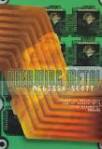
Scott likes tackling hard topics, and here she’s asking – when does intelligence become intelligence? When can, in crude terms, a computer be regarded as a being in its own right? Does there have to be a deliberate effort on the part of humans for it to happen, or could it develop accidentally? And when we finally find that silicone intelligence shares the same space as us… what will be our reaction? Because we have such a good track record of dealing with humans with different perspectives from our own, let alone an entirely different type of intelligence. Scott presents some intriguing suggestions to these questions – and a few answers, but nothing completely definitive. It’s nicely tantalising, in a lot of ways.
I generally love Scott’s worlds, and this is no different. Humanity has spread to several planets; this story is set on Persephone. For all that there’s some seriously upgraded tech, and that it’s set an unknown distance into the future, it still feels recognisably human. Like, after initial freak-out-edness, it seems like I could probably live on Persephone. This is probably helped by the fact that the story revolves around people whose own lives revolve around that rather ubiquitous human characteristic, a love of music. Initial events are spurred on by the death of much-loved music star, and one of the main characters has a souped-up illusions show at one of the ‘Empires’ – which I think are basically futuristic theatres, catering to a variety of entertainments, from rock music to vaudeville (or their futuristic equivalents). I love this idea that the human desire to be entertained, on the one hand, and the equally pressing desire to express oneself in public somehow, will continue into the future – it’s something that doesn’t get enough airplay in SF I think.
Another aspect of the world-building that I really appreciated is that it’s clearly not a monoculture. I think this is the one main area where not having read Dreamships was a problem (aside from a couple of plot points that I managed to catch up on); the use of ‘coolie’ and ‘yanqui’ and other terms clearly referring to ethnic background didn’t always make sense to me – or, where I could but out the basic meaning (like with those two), it sometimes took me a while to figure out all the subtleties, like whose allegiances lay where and who felt which grievances. Nonetheless – this is a future that is not overwhelmingly white, where cultures have continued to develop and take on bits and pieces of older traditions and moosh them together, and where people can live on the same planet and not be identical. Also, where a common expletive is “Elvis Christ”.
The plot? Assassinations, destruction of property, intrigue, romance – all revolving around that idea of artificial intelligence, how it might come about, what should be done about it if it does, whether machines taking over from humanity in any area is a good thing, and all of those good things.
Scott writes beautifully. She switches between characters effortlessly and gives each a distinct voice. She matches a great plot with hard questions and does wonderful service to both. It’s not quite as cyberpunk as, say, Trouble and Her Friends, but it’s wonderful science fiction.
Bitter Seeds: a review

First things first: this is not an Alisa book (WW2 references and events), nor is it a Tansy book (there are children, and babies, and things are not always nice).
This is not, actually, what I would immediately think of as an Alex book, either. I don’t tend to go in for WW2 alternative histories. I don’t object to them, but I don’t have the fascination for Nazis that still seems to occur in Western culture. (Seriously, what is WITH that? Can’t we move on?) I also don’t have the deep understanding of WW2 tactics and dramatis personae that enables me to pick the subtle alterations that can be made. Nonetheless, I got it for review, and the front cover phrase – “An unnatural power. An unstoppable force” – was intriguing, as was Cory Doctorow’s description of it as “Mad English warlocks battling twisted Nazi psychics.”
That is, indeed, the premise of the plot. A German scientist (I use the term in its broadest, amoral sense) has been experimenting with the aim of creating – you guessed it – superhumans. The English find out about it, or bits of it anyway, and in response start trying to figure out what their defence can possibly be. The answer is… not very nice. There’s an element of ‘doing wrong in order to do good’ about a lot of the English response, which causes some of the characters some angst but occasionally didn’t seem to worry them nearly as much as it ought. My reaction to this vacillated. On the one hand, a bit more hand-wringing (or more effective equivalent) would have increased the humanity of the characters; on the other hand, I fully understand that war can and does change perception and attitude, and perhaps what Tregillis is being is brutally realistic. Whichever, it often makes for somewhat unpleasant reading.
The story begins with three significant events in 1920, then jumps to 1939 and continues on to 1941. The 1920 prologue introduces three significant characters and their assorted others. Two children arrive at a deserted German farm (spooky); a group of children steal from a backyard vegetable garden and their ringleader gets rather more than he expects from the garden’s owner (amusing); and the very young scion of a noble family learns rather more than he wants about his odd grandfather (spooky, again). The German children, of course, are subjects for the German doctor’s experiments and – slight spoiler? – both live to become agents in service of the doctor and his patron, Himmler. The young ringleader is taken under the gardener’s wing and joins the Royal Navy and then the Secret Intelligence Service (you know James Bond started off in the navy, right?), and is the one who starts cracking the nut that is the weird German actions. And the other gentleman… well, that would be a spoiler, so I won’t explain him. But he definitely crops up again. Of these characters it is fair to say that none are especially loveable, or even likeable, most of the time. The English secret agent, Marsh, is initially the most approachable, but that doesn’t last. They each have moments where sympathy is definitely appropriate, but half the time they’d go and do something or say something that, if not actively making me dislike them, certainly made me ambivalent. That’s not necessarily a bad thing in a character, but it certainly made the reading experience more wearisome than others.
The plot basically follows the development of WW2, with added supernatural/psychic/weird elements that naturally alter how some things pan out. I think Tregillis has thought out the repercussions of these new weapons quite well, but then I’m no military historian so my approval is definitely suspect. As with any war, things get more and more unpleasant as time goes on. This is not a nice novel. People get hurt, and not always the right people.
Bitter Seeds is well written and a very examination of the way psychic weapons could alter warfare. It’s also a fairly bleak look at how people react under stress. It’s very well written – engaging, well paced, and with well-timed shifts between characters. All of that said, I don’t see myself seeking out the sequel. I don’t think I could handle the fact that I am quite sure the story can only get bleaker before it maybe, possibly, gets brighter – and sometimes the brighter doesn’t entirely make up for the bleak. So, enjoyable, but not really my sort of thing after all.
You can buy Bitter Seeds at Fishpond.
Etiquette and Espionage: a review

“Young ladies ought to be seen and not heard, except when they’re climbing over dirigibles or looking for secret information. Unless the being seen bit is part of a misdirection.”
This advice pretty much sums up what Mademoiselle Geraldine’s Finishing Academy for Young Ladies of Quality is all about. They learn music and etiquette, along with eyelash-fluttering and the language of parasols, but all of it goes into the service of turning out young ladies who are capable of stealing, finding, maiming, subverting or even killing anything or anyone as required. With decorum, modesty, and a poise that befits their position. Woe betide any stain on a petticoat hem.
Gail Carriger has returned to the world she created in the Alexia Tarabotti (two of which I’ve reviewed here), although this appears – from various internal hints – to be set before Alexia’s thrilling adventures into how to dress to deal with the supernatural. This means that this is a decidedly other version of Victorian England; one in which mechanical servants are completely de rigeur, as is having both a werewolf and a vampire on the faculty of said Finishing School. There are trains but there are also dirigibles; there is no telegraph, but it’s ok – there’s still lots of fashion.
For fans of Carriger’s previous work, I should mention some of the differences, the foremost being in the main character. Sophronia is fourteen, and therefore – despite a propensity towards precociousness – very different in outlook from the adult Alexia. Attached to this is that Sophronia is a student, and therefore at least nominally restricted in her movements, unlike Alexia.And, while Alexia’s adventures revolve around the supernatural because of her unusual preternatural status, the supernatural is just there for Sophronia – to be admired or scared of occasionally, but not intersecting with her everyday life in much of a way (although Captain Niall is a spunk). None of these comments are intended to be in any way a complaint about this new novel; it’s just good to clear the air for fans of the previous work.
So, Sophronia. Imagine getting settled with that for a first name. She’s the youngest daughter but somewhere-in-the-middle child of the Temminnick household, consistently getting into trouble and generally causing small-to-medium mayhem (landing a trifle on a lady’s head doesn’t quite count as major mayhem, since said lady was a duchess or anything). This mayhem is naturally upsetting to her mother, mostly because it means that Sophronia is not acting like a lady and generally ends up looking very unlike a lady (custard is unbecoming). Thus, to finishing school, much to her sister Petunia’s relief (… I think I would rather Sophronia as my name) and Sophronia’s dismay. Fortunately, the journey to the school itself contains adventure, and Sophronia begins to suspect that this school may not be quite what she was expecting. And then she reaches the school itself, and the very buildings indicate that this is quite something else.
The plot revolves around good old fashioned intrigue amongst students and staff, as well as an external threat. As with any good school-based novel there’s a deal of sussing-out the good eggs from the bad, figuring out which teachers can be manipulated in which ways, and poking at the edges of the rules to see which break and which bend. The first is just complex enough to be interesting, even amongst Sophronia’s group of ‘debuts’ (first-years) – there’s only 6. The second is complicated by the fact that the staff are naturally quite good at the things they teach – diversion, for example, and manipulation, and generally devious behaviour. And the third – well, that’s where the fun lies, isn’t it?
The Alexia novels have been referred to as ‘bustlepunk’, and it’s fair to say that you have to have a genuine fascination with, or high tolerance for, descriptions of clothing, toilette in general, and eating to really enjoy those novels. The same applies here, although it’s laid on a little less thick – we’re mostly dealing with young teenaged girls after all, with little interaction with outside society (which doesn’t mean they can get away with not having their hair and nails perfect, nor that they can ever be seen less than fully clothed (inc several petticoats)). Sophronia is an interesting perspective to share, in this case, because her previous attitude was definitely one of scowling at the notion of ‘ladylike’. This changes over time, but the reasons for her change in attitude are also shown – and it’s not that catching a husband suddenly assumes an enormous significance for her. This slight undercutting of the social expectations of a Victorian lady was nice to see.
My one complaint, and fortunately it does not crop up very often, is something that also bugged me in a couple of the Alexia novels, and that’s the attitude towards class. Just occasionally there are comments about those not in the rarified ranks of quail-tay. Usually those comments come from unpleasant characters, but – unlike the comments on social expectations – they are not undercut to show the unpleasant snobbery inherent in such words. It’s somewhat mollified by Sophronia’s unconventional friendship with some Downstairs types, who – glory! – actually manage to be quite useful, but still… the comments rankled.
Overall, this is a rocking, enjoyable novel. Steampunk for the sake of the plot, not the aesthetic; spunky female lead (this definitely passes the Bechdel test); and a satisfactorily intriguing plot. Yes I am looking forward to the sequel… which, given this has only just come out, is something of a problem for me.
You can get Etiquette and Espionage from Fishpond.
Galactic Suburbia is 3/4 of a century old
 In which we reveal the winner & shortlist of the Galactic Suburbia Award for activism and/ or communication that advances the feminist conversation in the field of speculative fiction in 2012. You can get us from iTunes or at Galactic Suburbia.
NEWS
Hugo Nominations close on Sunday, March 10, 2013
Chronos Awards also open: http://continuum.org.au/c9/chronos-awards/
Stranger with My Face Women in Horror Film Festival – 7-10 March in Hobart, Tasmania
Glitter and Madness Kickstarter – last days to support this anthology project!
CULTURE CONSUMED
ALISA: Editing – Asymmetry by Thoraiya Dyer; A Trifle Dead by Livia Day; reading the country you have never seen: essays and reviews by Joanna Russ
ALEX: Saga, Brian K Vaughan; Band of Gypsys, Gwyneth Jones; The James Tiptree Award Anthology vol 2.
TANSY: Cabin in the Woods, Small Blue Planet, “The Lady Astronaut of Mars” by Mary Robinette Kowal (novelette)
Please send feedback to us at galacticsuburbia@gmail.com, follow us on Twitter at @galacticsuburbs, check out Galactic Suburbia Podcast on Facebook and don’t forget to leave a review on iTunes if you love us!
Request for comment: review books
Some of the books I discuss here are ones that I have received from publishers. This was especially the case when I was reviewing for the now sadly closed Australian Speculative Fiction in Focus. I have, however, rarely (if ever?) made this clear in my comments. Not from a desire to hide that fact, or in any way be deceitful; rather it’s never a habit I got into, and sometimes I forget the provenance of a book I really want to read! Some book bloggers do a very good job of announcing it (I think of Sean the Blogonaut). So what I’m wondering is… does it make a difference? Should I make a conscious effort to notify my readers of when a book was given to me gratis by a publisher or author? I’d be very interested in your thoughts.


