Saga: a graphic novel

Look, I’ll be honest: when Tansy wrote her blog post with some recommendations for the Hugo graphic novels category, and mentioned this one, and then made a rather pointed comment about me having to read it, I kinda skimmed the post because I don’t NEED another graphic novel to be reading! This is meant to be my year of reading books I already OWN! So, you know, I was just going to… not pay much attention… 😀
Then, Tansy discussed said graphic novel on Galactic Suburbia, and made it sound even more compelling – comparing it very favourably to the Deathstalker series, which she just KNOWS is bound to pique my interest.
I went and downloaded the first instalment. (I know there’s controversy around paper vs electronic comics, but I don’t want to start buying hard copy comics – I already struggle to find space for my books, this would just be another imposition. Plus, convenience.) And then I downloaded the next one. And then… yeh. So now I am as addicted as that nasty Tansy KNEW I would be. Maybe I should send her the bill. I do, though, disagree slightly with her comparison – I think the relationship is closer to that of Hawk and Fisher than Deathstalker.
Look closely at the cover and you’ll see why Tansy was smitten so quickly. That’s a mixed race (species) couple, with the woman breastfeeding a baby. And this image was on the very first issue. Remarkable, no? The story itself is actually told from the point of view of the baby herself, which is a clever little quirk and – as Tansy pointed out with some relief – it means you know that THE BABY SURVIVES. This is a good thing. The couple themselves are soldiers from opposite sides of a galaxy-spanning war, which has been going on for more years than people care to remember. She’s got wings; he’s got horns; they’re both soldiers. Their relationship – once discovered – is naturally one that does not bring joy to their respective authorities. Especially after the revelation of the abomination that is their mixed-species child.
I am still coming to terms with the idea that I have to genuinely consider the art when I read graphic novels. First, I don’t have an instinctive love of the visual medium; second, I don’t always feel that the art is… integral?… to the comics I read. It is vital in Girl Genius but seems less so in the new Captain Marvel or Hawkeye. Maybe that just makes me a bad comic-book reader. At any rate, Fiona Staples’ art is wonderful and rich and nuanced and definitely adds to the story overall. Alana and Marko – the couple – are drawn with great expression and realism. Maybe the art works here because there’s such a range of characters and species and settings – which is more like Girl Genius and less like Captain Marvel and Hawkeye. Eh; that’s probably an indefensible proposition. Probably I just need to pay more attention to the art in those stories, like I do with Saga.
There have been 9 issues as I write. Brian K Vaughan has said that there’s a definite arc he has in mind for the story, but it’s not clear how long that will take. This could be a long term commitment, TANSY. So far, there have been mercenaries; ghost-girl nannies; subversive romance novels; attempted assassinations; robot-headed folks; in-laws; magic; blasters; secrets revealed; rocketship forests; space travel; and the sorts of domestic interludes that we’ve been complaining don’t turn up often enough in science fiction and fantasy but that clearly MUST if these people are to be believed and their relationships to function. It’s a science fiction and fantasy heroic domestic adventure. It’s Mad About You meets Guess Who’s Coming to Dinner. In space. With magic.
I second the nomination of this as a nominee for Best Graphic Novel 🙂
You can buy Saga Vol 1 here; it collects issues #1-6.
First Galactic Suburbia ep for 2013!
 In which Alex touches Troy with her bare hand, Alisa discovers that the best part of Paris is not the part that’s underground, and Tansy cheats on both of them for love of Doctor Who (it was inevitable, really). You can get us from iTunes or at Galactic Suburbia.
WHAT WE DID ON OUR SUMMER HOLIDAY!
Alex: Turkey and Egypt
Alisa: Honeymoon in Paris
Tansy: adventures on the internet including the article “Historically Authentic Sexism in Fantasy. Let’s Unpack That” syndicated on Tor.com, selling Wet Shirt Mr Darcy for the Deepings Dolls, and Verity! (a Doctor Who podcast)
Hugo Nominations close on Sunday, March 10, 2013. We’ll be making recs over the next few episodes, though in the mean time check out Tansy’s post on Hugo Recs for Best Graphic Story.
The Galactic Suburbia Award: for activism and/ or communication that advances the feminist conversation in the field of speculative fiction in 2011 – to be announced in 2 weeks, get your nominations in quick! Check out last year’s winner and honours list to see the type of thing we want to hear about, or be reminded of!
Culture Consumed:
TANSY: Eureka Seasons 1-4; Captain Marvel by Kelly Due DeConnick, Dexter Soy & Emma Rios; Saga by Brian K Vaughan and Fiona Staples.
ALISA: The entire series of The Closer, Tara Sharp 1: Sharpshooter and 2: Sharp Turn.
ALEX: Abraham Lincoln, Vampire Hunter (the movie); Zendegi, Greg Egan; The Telling, Ursula le Guin… and how many books in total? Yes, Alisa really ran a book on this one.
AND!! Alisa’s exciting news!!
Happy Birthday to the Silent Producer, who totally missed us while we were away, and got a brand new episode to edit as his birthday present.
Please send feedback to us at galacticsuburbia@gmail.com, follow us on Twitter at @galacticsuburbs, check out Galactic Suburbia Podcast on Facebook and don’t forget to leave a review on iTunes if you love us!

My year in reading
I’ve done a rough breakdown of the gender stats, and it’s not really that surprising:
Fiction
Male authors: 40 books
Female authors: 47 books
Unknown: 1
Also four anthologies, which I’m not counting.
So, roughly equitable. It’s skewed more towards male than it might have been had I been reading entirely for pleasure, rather than reading judging books.
Non-fiction
Male authors: 7 books
Female authors: 3 books
A bit disappointing here, but I pay less attention to authors when it comes to history stuff; topic is way more important. That said, it still is reflective of the books that get recommended on particular topics, or that get stocked and are therefore easily available.
I read 105 books, apparently, including graphic novels. That’s down on last year, but not by much.
My year in media
For the first time I have kept track of the films and TV I have consumed over the year. I don’t watch much random TV; we tend to consume an entire series in one (sometimes extended) hit. So this list covers almost everything I watched on the screen in 2012, bar the occasional foray into the news.
Films watched for the first time:
Frost/Nixon * Going Postal * Fair Game * All Quiet on the Western Front * Source Code * Conan the Barbarian (2011) * Tangled * The Adjustment Bureau * Captain America * Iron Jawed Angels * The Avengers * Moneyball * Contagion * Underworld Awakening * Prometheus * Snow White and the Huntsman * The Dark Knight Rises * Beckett * Battleship * Margin Call * Looper * Led Zeppelin: Celebration Day (2008 concert) * Hamlet (David Tennant/Patrick Stewart version) * Argo * Quatermass Experiments (2005 BBC live production) * The Breakfast Club (FOR THE FIRST TIME YES I KNOW) * Skyfall * One in the Chamber * The Bourne Legacy * The Expendables 2 (…twice…) * Total Recall (the remake) * The Hobbit, Part 1
That’s not actually as many as I would have guessed. Possibly because the next list is a lot longer… what can I say, I like things that are familiar.
Films: the rewatch:
Chronicles of Riddick * DOA (I know. No, seriously, I know) * Lethal Weapon 4 * Alien * Under Siege * Aliens * X-Men: First Class * Stand By Me * All Quiet on the Western Front * The Siege * Marie Antoinette * Harry Potter and the Goblet of Fire * Tomb Raider * Harry Potter and the Half Blood Prince * Aeon Flux * Children of Men * Mr and Mrs Smith * Iron Jawed Angels * Danton * One Night the Moon *Aliens (again) * Batman Begins * Serenity * The Dark Knight * Nicholas and Alexandra * Minority Report * Grease * Romeo and Juliet (Zefirelli * Romeo + Juliet (Luhrmann) * Sahara * The Avengers (um, twice) * Chronicles of Riddick (again, ok?) * The Imaginarium of Doctor Parnassus * Good Morning Vietnam * The Outsiders * 2012 * Fellowship of the Ring (extennnnded edition) * The Two Towers (extennnnded edition) * The Return of the King (extennnnded edition) * Star Wars IV: A New Hope * Avengers (…) * Beneath Clouds * The Imaginarium of Dr Parnassus * Van Helsing * Quantum of Solace * Expendables * Salt * The Negotiator * The Mask (most of) (omg so bad) * Dante’s Peak * Goldeneye * Tomorrow Never Dies * The Dark Knight Rises
So that’s quite a few. Some of these I watched for/at school – occasionally twice in a semester, once to preview it and once with a class. Also, there are just some films that are go-to. I am astonished that The Fifth Element is not here!
TV for the first time and rewatch:
Ashes to Ashes (season 2) * (New) Doctor Who (season 1) (rewatch) * Las Vegas (season 1) (rewatch) * Las Vegas (season 2) (partial rewatch) * Las Vegas (season 3) * Sherlock (season 2) * Las Vegas (season 4) * (New) Doctor Who (season 4) * Las Vegas (season 5) * House (season 7) * (New) Doctor Who (season 5) (rewatch) * Top Gear (season 18) * Dirk Gently’s Holistic Detective Agency (season 1) * House (season 8) * Game of Thrones (season 1) * The Prophets of Science Fiction (most of most of the episodes) * Firefly (rewatch) * Stargate Universe (season 1) * Ashes to Ashes (season 3) * A Rather Large Amount of the Olympics, inc opening and closing ceremonies * Outcasts (the first and ONLY (sob) season) * Doctor Who (season 7… well the first half) * Heston Blumenthal’s Search for Perfection (season 1) * Metal Evolution * The Deep * random bits of Classic Who * Paradox (the five eps that got made before cancellation… /gnashing teeth) * Homeland (season 1)
This list doesn’t look as long, but of course they don’t represent just 2 hours of viewing like most of the films (all right, nearly four for each of the extended LOTR; whatever). Las Vegas seasons each had 22-odd episodes, for example…
Overall I think my media consumption reflects me pretty well. Loads of SF and action, with some literary stuff chucked in there along with Metal Evolution for some balance, and some trashy but enjoyable stuff as well.
Remnant Population
 As soon as I have written this review, I am throwing my copy in the bin.
Which is a tragedy, because I loved it.
So why the bin? Because page 122 proceeds to page 171, goes through to page 202, and then to page 155… and thence to the end. So I can never read this again, and can never lend my copy to anyone, and I cannot in good conscience even give it to a charity.
So sad.
But yes, I kept reading, even with missing 30 pages in the middle, because this book is ABSOLUTELY INCREDIBLE.
If there’s no country for old men, there’s barely even a nice quiet kitchen for old women. But this story is centred almost entirely on the experiences of one old woman, Ofelia – whom Ursula le Guin described as “one of the most probably heroines science fiction has ever known.”
I got hold of this last year as part of the Women in SF book club which sadly imploded in about May, as the host decided she couldn’t do it any more. Hence its sitting on my TBR shelf all this time. When I decided to finally read it a few days ago, I didn’t even read the blurb, I just jumped on in. Which can be a really awesome way of doing things, if you either trust the author or the recommender enough.
Ofelia is a widow, living with her sole remaining son and his rather unpleasant wife on Colony 3245.12. Sims Bancorp Company has the franchise for the planet (… what the?? Ah capitalism…), and the colonists are all basically contractors to them. So when the Company loses the franchise, because the colony isn’t doing well enough, all of the colonists have to leave. With 20kg of stuff each. After living there for forty years. In 30 days’ time. Ofelia, though, gets a very sneaky idea: what if she didn’t leave? What if she hid out until the shuttles have left, and just… stayed? Which she proceeds to do.
A good chunk of the story is concerned with Ofelia on her own, and how she physically copes with gardening and what she decides to make and so on. There is an interesting comparison to be made here between her experience and that of the woman in Joanna Russ’ “We Who Are About To…”. Very different situations, of course, but both women alone on a planet, and very different responses. Perhaps more intriguing is the decisions that Ofelia makes about herself, and the internal dialogue she has about those things: about doing what she wants and not what she doesn’t – wear clothes? plant certain things? and whatever else. Her reflections on her life, and the expectations on her as a daughter, a wife, a mother… a woman… are painful because they ring so true.
It’s a bit of a spoiler that Ofelia eventually discovers that she’s not alone on the planet, but the blurb reveals that (it turns out), so I don’t feel bad about saying it. The relationship between Ofelia and the aliens (who are after all the indigenous ones) is utterly captivating and real and compelling. And Ofelia never stops being an old woman: it’s not like she’s magically transformed into a Ripley, all brave and sacrificial, or any other somewhat-stereotyped female figure. She stays a bit cranky, and quite achy, and impatient; when the creatures turn up, she’s more cranky about losing her precious, precious solitude than anything else, and when they want to learn she has a moment of, “Again? But I’ve DONE the mother thing already!” – which I think is hilarious and totally appropriate.
Moon makes me think again about the way the elderly are treated in society, which I’m sure is at least part of the point. The way Ofelia is treated because she has no formal training, and because she is old, is horrible and cringe-worthy. The alternatives are joyous and far more honourable.
It’s a wonderfully written story, and even with missing 30 pages I loved it very much.
You can buy it here: Remnant Population: A Novel
Amazons of Black Sparta: a review
 My mother gave me this book for Christmas 2010, I think after hearing about it on the radio? I’ve had great intentions of reading it since then, of course, but until now they have gone the way of many other good intentions. The other day, though – at least partly inspired by Tansy’s post about ‘Historically Authentic Sexism in Fantasy’ (which also appeared over at Tor.com, although be warned that one of the first comments is ‘most readers of SF are men’ and…I don’t even) – I decided it was time to read it. (There’s also been a bunch of great stuff written about the historical position of powerful women, as queens and warriors etc recently, calling out people who say women have had basically no part in the Great Historical Narrative That Is Mankind.)
This is a book of history. It appears to be thoroughly researched and meticulously end-noted. Alpern constantly refers to his sources, comparing the differences in their perspectives and attempting to explain them based on time, possible prejudice, and other aspects. This is particularly relevant and important because the sources come from a span of two centuries or so, sometimes using second-hand sources, and occasionally coming long after the actual events.
The book is about genuinely documented, real-life warrior women, who were pretty much automatically called Amazons by European observers, in the kingdom of Dahomey, on Africa’s western coast. And these are not from some far-off misty time; no, they date from the late 1700s at the very latest, and last saw action against the dastardly French when those colonisers decided to fight against and take Dahomey… in 1892. They were experts at the use of muskets and spears and – my favourite – the giant razor: said to have weighed 20 pounds or more, it had a blade 24-36 inches long that folded into a wooden handle. It was wielded with both hands and was particularly good for decapitations.
It’s not quite the book I was expecting. I think I was anticipating that was more narrative-driven, but only the last quarter or so fits that bill. The first three quarters read more like a catalogue: the recruitment, training, weapons, and everyday life of these women. The narrative comes when Alpern documents the battles that the ‘warrioresses’ took part in – first against other local tribes for a variety of reasons, then in two set of skirmishes/pitched battles with the French.
There are a lot of fascinating parts to this book – like the fact that the women as warriors may have originated in them being elephant hunters, and the fact that Dahomey had a lot of symmetry going on with women having parallel offices etc to the male hierarchy. One awesome, somewhat incidental bit – and this is for the fabric fetishists – is that the warrior women may have been involved in creating a gigantic patchwork, along with other palace women. It was composed of samples of every type of fabric imported into the kingdom or made locally. At one stage it was apparently up to 400 yards by 10 feet, and exactly it was intended for is unclear. The other mighty fact in the story is that pretty much everyone acknowledges that the women were mighty warriors, as good or better than their male counterparts, and generally even fiercer in actual battle: like, they were the last to retreat, and on a couple of occasions it was only women who got past the enemy’s barricades. And before anyone even thinks it, apparently the enemy generally did not realise that they were facing women, at least in the early battles, so no it’s not because they let the women in (besides, they were CARRYING MUSKETS or other guns – who would be stupid to let in anyone carrying a GUN? (hmm, perhaps this is a little close to the bone today)).
A very interesting read, and a fascinating period of history in general and in specific.
Four Ways to Forgiveness, or, Ursula le Guin is the best
There is just no denying it: Ursula le Guin is one of the greatest writers of the last 50 years (at least), and I firmly believe that the only reason she does not get more recognition for her commentary on race, politics, and – especially – gender – is because she sets much of that discussion off world. But, as I’ve mentioned before, this makes the discussion both easier to read – it’s not my society being critiqued! – and harder-hitting, because when we see our faults in aliens… it hurts more, somehow. Or maybe that’s just le Guin’s genius.
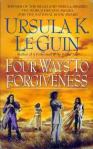
So. Here we have four interconnected short stories (although if we’re being technical I think the last two are probably closer to novellas). We have two planets, Werel and Yeowe. Yeowe was uninhabited until the Owners on Werel decided to start mining and farming it, for which they used the labour of their assets. Yes, Werel is a slave-owning society, and a capitalist one (I see what you did there, le Guin – very nice indeed – Marx needs a little chastising sometimes). And within the hierarchy of owner/owned there’s a gender hierarchy as well, with women being firmly the lowest section of each caste. Sounding familiar? Well yes, except that here lovely onyx skin is the most prized, and the paler you are – the more ‘dusty’ – the more obvious your slave status.
Me, I’m one of the palest of the pale whitefellas around. No way can I presume to comment on how people of colour would react to this inversion. For myself, I’ll admit that reading the derogatory term ‘dusty’ did not at first make sense (I thought it was referring to them living in the dirt and dust); and while it was uncomfortable in the context of slave/free, it’s awesome to read stories wherein black is desirable and beautiful… and it’s not a big deal.
The four stories all deal with the same basic issue and time: the consequences of a revolt of the ‘assets’ on Yeowe against the Corporation who owned them: consequences for the Owners and the assets, for men and women, and for the alien Ekumen observers (this fits into le Guin’s Hainish cycle). For me, while revolutions are interesting and all, it’s the aftermath that’s really the meat of history. What difference does it actually make? How long do changes take and how long do they hang around? Changing the world is one thing; changing attitudes and desires and beliefs quite another.
The first story, “Betrayals,” is set some time after the Liberation, in a nowhere town on Yeowe. It’s the story that has least to do with the Liberation itself, although it comes about as a result of it. It’s a tale of two old people – and how refreshing is that? – dealing with being old, and the changes in their world, and how frustrating the world can be when you’re not able or allowed to make big changes yourself any more… but you can still make small ones, that do make a difference. Bitterness and growth and love. Also gossip, and the downfall of heroes.
“Forgiveness Day” comes first from the perspective of a ‘space brat’ – a worldly (hmm, or not; she doesn’t really have a world) woman of the Ekumen sent to Werel to act as an observer there. Being an observer on tight-knit, inward-facing and closed-mouth Werel was always going to be a difficult task, but having a woman in that position – going out, rather than staying in the beza (woman’s side); her own property, rather than a man’s; speaking to men as their equal – is yet another kettle of proverbial. Solly deals with it rather bullishly, which is perfectly fair and understandable. What puts le Guin at the pinnacle is that she writes Solly completely sympathetically for maybe a quarter? of the story, and then relates the next section from the perspective of Teyeo, her bodyguard, of whom Solly has a very dim view but who again comes across as immensely sympathetic, and casts some shade on Solly; and then the rest is the two of them in rather a pickle. It’s a commanding story of attitudes and cultural perspectives, and change in the face of necessity. It also starts opening up Werel society to the reader, giving hints and clues about how and why it works, which while not making it likeable begins to make it comprehensible.
“A Man of the People” begins on Hain, with a young boy growing up in a sheltered, insular pueblo… who eventually gets impatient with the local knowledge available and longs for something bigger. Nearly half of the story takes place on Hain as Havzhida learns about universal knowledge and eventually becomes a member of the Hainish delegation to Yeowe. While the previous story showed Werel from an outsider’s perspective, seeing Yeowe post-Liberation from such a view is revealing too, not least because the gender hierarchy has been replicated. The rhetoric of freedom, of liberation, is a complex one, and le Guin makes some offerings on how to understand it in this and the next story in particular. I think this story is my favourite, at least partly because it shows how power doesn’t have to come from violence, and subversion doesn’t have to involve deceit. And the characters are wonderful and varied, and Havzhida is a willing observer – not insistent on participation where that might not be appropriate. Which is something that some activists might do well to understand.
Finally, “A Woman’s Liberation” is probably the most difficult to read of the lot. The first is post-Liberation Yeowe, so at least the theory of freedom is present; the second is Werel, where there is no freedom for ‘assets’ but Solly and Teyeo move freely (mostly); the third is post-Liberation Yeowe too, with Havzhida moving freely and women beginning to do so. “A Woman’s Liberation,” though, is from the perspective of a bondswoman – an asset – on Werel. She is thus doubly bonded, doubly enslaved, both to her Owner and to the men of her caste. This makes for a sometimes-painful reading experience – not gratuitous, not unnecessary, but painful nonetheless. Things do change, as the name suggests, but le Guin does not hide the fact that changing official status is difficult, and indeed is only one step in losing the ‘slave-mind’. Rakam is a glorious character who grows and struggles and is unrelentingly honest with the reader. She’s inspirational.
These stories are complex and challenging and absorbing and frustrating because they do not fill in all of the gaps. By the end a general sweep of the history and society of Werel and Yeowe has been revealed, but there is so much more that could be written! This is one of the peculiar gifts of le Guin, I think – she does not tell us everything. Only what we need to know. Which is about liberation, and freedom, and individuality, and community, and love.
China Mountain Zhang
I’m conflicted about what to think about this lovely novel. On the one hand, there’s a part of me that thinks “it’s lovely, but it’s not that original.” This is partly because gay characters aren’t unusual in SF any more. Of course, there’s still not a huge number of them, so having a gay protagonist is indeed a good and challenging and different thing. I’m not sure what else makes this novel feel… familiar, I think, rather than avant garde or edgy; perhaps it’s that it doesn’t push the SF element, so the place does indeed feel close to home. And I usually like my novels to have that aspect of challenging edginess to them. Of course, this one does have those elements; they’re just not that outrageously obvious.
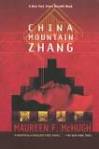 There are some novels that feel ‘pushy’ – I do hesitate to use the word, because of the negative connotations, but books like Alastair Reynolds’ Revelation Space sequence or Iain M Banks’ Culture novels are pushy SF; they make the SFnal features a front and centre part of the story, with the rest of the story necessarily incorporating giant AI minds or space ships. China Mountain Zhang does not make the fact that these events are happening at an unspecified time in the future an upfront-and-obvious part of the story; it’s fundamental to the events, yes, but McHugh unfolds it gently and quietly and innocently: “Oh, you didn’t realise my story was set in a post-socialist revolution America? What did you think was going on?”
The whole novel could be described as gentle and quiet. Even big events in characters’ lives are somewhat down-played. Even though the reader gets events from different characters’ perspectives, there is a feeling of detachment that lends a certain remoteness to it all; a certain in-the-larger-scheme-of-things attitude. Which in a bizarre way I think often emphasises the losses, especially, that each of the characters experiences.
This is in many ways a story of loss – actually a series of stories of loss. Half of the chapters focus on Zhang, the titular character, and follow his life across several years as he tries to find his way through the minefields of being gay when that’s basically unspeakable, of being ABC (American Born Chinese) when being Chinese-born is the way to the best jobs, and the other lesser and greater difficulties of growing up and moving around and fitting in. The alternate chapters do not always seem to fit in, although of course there are ties that bind. A kite-flyer who’s down and out; a goat-herder on Mars; a new-to-Mars immigrant; a Chinese-born woman in America. All with losses and experiences and fierce joys that are so different from Zhang’s but that clearly fit into this remarkable world that McHugh has created.
Because while Zhang is a compelling character, for me it really was the world-building here that fascinated and still has me thinking. I can well imagine that a non-SF lover could read this novel without being overwhelmed by the SF elements, which is for me always an interesting exercise to consider; yes there’s people on Mars, but the considerations of life there are generally so mundane, as of course they would (will?) be for any sizeable population, that you could almost overlook that. There are other SF elements that I really loved – like the system that allows a user to design buildings and other things – but really the most shocking aspect is the one that very little real attention until the last chapter: that little fact that America is now a Socialist nation, and has effectively become a client state of China. Knowing only a few Americans well, and having had very few political discussions with them, I am still well aware of how outrageous using the s-word to describe any aspect of their politics is. I cannot begin to imagine how McHugh’s book was received by the general public – if any of them were aware of it – in 1992. Just like I can’t imagine how people read le Guin’s The Dispossessed in the 1970s.
I really enjoyed it. It’s an easy read that sucks you in and gently smacks you over the head.
At the Mouth of the River of Bees
Turns out I have loved Kij Johnson longer than I thought I had. I first remember reading something of hers and being blown away with “Spar,” in 2009. Except, though, it turns out she wrote “26 Monkeys, Also the Abyss,” which I read and adored (possibly unreasonably) in 2008. And

now I own these two and a whole bunch of other glorious work in this fabulous collection. Also, “Ponies.”
“26 Monkeys, Also the Abyss” is told in 24 parts of varying length and purpose. It revolves around Aimee, who one day became the owner/manager/carer of a troupe of 26 monkeys (well, 25 monkeys and a primate), who travel the fairs and carnivals of America (127 in a year, with time off for Christmas) performing their routine… which ends with them disappearing from a bathtub. It’s a story of the unexpected things in life and how they are the things which can matter most; that the things we love don’t have to make sense, and it’s ok when they don’t. Life has loss and love and discovery. And, sometimes, monkeys. (And a primate.) I love, LOVE, this story.
“Fox Magic” is one example of Johnson’s penchant for Japan and Japanese culture and myth. Here, a fox falls in love with a man, and the magic is to make it reciprocal. This, of course, has Repercussions. One thing I admired about this story in particular is that the fox maiden is mostly very aware of the doubled world created by the magic. There is little pretence that the magic has made everything (some things, yes, but not everything) different. Also, it confronts some of the detrimental repercussions, beyond the fox and her beloved. This sort of honesty and, well, bluntness is a bit of a hallmark of Johnson’s.
“Names for Water” is utterly unlike the previous two stories – which, let’s face it, is also a hallmark of Johnson’s stories. You never quite know what you’re going to get. This one… well, it could be read as a reason for keeping up your studies; it could be read as a meditation on the long-term and unexpected consequences of small things, and on the inter-connectedness of the universe. Johnson takes the idea of static on a phone call and… goes places. It’s also lovely how many names for water she includes.
“The Bitey Cat” is a fairly unpleasant little story – that is, well written, but the narrative itself is not nice. A little girl and her bitey cat and the trouble they get into. It’s dark with the sort of darkness that you can only talk about with childhood.
“The Horse Raiders” is also dark, this time the sort of dark you get when a story’s about, well, horse raiders; a planet where things are not going that well, where communication between different groups has broken down, and different groups have very different sets of values. Katia’s family are nomads, travelling with their horse herd; she is the vet. Tragedy strikes and she must adapt, through pain and difficulty and anger, to a new life. One of the most intriguing parts of the whole story is the concept of n’dau. The world here turns so slowly that it is possible, being a nomad, to always be where a person and her shadow are matched in height; a right place. I love this idea of the psychic matching the landscape.
This is not a generally happy collection, is it? Brilliant, but by no means happy. “Dia Chjerman’s Tale” is in some ways the impersonal story of an entire planet – one that is theoretically part of an empire, and has contact with an alien race, and the repercussions of that. But it is also a heartbreaking personal story, as the opening indicates; Dia Chjerman is the 27-times grandmother of the woman relating the tale, who is now living those repercussions. Yeh. Personal and political, hello.
On a completely different note is “My Wife Reincarnated as a Solitaire – Exposition on the Flaws in my Wife’s Character – The Nature of the Bird – The Possible Causes – Her Final Disposition.” For a start, oh that title. This is Johnson playing with what I think of as 19th-century prose that’s quite different from her normal style. And it is clever. Oh, so clever. Nice layers, nice inversions.
It took me a little while to fully understand the joke that Johnson was making with “Schrodinger’s Cathouse,” but I got there. It’s a one-shot trick, but she does play it out nicely.
After those slightly more lighthearted tales, it is back to the bleaker side with “Chenting, in the Land of the Dead.” Choices that we make, and how perception is everything, how even when the outcome appears exactly the same for two people it’s not – it’s really not. She’s good at gently and softly and smilingly breaking your heart, Johnson.
I seem to be coming across tales of prophecy a lot recently. “The Empress Jingu Fishes” deals with that ever-vexed question of if you know the future, can and should you change it? Does trying to change it lead to exactly the foreseen outcome? Ah predestination; it will never cease to be a human challenge.
“At the Mouth of the River of Bees” is, I think, my really Great Big Discovery of this collection. It’s glorious and bewildering and comforting and inexplicable. It’s another story of a woman who makes a choice even though she doesn’t understand what motivates it, or where it will lead – in fact even though she knows that it might be a bit crazy. Like following a river of bees. I did not want this story to end, although when it did it was absolutely perfect.
“Story Kit” is one of those stories with multiple strands that don’t immediately seem to connect with one another at all until… and then… oh yes. The story of Dido and Aeneas; lists of reactions, of words, books; an author’s notes on her attempts to compose a story, the decisions she makes, the consequences around her. I suspect this is very much a writer’s story. I love this sort of playing with structure, through short stories.
“Wolf Trapping” is a story of obsession and the desire to belong, and ways in which that can go wrong. I don’t know where Lake Juhl is, or even if it’s real, but Johnson made me feel cold just reading about it – and glad to live in a country with no wolves. And also glad not to experience the sort of obsession that might drive someone to want to be a wolf. Interestingly, she doesn’t actually make that much attempt to explain that; it just demands to be accepted at face value, and if you can’t – well. Too bad.
“Ponies.” How I dislike “Ponies.” I appreciate that it is well written, but I just cannot like it. It’s just too, too unpleasant. Not least because on a symbolic level, it’s just too too real.
The last 130-some pages is made up of four stories; one quite short, the others novellas (I think). This is an interesting choice of structure; I would have thought you would want to spread the long ones out a bit more. Anyway, not my decision! I am conflicted by “The Cat Who walked a Thousand Miles.” It’s a rambly sort of story, and isn’t fantasy or sf – unless one counts the idea of self-aware cats as fantasy. Maybe that does fit. Anyway, it’s Japan, and has to leave its home. It has adventures… cat adventures, anyway, involving mice and lakes. It is captivating prose – it’s lovely – but… it’s kinda boring. The plot’s not that interesting, but neither are there particularly absorbing character developments or discoveries. Maybe this just isn’t the story for me.
… and then there’s “Spar.” Oh, “Spar.” A story that might have been written in order to answer the question, “can a story that revolves entirely around sex actually explore interesting issues?” with an “absolutely.” Because the story does just that – revolve around sex between a human and an alien – and explores questions of identity, and belonging, and communication, and ohmyhowcouldwehopetotalktoaliens? It’s squicky, that’s for sure, but it’s masterful too.
Penultimately comes “The Man Who Bridged the Mist,” and here I gave to admit that the first time I read this I skimmed it and did not appreciate it. It was while reading for the Hugos, and it seemed so long and a bit dull and… yeh. I skimmed. And, it turns out, I missed a lot. It is long; it’s a novella, it’s allowed to be. But things do happen; a bridge, for one, plus lots of complex and interesting and beautiful and difficult human interactions. To what extent are we what we do? Do we get to make our own decisions about things like that? While I appreciated the story of Kit and his bridge-building this time, I also really savoured Kit’s back-story, which I completely missed last time; it has some wonderfully poignant moments. I loved the affirmation of life and love and choice. I now fully endorse, long after it matters, its inclusion on the Hugo ballot. And I kinda wish it had concluded the collection, because
“The Evolution of Trickster Stories Among the Dogs of North Park After the Change” does not really compare. It too is poignant, and clever, and the rumination on what might happen if our pets suddenly developed the ability to speak is chilling and pointed and discomfiting. But it’s just not on the same level as “The Man Who Bridged the Mist,” for me. Maybe I’m just not enough of a pet person.
Overall, this collection cements for me that Kij Johnson is one of the most talented and varied writers of speculative fiction going at the moment. She changes style and genre effortlessly, she pokes fun and makes serious comments on the human condition, and she writes glorious prose. MORE.
The Rise of Endymion
After reading Endymion I wavered as to whether to back it up with the concluding the series. On the one hand, so many other books to read! On the other hand, getting a conclusion (again)! On the gripping hand, I knew I had Issues with this book when I first read it, and I was worried…

Anyway, I did it. In fact, I stayed up rather late last night to finish it, because I really, really wanted to get to the end again.
Spoilers ahead for the first three books. Actually, spoilers for this book, too. What the hell.
Endymion concludes with Aenea, Raul and A. Bettik on Earth – somewhat miraculously – with Aenea giving mysterious hints about her and Raul’s futures, and Raul being all confused (again). This final volume of the Cantos finally clears up most of the mysteries that have plagued it, especially about who Aenea is and what she’s meant to be and do. Raul does some travelling alone, which is mostly filled with terror; he reunites with Aenea and has some non-terror time; then they travel together again, with bonus terror. Also, you know, the finally being adults together in the same place and time *waggles eyebrows*.
I do love this book. I do. But I have more problems with this volume than with any of the others.
1. It’s bloated. There are some sections with extensive lists that really could, and should have been cut down. Also, gratuitous descriptions that could have been pared.
2. Sex scenes that are… well. They’re not quite Bad Sex Awards prize-worthy, but they’re not great.
3. The whole idea of using Aenea’s blood as some sort of communion thing… made me very uncomfortable. Perhaps it’s that I’m Christian and I’m offended/annoyed by the appropriation. Perhaps it’s that the suggestion of her being a virus had been an aspect of the Pax/TechnoCore’s propaganda that seemed just that, so to have it accepted and perpetuated by Aenea herself was jarring. Also, surely there are other ways of sharing nano machines? And if it has to be via blood, does it have to be in this parody of an important and immensely symbolic ritual, when Aenea herself keeps on insisting that she is no messiah, let alone a god?
I do not have a problem with the multiple conclusions. It makes sense, actually, since Raul has been writing a memoir and then we, the reader, finally catch up with his life and get to experience what comes next alongside him. That feels ok.
I have no problem with Aenea dying. It was sad, for sure, and I don’t doubt others have had legitimate problems with it and its outcomes: perhaps that it seems a way of redeeming the men via a woman’s sacrifice, or that it was pointless – and they wouldn’t be wrong, I just don’t have the same reaction. I guess I can accept the idea of a willing sacrifice, especially when it has the (admittedly perhaps overblown) consequences that it does here.
I think my big annoyance last time I read this was the time-travel aspect right at the end. This time, partly because I knew it was coming, it didn’t trouble me. It does seem like a little bit of a cop-out, but it’s neat and it works ok. And it’s not like it completely changes things – Aenea is still dead, they all still have to carry on.
So. Overall, I do think this is one of my best-beloved SF series. Simmons creates great and believable characters, he does masterful world-building, he does clever things interrogating how humanity might interact with AI (which here really stands for Autonomous Intelligence, which I like) and how they might use androids and story-telling. He melds the evil of humanity (have I mentioned this is not an Alisa book? THIS IS NOT AN ALISA BOOK) with the glory and wonderful potential of humanity. It was worth re-reading.


