Lord Avon. And some other people.
The Discovery of Blake’s 7 (complete with spoilers)
1.11: Bounty
I didn’t get to see all of this episode because the disc was a bit broked and kept skipping. I saw most of Blake and Cally going to convince an ex-president of a non-Federatation planet that he ought to return to his planet and stop it being subsumed by the Feds, and I saw that the Liberator was under possible attack… but I had no idea by whom until quite near the end. I had thought Zen the computer was acting very strangely and that we were about to find out more about the shifty AI! But no. Sigh. It was just ordinary run of the mill space pirates.
I am enjoying Blake and Cally working together. Her telepathy is of course an enormous boon, and presumably is one of the reasons she is so often used on missions requiring scouting etc – not that she can ‘hear’ guards or anything, but she can warn Blake when they are near. As well as that, though, she is resourceful and good at fighting. Of the other characters, Vila is a coward and Gan has the limiter chip and Avon is still not entirely trustworthy and Jenna has to fly the ship, so she’s a good choice for all of those reasons too. And there’s no flirtation. In this episode, I enjoyed their interaction with the ex-president, too, especially his infatuation with mid-20th-century Earth stuff. It’s a neat little device used to show how weird things we take for granted today might seem in the future; Blake’s reaction to an automobile was priceless.
Overall this is a fairly by-the-numbers episode I think. It shows how tricksy and sly the Federation can be in getting other planets under its sway, it shows how resourceful the crew is… but that’s about it.
1.12: Deliverance
It had to happen at some stage, I suppose. Avon being mistaken for a god, that is.
I think I’m beginning to figure out the general format for this show, and it often involves two parallel plots. With a crew of seven – even if one of them is constrained to the ship (I presume!) by virtue of being its computer, there are a limited number of plots that genuinely utilises every single one of them in a one-track story. So, two plots. In this case, after watching a spaceship ditch on a planet, the crew rescues one survivor and transports him back to the Liberator… while losing Jenna at the same time. So Blake and Cally stay on the ship, looking after the survivor and then being held hostage by him as he forces them to redirect the Liberator onto the course he had previously been following.
Meanwhile, on the planet, Vila, Gan and Avon are searching for Jenna, who has been kidnapped by a bunch of savages; the boys are saved by a mysterious woman in a cave who, naturally enough, greets Avon as a god. They manage to rescue Jenna and help out the mysterious woman, who is somehow part of a group of people who had been waiting for someone with just Avon’s talents to help them launch their own spaceship, packed with frozen embryos and seeds, towards a planet some 500-odd years away. Totally makes sense in context.
Once again it’s Avon who gets to be the most complex and interesting in this episode. For a start, his determination to save Jenna is a bit surprising – he has seemed mostly callous towards all of them previously – and is an indication that perhaps finally he is starting to feel some companionship towards the others. Mostly, though, it’s in how he treats his apparently divinity. Of course he makes light of it at times, and of course at other times there’s a glint in his eye that suggests he could get used to that sort of thing. But he does not, actually, take advantage of it at all. Instead he does exactly what the woman asks, fulfilling the prophecy and her dreams. It shows him to be a remarkably… moral, I guess, and peculiarly honest man. And there’s a wonderful exchange with Blake towards the end, where Blake asks him in an amused tone what he thought of being regarded as a god, and Avon asks back – somewhat archly, somewhat sarcastically – “Don’t you know?” or words to that effect. Blake looks at him, and acknowledges his point, and admits that he doesn’t much like it either.
So there’s one episode left in this series, and of course it’s on the next disc, so I hope Bigpond hurries up and sends it to me. I’m wildly excited to find out whether this is the sort of series that goes in for cliffhangers.
Julius Caesar on stage
I went to see Bell Shakespeare’s version of Julius Caesar last night as part of my 2010 Christmas present from my mother (Much Ado About Nothing was the first half, in which I laughed harder than I ever have before in a theatre). Often Bell makes a point of shifting a play into an obviously different era – Much Ado had a 1950s Italian-American vibe going on. But Julius just had the players in suits, and other than that was quite timeless.
It was a marvellous production and I am sure there are any number of brilliant reviews already out there. There a couple of things I wanted to note. One is that Cassius was played as a woman, which worked surprisingly well in that very few of the lines actually took on any other significance – unlike when Rosencrantz and Guildenstern are women, which I’ve seen, and gives their interaction with Hamlet maaaany more layers indeed. The woman who took the role was very good, although she did make her quite sharp and shrewd – interesting to consider whether I would have got this impression about a man (I haven’t seen this performed in years). Should also mention that Brutus was exceptionally good – and older than I have seen him played before, as was Caesar himself, which I really appreciated. Also Portia, Brutus’ wife, was agonisingly wonderful.
Mark Antony was appropriately young, and had a very clever transition in terms of costume: the first time he is on stage, his trousers are rolled up and he was shirtless. A bit later he was in a hoody… a while later he was in ‘office-casual’, shirt with cotton sweater; then by the end in quite a sharp suit, with his hair tied back (it had been out for the rest of the play; it wasn’t until this bit that it was obvious he had an UNDERCUT. Hello 1995!) So that was cleverly done.
The actress who played Calpurnia, Caesar’s wife, also played Octavian. Make of that what you will.
The thing that left me breathless with appreciation happened right at the end. The stage was enclosed on three side with office chairs, and the only prop on stage was a single pillar, a la the Forum, with some scaffolding around it. More of the scaffolding gets built throughout the play, by the actors themselves, in some beautifully choreographed movements. Right at the end the scaffold is built up quite high and rods attached to the top… and the final action, basically, is to hide the single pillar with drapes showing three pillars instead. O, the symbolism! I swoon in delight.
Snow and neurosurgery… and Avon
Yes yes, more Blake’s 7. I’m really enjoying it, okay?? Spoilers ahoy!
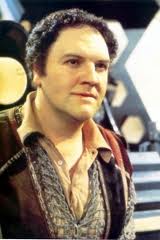 1.9 Project Avalon
The gender equity continues to impress me. Servelan appears again, observing Travis in his latest attempt at trapping Blake – more on that in a moment – and we’re reminded that she is Supreme Commander of the area. A key part of Travis’ plan involves an anti-Federation organiser named Avalon: also a woman. And is there any comment on these women being involved in the military or politics? Hell no. And Jenna and Cally, on the Liberator, continue to take a variety of roles – Jenna in particular playing a key part as pilot. And there has yet to be any suggestion of flirtation or sexual innuendo towards those women from the four men. I keep expecting to see Blake and Jenna ‘naturally’ pair off, but so far – nadda.
That said, Servelan and Travis are so an item. She is just so arch around him, even (perhaps especially) when bossing him around and wearing crazy outfits. I bet there’s just reams of fanfic on that. (Also on Blake and Travis I bet, but I don’t want to go there.)
Anyway. The plot here revolves around Blake wanting to make contact with Avalon. Travis of course gets there first – thanks to a traitor – where ‘there’ is a planet that makes Hoth look like a tropical getaway. He captures Avalon, scans a brain, tests a nasty plague… and then Blake breaks in and gets away with Avalon really quite easily. Bizarre? And just a little sus, yes. Turns out this Avalon is a kill-bot. Happily our heroes figure it out before any of them are killed and they turn the tables quite neatly on Travis, making him look quite the fool and getting away with Avalon in the end.
Another episode with Travis and Blake pitting their wits against one another, with Travis getting to be snarky at his capsicum-headed mutoids and wear his black leather pants and Blake getting all angsty at his crew having to break orbit and not beam them out right now. This seems to be getting towards a standard format.
1.10 Breakdown
Aaand as soon as I talk about a standard format, the show breaks from it. This episode reminded me a lot of the Firefly episode “Ariel,” because the crew has to risk themselves to get to a hospital. There, it was River, and the need to read her brain to figure out what was going on; here, it’s Gan, whose limiter is going on the blink and causing him to spin into uncontrollable, violent rages. Blake et al decide to head for an allegedly neutral space station in order to find a surgeon, although it turns out to be harder to get there than it ought to be: Zen flat out refuses to take them there directly, and refuses to actually explain why. Turns out there’s a gravity-something that means the crew have to be heroic, together, because Zen turns himself off for the duration. All very sweet. And that’s just half the episode…
This episode tripped a lot of my suspicions about Zen as a computer, and I’m wild to find out where the writers are actually going to go with it. The fact that it still hasn’t really been discussed just who developed the Liberator, and therefore who Zen originally interacted with, makes me very suspicious indeed. I really, really hope that this gets explained, because I have all sorts of suspicions about Zen being genuinely intelligent, either artificially or as an alien or… something else.
So the second half of the episode is the crew getting to the space station, taking the surgeon over to their ship, and waiting for him to deal with Gan – except that he’s a Federation stooge, so said surgeon notifies the pursuit ships of their location. Oh noes! The surgeon is played by Julian Glover, who I know I’ve seen in other British things.* Anyway, perhaps more interestingly than that – at least for this Avon-phile – is the fact that Avon declares during the gravity emergency that he is outta there ASAP. He heads over to the station… and it’s at that point that my rented DVD started skipping. I never did manage to see all of this episode, and have no idea what the station captain said to Avon to make him go back to the Liberator. Which is just slightly annoying. But the upshot is Avon is still on the ship, Gan’s limiter is fixed, and the seven thumb their noses at the Federation yet again. Hooray!
*Turns out he’s Triopas in Troy, the voice of Aragog in HP & the Chamber of Secrets, and OH! Walter Donovan in Indiana Jones and the Last Crusade!! and General Veers in The Empire Strikes Back!!
Destiny, blue women, and nuts
Continuing my dive into Blake’s 7… spoilers aplenty!

1.7
The team breaks the not-quite-format-yet by going to the rescue of a ship that appears to have been stuck in the same orbit for a long time. Turns out they’ve stumbled onto a classic locked-door murder mystery: the crew all asleep thanks to some gas through the filters, and one dead. They’re a group of non-Fed humans trying to take a crystal back to their planet which will save the colonists from starvation. Of course, said crystal is worth a very large amount of money, and one of the crew has made a deal to sell it and pocket the proceeds, to everyone’s loss. There are a number of red herrings, as you would expect from this sort of story, and I’ll admit that I didn’t expect it to be the innocuous-seeming blonde woman. It was quite a nice twist, actually.
Still loving Avon. I remember being impressed by Battlestar Galactica and its depiction of genuine fights between men and women, where the men were fighting another person, not a woman. Here, Avon totally decks Sara because she is a genuine danger to him and his. I really do appreciate that egalitarian spirit.
1.8
Mystical blue women (who turn out not to be blue) start this episode off, which immediately put me in mind of Farscape, although these women seem even weirder than Zhaan. And their place of worship is particularly bizarre, with what looks like people stuck in the ground reaching up. Creepy. (Also, Zhaan would have done something about getting a tshirt bra under that outfit.)
helLO Travis! There’s something peculiarly attractive about that eye-patch. (Maybe it’s the leather pants….) But your pilots look like they have black capsicums on their heads, which is a bit weird. They’re also mutoids, requiring blood serum for some reason, which is neither here nor there at the moment but I’ll bet it has some impact on the story arc (yup. Stranded on the planet with no serum). Mutoids were mentioned, I think, in the earlier Travis episode, but we finally get some explanation here: they’re people who have been modified in such a way that their memories are completely removed, as well as whatever else happens to them. Travis appears to get a perverse pleasure from telling his pilot who she had been, although she doesn’t respond at all.
Travis and Blake face off in their first full-on space battle in this episode, and it gets manipulated by the creepy mystic women for their own purposes; time distortion and stasis and everything (with oh such awesome 70s colour freakiness to demonstrate what’s happening). Their calm in the face of the “primitive violence” of Travis is magnificent – especially given the history they reveal, of their long-lasting violent global upheaval. Ah pacifism. And yet they propose a duel apparently to resolve their differences! How quaint… and how nasty, involving Jenna and the mutoid from Travis’ ship, making it all the nastier! Travis enjoys this fight way too much… as does Giroc, the old creepy woman. She’s a bit too sadistic for my tastes. The effect of having the ships’ crews watching everything that’s happening is quite clever, too, although I don’t think they got enough airtime to make it worthwhile.
Avon once again gets the best lines. Travis and Blake up trees for the night: “unless they’re planning on throwing nuts at one another I don’t see much of a fight developing before it gets light.” Also, he admits that he does care about Blake, cutting Villa and Gan down with devastating po-faced wit, pointing that it shouldn’t be necessary to go irrational to prove you care – nor, in fact, why it should be necessary to prove it at all. Oh Avon, I really look forward to more of your story.
Galactic Suburbia 40!!
Weird Tales sold
Strange Horizons Fundraising Drive
Galactic Chat: Kelley Armstrong and Ben Peek
What Culture Have we Consumed?
Alisa: Doctor Who Season 2, Outer Alliance Podcast
Alex: Trouble and her Friends, Melissa Scott; Only Ever Always, Penni Russon; Synners, Pat Cadigan; Blake’s 7.
Tansy: SF Squeecast #3, Panel2Panel (http://panel2panel.podbean.com/), Among Others by Jo Walton, Alcestis by Katherine Beukner, Stormlord’s Exile by Glenda Larke, KINDLED
Pet Subject: Hugoriffic!
Were you there for the Hugo Twitter party? Or did you have to resort to sitting in the live audience?
The stats
The results
Hugos commentary round up.
Please send feedback to us at galacticsuburbia@gmail.com, follow us on Twitter at @galacticsuburbs, check out Galactic Suburbia Podcast on Facebook and don’t forget to leave a review on iTunes if you love us!
Change for the Machine

I’d kinda forgotten how much I love good cyberpunk until I read this and Trouble and her Friends. Turns out I really really like it.
Interestingly, in many ways this feels like a prequel to much of the cyberpunk I’ve read. The main contention is the invention of putting sockets into people’s heads to allow them to experience and manipulate the datelines (read: internet) more directly… the result of which, or something similar, is what Gibson and Scott and their friends are basically examining. So from a ‘getting started’ perspective I found this book really awesome, and in lots of other ways too.
Cadigan takes the ‘cast of thousands’ approach, using multiple perspectives (although always in third person) to show lots of different dimensions and angles to the story. There were times at which this was a bit confusing, but on reflection I wonder if this wasn’t done intentionally. There were quite a few chapters which shifted perspective where the new character could have been one of several, and it’s only revealed whose story we’re reading after a page or so. This contributed to the fairly frenetic feel that the entire book indulges in, which is largely appropriate given the madness that ensues in the second half of the story. It’s also very nice because the variety of characters and their individual stories give wonderful perspective and insight into different aspects of the story. Which I liked.
The world Cadigan has created is simultaneously a bit dated – it was published in 1991 – but, once some of the terms are translated, also quite recognisable. She talks of datalines and how people get their news; that’s basically souped-up data retrieval services and massively hyped up RSS readers that do the work for you. And then they use the sockets initially to rev up rock music videos, which is just such an hysterically funny idea that the sheer bizarreness just carried me away giggling and happily belief-suspended. Also, there’s a lot of drug use. Which is perhaps neither here nor there, but also certainly adds to the manicness.
The plot revolves around the introduction of sockets and what that might mean for society, with a whole lot of corporate hijinkery and espionage and hackery as well. There’s a father/daughter relationship that pops up every now and then – not something you see every day in this sort of futuristic novel – as well as, somewhat surprisingly when you see the characters, a love story that’s not very romantic in one way, but actually really is sweet in a fierce I’ll-deck-you sort of way. Plus a load of bizarre and whacked friendships and enmities that go a long way towards populating this world with dysfunctional but quite entertaining characters.
This was my first Cadigan novel. I’ll be coming back for more. (In fact I have Tea from an Empty Cup sitting on my shelf….)
Only Ever Always forever
 I’ve always been wary of reviewers who call authors ‘ambitious’. It seems like a potentially back-handed compliment; like, ambitious but didn’t succeed? Ambitious in the evil stab-you-in-the-back way?
I must call Only Ever Always ambitious. And I mean ambitious in try-anything, why-the-hell-not way. Because this is a novel that combines first, third, AND second-person narratives, and that’s pretty ambitious. And outrageous to even suggest. What’s awesome is that, although I found the first few shifts in perspectives a bit disconcerting, it most definitely works.
Russon gives us two different worlds, two sides of the same coin in many ways, where – to push the analogy perhaps too far – one side has been subjected to normal wear and tear, but the other side has been used much, much harder. In the first world is Claire, living a very recognisable life with recognisable griefs – no less grief for being recognisable, of course. In the second is Clara, living in a world where medicine is hard to find and four walls for one room is unusual, but still with its recognisable elements: powerful people pulling strings, and small people getting stuffed around. Somehow, Claire’s and Clara’s paths come within reach of each other… and things change.
The narrative structure is one of the most striking things about this book; it’s only 157 pages long, but those changes in POV are dramatic and confronting and, well, striking. And effective; to be in the position of a character and telling the story one moment, to having your story told at you, to then being only an observer – it works, at this length anyway, to make the characters and their stories all the more enticing and compelling. This would probably have been the case anyway, because setting Claire’s grief against Clara’s struggle to survive and the conjunctions between their worlds makes for a really engaging plot. And the character of the two girls – their similarities and differences – made them very engaging characters, too; Claire in particular was believable, with her attitudes towards her family and beloved objects.
Finally, let me say that this is a really interesting cross-over of fantasy and science fiction. The multiple-worlds thing can be either a fantasy or SF trope. The dystopic world that Clara inhabits makes this, I think, more of a science fiction than a fantasy, but really that’s splitting hairs. It could be read as either. And it’s brilliant either way.
Malfunctions, space spiderwebs and tight black leather
Alex’s Discovery of Blake’s 7 continues…
numerous spoilers, if you’re concerned.
 1.5
1.5
Turns out telepathy in our new alien friend Cally might not be such a good thing after all. I really liked the cinematography when Cally was under the influence of the evil little homunculi, which by the way was very icky, especially when it’s revealed to be a corporate entity. Bit sad that it proved Jenna’s suspicion of Cally as worthy, and so quickly, although she does end up proving herself (again) and Jenna too falls under the telepathic spell.
These aliens (dressed in cling wrap), like the last set, are not particularly nice. They have plans to cull their run-away mutant experiments (dressed in papier mâché) who keep attacking them; and I’ll bet Tansy won’t be happy if I suggest that the female alien reminds me a lot of Luna Lovegood…. Blake and co are drawn to the planet by the experimenting telepathic psychopath so that they can get a power boost, and their ship (the Liberator) is kept there by a fungal space spiderweb analogue.
I was disappointed in Blake when he gave in so easily, giving the power cells rather than bargaining a bit harder for the cling-wrap aliens to leave the Decimas alive. However, when the experimental papier-mâché-clad types did get access to the base and not only destroyed the place but also their creators… well. I’m amazed that here, in the fifth episode, the writers have made the show quite so problematic. Those Blake wants to protect have twice proven to be nearly disastrous for the crew. And interestingly, despite their brutality, Blake still insists on defending the Decimas’ right to live. Perhaps this is one of the big things that differentiates him from the Federation.
Avon saved Blake from a bomb blast!! Aw, so cute. I bet there’s heaps of Blake/Avon slashfic out there… and I bet I get people at this post because of those words… it amuses me that Blake insists on seeing the good in everyone, while Avon keeps making snarky comments and even overt plans for what he will do when Blake is finally no longer in charge. Can’t wait to see how that relationship develops.
1.6
Blake’s crew carry their explosives in an esky. And the Federation’s security robots are even funnier than the original Marvin.
I don’t believe that it’s actually explained to the viewer what Blake et al is doing on this new planet at the start of this episode. Perhaps we are meant to go along with randomly progressing through the galaxy sabotaging our merry way. … Oh, turns out they’re after a cypher machine. Useful thing to steal.
I was just beginning to think that Vila’s extreme cowardice might eventually get quite wearing, when all of a sudden he sprinted to try and take down a guard! Remarkable. Perhaps he will continue to grow a spine.
Now there’s an idea: if Blake is Dorothy, what does everyone need? Avon needs a conscience, Vila bravery, Gan self-determination, Cally a purpose in life… can’t figure out what Jenna might be lacking.
It continues to be a really awesome aspect of this show that we get to see the perspective of Blake’s enemies – not just to see their evilness, but to watch their deliberations and understand their purposes. There’s not many shows like this that are either so confident in their viewers’ love for the good guys, or are so willing to show the grey realities of life.
The fashions continue to be spectacular. Supreme Commander Servelan’s ice-queen-and-diamonds outfit is particularly impressive (although I don’t yet understand why Tansy and others used #ignorethestrings on Twitter when discussing her…). And I’m guessing that, since our first introduction to Space Commander Travis is by looking at his butt in rather tight black leather, Travis will be an important character in this show. (I am also guessing this because I remember seeing a Blake’s 7 doll with a black eyepatch on Tansy’s blog.) I think I am going to enjoy Travis. His evil makes Avon look amateur. And the fact that Blake and Travis have A History will surely add some lovely nuances. Where ‘lovely’ is coloured by the fact that Travis has no compunctions about shooting unarmed prisoners, using drugs on Cally to get information out of her, and using the knowledge that Blake has a cypher machine to manipulate him. Everything a good villain needs to be capable of.
I’m now nearly halfway through this first season. If the format continues to be explode-Federation-base-and-meet-new-aliens, I’m not entirely sure that I’ll be able to go four seasons. However I will keep going, because for the moment it’s certainly entertaining.
Blake’s 7 finally becomes 7
Many spoilers in this second instalment of Alex’s Discovery of Blake’s 7.
1.3
So I was just getting comfortable with the idea of the prison ship towards the end of episode 2 when all of a sudden Blake, Avon, and the woman whose name I am still unsure of are in charge of an alien ship, running away from the prison transport and, somewhat bizarrely, towards Cygnus Alpha to pick up the other prisoners, so that they have a crew. Episode 3 opens with the three of them getting to know the ship, which includes interacting with a computer that, to my SF-cynical and AI-alert eyes, is exhibiting every symptom of a little bit too much intelligence for my liking (I couldn’t help but be suspicious when there was a room full of clothes for the humans to change into). As well as getting used to the navigational system, which is a whole lot faster than they were expecting, our heroes also discover a set of bracelets… which they somehow determine as likely to be transport devices (and hello, Stargate seems to owe something to Blake’s!), which Blake bravely decides to experiment with. Because they are now orbiting Cygnus Alpha, and it’s time to figure out how to get some prisoners back off again.
Of course, things are not hunky dory on the prison planet – how could they be? – and this is when things got all mind-bendy on me. Because from the original colonists has grown a lovely little cult which every new arrival is forced to join, or die. The prisoners are in the process of being introduced to their new way of life, including being told that they now have a deadly disease that can only be managed with a local drug (lies, all lies). There is, eventually, an awesome battle involving most of the prisoners, Blake, random priests and the leader of the cult – the mighty Brian Blessed, who is magnificent in this rather bizarre role.
This was quite a weird episode, although it does continue to develop the various characters. I am still loving Avon, much to Tansy’s delight; the fact that he very nearly convinces the woman to leave without Blake, when he is overdue from reporting in, is a measure of just tricksy he is likely to be. I’m really appreciating that there is a genuine diversity in the types of characters, from the cowardly to the brave and so on. Also, the woman is so the only pilot – I really hope that continues!
1.4
A sabotage mission and a rescue mission – this crew certainly like balancing their copy sheet.
I really thought, when I saw the two aliens in the cryo pod, that here would be Blake’s 6th and 7th. Instead they’re homicidal maniacs.
Gan is turning into a far more interesting character than I had initially anticipated. I thought he was going to be simply the brawn, but it was he who had the thought about the computer, Zen, having some sort of limiter on it, preventing it from helping the crew too much, and then his discussion of having to stay with Blake in order to survive (plus the view of his skull with something implanted in it, which turns out to be a limited so that he is incapable of killing)… well. I hope he develops more. The idea of a brain implant to control behaviour is yet another example of how evil the Federation is, and reinforces the need for what Blake etc are doing on Saurian 4 – destroying the interplanetary communication capabilities of the Federation as a whole.
Ooh, a female human-but-alien telepathic resistance fighter on Saurian 4! … unfortunately falls for very old tricks when fighting. Anyway, rather than suiciding in a blaze of glory she ends up helping our heroes. And joins the crew, completing the complement – because Blake counts Zen as a member. So, 2 women, 4 men, and a computer. Actually not bad for 1978. Sad they had to make Jenna (remembered her name!) a bit suspicious of Cally, because it can’t help but read as jealousy….
I’m loving Jenna’s boots.
Crossing the Universe: not as easy as it sounds

Girl. Boy. Spaceship. Murder. Deception. Totalitarian political system, manipulation, and art.
I loved this book a very, very great deal.
Like Leviathan Wakes (and it’s about the only thing the two books have in common, aside from the whole space thing), Across the Universe is a dual narrative, although here it’s two first-person voices. In this case, one POV is Amy: frozen in hibernation, accompanying her parents to a new planet to be amongst its first colonists. (Which may make you ask how she can be a narrator… just trust me on this one.) On the other hand is Elder, awake on the same ship Amy is sleeping on, part of the generation crew tasked with looking after the ship while it travels to the planet – a journey of some 300 years. The story revolves around Amy waking up ahead of time. Accidentally. And she’s cranky about it. As you would be. Amy’s awakening is a disruption on two significant levels: for Elder personally, because he finally has someone around of the same age but she’s like no one else he’s met; and for the ship, not least because it is mono-ethnic – an ethnicity that Amy quite clearly does not fit. Both Elder and the ship as a whole struggle to figure out how Amy can fit in. On a ship hurtling through space, with limited resources and no way to leave if you don’t like things, fitting in seems of paramount importance. So what does Amy do, what does Elder do, and why is Amy awake now anyway?
Along with a cracking pace and intriguing plot, there are some meaty issues to be dealt with. On the large scale, there’s the issue of how a generation ship could be made to work. This is a question that has frequently taxed SF; Elizabeth Bear’s Dust/Chill/Grail sequence is one example that goes in completely different directions from Revis. On the face of it life on the Godspeed looks like it works quite well, but very quickly it becomes obvious that perhaps there are cracks that have been papered over. Connected to this is the question of leadership, and what makes a good leader; Elder is learning from Eldest, and his reflections on what works and what does not are by no means trivial. On the more personal scale is how individuals deal with trauma, and expectations, and their own inner demons. Amy’s angst over whether to join her parents, and then how to cope with being woken early, is visceral and compelling. Elder’s disagreements with Eldest and how discoveries about the ship are in some ways less shattering, but have further-reaching consequences. And then there’s Harley, who I wish had had more of a presence in the novel. An artist, impacted by tragedy, and a better friend to both Elder and Amy than either to the other. His perspective, even though we get it solely through Amy and Elder, adds great richness. And poignancy.
Also, there is a love story. But not an easy one.
Plus, that cover! Beautiful!
There is some hand-wavey science-y stuff that doesn’t entirely make sense, and for the more technically-minded this may well be enough to throw you out of the story (Niall H!). I am not that person; I love my science but I am willing, for a good cause, to be very forgiving of hand-waving when it’s not too obvious (to me!) – and as you can see, this was a very good cause indeed (for me).
This is (of course) the first in a projected trilogy. I hope Revis can maintain the awesomeness.
(To make things even more fun, Beth Revis sounds like a totally awesome person. She was a teacher, who loved teaching! She likes Shakespeare for the dirty jokes and wrote her MA on CS Lewis’ Till We Have Faces (oh I must re-read that, I haven’t read it in such a long time). She is racing her mother to see which can get to the most (US) states! That says… quite a lot, really.)
Some slight spoilers in the comments.


