The Year of Miracles (recipes about love + grief + growing things)
I was sent this book by the publisher, Bloomsbury, at no cost. It’s out now; $44.99.
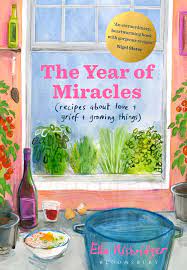
The memoir / cookbook genre is not one I knew I needed, but it turns out I do. When it’s done well, anyway. Looking over other food-type books I realise I do own a couple. I think I hope it accrues even more examples, and that they will be as well written as this.
Firstly, this book is gorgeous. The front cover there gives a sense of the illustrations – watercolours, I think? – that appear throughout the whole book. It’s a memoir of a year, and each month is a chapter and the first page of each gets a lovely, representative image; so do most of the recipes, and the headings for each get a band of colour. It’s the sort of book that’s a delight to literally flick through as pops of colour jump out.
Also: it has a ribbon. All cookbooks, and indeed every hardback, should come with a ribbon. It’s a fact; I don’t make the rules.
I haven’t read the first of Risbridger’s memoir/cookbooks (but watch me watch out for it now) so I don’t know about her life as described there, beyond what you glean from this one. But the prologue explains that her partner died a couple of years before, and at the start of 2020 (oh, what a phrase that is just resonant now) she has moved into a new house with one of her best friends to try and start anew. And then, you know. 2020 happens. But as we also know, life continues, and continued. Friends still exist and people still need to eat and plants can be planted, and love still exists. And this is really what the book is: a meditation on all those things. Risbridger reflects on grief and love, and coming to terms with the messy realities of how people affect us for good and ill – and how even when we love people we can resent doing things for or with them but simultaneously not resent it thanks to that love. Risbridger seems very honest in these pages. Memoirs are not my natural reading fodder but this one, I enjoyed.
The other aspect is the food, of course, and reading the recipes was also a delight. I am not the person who reads recipes for fun, as a rule, but these ones I did because Risbridger brings a chatty style even to her instructions. That won’t be to everyone’s taste, I’m sure, but I enjoyed it a lot. On making pie pastry: “Try not to work it too hard, but honestly? You’re probably fine. You’re making your own pastry” (p10). [Note: I was not entirely fine, but that’s probably because I didn’t have enough Parmesan in the pastry. Also, I’ve never grated butter for pastry; it’s messy but also a whole lot easier than trying to cube it.] The recipes are a glorious range from three-ingredient brownies (hint: a LOT of Nutella) to chicken pie, with dumplings and several soups and various condiments along the way. I have made the pie – chicken and mushroom and miso (I have bought miso! I’ve never used miso!), and it’s fantastic; her sour cherry and chocolate chip biscuits, which are meant to have marzipan but a) I didn’t have any and b) the other person wouldn’t enjoy them (burnt butter! what an idea!); and “Theo’s chicken”, which also has miso, and ketchup and ginger and garlic and sesame oil. You cook it super hot at first and then a bit lower, and the marinade basically burns; I didn’t love that part quite so much but overall it tasted fantastic. There are definitely other recipes in here that I’ll be trying, too.
This is a delight of a book.
The Path of Thorns
I read this courtesy of NetGalley. It’s out at the end of June, 2022.
You know those authors where you know you love their work but somehow they’re not automatically at the top of your mind and then you see a new book by them and you think, oh yeah I should read that; and then you do read it (perhaps eventually) and you think WHY DO I FORGET HOW MUCH I LOVE THEM?
Maybe that’s just me.
Sorry, AG Slatter. I really do love your work.
This novel is set in the world of Slatter’s mosaic novels – Sourdough and Other Stories, and The Bitterwood Bible and Other Recountings. You don’t have to know those stories to love and appreciate this one; they’re not about the same characters, or even necessarily the same places in the world. This is a world where magic is real, at least some of the time, but not everyone approves. Magic is mostly done (at least in these stories) by women, which feeds into the disapproval of that ‘not everyone’. It’s used for good and for ill and sometimes doing it for one reason ends up having the opposite consequences. In her Author’s Note, Slatter points that the world is a mishmash of the Victorian, Renaissance and Medieval – and asks readers not to go looking for historical accuracy. So there are moments that maybe kind of feel familiar from history, but they’re set with moments that really don’t.
What I particularly love about this and the other Sourdough stories is that they feel like fairytales, even though they’re definitely not tales that I know. There’s something about the ideas and themes – as Slatter suggests, “weird family dynamics, manipulation and lies, false faces, lost families and found, terrible acts and the potential for redemption”. There’s also something about the way Slatter writes, and here I am completely lost for words. I can’t tell you what words or phrases she uses to evoke a slightly eerie world, the sense that this is a world just slightly off from ours; that makes me a bit amazed that this is NEW work, rather than something that was told ages ago and has that patina of tradition, of being a well-worn and beloved story – of familiarity. And that last is particularly odd, frankly, because I really didn’t know what on earth was going to happen from page to page. She uses phrases and stories-within-stories that read like they SHOULD be as old and familiar as the wine-dark sea and Achilles’ rage, but … they’re not.
So: Asher goes to Morwood Grange, to be governess to three young children. She has a frightening experience on arrival, and brings with her some things that she immediately puts under a floorboard. And see, right from that, you just know things aren’t going to be straightforward. And so the story proceeds – making friends and enemies and figuring out how to do what she’s come to do; you already guessed that Asher didn’t come to Morwood accidentally, right? In some ways a bit claustrophobic – Asher mostly interacts with the family and few servants at Morwood – it’s saved from being TOO gothic the-house-is-trying-to-eat-me by occasional visits to the village and out into the grounds of the estate, and also through Asher’s occasional reminiscences, It’s an intense story, intensely inwards-focussed – and look, I read it in a day.
I loved it. A lot. It’s not always easy to read; the family is a deeply broken one, Asher’s not exactly perfect, and there are definitely actions that people regret (or should, but don’t). And yet, I loved it.
The Atlas Six
I read this courtesy of NetGalley.
This is one of those books where the originality lies primarily in the execution, rather than the initial premise. And this is in no way an insult! Reading a new take on old ideas is exciting.
The basics: six people with extraordinary gifts are chosen to learn about a secret institution. Things are, unsurprisingly, not what they seem – and there is a lot of interpersonal tension as well.
See? Not a radically new idea. But the execution and the details made this a deeply intriguing book.
The world is one where magic is real, and even the non-magic users know about. Hard to hide a magic university in the middle of New York, I suspect. Also, some people have used their talents to get (legally) spectacularly rich. Anyway: it seems most people don’t have astounding levels of magic. So the six people chosen to learn about the secrets are told they’re pretty much the strongest, most gifted magic-users of their generation. Great way to manage those egos right up. Anyway, they are invited to learn about the Library of Alexandria – now somewhat metaphorical, as it’s not in Alexandria, although it is still a library. And that’s one of the key drawcards: the right, and ability, to search the library for anything they want… if they get through the year.
So we have magic, and we have knowledge, and we have massive personal conflict – mostly because of the individual personalities. Intriguingly, the narrative moves between all six of the initiates, meaning that there’s not automatically one of them the reader is guided towards supporting. While some of them are absolutely unpleasant people, this multi-focus allows the reader to see their complexities and thus make the story that much more complex.
It’s a clever set up, and the twists are just as clever, and the characters are right on that borderline of horrible-but-not-so-horrible (unlike, say, Heathcliff). Clearest sign I enjoyed it? Can’t wait to read the sequel.
Kon-Tiki, by Thor Heyerdahl
I do love a good adventure/ travel story, so when I saw this in a secondhand book shop I thought – why would I not read the book that as far as I can tell, arguably started the modern version of ‘person goes on crazy adventure and writes about it’?
I am… ambivalent, now, having read it. Basically one part positive, two parts negative.
Positive: it really is a riveting story. Six men in 1947 on a balsa wood raft, sailing from Peru to Polynesia. They have a radio and a sextant, and modern clothes and sleeping bags; but their raft is genuinely balsa wood, held together with rope. They have no particularly good way to steer. It’s made (apparently) as accurately as they could to match the descriptions from Spanish conquerors to the area. They truly have remarkable experiences, and they went 100-odd days crossing the Pacific. That is epic, as are their encounters with a whale shark, various other wildlife, storms, and just life in general. For that aspect, I don’t regret reading it.
The negatives… well. To start with the journey itself – no, even before. The description of cutting down massive old balsa trees for the construction of the raft had me cringing. Then there’s the seemingly-wanton ‘fishing’ while they’re at sea: they’re hooking and killing far more shark and other fish than they eat, which is just awful. (It is kind of hilarious to read of the flying fish just randomly landing on the boat, I will admit, and eating those makes sense – especially when they’ve been piling up throughout the night.) Also, Thor at least is married and… in the entire book, no mention of the wife. Ever. Not even before the journey, when he’s in America trying to convince people of his theories.
And, yes, here’s the rub, the sticking point, the main problem. Thor goes on this journey to show that it would have been possible for humans to sail from South America to Polynesia, and thereby be the progenitors of at least some of the people living in those islands, and therefore responsible for the impressive statues and pyramids and other ‘advanced’ things that can be found on some islands. But not the Inca, oh no, and not the Olmec, or anyone else you might have heard of: rather, it was a white, bearded race who apparently came before the Inca. And were more civilised, and taught them everything and then got chased off. So… yeah. His entire premise is deeply, deeply racist. This also comes out in descriptions of the Polynesians and others. I’m privileged because I’m white; if a person of native South American – anywhere on that continent – or Polynesian or, I’m afraid, Jewish descent said they were thinking of reading this, I would want to have a good long conversation with them so that they knew what they were getting into. This absolutely means the entire book is problematic, and being a ripping adventure yarn in no way excuses it. It is written in 1947, which offers some context for why Heyerdahl thought it was appropriate to write such things and the publishers apparently had no problem with it – hey, no Polynesian is likely to read it, amiright? and why would they complain even if they did? etc.
Did it have fun bits to read? Totally. Is the book problematic? Absolutely. Did I buy the other two books he wrote, to try and show that Egyptians AND Mesopotamians got to South America by boat? I absolutely did and fully intend to read them to rip the theories to shreds.
Rocannon’s World
Many years ago I had this idea for essays about Ursula K Le Guin’s Hainish Cycle. They’ve been sitting around in my brain for ages, so I thought I’d post a short bit from the first one. Partly as a kick to myself, partly to see what other people think… if you’ve read Rocannon’s World I’d be interested to hear what you think (it’s still very draft!).
Narrative conventions: questioning “the hero”
Le Guin’s playing with narrative conventions begins in the Prologue. Semley’s experience fits a pattern for those who spend time with the fairies under the hill – one night with them being, in reality, much longer. However, although her story seems at first that of the hero on a quest, Semley definitely does not fit that pattern. Her quest is ultimately pointless, since she gains the jewel but loses her family. Thus Le Guin questions the very idea of the hero’s quest, with one objective met but devastating long-term consequences. Indeed, the idea of the hero has already been challenged through the fact that it is Semley, not Durhal her husband, who has the idea and the courage to undertake the journey.
As the main character, it might be expected that Rocannon would be the hero. However, he never plays into that role. It isn’t that he is a coward; he rejects Mogien’s suggestion that they find the ship given to the Clayfolk so that Rocannon can leave the planet, saying “I’m not going to run off eight years into the future and find out what happened next!” (27). However, he rarely plays a direct part in the action. He does participate in combat at one point, and gets in a shot at an enemy, but then himself gets shot through the leg. When he does manage to have an impact on events he is closer to an Odysseus than anything else, using words, silence and cunning to get his way – sometimes. For instance, when he is about to be burned at the stake, he uses his impermasuit to withstand the heat and refuses to speak to his captor Zgama. He doesn’t rescue himself, though, relying on a companion to do that; neither does he rescue his friends from the strange insect-like people, this time relying on the help of strangers to do so. When he and a companion are threatened by ruffians, he gives up Semley’s necklace rather than attempting to fight or connive his way out. Thus, while he is the protagonist, he is not heroic. Mogien is far more traditionally the hero, riding his wingsteed into battle and slaying enemies. Interestingly, there is never a comparison made between the two: Mogien, while not as knowledgeable as Rocannon, is never shown to be a thug; Rocannon is not lacking in manliness for not matching Mogien. Le Guin suggests that survival doesn’t necessarily have to do with heroism, and that there are multiple ways of being a man and being useful.
Story and reality
The Prologue opens with a question: “How can you tell the legend from the fact on these worlds that lie so many years away?” (3). It continues, “How can you tell fact from legend, truth from truth?” – proposing that legend is, in fact, a form of truth. The opening of the story proper furthers this theme: “So ends the first part of the legend; and all of it is true. Now for some facts, which are equally true, from the League Handbook for Galactic Area Eight” (22). Mythology and academic texts are thus given equal stature in the matter of ‘truth’.
A Spectre, Haunting

This book was sent to me by the publisher, Head of Zeus (via Bloomsbury), at no cost. It’s out now; $29.99.
It’s a joke some people make to say that I’m basically a Communist. I’m not; I’m not dedicated enough. I am happy to wear ‘vaguely socialist’; there are a lot of things within the ideals of socialism – and, yes, communism, depending on how you talk about it – that I absolutely subscribe to. And yes, of course I know that the whole concept of communism is now utterly tied up with the various 20th century versions that claimed to putting it into practise. I am a history teacher.
Mieville, too, is open about his context. In the introduction he explains that he’s trying to present the historical aspects in such a way that a reader of any political persuasion will be able to read it (without frothing in a rage is, I think, the subtext). He is clear that the final chapter is much more subjective but again hopes that people will be able to engage thoughtfully. I deeply appreciate that he’s not pretending to be neutral, which is something that would be impossible (and that anyone who knows his background wouldn’t believe anyway).
All of that is context around the fact that I think this book is incredible and anyone who wants to make any claims for or against communism in the 21st century absolutely needs to read it.
First, it contains the entire text of the Communist Manifesto. I’ve read bits and pieces but I don’t think I’ve ever sat down and read the whole thing from cover to cover (it’s an honours thesis in length! Only 12,000 words!). And every paragraph is numbered and every time Mieville refers to something from the Manifesto, it’s right there for you to refer to. I present: integrity. Bits that shook me: reading about workers being alienated from the products of their labour while watching Severance; also that the bourgeoisie / capitalism “has resolved personal worth into exchange value” and nothing else.
Second, I am deeply appreciative of Mieville giving the historical context not just of Marx and Engels, and not just of Communism (not completely comprehensive, which Mieville acknowledges) but also the context of manifestos as a genre. That’s pretty great and something I’ve not seen before. He also examines various criticisms of the Manifesto, from different times and perspectives, and discusses their validity or not. Mieville is in no way suggesting that the Manifesto is perfect, and accepts some of the problems quite readily; those he doesn’t, I think he deals with thoughtfully.
Finally, the bit that may well have some people frothing at the mouth and that particularly struck me is the chapter in which Mieville examines the utility of the Manifesto for the 21st century. And the important thing here is that Mieville comes across as angry. Really quite angry about the piles and multitudes of inequality and despair and awfulness in the world today. I can’t adequately give an overview of this chapter, because he has several points and I haven’t entirely decided whether I agree with all of them. But what I am is convinced that this rushed (although still missing its deadline), somewhat incomplete, more than 150 year old document still has something to offer – even if it’s largely as a starting point, and it’s definitely not perfect.
Queens of the Wild
I received this book via NetGalley. It’s out at the end of May, 2022.

As an Arts student of the late 90s, who did do some mythology-type subjects, I have vaguely come across some of the ideas that Hutton explodes here. So that was quite the trip.
The main idea: that the four concepts, or beings, or narrative tools – Mother Earth, the Fairy Queen, The Lady of the Night, and the Cailleach – are in no way part of a pagan religion that has survived sin Europe since pre-Christian times. No matter all the stories about witches as pagans or Beltane feasts.
In the opening Hutton revives a differentiation (first proposed by himself in 1991) between two concepts: ‘surviving paganism’, where a pre-Christian religion has actually survived beneath/within Christianity; and ‘pagan survival’, where a belief of object has been redeployed from a pre-Christian to a Christian religious context.
This book has a LOT of historiography, as Hutton explores some of the why and some of the how for the development of the idea that four specific concepts have a long, pagan, pedigree. The very first chapter was probably my favourite, as he explores the development of the study of folklore and how various academic and non-academic types explored and theorised beliefs – especially peasant beliefs – and how attitudes to those sorts of things changed over time. Following the thread from one person to another – occasionally from just one article to an explosion of theories, books, films, and other academic articles – was astonishing.
In the four main chapters, Hutton seeks to find the four characters he has chosen to interrogate – to find the earliest mentions, to find their possible connections to pre-Christian ideas, to find the ways in which they’ve been used in the academic literature. In every case, he comes to the conclusion that none of these are true ‘surviving paganism’ – always with the caveat that more information may be found, and that of course there’s a dearth of written information for so much of the early part of the pre-Christian/Christian boundary. He’s pretty convincing, unsurprisingly.
Moderately academic, but I think accessible for a reader with only a basic knowledge of both the historiography and the characters he explores (which is me).
Breadsong: How Baking Changed Our Lives
This book was sent to me by the publisher, Bloomsbury, at no cost. It’s out today (3 May 2022); $39.99.
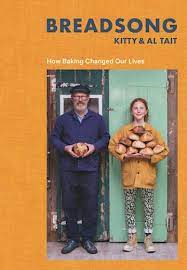
I actually finished reading the memoir part of this book a couple of weeks ago – the day I received it in fact. But I had to wait until I had baked a couple of the recipes before I could do a legit review!
This is two books in one. The second part is a cookbook – all bread or bread-adjacent (a couple of biscuits and cakes). So far I have made the Miracle Overnight White Loaf, which is a marvellous no-knead, overnight (duh) bread that you cook in casserole dish; and today I made the focaccia, which uses the same dough but you press it out to make focaccia. Both of these are AMAZING and will definitely be in high rotation. A large section of the recipes is sourdough, and… I’ve done the sourdough thing, and I’m just not sure I can face going back to the world of the starter. I’ll have to give it some more thought. There are definitely other recipes I want to try – bialys, and their mini panettone buns. Each of the recipes is laid out beautifully – I love that there is a different font for the chat at the start, and the ingredients, and the recipe itself. It’s also got delightful photos and in general the cookbook aspect is just fabulous.
But the recipes are only half the book. The first half of the book is a memoir. This book is written by Kitty and her father, Al – they tell the story together and they each have a distinct font. It’s the story of how they ended up running a bakery together, and while that sounds all heartwarming – and it is, absolutely – but it starts because baking a loaf of bread is one thing that Al tries to help Kitty with her crippling anxiety. Like, anxiety that made going to school impossible, getting out of bed barely feasible, nothing in the world seeming worthwhile. I deeply appreciated the honesty that Al in particular presents here – that he and his wife did not see what was happening at the start, that they were bewildered by the change in their youngest daughter, and that they struggled to figure out what to do. Kitty, of course, is also very honest: she didn’t know why it happened, either, and makes no excuses for it, or for feeling the way she did. It just was.
The book explores the slow movement from Kitty deciding she wanted to bake a loaf of bread – to wanting to make more, and therefore being allowed to use neighbouring ovens – to giving bread away because she was making so much, leading to a subscription service, then a pop-up, and then an actual real bakery and high street shop. Well, I say slow, but it all happened over about 2 years and that’s just incredible.
It’s the sort of book that makes me think “maybe I could be a baker and make bread all the time and bring joy to people!” and then you keep reading and you realise just how much stress the whole thing is, and how early you have to get up (unless you’re the Margaret River bakers who sell their bread from 3pm onwards, LIFE GOALS) and… yeh. I’ll just stick with making bread for people in my house, thanks.
As a memoir, the book is a delight. It’s honest and thoughtful and funny (when appropriate). It’s got enough context of other things going on that you know bread isn’t absolutely everything, but it’s also very clear that the focus is the story of Kitty not being able to go to school —> opening the bakery; it’s not a complete autobiography. The different fonts make the dual authorship work really well, there’s lovely pictures and photos throughout, and I really did sit and read the 150-odd pages in one day, because I started and then I had to keep going. I didn’t really need another bread book in my life but I definitely needed this book.
Elektra, by Jennifer Saint

I received this book from the publisher, Hachette, at no cost. It’s out now; $32.99.
Maybe it’s me, but when I see a book described as a retelling – particularly of something from Greek mythology – I expect to get new insights, a twist on the narrative, or something else unexpected. Sadly, I did not get any of those from this book.
I know a fair bit about Greek mythology – I’m not an expert, but I’ve done my share of reading. I know the story of the House of Atreus; it’s why I was so keen to read a new version of Elektra’s story. I can’t really imagine being someone who doesn’t know about the stories wanting to pick up this book; why would you? But if you are like me, and you do know about Elektra and her parents, then I feel that this book doesn’t really offer anything. And I’m a bit sad about that.
One unexpected thing that the book does have is three narrators. For all that it’s named for Elektra, there’s nearly as much space given to her mother, Clytemnestra, and the Trojan princess/eternally ignored prophet, Cassandra. Now, maybe having Clytemnestra there is an interesting foil for Elektra’s perspective – she is, after all, a child when Agamemnon heads off to war, and it’s Clytemnestra’s desire for vengeance that leads to the later events around Orestes. And Clytemnestra also allows the author to start the story much earlier, with the ‘wooing of Helen’ and all. And I understand why you’d have Cassandra too – the Trojan perspective – but it felt jarring in a book named for the Mycenaean daughter.
My final whinge is some of the anachronisms, which I found a bit uncomfortable. Firstly, the use of ‘Greek’ as a collective term for all the little city states who banned together to go reclaim/recapture Helen. Maybe ‘Hellene’ is too weird for a general reader? Is it too weird to have an explanatory note at the start of the book? I don’t know. But it made me a bit grumpy. And there were other little things too, mostly more concerned with atmosphere: it felt like Saint couldn’t decide whether she wanted this world to feel really familiar, just with added deities and exotic-ness; or whether she wanted to play up the temporal distance from the reader. I think she mostly leaned to the former, and so in an odd way Clytemnestra and Elektra and everyone felt too familiar.
So… a lot of things to complain about. Why did I finish it? It really is well written; it’s easy to read, the pacing is good, the language is often lovely. (I partly kept reading in the hopes of something different, too, which was a bad reason to continue but is nonetheless true.)
Could you read this if you didn’t know the source material? I think so. I think there’s enough explanation that you would be able to follow the intricacies of the different problems with no trouble. And perhaps that’s indeed part of the problem for me – everything was too laid out, I wasn’t required to do any thinking at all.
Recipe, by Lynn Z Bloom
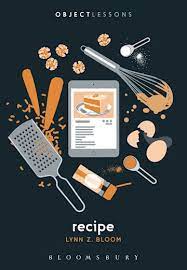
I read this courtesy of NetGalley. It’s out in May.
This is an eclectic book. It’s not an in-depth examination into the social, cultural or culinary history of the recipe – and it doesn’t want to be that. This is more whimsical, more meandering, more dip-a-toe-into-interesting-spaces than that.
It’s also super American; I feel I should flag that for all the other non-US readers. There’s a whole chapter on Thanksgiving – and I get why you would do that, but also there’s no acknowledgement that it’s restricted as “a recipe” to one country and its diaspora. And in the first chapter, about the basics of what a recipe is, the author uses the idea of chicken stock to elaborate on the idea of variation. Which makes sense! But then says this: “Every version of this basic recipe involves the same ingredients in the same proportions – the amount of chicken in the recipe is always five pounds” (12). Um. Not in my recipes? Even given that maybe she just couldn’t be bothered mentioning that other countries might use different measurements, it’s still a weirdly sweeping generalisation. (This one might be picked up in editing, but the author also refers to “the Great British Baking Show” which struck me a really WEIRD mistake.)
ANYWAY. Despite those things, I did enjoy reading this a lot. I love Bloom’s idea that “as a literary genre and social construct, multi-faceted and complex, a recipe in its human context offers lessons in life and living” (3) – that’s such a fantastic way of putting it. Throughout the book, she shows those different aspects of the idea of ‘a recipe’. And also made me feel better about the fact that I often don’t follow a recipe to the absolute letter (except in baking, which is chemistry) – she says this is indeed what people everywhere always do. I love the idea of recipe as story, and as memory. I’m less wild about it as a symbol of power or politics, but absolutely accept that it can be.
All up, a really great read. Also it’s made me dead keen to find other books in the Object Lesson series: a book on the eye chart? on exits? THE TRENCH COAT??

 Randomly Yours, Alex