Nettle and Bone
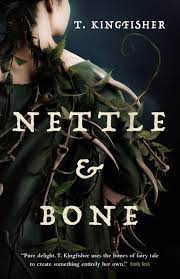
I read this courtesy of NetGalley.
If you’re a fan of T. Kingfisher, I can say “this is exquisitely T. Kingfisher” and know that you’ll run for a copy of this book. (Fair warning: book does include reference to family violence, and an abusive partner.)
If you’re not already… maybe you’re a fan of Angela Slatter? Kingfisher’s books remind me of her work too.
What does that mean?
They’re both doing fascinating things with fairy tales… except not really fairy tales, because they’re not always familiar stories, but it’s the vibe of fairy tales – fairy tale logic – fairy tale expectations and narrative structures. And I don’t mean Disney versions, I mean grim/m and sometimes gritty and meaty and fully embedded in the world, where not everything is lovely and wonderful but sometimes they are, and sometimes by force of personality you can make a change in the world and sometimes you just have to roll with the world’s punches.
I loved this book a lot.
There’s a princess who doesn’t especially want to be and who is really sure that she’s good at it, and a bone dog, and two godmothers, and a dust-wife. Also a quest and a heavy dose of gritted-teeth determination and a good level of snark, generally dished out by old ladies, which is of course the best sort. It goes at a good pace – not so fast as to leave you spinning, but you’re also not just sitting around always admiring flowers. I read this quickly and it felt just right.
This book keeps Kingfisher as one of those novelists whose work I just read pretty much automatically. I mean, it includes such gems as: “My dog trusts me… My dog is witless and also dead” and also this, addressed to a chicken: “I know you aren’t broody, demon, but you’re going to make an exception or so help me…”.
Definitely should go on your to-read shelf.
Women’s History Month: Jean McLean (part 3)

Yes, I know; three posts from Jean McLean does seem to fall into the same trap I mentioned in my first post. But the reality is that she has given a great deal of thought to the issues around the Vietnam War protests, and that she was a vital part of the whole thing – particularly in organising the May 1970 moratorium. And so, I give her the final word, about organising that moratorium – and about how it reflected the enormous change in Australian attitudes. In the mid 1960s, most adults supported the idea of conscription, and the Vietnam War also seemed necessary to many. But the 8 May 1970 moratorium saw somewhere between 60 and 100,000 people on the streets of Melbourne, and more in other capital cities; and then in 1972, Whitlam was elected, and most agree that the conscription issue was a significant factor in that. So here’s Jean’s perspective on how you keep going over nearly a decade (longer than most other excerpts):
Transcript
Alex: You said before that, obviously, the campaign had a beginning, a middle and an end. But you didn’t know that when you started – – –
Jean: Oh, no.
Alex: – – – and I’ve read a lot about just how distressing the 1966 election was in terms of hoping against hope that it wouldn’t happen, and then it did.
Jean: Yeah, well, we thought that would all happen just like that.
Alex: Yeah. How did you keep enthusiastic? How did you – how did you keep an organisation like that – you, in general – how did you keep going?
Jean: Well, part of it was, there was Ian Turner, but also a guy called Max Teichmann, he’d been a philosopher, and then he became an international affairs lecturer. He went through phases of being left and being right, but luckily I had him in the left bit. But he was very good, because he understood the history of all this anti-conscription stuff better than I did. I mean, I didn’t read a book then think, I’ll do it.
And at that election, and at the ’69, when people were, you know, young people who’d been handing out how to vote cards, and they were crying, “Oh, we’ve lost.” Max said, “No. We got more votes this time. We’ll get more votes next time.” And he did that again with the ’69, you know? He said, “It takes time. It takes time for people to understand. We’re doing better.” So – – –
Alex: So you had a long-term vision – – –
Jean: Yeah. Able to see in the long term. And also because we got more and more support. We didn’t get less. We got more.
Alex: Yeah. So you could see that you were having an effect?
Jean: Yeah, yeah. And I must say that, obviously, the reason that they don’t allow journalists into the Middle East wars is because every night that it was on the television, every single night, there was what was happening in Vietnam. And it was all terrible. And – you know? And they’d try and tell you something, “Oh, we won, we killed five thousand Viet Cong.” And people said, “That’s disgusting.”
So, now, they don’t let people know what’s happening. You know, and it was just, sort of – – –
Alex: The media really played into showing people just how terrible things were, and then you’re right there, your organisation’s right there, and gives some people a real way of reacting against it.
Jean: Exactly.
Alex: I guess, if anybody knows anything about the anti-conscription movement, they tend to know about the moratorium marches. Do you think they were effective?
Jean: Oh, incredibly so. Because – and the Victorian one was the most successful, in part because of Jim Cairns. Who was the deputy prime minister – he’s been written out of history.
Alex: Yeah.
Jean: He’s been written out of history, you know? You never hear anyone talk about Jim Cairns. And yet, it was Jim who, in ’62, he spoke out against the war. The secret war in Laos. And, anyway, he was the chair of the moratorium. And so, you know, we had to do the work, because he was in Parliament. You know, but he’d come to address meetings. But he was a very important figurehead, because he spoke very, very well against war.
So anyway, the moratorium movement in Melbourne – we started with a meeting of all the different groups. Save Our Sons, the Youth Campaign Against Conscription, all the different groups. We met in Richmond Town Hall. And we worked out programs, including – like, we used to go and – I was – Jim was the chair, I was deputy chair, Bernie Taft was another deputy chair. And Harry Van Moorst was – for one of them was the deputy chair.
Anyway, we’d have meetings, and – we’d go and address people at – through working with the trade union movement – at all the factory doors. Sometimes we were allowed in the dining room, depending on the make-up of the factories. Others, we had to speak at the gates. But we did that. We went, you know, just hundreds of meetings. We went and distributed leaflets. We raised funds.
So that by the time May the 8th turned up, there were just hundreds and hundreds of people. The police had been told – and I had a police spy, a brother of a friend who was in the police, and he said – like, he just told us that they’d been given instructions in the morning, that they’d have all the horses at the top of town, and they’d have all these police – so they’d break up the demonstration, they wouldn’t allow it to happen.
And so we had a meeting at the Assembly Hall the morning of the demo, where we were going to get everybody to be marshals. They’d have a band. So everybody had to try and make sure there was no – nobody’d get out and start hitting. You know, bash them.
Anyway, so then we came out of that meeting, and my friend said, “All the rules have been changed. We’ve now been told to make sure that the demonstration isn’t – you know, facilitate. Facilitate the demonstration.” Make sure that – no cars in the way when we march, you know, so the route from the gardens down, to march.
Because what had happened was, everywhere you looked that morning, when we were going to the meeting, everywhere you looked, there were people with rolled up banners, there were people with T-shirts, there were – you could see that everyone was going to the demo. This is going to be huge. Couldn’t believe it. Schools! High schools! And they let the kids go, the – you know, the senior kids. All that sort of thing. And, yeah, it was just amazing. And that’s why it was so successful. Was not tweets, but physical meeting and talking. And I still believe that that’s the only real way to do things.
If you know of a Melbourne woman involved in protesting against the Vietnam War, please leave a comment!
Women’s History Month: Sue McCulloch (again)
Sue McCulloch was very involved in protesting against the Vietnam War, including working for the Congress for International Cooperation and Disarmament (CICD) and being the secretary of the Draft Resisters Union. Here she reflects on the position of women overall in the protest movement.
Transcript
Alex: And just finally, so the focus of what I’ve been looking at is really the motivation and the actions of women in particular; from your memory, did you get a sense that there were a lot of women? Like, would you have said it would have been about half or less, in terms of people doing things?
Sue: Absolutely. Yes, I do, I think there were at least half who were women. And I – we were not acknowledged. And I think a number of the men, now, these days, would say that, too. We were regarded as, you know, the sort of – the help maids, you know, the people who did the typical kind of role of women. And it was, at the time, when women were also, you know, it did really go hand in hand with the women’s movement.
And I think women within the anti-war movement were facing the same struggles of recognition and autonomy as women in general. So, you know, the fact that we were in an anti-war movement didn’t necessarily – in fact, it didn’t give us any greater presence or voice.
In terms of our power in that movement, I think we had less power. You know, there were very strong – the main people in the anti-war movement like Jim Cairns, was sort of the figurehead, the people on the executives of various things were largely all men, except for Jean McLean. Oh, maybe Joan Coxsedge. And one or two others.
But I don’t think the number of women in those powerful positions reflected by any means the actual number of women who were involved in the entire movement. So it was very frustrating at the time. And I think there were people who actually left the anti-war movement, who found themselves frustrated as women in that movement. They joined the women’s liberation movement more – you know, to be their main focus of activity. Because they just felt that they were not, you know, it was endlessly frustrating for them to be in this movement where they weren’t being given an equal say.
One of my jobs was as a media liaison person, and it’s actually how I met my daughter’s father, because he was a journalist on The Age. And I used to blindfold him and take him to meet draft resisters and others. But in the newspapers, there were actually a lot of women – like, we were the main people who were usually photographed doing things. There are photographs of Jeanie and me, and a model who – we walked across Collins Street on the 11th day at the 11th hour, you know, when the whole city is kind of stopped for – and we walked out to protest about Vietnam. There were photos of us often in the newspapers, being dragged around. You know, photos of Jeanie being dragged by her hair. I also had long, blonde hair, and a number of others had long, blonde hair, so it was quite often hard to tell who it was. But I’ve got photos of me handing out leaflets at places like Melbourne Grammar, me doing things in the City Square, handing out leaflets to publicise various things.
So women were often photographed, and in the newspapers, just as much as – or probably as much as the men. Maybe not as much as the men, but certainly significantly. But we were also sort of regarded as these rather, you know, quirky, kind of – yeah. I think because newspapers probably liked to see women rather than men – you know, a bit more colourful, or something. The sexist newspapers of the day.
If you know of a Melbourne woman involved in protesting against the Vietnam War, please leave a comment!
Women’s History Month: Robin Laurie
Robin Laurie first got involved in protesting against the Vietnam War in London, where she had joined a theatre group who used street theatre in those protests. Back in Melbourne she joined La Mama and the Pram Factory, which also used street theatre. In this excerpt she discusses the purpose of theatre in demonstrations.
Transcript
Alex: So being involved in the moratorium is that – I’m really interested to know whether, you know, the street theatre and the tableaux and so on, were you specifically invited along to demonstrations? Or was it that you would have been going to the demonstrations and that that – those performances – are what you wanted to contribute?
Robin: Both things happened. We would just go along, and we went, and that’s what we did, you know, because that was our, that’s what we could contribute. It’s always good on a demonstration to have some sort of focus. Something, you know, that’s not just people walking along; it’s like the banners, the things that people had written in the climate strike, it’s always great to read them, you know, and the jokes and the witty things people say and things like that. So we knew that there were other ways to communicate rather than just sort of speeches and flyers and things like that. And we were interested in what they were. But then we did start to get invitations to do something. And sometimes it felt a bit like, you know, we were the – we weren’t the serious part of things. We thought we were just as important and just as, you know, interesting and useful as anything else. But there were some people who were very – yeah, just had different ideas about how to connect with people, communicate – that sometimes we would be specifically invited in to do a five minute piece or something like that. So it’s like, now when there’s a demo, sometimes some – a singer might get up or a band might be asked to perform. So it was like that.
Alex: I was just going to say, I think – you talked about you know, being useful. Clearly some people did think you were, if we were together you’d see my scare quotes – just entertainment. What do you think, or what were you adding, aside from the quote unquote, just entertainment aspect?
Robin: I think things operate at many different levels. I think words are one. But sometimes you can – there’s something else going on, as well as the words, and you respond, you can see that or hear that, and you respond in a different way. And you might not have – you might not put all that together at the time. But I think sometimes images stay in your head, or stay in your heart or body or wherever that – an image resides. Sometimes an image can affect you in a way that – and it’s different for different people, and it depends if you can find a really powerful image of some kind – but I think they can; and it’s like music and dance and circus – I was a part of circus after that – there’s a physical interaction between people at – a kineasthetic response. And even though you might be on a stage and in front of a big crowd of people, something still happens that’s different to watching a film. And it happens because all your senses are involved, I think. And so it’s not just an intellectual response. I think that’s what I’m trying to say. I think words are really powerful. There are, you know, people who are great orators and poets, and – wish more of our politicians said that capacity – they can be really inspirational. But I guess I always thought too, it’s necessary to find courage. You know, because I think the system we live in is – because it’s based around commodities and things – it’s a system that breeds despair. Because you think, Oh, if only I own this, everything will be right. And you own it and it’s not, you know – perfect example now with the virus. So you need – you need something that can give you courage to contemplate and confront things that are quite difficult in life I think. Life can be quite hard, in many ways. It’s not all rosy and you can’t always do everything you want and live your dream. So I think – I think those things that operate at that sort of level can touch something deeper inside, maybe – or that’s the hope. Doesn’t happen that often. But it can, it can happen.
If you know a Melbourne woman who was involved in protesting against the Vietnam War, please leave a comment!
Women’s History Month: Elisabeth Jackson
Elisabeth Jackson was opposed to the Vietnam War and conscription from the beginning, partly through the influence of her parents. She attended demonstrations once she got to Melbourne University, which she discusses in this excerpt.
Transcript
Alex: Did you do anything to kind of express that when you were at high school, which is obviously where you were at the start?
Elisabeth: I got into a terrible argument with one of the teachers who thought that the war was a good thing; that the communists had to be stopped at any cost. He was from Eastern Europe, I think. And he was staunchly anti communist. Yeah.
Alex: So what other sorts of things did you eventually get involved with? Were you involved in any of the demonstrations?
Elisabeth: Not while I was at school, they weren’t really taking place so much when I was at school. But I started university in 1968. So it was all happening then. So I used to, we’d go to demonstrations regularly.
Alex: Which university were you at?
Elisabeth: Melbourne.
Alex: Did you feel like there was a strong push to be anti war at university, on the campus?
Elisabeth: Yes. I mean, the left wing clubs and so on were quite strong.
Alex: Did you get involved in any of them?
Elisabeth: Not really. I was sort of nominally a member of the Labor Club, but I was still too young and nervous, too… And there was this organisation called the SDS – Harry Van Moorst, who I notice has just died, he was a leading figure in that. So I sort of buzzed around the edges of that, but I mean, I was just very shy and lacking in confidence at that time. So I didn’t get deeply involved.
Alex: And yet you went along to demonstrations?
Elisabeth: Yes.
Alex: That seems to me like the sort of thing that someone who’s shy wouldn’t automatically do.
Elisabeth: Oh I did, yeah, yeah, I would go with family or friends, yeah.
Alex: Not a solo thing, but a group thing.
Elisabeth: Yes.
Alex: And what was it like being involved in the demonstrations?
Elisabeth: It was just like being in a demonstration. It was interesting. There were sort of violent clashes at some of the demonstrations. And I was a bit horrified by how some of the people attending them seemed to really like the violence. As soon as the policeman came on a horse, they’d sort of rush over there and start attacking the horse and carrying on trying to stir up violence, which I disapproved of I must say.
Alex: So you are obviously not involved in that aspect.
Elisabeth: No, no, I stayed well away from that.
Alex: Did you go to the moratorium march in 1970, the big one?
Elisabeth: Yes.
Alex: Obviously, there are differing reports – 60,000 100,000, depending on who you believe – do you remember what it was like to be there?
Elisabeth: It was just amazing to be with all these people – I mean, I don’t know if it was 60,000 or 100,000 – but it was huge. It just went on for block after block after block in the city. And it was quite exciting to be part of such a huge movement.
If you know a Melbourne woman who was involved in protesting against the Vietnam War, please leave a comment!
Women’s History Month: Helen Rowe
Helen Rowe became more aware of the Vietnam War and the protest movement against it after she met her husband. She discusses that here, and how support for the protests doesn’t always mean going to all of them.
Transcript
Helen: And I met my husband at the end of 1970. And he had gone into the raffle, you know, and so he’s got the ticket in his filing cabinet, where his number didn’t come up. So that was new. So here’s a person who missed out, you know, and then he was pretty actively involved in protest movement and things, but just as a regular citizen, not out there as a leader. And look, I think I marched in a moratorium. But it’s funny. I don’t know whether it’s the photos, you know, you remember the photos, I actually can’t remember, to tell you the truth. Because, because it then filled our lives. It became – I became involved really through him. I’ve marched in plenty of other anti nuclear and all sorts of stuff. But, you know, did I match in the moratorium? I don’t know.
Alex: Before you met your husband, did you think much about the conscription issue? one way or the other?
Helen: Oh, no, because I’m the second of three sisters. And then my brother was born nine years younger than me. So in our family, in our big wide family, no one was impacted by war. So even in my parents’ family, father and mother, neither of them – and they came from big families – there was no male siblings who went to war in the First or Second World War. And then my own brother was not the age. And then I’ve got three brothers, but they’re also all younger. And at the church we went to, the youth group and everything, I’m just not aware that anyone had – was called up. It’s quite possible there were people there who missed out. But it wasn’t talked about, as I said, it was – the church didn’t speak about it. Probably individuals in the congregation did, with each other, but certainly wasn’t something we got collectively.
Alex: Do you remember seeing or hearing very much about Vietnam on the news at the time?
Helen: Probably didn’t watch TV, because, you know, shifts precluded that really in the times and things; and I wasn’t drawn to political, you know news if you like. Quite naive really.
Alex: After you did meet your husband and you got that bit more involved do you think you did go on some of those protest marches in the in the early 70s?
Helen: Yeah, definitely. But we weren’t there with other – we weren’t part of a group that was political activists; we would have gone along as individuals I think and supported as you do right perhaps with some of these family violence things at the minute – all walk together in that way. I think he didn’t talk about his engagement with some of the individuals who were called up and who were quite public figures just because he’s a quiet person. But also I wasn’t in an inquirer. But he went to school with John Zarb at Essendon Tech and a strong influence of my husband’s was one of the teachers there at the school. If you go to school with someone that’s called up and imprisoned because it was he jailed… I do remember on the train in from Box Hill into the city – I worked in the city for a while – his name, John Zarb’s name, was all across the you know, the graffiti that was in the – going through Camberwell and Alamein and everything you know – where there’s a big cutting: “John Zarb” and “Free John Zarb”. I remember all that. It’s interesting in my involvement was actually noticing that – it’s funny how you can be supportive through noticing. You identify with it quite strongly. It is interesting thinking about it because I was a protester, but I was a quiet supportive protester and would never have – would never have spoken against what the protesters were doing, so I was for what they were doing; I mightn’t have, you know, been there – well I was long haired, we were all long-haired. Anyway.
If you know a Melbourne woman who was involved in protesting against the Vietnam War, please leave a comment!
Women’s History Month: Helen McCulloch
Helen McCulloch started her political activism at the University of Tasmania, drawing attention to apartheid in South Africa. When she moved to Monash, she got involved in the Labor Club there, including serving on the Club’s committee, and supporting the idea of sending non-specified aid to the North Vietnamese. Here, she discusses the importance of women being involved in the anti-war and anti-conscription movement.
Transcript
Alex: So I mean, as I said, I’m interested in the actions and the motivations of the women who were involved, partly because it is leading into quote, unquote, second wave feminism and those things. But it’s not, I guess, I’m not just interested about it as – from that perspective, but more as, as you said, at the start, you know, because women couldn’t be conscripted. There have been people that I’ve read from the time who are like, you’re not personally involved – their words not mine – so why do you care?
Helen: I was personally involved. It was my friends who were threatened.
Alex: Yeah. So this is I guess what I’m trying to get at is, clearly it’s a personal and political issue. So –
Helen: The issue is so – bites so much harder, if it is personal. But even if it’s not, you know, like the apartheid in South Africa, you still stand up for principle.
Alex: Do you think that it would have been different if women had not been involved in the demonstrations and the posting up of posters?
Helen: It may well have been – the cops might have hit harder.
Alex: Interesting. Do you think maybe women being present, there was still a little bit of chivalry?
Helen: Yeah, there was a little bit of chivalry, you know, when we were caught sticking up posters – there were four of us – we took shelter in the car. The cops surrounded the car. They said, Out of the car, gentlemen; we all got out and said oh, one of them’s a girl. No, I think there was a little bit of chivalry still involved yes.
Alex: Do you think there would’ve –
Helen: But they didn’t, they didn’t quite know what to do with it.
Alex: Yeah, I have wondered that. Because it feels – I mean, obviously the World War One women were involved then. But women hadn’t really been on the streets so much in terms of protest, really, until the ’60s with anti apartheid and so on.
Helen: But there’s also appearance, you know, I think a lot of it – this was the time when the boys grew their hair long and their beards and dressed in bright coloured clothes. And the girls had long hair, they didn’t have beards, but they dressed in bright coloured clothes, too. So we all looked very similar to each other. And I think that’s a good thing, basically, because people don’t make this big distinction as much. You know, I’ve heard older people look at the hippies and say, Ah, you can’t tell who’s a boy and who’s a girl. But, you know, if you’re one of them, you know.
Alex: Do you think that there was a difference in the way the public saw the issue because there were women involved as well?
Helen: I don’t know. I don’t know. Jean McLean was the respectable end; she was saying save our sons. She was appealing to mother instinct, which you can always rely on mother instinct to tap. Yes. And we were talking about the justice or not attacking of Vietnam, which is a different question.
Alex: Do you think both of those were necessary or important in that time?
Helen: Everything’s important to help get it done.
Alex: I think those are the questions that I had.
If you know a Melbourne woman who was involved in protesting against the Vietnam War, please leave a comment!
Women’s History Month: Kay Setches
Kay Setches objected to the Vietnam War and conscription for a variety of reasons. Her main involvement in protesting against them was participation in the later moratoriums, which she discusses here.
Transcript
Kay:Wwe were doing those marches. And we used to just take the children in the car, and – the babies really – and put them in the pusher and… push.
Alex: So you went to the three moratorium marches, or just the first one –
Kay: I know that we went to the last. And I think we went to the one before.
Alex: But what was it like to be at those moratoriums when there was so many thousands of people with one goal?
Kay: Well, I was up near the intersection… where we were in the middle of Swanson and Flinders Street once on one of the marches. And I was scared. I was – I was scared because I was – there was so many people. So many, many, many people. And that, you know, there was a flash of scare there, I’ll always remember it. But really, it was very uplifting to be walking with people that had the same view as you. It was so neighbourly as well, when you’re going along, we were very hopeful that this would lead to a change. A huge change. You know, we had been under a Liberal National government for 23 years by ’72. And it had to stop.
Alex: From what I’ve seen of the pictures of the moratorium, it looks like there are a lot of women there. Did you feel like there were lots of women present on the day?
Kay: Yes, I did. Yes, I did.
Alex: Aside from the marches, were there other things that you were involved in?
Kay: I didn’t do anything. No; I went home. And I thought I’d done well, and then I cleaned up the kids, and then we went to bed. That’s what we did; no I didn’t do anything much afterwards.
Alex: Was it the sort of issue that people would talk about at parties or gatherings?
Kay: Always, always because your friends were not that different to you, you know. And so it was uppermost on everyone’s mind, we knew that they were bombing the hell out of Vietnam. We had seen the pictures, the pictures, and we didn’t want our soldiers there.
If you know a Melbourne woman who was involved in protesting against the Vietnam War, please leave a comment!
Women’s History Month: Vera Boston
Vera Boston was involved in protesting against the Vietnam War largely through Melbourne University connections, having been concerned about the issues since high school. In this excerpt she speaks about being involved with SDS – Students for a Democratic Society.
Note: the sound quality isn’t great, because my recorder got very enthusiastic about picking up all the ambient noise…
Transcript
Alex: what sorts of things were you involved with? What did you – – –
Vera: Oh, everything. I mean, you know, from printing posters and, you know – the thing that strikes me as bizarre, well, only, I guess, as an indicator of how different the world was then, but one of the early posters that I remember silk screening was one that said, “Girls say yes to boys who say no.” It was an absolute – and it was a very (…)
Alex: That’s amazing.
Vera: It’s amazing. And it’s amazing that women like me and Diana, and everybody else I know, didn’t think anything about that. That was just the – that was us quite consciously, in a way, using our sexuality to encourage young men not to register.
Alex: As a political statement.
Vera: It’s just unbelievable. To me, it’s unbelievable. What else? Well, I joined SDS right away, which was the Students for a Democratic Society. So, you know, I was involved in all of that stuff, you know.
Alex: Was that through Melbourne University?
Vera: Yeah, yeah, Melbourne.
Alex: Yep.
Vera: So it was, you know, organising rallies, speaking at rallies, you know, I was one of the few people in that group who had a car, so the car was very useful for taking things to and from demonstrations, you know?
Alex: I can imagine.
Vera: Like the PA system, you know. Boxes of paper, you know. Not long after that, we got our own press, we had a printing press, so I was involved with the printing, all of that type of thing.
Alex: Wow, that’s incredible. So you spoke at rallies?
Vera: Yeah, yeah.
Alex: And that was fine? The guys were happy to let you be up there, and so on?
Vera: Yeah, no, it wasn’t like that.
Alex: I’ve read a little bit of stuff by Harry Van Moorst and Michael Hamel-Green, and, I guess understandably, they’re a lot focused on their own actions. But often, the women kind of seem to be ignored. You know, Jean McLean and SOS get a line, and so on, but when they’re off avoiding the police, surely it was the women who were kind of organising stuff a lot of the time.
Vera: Some of the time. But, to be fair, SOS was considered by people like us, like Harry and Michael, quite a middle-class kind of – – –
Alex: Yeah, of course.
Vera: not terribly revolutionary (…) progressives, you know. Yeah. So – – –
Alex: Quite different spheres of action, then.
Vera: Yeah.
Alex: And so, the printing press was run or owned by SDS?
Vera: Yeah.
Alex: Was it housed at somebody’s place, or did you have an office?
Vera: No, SDS – place up in Palmerston Street, 57 Palmerston – that was the headquarters, but a number of people lived there. I never did. My brother did. Harry and Di did, of course, for a long time. You know, Michael Hamel-Green and Frances lived there so, you know. And there was a big garage, and the printing press was in the garage.
Alex: Were you designing posters as well as printing them? Or is that other people?
Vera: Not really. I don’t think I was designing stuff. I think it was more arty people than me. And, well, look, I might have, but they would have been really simple ones, like, you know, “Stop the war now” kind of thing.
If you know a Melbourne woman who was involved in protesting against the Vietnam War, please leave a comment!
Women’s History Month: Margaret Williamson
Margaret Williamson got involved in Young Labor in her late teens. She worked in various roles in the union movement, including as the Bendigo Trades and Labor Council secretary. Margaret participated in anti-Vietnam War activities through both her Labor and union connections. In this excerpt, she discusses her initial introduction to Young Labor, and her experience demonstrating in front of the American Embassy.
Transcript
Margaret: It was my mother who got me involved in politics. She listened to the conversations with myself and my father. And it must have been pretty hard to shut me up, I think. So she actually rang the Labor Party and asked them, Did they have anything for a young woman? And so they said, Yeah, we’ve got Young Labor. And, and without me even knowing that she’d done that, I did get a phone call from a young man inviting me to go to a meeting. Well, the first meeting I went to with them, was about chemical warfare. The first time I’d ever stepped foot inside a university, Melbourne Uni. It was a very romantic sort of evening, you know, it was dark, and there were lights, and it was a beautiful building. And then we went after that to – I’m just trying to remember the name of the restaurant, there was a lovely restaurant where – in Carlton there. And I should remember the name… and it was like being inside the tower of Babel, because there were, you know, a stack of people in there, and everybody yelling at everybody else, talking about how to change the world. Talking about the latest on the war, the young group of people that I were with – I was the only girl – they were all on about what the latest was; I just had to get involved. I – there was no, no ifs, buts, or maybes. You know, to me it was a responsibility that I had. I know that sounds a bit severe for a young woman of those times. But, you know, I didn’t even think twice about the fact that I was the only woman in the group. I can remember not even thinking twice about the fact that in that cafe, I couldn’t see another girl like me. I can remember once being told by fellow at a dance that his mother wouldn’t approve of my politics. And that – that sort of inspired me to have a few words with him. And I can remember other young people, young men, actually suggesting that I might have had a mental problem because I was so anti war, and so anti conscription, and so politically motivated. So clearly they’d not struck a person like myself. I never gave it a second thought. I started going – I can remember that we went to meetings, I’m pretty sure, it was at a place called Assembly Hall in Collins Street, which I think is still there. I can remember there were meetings – not so many – but there were meetings in the Labor Party, and certainly huge discussions in Young Labor among the young people. But I can remember going to meetings at Assembly Hall. And I can remember then going to the very early rallies, which were quite small; because the first ones around Fourth of July demonstrations and things like that they were quite small, and at times quite dangerous. I remember at –
Alex: This was at the American Embassy?
Margaret: Yes, yes.
Alex: I’ve heard of those.
Margaret: Yes, I can remember being sort of pulled out of the way by a friend, as they rode police horses in on top of people that were sitting in the driveway. One of my friends got – a horse walked on her, which wasn’t good. And I can remember, I can remember another night when we’d been to Assembly Hall. And then people had been arrested. So we marched up to the City Watchhouse, which was sort of up where the old magistrate – behind the old magistrate’s court, Russell Street police station over the road. And there was a lot of brutality that night; a lot of brutality. People were hunted across the city of Melbourne. You just … there’s things that slip into your understanding of what’s happening, about where you are, and where society is.
If you know a Melbourne woman who was involved in protesting against the Vietnam War, please leave a comment!

 Randomly Yours, Alex