Scourge of Henry VIII: the Life of Marie de Guise
I received this book courtesy of NetGalley.
I am ambivalent about this book.

The good things:
- Reclaim the women! I am always in favour of a book that highlights a woman who has either been forgotten, or whom history has portrayed in an unfavourable-because-patriarchy light. This book largely does that, going into details about Marie’s life, highlighting the reasons for the decisions that she made as well as the importance of those actions, not just her womb. These are really important things.
- It’s accessible. This is intended for a general readership: there are no footnotes, it opens with a list of people the reader can refer back to when the titles etc get to be too much, and it usually balances complex foreign policy decision-making with ease of reading.
The slightly uncomfortable things:
- The lack of footnotes etc means it’s not the most detailed of historical research: there’s not that many primary sources directly used, and no other historians are referenced, which makes me a bit queasy.
- There are some editing mistakes. Sentences that lack of a primary verb, probably because there are so many clauses that it’s easy to get lost; sentences where it’s unclear whether one person with multiple titles, or several different people, are being discussed.
- Marie’s apparently deliberately decision to remain single after James V’s death is lamented as sad for a woman in her 30s. But… she’s a widow twice over, she has the disastrous example of her mother-in-law to show how badly things can go for a widowed queen with an infant monarch. Why couldn’t this be a sensible political choice? Why couldn’t this be a relief to a woman whose life has been tied to the idea of marriage for more than two decades, usually not at her own decision? No evidence to suggest that she regretted this, and so… attributing emotions is a fraught business. It shouldn’t be done.
The negative things:
- At one point, Clegg describes Marie’s daughter Mary as having various ailments, and suggests they may be dismissed as nothing more than an anxiety related disorder. Uh. That’s… not good.
- The way Marie’s whole life is framed around men. Now I understand that to some extent, with the biography of a powerful woman in the sixteenth century this is unavoidable; her male relations were always going to play a huge part, especially early on, and any husband likewise. However, it felt like a lot of space was spent on men and their doings, sometimes only tangentially connected to Marie’s life. Perhaps this was for added context, but it just served to detract from making Marie the focus. The greatest example of this is the title. In a book of nearly 220 pages, Henry VIII dies on p140. Marie was on a list of possible wives but got away; she got in his way to some extent around the issue of young Mary marrying Prince Edward… but to call her the Scourge of Henry VIII is ridiculous. I guess it made a good title? But I was expecting to discover that she had actively, and over a long period, skewered Henry’s ambitions in the north. Yeh not so much.
Look, overall, for people wanting to find out more about Marie of Guise, this isn’t a bad option – not bad at all, in fact. Just beware that it’s by no means perfect.
Peel Me a Lotus
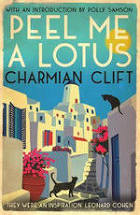
I read this courtesy of NetGalley.
You don’t HAVE to read Mermaid Singing, the first of Clift’s memoirs about living on a Greek island in the 1950s, in order to understand what’s going on here; not least because they’ve moved islands, so it’s a whole new crowd of people. But I think it helps, because you come with a sense of what Clift and her husband George Johnston have already experienced, why they left London, and thus can better appreciate their experiences.
Like Mermaid Singing, this is a “domesticity in the exotic” story – Clift and her family living now on Hydra, a small, largely poor Greek island, on the cusp on becoming A Destination for the Artistic, the Beautiful, and the Hangers-On. Clift and her husband/collaborator have bought a house, which brings with it large dollops of angst: partly because of the never-ending requirement for repairs, on a budget that’s basically nonexistent; and partly because now they are settled, they are halfway back to being bourgeois, and many of their fellow Artistic Types can’t figure out if they’re jealous or derisive. Both, it seems.
Unlike Mermaid Singing, Clift is much more ambivalent here about the whole experience: both her own experience, and what island life is like. While in the first she and George are actively writing a novel together about the sponge divers, here she seems to be entirely consumed with looking after the house and the children – indeed, she is hugely pregnant as the book opens, an experience which understandably consumes a significant part of her mind and time. George gets to clatter away at the typewriters, but Clift is busy buying food, making dinner, caring for the baby and the other two children, and so on. Sometimes she seems content with this, and at other times deeply frustrated, worried she is merging into that always-has-been, always-will-be experience of motherhood that she sees all around her. So… a fairly familiar experience, no doubt, for many women who find motherhood a time of personal conflict.
Island life bounces between the seeming idyllic – the beach swim every afternoon, cheap and bountiful food, glorious landscape, interesting if infuriating neighbours (usually it’s the foreigners who are infuriating) – and its opposite. There’s hardly any water to be had in summer. Many people’s health is poor, there are huge prowling alley cats, rubbish is dumped directly into the harbour and no one knows where the sewers drain. Clift doesn’t shy away from the negatives, and also makes little effort to reconcile the two extremes; it’s the reality of life, after all.
A lot of time is spent talking about the other foreigners, for whom she uses pseudonyms, and it’s probably a good thing she did. Having read the introduction, though, it seems their identities are – were? – no secret; Henry and Ursula are Sidney Nolan and his wife Cynthia. Clift presents the various non-Greeks as looking for inspiration or pretending to do so, living dissolutely because they can afford to; some of them are getting allowances from parents, for instance, so they barely even need to dabble in their art. Not so for Clift and Johnston, who are trying to eke out a living on royalties. I don’t even want to look up Hydra today, for fear it’s exactly as Clift prophesied – fancy tourist hotels for the Beautiful People – which may or may not have had positive benefits for the people whose ancestors initially colonised the place.
In some ways I can’t believe this book is more than 60 years old. Parts of it show what feels like a very modern sensibility, while other bits are clearly products of the 1950s. It’s gorgeously, evocatively, provocatively written and I hope lots of people get to read it.
The Dictionary of Lost Words

It really annoys me when people say ‘this book isn’t what I expected’ and then write a negative review as if it’s the books fault that the reader had the wrong impression.
This book isn’t what I expected.
My review isn’t a negative one, but I do want to explain what I expected, in case others are similarly misled.
I thought this book was predominantly about words, and lost words, and gendered language. I expected the narrative to be driven by words and for them to be centre stage, or that they would somehow frame the narrative.
Books, and the development of the Oxford English Dictionary, are indeed important to the story. But words do not drive or frame the narrative. Esme, the main character, grows up around the men compiling the OED and herself becomes involved in that; she does find and compile ‘lost words’, in the varied senses of that phrase. The story, though, is the story of Esme as a young white English woman at the turn of the 20th century, and her experiences: with the OED, of sexism, of the women’s suffrage movement, of loss and love and friendship. She uses the words she finds to help navigate the world; she learns words from people of different classes in an effort to validate the existence of all words; and sometimes, of course, words are useless. Contrary to my expectations, words are secondary to the biography of Esme.
Having said all of that, this is a lovely novel. Williams writes beautifully, she does use the idea of words as gendered in interesting and meaningful ways, and Esme is of course living in a fascinating era. I wasn’t expecting the suffrage issue to be as significant as it turned out to be: I already know a lot about this as an issue, but for someone coming to it with little knowledge, this is a pretty great introduction to the actions (and words) of the suffragettes, and those who were opposed to their means.
You might notice that I don’t read a whole lot of realist fiction. When I do, I want it to do something interesting and clever and make me think. I have thought about gendered language, and about the gatekeepers of knowledge and language, so for me the ideas weren’t brand new. They are, though, presented in a deeply engaging manner, with neat intersections between ideas and with sympathy for different perspectives. I really enjoyed it.
Mermaid Singing
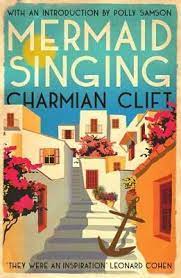
I had thought that I liked travel memoirs. And I do – I can enjoy a good ‘and then we went here and experienced that’ story. But I’ve eventually realised that what I really enjoy is what I choose to call ‘domesticity in the exotic’. Exotic is a loaded word, but I use it here to evoke a sense of difference that I don’t think ‘foreign’ really captures; and I’m just as including a Brazilian or Nigerian writing about moving to Melbourne as I am a Londoner moving to Provence (I think Romulus, My Father arguably fits neatly into my category).
Before A Year in Provence or Under a Tuscan Sun came Mermaid Singing, by Australian Charmian Clift.
I read this book thanks to NetGalley. I’m incredibly pleased that it’s been republished.
Its most obvious parallel is My Family and Other Animals, and the rest of the Corfu Trilogy. Indeed, they were originally published in the same year, 1956. But ‘parallel’ is right: they seem to start similarly and go in the same direction – family moves impetuously to Greek island, experiences with Greek locals don’t always go as expected, genteel poverty etc – but they are fundamentally separated stories. Where My Family is written two decades after the events, Mermaid is contemporaneous. Where Durrell was the spoilt youngest son of the family and was off having adventures and occasionally going to school, Clift is a writer and a mother and a wife; while she has adventures, they’re not the focus, because she has the cares and concerns of an adult: both for her own family and the way she views the people around them.
My Family is a fond recollection of a childhood dream, /something something the world before World War 2 blah blah. Mermaid Singing is part ‘domesticity in the exotic’, but also a rumination on the hardship of Kalymnos life, and the difficulties of being a woman in the 1950s trying to forge and continue a career alongside motherhood.
Clift writes beautifully, and evocatively. Kalymnos is an island that largely relies on about 10% of its population going out on sponge-diving expeditions for 7 months of the year – a dangerous occupation and one that’s bringing back less revenue as, in the 50s, artificial sponges are taking over the market. It’s also an island still, in Clift’s experience, in the grip of patriarchal attitudes (and Clift herself is part of this as she notes she has no right to comment on whether someone has beaten his wife at the end of a drunken week). The whole reason for moving here is for Clift and her husband to collaborate on their third novel, this one to be about the sponge-divers. And they do manage to do this, in between drinking a lot of retzina and being closely observed by all their neighbours and seemingly endless rounds of engagements and baptisms.
This is no day-by-day account of life. Like A Year in Provence it follows a year, observing the changes to life as the seasons come and go. Clift observes moments: a friend giving birth, experiences in the taverna, the experiences of her two children during Carnival…. As a gifted writer, she uses these moments to reflect on life itself – and death; and she conjures a wondrous view of Kalymnos. Is this likely to reflect the lives of the people who lived there their whole lives? Perhaps not. Perhaps they would recognise some aspect of their lives but be confused by an emphasis or examination. It does seem like a genuine reflection of Clift’s experience – an an ex-pat Australian, a writer, a woman who didn’t quite fit the expected mould of womanhood on the island.
I’m inspired to buy this in hard copy if I come across it.
Star Trek: Voyager (after s7)
And then it just… ended.
Don’t get me wrong; I really am glad they got back to the Alpha Quadrant. I’m glad the writers had an opportunity to make that happen when, I assume, the show was cancelled (for all their faults, I think here of Firefly, and to a lesser degree Jericho). But. Wow. What a last episode. What a sudden, screeching halt. I guess if it had to be done that way, it was fine?
Don’t get me wrong #2: two Janeways? Who disagree with one another? I can’t be sad about that.
Janeway: I adore the fact that she’s just so damned complicated. I really, really didn’t like her for the way she went after that rogue Federation ship to the detriment of all. And the time she basically condoned genocide. And several other very dubious choices. But they were never choices she was forced into – that is, she actively chose those things, and believed she was right; it wasn’t a state of helplessness. And it was never being “emotional” in a silly woman stereotype. I am perversely pleased that I got a chance to be legit angry at her. I do not regret to watch all of Voyager mostly so that I had a chance to understand this pivotal character in Star Trek.
Chakotay: nothing will ever remove my pure love for this character. Nothing. He is a marvellous 2IC, he got some great storylines, and there’s basically nothing I would change.
Janeway/Chakotay: never in my life have I shipped a non-canon couple as completely, as wholeheartedly, as I ship these two.
I have taken to reading J/C fanfiction.
Seven of Nine: given my words above, you might think I am angry at Seven by the end of the show. You would be wrong, not least because I am capable of divorcing a character from the narrative choices made by showrunners. I do not like the Seven/Chakotay romance idea, but that’s largely because of the age difference (not necessarily a problem but made more problematic by her relative youth as a human) and the abruptness of it all. I was intrigued by the idea of her “practising” with a hologram of Chakotay (and can’t fault her choice), and choose to believe that she was continuing the experiment. ANYWAY, aside from all that, I do feel resentment that Seven was basically a long-running experiment herself, along the lines of “how long can we keep an actress in a catsuit OH LOOK AS LONG AS WE LIKE.” I liked a lot about Seven’s narrative arcs: her growth, her experiences, her comments on the rest of the crew… usually…
B’Elanna: I continued to enjoy her a lot, too. I like her attitude and her honesty and her competence.
B’Elanna/Tom Paris: dear God I came around to B/T. I can’t believe it.
Naomi Wildemann: I will never understand the seeming necessity for including a child character. That said, if there had to be one, Naomi was usually ok. I didn’t enjoy the one ep where she was hiding on the holodeck with the kids’ characters blah blah, but overall she wasn’t written too saccharine.
Neelix: eventually blended into the background, I guess? I still don’t really care for him but he did have some good moments. And quite a good end to his narrative, I thought.
The Doctor: continues to be a pain in the butt.
Harry: continues to just be a bit bland. Sorry, Harry; you are a henchman, not a leader.
Tuvok: I love that Tim Russ got to show a few moments of not being Vulcan; it made Tuvok all the more remarkable as a character. Like Seven, I like Tuvok for the contrast he provides with the rest of the crew, as well as for his own contributions.
I spent… a lot of the last few months pretty obsessed with Voyager. Clearly; seven seasons is a lot of television. And now it’s done. I feel somewhat bereft! (well, I would be feeling more bereft were it not for the admission made above about J/C…) This is the first Star Trek I’ve watched end to end, aside from Disco, which of course is not yet finished. I crammed seven years into about four months, which I would probably not repeat, but again – I don’t regret it. It was fascinating to see narrative choices, and reflect on late 90s tv choices, and all of those sorts of things.
And now that I’m done with Voyager, I can start of Picard.
Escape from Puroland
I received this book as an ARC through NetGalley.

This novella is noted by Goodreads as number 7.5 in the Laundry Files series – it fills in a gap, basically, about one of the chief characters. For reference, I have read a few Laundry Files stories: I enjoy them a lot, but not quite enough to obsessively chase every single book down. I did enjoy this one a lot, which means that you could probably come to this with maybe even no knowledge of the rest of the books – as long as you’re happy enough not knowing some of the background (like who Mo is). I think there’s enough explanation about things like computers creating magical energy, and therefore background magical radiation increasing as computational power increases, that a reader who’s prepared to roll with it can do just that.
So, the story: Bob Howard is sent to Japan to help them deal with incursions of entities from other dimensions. These can take the shape of various things depending on mythology and so on in the surrounding area… and when Howard is given a hotel room that’s Hello, Kitty themed, alarm bells should have started ringing…
The Laundry Files are what I would consider very pop-literature. This is in no way a statement on quality! What I mean is that they’re fast-paced (very fast-paced, in this instance); there’s a lot of banter; there’s a lot of pop-culture references, some of which I admit I didn’t get but the general gist was obvious. This story just barges along and drags you along in its wake. And it’s a whole lot of fun. In fact, it’s made me start eyeing off the rest of the series…
The Best Thing you can steal

I received this book from the publisher at no cost, via NetGalley.
If you have read any of Simon R Green’s Nightsider books, or his Hawk and Fisher, then you already have a sense of what this book is like. Whether you enjoy that or not is a different matter – Green has a definite style, and it’s on display here. (There’s a level to which it’s true of the Deathstalker books, too, although they have a whole other thing going on as well.)
Green’s style happens to work very well for me, as a rule, now that I know what to expect. Witty banter, cheerful playing with tropes, a courteous if shallow nod to the notion of substance, with a narrative that’s mostly flash and style in a “I’m fabulous and loving it” way. It’s not quite textual candy floss – there’s a bit more substance than that – but maybe it’s… candied peanuts. Tasty, some nutrition, pretty sweet, and even I can’t eat toooo many of them at a time. But I love it when I do have them. (And some people hate them.)
This book is a heist story and it doesn’t pretend to be anything else. Characters literally call it a heist and the section headings do too. So you know what you’re getting, and it delivers. The first part, therefore, is getting the team together, which is often my favourite part of such stories. Our narrator is now called Gideon Sable – we don’t know who he used to be. His first recruit is Annie Anybody, master of disguise (who, I now realise, is therefore much like Face in the A-Team) who is also Sable’s ex, which of course is going to lead to some tension. Then there’s a Ghost – who is actually a ghost; the Damned (… who, I now realise, is something like BA… in the A-Team…), who is damned for a dreadful misdeed but is spending his remaining time on earth killing bad people just to stick it to Hell; and Johnny Wilde (…who is… a lot… like Murdoch…), aka the Wild Card, who does terrifying things to reality.
(I’ll just stop here and think about the A-Team similarity. Sable doesn’t smoke a cigar and there’s no tanks; I don’t think this is actually deliberate. It’s just that those tropes – disguise, muscle, the spanner in the works – are exactly that; tropes, and useful ones at that.)
Team gets together, team plans heist, team attempts heist, hijinks ensue. The fun thing with a relatively standard narrative is knowing what to expect, AND the ways the author gets to spin expectations – and with Green, have fun and do ridiculous things along the way. Because, as this is Green, it is of course no ordinary setting: this is the magical side of London (a well-traveled path, I know), which means objects that defy reality and people with terrifying abilities and a ball point pen that can stop time (only briefly though).
This is a fun book. At times silly, always fast-paced, it’s also short at about 160 pages in my e-copy – so there’s no mucking around.
Fugitive Telemetry
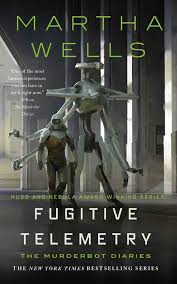
This book was provided by the publisher at no cost.
I’ll be honest – it would be hard for me to give a completely objective review of this novella, because basically Murderbot can do no wrong.
Important thing to note: I really don’t think it’s worth coming to this book as your first Murderbot experience. In the first place, reading all of Murderbot in chronological order is just such an enormously rewarding endeavour that why would you not? (I’m so embarrassed it took me until this year to tell my mother to read these stories.) Secondly, of course, this is the sixth book: there’s so much character development, and narrative, that is alluded to here – you’d be doing yourself a complete disservice.
So. Read Murderbot. Of course.
This story actually isn’t the the one I was expecting; I had thought we were getting Murderbot and ART hanging out being snarky. Not that I’m complaining! All Murderbot is good Murderbot. Instead, we’ve got Murderbot on Preservation Station, being Dr Mensah’s protection, and kinda accidentally ending up as part of a murder investigation team (which it totally didn’t do, and you know that’s true because if it had, it would have done a way better job of hiding the evidence). As usual with a Murderbot story, we get a sometimes-hilarious look at a Security Unit’s impression of human security measures (very poor), its intense dislike of human interactions, and a longing to just be left alone to (re)watch Sanctuary Moon (relatable). There’s snark, and the figuring out of whodunnit, and some grudging personal reflection that Murderbot would honestly rather do without. Also the odd fight and some relationship-building that eventually works out okay.
Murderbot continues to be one of the great AIs of modern fiction. Its deep commitment to keeping up with its preferred media, its irritation at human foibles, and its exasperated habit of looking out for hapless humans make it deeply relatable in a way that it would surely find deeply offensive. I would read Murderbot’s reviews of Sanctuary Moon, I would read Murderbot doing routine security patrols, and I would read Murderbot inter-bot snark until the cows come home.
Star Trek: Voyager #2
Previously, on Star Trek: Voyager… (my take on it anyway).
I’ve just started season 5 so I thought I’d offer some more ruminations.

I continue to love Janeway. I think I particularly love that I don’t always like her and the decisions she makes – she’s allowed to be flawed, and occasionally vicious, and the sorts of things I dislike in other captains: egotistical, mildly imperialist, and so on. I am unconvinced by the number of away missions she herself leads, and especially when she and Chakotay both go. Really? you’re taking your entire command structure to an unknown planet? That seems… unwise. Anyway, “Night” is an amazing episode for suggesting Janeway may not always cope, although the fact that it comes back to her being all self-sacrificial due to guilt was a bit passe. She’s had a few awesome Ripley moments, too, which I enjoyed very much. She can be both a cerebral scientist and a gun-toting soldier.
I have nothing much to add about Chakotay. My love for him remains pure and unsullied. The opening of “Worst Case Scenario” therefore had me very worried, at the idea that he would be a mutineer, although it was clear something hinky was happening… the revelation about the holodeck story and how that all plays out is magnificent. “Year of Hell” was exceptional and I was hugely impressed by the stress everyone, but perhaps especially Chakotay, was put under… although less impressed by the “it was all a dream!” retcon. “Unforgettable” made me deeply uncomfortable because I was never entirely sure that the alien who claims Chakotay used to be in love with her was actually for real. At this point I can absolutely see why there are people who ship Janeway and Chakotay; especially after their little holiday alone on a planet that kept them alive. I am reserving judgement.
I was so sad that Kes left, especially so abruptly. I was particularly sad that it happened literally as Seven of Nine arrived, making it seem like only so many women are allowed to have the screen. Kes had some great episodes – I am very ambivalent about “Before and After”, though: while I enjoyed Kes having centre stage, I was unconvinced by either the Tom or the Harry relationships. In fact I found them a bit squicky. I’m glad the show had a place for someone like Kes, even if she didn’t continue for the whole series.
And so, Seven of Nine. My first question is about how Jeri Ryan felt about acting in a body stocking with her underwear clearly visible. I think she’s fantastic, and working in that sort of situation just makes her even more remarkable. I was grumbling a bit about the costuming and then discovered that apparently her appearance on the show made ratings rise 60% so… yeh. Guess that worked out for the show and Ryan just had to put up with it, right? I think Seven is a fabulous character. I love her development as a character, and as a human; I love her struggle with human inefficiencies, like politeness, which let’s face it a lot of us get impatient with occasionally. “One” was fantastic in the way it examined what it would be like to go from part of the collective to completely alone; almost every interaction between Seven and Janeway is a delight to watch.
“Retrospect” nearly made me stop watching the show. In it, Seven exhibits anxiety during a routine medical, and the Doctor works with her to uncover repressed memories of having been assaulted and Borg nano-stuff taken from her by an alien Voyager is currently trading with. Said trader denies it all, there’s a chase and the trader ends up dying. People start by believing Seven, but then everyone gradually changes their mind. The analogy to rape cannot be ignored, and neither can the all-too-familiar story of a woman’s word being ignored. Seven’s distress is ultimately dismissed. There is no further help for her in dealing with the memories – and even if they’re false, they’re still present and still distressing. All of that is horrifying and basically had me sitting there thinking “this is 45 minutes explaining why #MeToo was necessary.” And then, to top it all off, the show ends with a focus on the Doctor, not on Seven: the Doctor feeling remorseful about trying out his new psychologist subroutine, and “oh no maybe I did something terrible I feel so bad.” So the show manages to make a rape-analogous narrative coming back to being about a man and his inadequacies.
I decided I would keep watching, obviously. And there are a lot of good reasons to do so – not least Seven herself who keeps being awesome (although I am ambivalent about the episode “Drone” where she kinda gets a weird version of the Magical Pregnancy).
I have little more to say about the rest of the crew. Tom manages to be slightly less annoying as things progress although he’s still a pain in the butt; the way he treats B’Elanna infuriates me. B’Elanna continues to be awesome, Harry is fine but rarely stands out, Neelix is never going to be a favourite. I remain keen to watch the rest of the series and look forward to discovering what happens to them all. I assume they get home but I have no idea how!
Ann Leckie’s Ancillaries
Sometimes I make myself feel guilty about my book choices. Occasionally it’s the actual type of book – although that’s less common since I taught myself to (generally) not be embarrassed about romance fiction. More often these days it’s about re-reading. Because how can I consider re-reading when there are books I own that I haven’t read yet??
2020 involved both a fair bit of guilt and a fair bit of “need comfort, shuddup brain”. I got to December and really wanted to read a certain trilogy but realised I had already comfort-re-read it that year. I found something else that was reassuring to read instead.
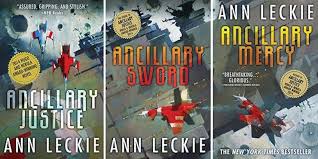
This post is brought to you because I just finished re-reading the Ancillary trilogy by Ann Leckie. It was the fifth time I had read Ancillar Justice, and the fourth time for Ancillary Sword and Mercy. (I seem to have not read Sword when it first came out, or something??) And there are still things that I had forgotten – details that delighted me again – and bits that I had forgotten. And along with all of that, the magnificent reasons why we – I – re-read: the comfort of knowing that the writing will be good. That (in this instance) things will work out ok, despite the dramatic and serious problems. That even though I’ve forgotten details, I know in the back of my head these are books that I have enjoyed and will continue to enjoy. I inhaled them, once again.
The fact that Breq refers to everyone as “she” because there’s no gendering in her language struck me again, not least because I remember it being one of the big issues everyone brought up eight years ago when it was published; this sort of recursive thinking is also part of the reason for why re-reading is fun – you get to reflect on your initial reflections and see how things have changed. I admit, I did once again find myself sometimes wondering about the gender of different characters, just like every other time, and then reminding myself that the point is it literally doesn’t matter. I was also massively struck, once again, by the imperialism and colonialism aspects – Arkady Martine’s A Memory Called Empire now contributes to the dialogue on this issue in fascinating ways that I still haven’t sat down to fully analyse.
The part that got me more this time is the delightful almost-domestic aspects that contrast spectacularly with the empire-threatening aspects. Breq and Seivarden’s relationship – its development, its purpose, the difficulty both of them have with it; relationships between crew and ship; and the actual familial relationships too. I find I am becoming more interested in exploring ‘found family’ in fiction, and I’m intrigued to realise how often this is part of the narratives I already enjoy.
This will not be the last time I read this trilogy and I am almost excited for future-me that I get to come back again.
(After finishing Mercy I then spent about an hour and a half faffing around trying to figure out what to do next because my brain really wanted to start re-reading Yoon Ha Lee’s Machineries of Empire series, and I felt too guilty to consider it. Then I finally gave in. And Ninefox Gambit is just mad, wonderful, brilliance (and I had completely forgotten how it opens). )

 Randomly Yours, Alex