Flight&Anchor, Nicole Kornher-Stace

Reasons to read the Acknowledgments at the end of the book: you find out that the brilliant book you just read is a prequel written some years after two other instalments.
Cue happy dancing.
In some medium-term future, America has gone entirely corporate, and there’s wars between the main ones (I mean…). This is, however, not the focus of this story at all (but possibly is of the main novel, Firebreak?). Instead, the focus is on 06 and 22 – two children who are no longer children in many ways, but still have some child-like aspects. They have been changed by a corporation, and I don’t really want to go into exactly how or why because discovering that was part of the absolute joy in reading this book. It’s not exactly pleasant, so maybe don’t read it if you’re feeling particularly attuned to nasty things happening to kids, but there’s not a lot of terrible detail, so there’s that.
The story is basically split in two. The main bits are focused on 06 and 22 – biologically 12, kept in a secret facility for four years – having broken out and now trying to find food and survive in what is basically a foreign environment. There’s an intense focus on the relationship between the two (don’t be gross, not like that), which is clearly a huge aspect of the later books but still works without knowing anything of their futures. It’s beautiful and sometimes funny and also quite affecting.
The other, smaller part of the story is the experience of the Director, as she tries to figure out how to get the pair back. For someone who is quite clearly reprehensible, Kornher-Stace does a good job of both humanising her and never minimising how awful she is. It’s an admirable presentation and again, makes me very keen to read more about her, even though I do now know some of what will happen to her in the future: Kornher-Stace is clearly writing this for people who’ve read the other stories, and yet the future-reflections actually still work for someone like me.
I enjoyed everything about this story and have every intention of going to find the rest.
The Iron Garden Sutra, A.D Sui
Um. Wow. This is absolutely brilliant.
I read this courtesy of NetGalley and the publisher; it’s out in February 2026.

Humans have spread through the stars. People die on spaceships, and in accidents, and sometimes lost slow-traveling generation spaceships are found with all crew dead. In those instances, monks of the Starlit Order are often called on, to lay the dead to rest, and to remind the dead that they are one with the Infinite Light. Not everyone believes in the Infinite Light (and the Infinite Light doesn’t care about your belief), but the monks seem to carry out a role that people need. People have always needed closure with death.
Iris is a Starlit monk, and as such has a personal AI in their head – not something that is very well regarded any more. Iris isn’t sure that he’s a very good monk, but he wants to be good at it. He is sent to a newly ‘arrived’ generation ship – sent many generations ago, just now arriving in populated space, and all crew dead. When Iris arrives onboard, however, he is not alone: there’s an archaeological team onboard as well, which just makes everything more difficult. And then things get even MORE difficult, but it’s not the fault of the humans…
I’m tempted to say that this is a little bit gothic – a giant spaceship is kind of like a house, right? I’m not sure whether or not it’s horror; I did not find it scary, although I imagine that if it were a film I would have found it so. Guess it’s a good thing I’m not doing the genre marketing.
No matter the genre, I absolutely adored this book. I love Iris and his inner conflict, although I definitely wanted to scold him at several (many) points and urge him to take better care of himself. I was deeply amused by Iris’ relationship with his AI (VIFAI), as well as occasionally troubled. The archaeologists and engineers are characterised swiftly and beautifully – even the ones who don’t live all that long (spoiler!). The arguments between the different groups were all too believable. And I was utterly intrigued by the eventual reveal of what was going on; it may not be an entirely unique take, but it’s incredibly well done and feels like a really fascinating direction for further exploration.
AND THEN I got to the end and discovered there’s another book in the offing! Truly a wonderful surprise. A.D Sui keeps being one to watch.
Margaret Beaufort: Survivor, Rebel, Kingmaker
I read this courtesy of NetGalley and the publisher. It’s out in November.
Absolutely fantastic biography, and also introduction to the entire period.
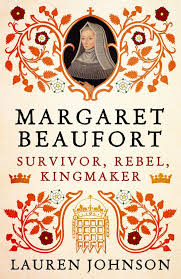
I love a biography that (re-)examines a woman in her context. Johnson is clear that she’s not the first to write a biography of Margaret Beaufort, but that one of the new things she’s doing is putting her very much in the context of women – the women she interacts with over her life: her mother and half-sisters, mothers-in-law and friends and servants and rivals, daughter-in-law and granddaughters. This gives a fantastic insight into what’s going on for noblewomen at this time in England, Wales, and even Scotland.
Of course, an enormous amount of the book is about Margaret’s interactions with men, too: husbands, mostly, but then eventually her son, as well as various half-brothers and stepchildren, not to mention cousins. My goodness, the cousins: when you’re a noble with a long lineage, you are related to EVERYONE of any importance. And, apparently, you knew them, or could at least call on them in times of need / just for the heck of it. Which really puts the War of the Roses in context, because it’s all about brothers and cousins fighting amongst themselves and devastating the countryside in the process.
Margaret Beaufort had a remarkable life. Terrible, at some points – pregnant and widowed at 13 – but also long, with many healthy and loving relationships (as far as we can tell), and eventually a son and then grandson on the throne. Not a terrible ending, one suspects. Lauren Johnson does an excellent job of making Margaret as human and relatable as feasible, while still reminding us that her life 500 years ago was very, very different from what we experience today. She does a very good job of trying to make the names easy to process (TOO MANY HENRYS and JOHNS), and the politicking easy (ish) to follow. This is a really great book.
Into the Mainstream, by Tom O’Lincoln

This is not the book I thought it would be. Which isn’t the book’s fault, but does affect how I think about it.
I thought I was getting a … straightforward history of the Communist Party of Australia. And that’s certainly a significant part of this book. But what the book is ultimately focussed on is the way Communism, and Marxist ideas, has often been done badly in Australia. O’Lincoln is very upfront about the fact that he is very unimpressed by most of the leadership of the CPA, especially from the 1970s onwards. Of note: the book was published in this format in 2009 but was actually written in 1985, which itself definitely and necessarily has an impact.
The other problem is that the book presupposes quite a lot of knowledge – both philosophical and historical – that I don’t really have. Again, that’s partly a factor of it having been written 30 years ago, so the intended audience would have had more immediate knowledge of things that I just don’t. But there’s also no interest in defining “left” and “right”, assuming that the reader will have a shared understanding of what that means – and I have to tell you, reading about a Communist party veering to the right is always weird (yes, I do understand how that works). There’s no attempt here at leading the reader into understanding the various issues (like the difference between socialism and communism, and why you would regard liberal reformism as bad) – because the reader is assumed to already be on O’Lincoln’s wavelength. Again, not necessarily bad, but does suggest a very specific audience.
Worth reading? If you’re interested in the development of the CPA over time, probably yes. But prepare yourself for some pretty heavy philosophical lifting.
Starling House, by Alix E Harrow
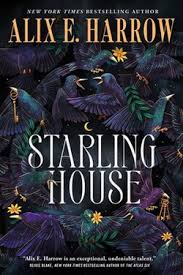
I think I avoided this when it first came out because it was called horror – or perhaps it was called ‘gothic’ and my brain generally translates that to ‘horror’ and as a rule, I avoid horror unless I know precisely what I’m getting; I do not enjoy being scared. However, it was turned face-out at the library when I went to pick up one book, and I decided to give it a go partly because it’s Harrow, and I have liked her other work, and partly because I’m beginning to suspect that much ‘gothic’ work is actually work that I do like. Nuance! It’s a good thing.
So anyway yeah I read this really quickly and it’s brilliant.
In terms of genre: I would not personally call it horror. For me, there was no moment when I was afraid: worried for the characters, yes, because they were likely to make truly stupid decisions; but no literary equivalents of jump-scares. So that’s an interesting discovery for me.
More importantly, the novel: it’s wonderful.
The writing is a delight – so easy to read, so lovely and lyrical, so evocative.
The characters are compelling – and, like I said, showing tendencies towards stupid decisions, although often for good – “good” – reasons.
The story – well. We have two points of view: one is Opal, in first person, and the other is third-person and focused on Arthur. Small-town USA, not a great place to grow up if you don’t really fit in, and Opal really doesn’t. She’s been looking after her brother since their mother died some years ago, working a crappy job and occasionally stealing as well. And she’s having dreams about a house. Through unlikely circumstance, she becomes the housekeeper at Starling House – a house that no one else ever visits, that even kids don’t approach on dares, so basically your classic threatening gothic house; Opal even references Boo Radley for its lone inhabitant. As you can probably imagine, things rather quickly go… well. Sideways? Weird, anyway.
The House is utterly central to the whole book – it’s where things happen, it’s what outsiders are obsessed with, it’s determined everything about Arthur’s life. Perhaps this is one of the key aspects of being a gothic story. And it’s a wonderfully developed house, too.
Harrow has done a wonderful thing here. She notes in her introduction that this is a story about staying, rather than leaving, and that made me really think about leaving and staying as tropes and what they tell us about how to approach the world.
I loved it. I should just trust Alix E. Harrow to write amazing stories.
Death of the Author, Nnedi Okorafor
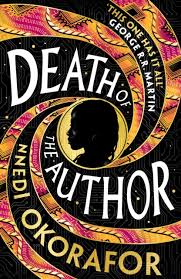
I am so torn by this book.
On the one hand, I really liked the structure and the themes and the way it developed, and the final twist did EXACTLY what it was meant to.
On the other hand… I did not particularly enjoy the writing itself.
The novel’s structure comprises three parts: sometimes we’re following Zelu’s life as she navigates being Nigerian-American, and a paraplegic, and unemployed, and a struggling author. Sometimes we get interviews with people in Zelu’s life, from later in time than the bit we’re reading of Zelu’s life. And sometimes we’re reading the science fiction novel that Zelu writes pretty early on in the book, which becomes a phenomenon: it’s about the robots who are left on Earth after the humans are gone (died?), and whether the embodied can coexist with the disembodied. So, for me, structure: big tick. This way of telling a story, and the story itself, are fantastic.
Themes? Well, they’re kind of obvious from the above paragraph, aren’t they. Zelu is impacted by multiple structural inequalities; she rages against them, and the way she does so informs a lot of the novel. Okorafor is doing A LOT with ideas of AI, both in Zelu’s novel and her life. There’s an enormous amount to unpack around questions of identity (for immigrants, the way people view those with disabilities, patriarchy, etc etc). Okorafor has a deft hand – the novel is in no way preachy, but it was also (at least for me) impossible to avoid thinking about the ideas. And I mean that in a good way.
And then there’s the reference to Roland Barthes’ essay, of course. That the author is just another reader when it comes to interpreting a text. You don’t need to have read his piece, or even have heard of it, to understand the novel, but it’s certainly another level if you have.
And yet. I did not especially enjoy the novel, on a word or sentence level. Rusted Robots, Zelu’s novel, is not a novel I would rate by itself – is that part of the point? I have no idea. Perhaps I am simply not connecting with Okorafor’s style – which is fine! There are plenty of novels that other people hate and I love! But it makes me sad, because I wanted to love this book a lot, and I cannot in all honesty say that I did. I did not find the reading experience a transportive one.
Around the Table: 52 Essays on Food and Life
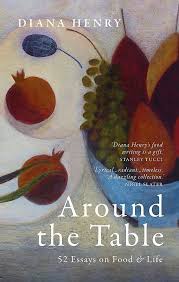
I adore well-written food essays, and Diana Henry definitely knows how to write them.
These are not new essays: they are collected from the many books that Henry has written over the lat few decades. As she acknowledges in the Introduction, this means that the essays follow changes in her own life – both children now adults – as well as changes in the British food scene, which is the audience she primarily writes for. Much easier now to find preserved lemons and sumac and other such ingredients that were ‘exotic’ some years ago. So it’s an interesting time capsule in that way.
Are there elements of this reflecting a deeply privileged life? Of course. Henry has travelled a lot, and she has visited some amazing restaurants – although she is at pains to point out that most of the places she visits are not the very high-end places, and that when she does get to those, it’s a determined effort. That said, she does still manage to buy a truffle every couple of years; and travel appears to have been straightforward for her over her whole life. Having said all of that, a book like this is aspirational – and it’s also armchair travelling. It fills those niches neatly; I will never get to have the experiences that she did, but I can enjoy hers vicariously.
I have several recipes online that I want to try already – socca, in particular – and I was reminded that you can make vin d’orange and that one might make that with mandarins instead. And if I were reading this in paper, I would have dog-eared pages or dug out the sticky notes to keep track of all of the ideas they inspired (apricot and lavender jam). As it is, I do believe I might need to buy this in paper. That’s a mark of a good book.
Once There were Wolves

This is not the sort of book I would tend to read, but it was our book club pick so I went ahead. And let me tell you, there was a degree of whiplash because I had just finished EJ Swift’s When There are Wolves Again, which has some similar ideas – rewilding, wolves should be back in Britain – but is also completely different.
Content warning: animal deaths, and violence towards women.
Once isn’t linear; we get a lot of flashbacks to points in Inti’s life, explaining how she and her twin have ended up in the Cairngorms. It’s clear that there’s been a significant trauma for the sister, Aggie, but it’s unclear just how far in the past that is – until it’s not, and then it’s sadly predictable.
So there’s the unravelling of what happened to Aggie, and there’s the reintroduction of wolves to Scotland and in particular around a farming community that is deeply divided as to whether the wolves are a good idea. And then there’s the death of a man who has clearly been violent towards his wife, and with whom Inti has been clashing. Figuring out who or what killed him runs parallel with Aggie and Inti’s story.
The book is well enough written; I skimmed a few sections, I admit, because I got a bit impatient with some of the angsting. I didn’t exercise myself to try and figure out what was going on, but let myself be carried along by the narrative, partly because I was feeling lazy and partly because the story didn’t really incite much enthusiasm for doing so – I knew it would all be tied up neatly.
It’s fine. If you’re up for a standalone mystery set in Scotland with a few different threads, this may well be for you.
When There are Wolves Again, EJ Swift
I read this courtesy of Netgalley and the publisher. It’s out in October.

I have never read a book quite like this.
It is one of my favourite books of the year.
Partly it’s the structure. We open with Lucy and Hester talking in 2070, and then swiftly move to Lucy recounting her life, starting as a child going to stay with her grandparents during 2020 (yes, the real 2020). Chapters alternate between Hester – documentary film maker, estranged from her family, a lineage of dogs her constant companions – and Lucy, growing up in a Britain rapidly coming apart thanks to climate change, also largely estranged from her parents. Both women provide a lens through which to understand the ecological changes being wrought – the heat, the floods, the fires – as well as the attempts at mitigation, particularly through rewilding efforts. These two interwoven narratives – lives that have brushed against one another over decades, then finally cross in 2070 – are a beautiful way of exploring different reactions to events, giving two generational perspectives on those events, and laying out the similarities and differences between the two women.
Partly it’s the climate change. I have read a few books focused on its near-future impacts, but it’s not something I have sought out; I generally find such speculation too depressing to want to immerse myself in. And Swift’s vision definitely has its grim aspects. As well, my exposure has tended to focus on America (because cultural imperialism) or Australia (because home). To read about what might happen in Britain – the fires, the impact of 40+ degree heat in a place where homes REALLY aren’t designed for it, let alone the impact on wildlife and particularly birds – was shocking all over again. Perhaps, even probably, this sort of thing has been written before. But I haven’t read it, and I’m going to go out on a limb and say very little will have been written with the lyricism and intensity that Swift brings.
And partly it’s the ultimate hope that Swift holds out. Between 2020 and 2070, truly devastating things happen, death and destruction and political evil (I haven’t even mentioned Albion First yet). And yet. And yet, there are people actively trying to mitigate the worst effects, who struggle on in the face of immense pressure. Greta Thunberg is name-checked. People push on despite obstacles, mostly as a group, and this offers hope.
I loved it.
The Far Edges of the Known World
This book is right up my alley. Really old stuff, questioning received wisdom, drawing together both evidence that has been known for ages and new discoveries via archaeology… and engagingly written as well. I enjoyed it immensely.
Rees starts with the poet Ovid, who for some unknown reason got exiled by that Great Bastion of Reason, Octavian Who Got Himself Called Augustus (“Illustrious One”). Basically for the rest of his life – as far as we can tell – Ovid spent his time complaining and petitioning to be allowed back to the Centre Of Life and Light, Rome. Now, firstly this does give us David Malouf’s quite fabulous An Imaginary Life, so that’s a good thing. But it also deeply colours how subsequent historians have thought about “the edges” – those bits where if there’s a bright centre to the universe, you’re in the town that it’s farthest from. And as Owen Rees shows, this is just not a fair way of characterising “the edges” at all. Not least because “edges” implies a centre, and (the centre of a galaxy being a real thing notwithstanding), the idea that there is a “centre” to “civilisation” brings up SO MANY QUESTIONS.
The first section is about pre-history – which is a concept that Rees takes pains to explore as a concept – and it looks at Lake Turkana in Kenya (some of the earliest human occupation), the Great Cataract in Sudan, and Megiddo in Israel. This section was absolutely enchanting and sets up a lot of the ideas followed in the rest of the book: contact between different areas, the sorts of evidence we can use, and so on.
Section 2 looks at the Greek world, and Section 3 looks at the Roman. So we get the expected ‘edges’: ancient towns in (what is now) Ukraine, Egypt, France, and England, Morocco, and Egypt. This was the bit that was most familiar to me – because I know about these empires – and which was therefore the most fascinating, because it complicated all of that so fantastically. The cross-fertilisation between the hegemonic empire and the ‘barbarians’ on the border, what we can figure out of how people interacted: I LOVE IT.
Finally, the last section is ‘Beyond the Classical World’ – the book is really aiming at a specifically English, maybe American, audience, those people who are very firmly in the “Greece and Rome are THE ancient areas and everywhere else is weird.” I suspect folks who come from a perspective that says India and China were really important – let alone other civilisations – will find some of the sentences a bit surprising, maybe borderline patronising, because there’s a little bit of “these other civilisations also existed!” I suspect this does not actually reflect Rees’ own perspective, but the expected audience. ANYWAY, this section looks at ancient towns in Ukraine, Pakistan, Vietnam, and Ethiopia and Eritrea. This section was really cool and MUCH more unknown for me.
I guess the short version is “I learned a lot and enjoyed doing it.”

 Randomly Yours, Alex