Bean there, Done that: The Island (2005)
I might have seen this twice? Maybe I saw it at the cinema? I have no clear recollection. Unlike Ronin, though, I know I have seem it.
- It has such a spectacular opening: the idyllic boat ride, the terrifying maybe-drowning, waking up in the whiteness of the bed… also, Ewan and Scarlett. SO hot in 2005… and also in 2025.
- I had forgotten this was a Michael Bay! Lots of blue already.
- Michael Clarke Duncan!
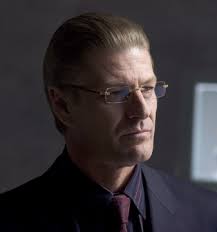
- And THERE’S Bean: Dr Merrick. Maybe a psych? Certainly a top person. And Lincoln knows that needing to see him means there’s something wrong…
- I adore his office. The art, the architecture, the desk-as-screen.
- His glasses are amazing – so early 21st century: frameless, rectangular.
- Slicked back hair, short of course.
- McGregor’s accent is very confused.
- (Steve Buscemi!)
- A pod with “Merrick something” on it, with a human inside… so Dr Merrick is the person in charge then. And thus we discover that the facility is making humans, and the whole “surviving a catastrophe” thing is a lie.
- The xbox boxing arena is terrifying.
- Bean sitting in his room, alone, to watch the Lottery: fireplace, high ceilings, very different from the rest of the place.
- McGregor gets to the area he’s not meant to be in… and then Bean sees him on the security footage and loses his nut.
- Bean does coldly furious very nicely.
- Finally realised who Jones Three Echo is: Neelix, from Star Trek: Voyager.
- Bean selling his product to rich people: the ability to grow a body that will provide organs, and promising that all bodies are vegetative, rather than aware.
- But apparently without living, the organs fail. Which… seems unlikely, but it’s a good story.
- (Djimon Hounsou! Oh. Except he’s a bit evil. Well, a security consultant anyway.)
- Hearing the original Tom Lincoln with Ewan M’s actual accent is wild.
- Bean announces that because of the defect – developing curiosity – four product lines are going to be… eliminated.
- And then he shows that he has a god complex, and that he has convinced himself his ‘products’ have no souls.
- (Dijon Hounsou comes good!)
- Bean actually gets his hands dirty, going after Lincoln with a gun! Fisticuffs ensue.
- Also his hair gets mussed.
- And then he dies because their fight means he ends up hanged.
- Everyone gets out, and now there’s going to be a terrible problem with famous people having clones hanging around, plus they all need to be taught how to live in the world… but that’s not the problem of this film.
- Thing I just realised: I know it’s a completely different situation, but there’s definitely a similarity between this and Severance. Innies and outies.
Verdict: Corporate villain. Even the starting point of his journey – wanting to provide organs for rich people so they can live longer – is grotesque: there’s no suggestion that he starts from a particularly altruistic position. And then willingly keeping conscious humans in prison for his own greed? Evil.
Movies: 5. Beans dead: 4.
Esperance, by Adam Oyebanji

Read courtesy of NetGalley and the publisher. It’s out in May.
Starts as a police procedural, which is fine by me – I love them: Chicago cops turn up to investigate a death, the cause of death is very weird, and how it was managed is baffling. Cops hear about a similar murder a long way across the country…
Meanwhile, someone has just arrived in England – we don’t know where from – and talks like someone from a bad 1930s film. She meets a grifter, they fall into some trouble together, and of course their paths eventually cross the paths of the American cops. And I can’t tell you why or how without going into some of the key revelations, the discovery which was a massive part of why I enjoyed this novel so much.
I spent a lot of this novel not really sure who the traveller was, where they were from, and what their purpose would turn out to be. Sometimes this sort of suspense is really annoying, but not here: although their overall intention was mysterious, Oyebanji still managed to create a character who was fascinating and appealing enough that I wanted to keep hanging out with them. He also does some very clever things with the American cops, I think, although as a white Australian I’m really not in a position to fully comment on that.
The book is fantastic. There’s wonderful characters, excellent interactions between them, and an intriguing and compelling mystery. It covers racism, mammoth questions like what justice really is or looks like – and is a standalone story. Highly recommended.
Beast, by Jade Linwood
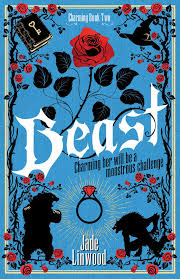
I read this courtesy of the publisher and NetGalley. It’s out in June, in Australia.
This was a lot of fun.
I haven’t read the first book, Charming, which presumably introduces the titular prince and the variety of ladies he has rescued. Fortunately, there was enough backstory provided – and without it being super info-dump-y – that that wasn’t too much of a problem; I picked up fairly quickly that Charming is every Prince Charming, that he’s therefore regarded as a conman and a rogue by the rescuees who have now banded together, and that there’s also some sort of curse on Charming himself, organised by Mephistopheles, that the ladies need to work with Charming to break. Which is all well and good until Charming gets pulled into yet another curse – the focus of this novel, which is of course the Beauty and the Beast one. And it’s gender-swapped, with Charming as the Beauty and a woman as the Beast.
It’s interesting to read a flipped B&B, especially when it’s primarily from the man’s perspective (now I want to read a flipped version from the woman’s perspective). Because of the sort of story this is, Charming never finds Beast particularly offensive, and indeed appreciates many of her qualities from early on. The novel does acknowledge that other men have not been as generous, with some reduced to gibbering wrecks because they’re incapable of seeing past the idea of a very large furry bipedal ‘animal’ coming towards them while inside a house. There’s no great interrogation here or psychoanalytical discussion of what it means to have been transformed; that’s not what this novel wants to do. But there is commentary on Beast having to use a tankard rather than a wine glass, and not wanting to eat in front of potential suitors, and a few other notes that compare how a well-bred lady of the pseudo-medieval society would be expected to look and behave compared with how she looks now.
Other fairy tales also get a look-in here, in particular Red Riding Hood and Hansel & Gretel; they are likewise fractured in really fascinating ways. Linwood seems to have had a lot of fun playing with all of these stories and thinking about how to make recognisable and yet just a bit other. (Red’s hanging out with werewolves; Gretel is traumatised from her childhood – and not by a witch – and now protects herself with bears.)
Fast-paced in a good way, easy to read, some delightful characters: this book was great.
Bean there, done that: The Fellowship of the Ring (2001)
Takes a while to get to Boromir, but that’s ok. We know he’s on the way. Just need to get through the birthday party (not my favourite part of the story), the events in Bree, and the disaster at Weathertop. And THEN we get to Rivendell, and the Council of Elrond.
- Boromir’s entrance is glorious: hair flowing, shield on back, horse looking epic. The very picture of a warrior.
- The hair doesn’t look too bad: not as long as in Patriot Games, at least. And it suits the pseudo-medieval feel of the world.
- Boromir goes wandering, admiring art, meets Aragon… and realises who Aragorn is.
- Already we see some of Boromir’s trouble; ambition, a desire to be great, feeling overwhelmed by someone he thinks could be greater than him.
- Bean does stately very well – relating his dream, arguing with Gandalf from the point of view that he understands.
- And then Boromir gets spiteful: Gondor needs no king.
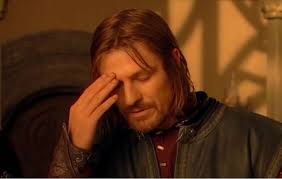
- “One does not simply walk into Mordor” – Boromir gets some of the great meme-worthy lines.
- Boromir shows his worth in accepting the decision of the Council. (Going just from the movie) I see no reason to suggest, from how this part is portrayed, that Boromir has any thought of treachery in this moment. He is committed to following what the others have decided. Partly to make sure Gondor get in on the honour, to be sure, but that’s understandable and not evil in itself.
- I really enjoy the ‘teaching the hobbits to fight’ scene. It’s about the most human Boromir gets to be, rather than the stuffed-shirt warrior – and shows us his connection to Merry and Pippin early on.
- Picking up the ring in the snow: poor Boromir. He’s far more fallible than he wants to be. (Also Bean plays this scene really nicely.)
- “This is no mine; it’s a tomb” – another great line.
- Nobody can doubt Boromir’s courage, with the way he goes wading into the pool to fight the basically-a-kraken.
- And again – as in the snow on Caradhas – Boromir takes care of Merry and Pippin.
- “They have a cave troll” – ngl, always love this moment. Every time.
- Again, in this fight Boromir shows his true worth; he is a skilled and fierce warrior.
- And again: crossing the broken stairs, Boromir jumps with Merry and Pippin.
- I knew all of these moments but I had never really put them together before. It’s quite lovely, actually.
- (Dwarves should be spoken to about the concept of balustrades, though.)
- It’s Boromir who holds Frodo back when Gandalf is about to fall – which makes sense: he’s probably the least connected to Gandalf of any of the Fellowship.
- When everyone is having a weep, Boromir comforts Gimli. And when Aragorn is being a tough leader, Boromir is the one who pleads to let them have a moment, “for pity’s sake.”
- Boromir’s gentle words to Frodo, about not carrying he weight of the dead, are revealing of who he could have been, with more encouragement.
- Ah Lothlorien. Poor Boromir’s background gives him no way of dealing with so many elves at once, and certainly not the power and majesty of Galadriel.
- What makes Boromir distraught is also revealing – the fear that Gondor is failing, that his father’s strength is failing, and what that will mean for his people and his city.
- And for just a moment, Boromir acknowledges Aragorn as king, and that his return to the city will be exactly what they need.
- Bean plays distraught well.
- I have never noticed that Boromir doesn’t get a special gift (aside from a cloak) from Galadriel.
- Boromir’s boat has Merry and Pippin in it.
- I don’t blame Boromir for trying to convince Aragorn to go via Gondor. He has so much faith in the strength of his people, and it blinds him to alternatives – and to Gondor’s failings.
- I like that Boromir is collecting firewood – he’s not too proud to do menial work.
- “You are not yourself” – this is the key, and Frodo knows it: the ring is using Boromir’s best qualities and twisting them.
- Bean plays the changing emotions in this section beautifully.
- And Boromir gets one glorious last stand. Protecting Merry and Pippin.
- He does a marvellous death scene, Bean.
- Boromir and Aragorn’s last scene is a beautiful one. It’s a cliche, the deathbed clarity, but I don’t care: “I would have followed you, my brother, my captain, my king.”
- Farewell Boromir, over the Falls of Rauros you go.
Verdict: A valiant warrior, let down by his upbringing (OK, so I know that from the rest of the trilogy, whatever) and ultimately susceptible to the ring precisely because he wants to bring glory and honour to his city-state and can’t see the broader picture.
Movies: 4. Beans dead: 3.
Bean there, done that: Ronin (1998)
I have absolutely no idea when I watched this film. I wouldn’t have seen it at the cinema, so it will have been at home sometime… something like two decades ago??
So, it’s a heist…
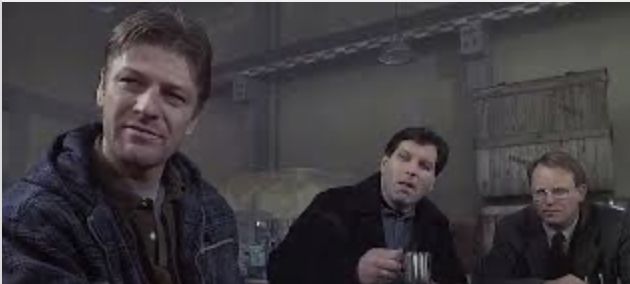
- Sean Bean is Spence, one of the men employed to retrieve a case.
- He seems to be ex-military, and calls himself “a weapons man.” Pretty sure that’s not an innuendo. At least, not in this context.
- (It’s a pretty great cast: I am indifferent towards De Niro, myself, but that’s a very young Stellan Skarsgard, and I often love Jean Reno. I recognise Natascha McElhone but I have no idea from where. And
Elliot CarverJonathan Pryce. ) - He’s English, and has short hair again (I approve). He’s also super nervy, and likes to big-note himself.
- Suddenly Spence is taking over the gun-buying operation? And he’s very jumpy. This seems like a very bad idea.
- It was. Sniper on the bridge, everybody shooting… Spence is very cranky. Absolutely no self-control.
- And then, when they’re back in the car, he’s manic: pleased and excited way out of proportion.
- And then he vomits. Is he high?
- I had completely forgotten how epic the driving is in this film. I know it’s what the film is known for, but knowing is different from seeing.
- Spence then tries to take over the briefing… but Sam / De Niro calls him, and there’s a scuffle, out of which Spence looks very poor. It’s beginning to sound like Spence isn’t the military man he claims to be.
- And so he is let go. With a stark warning about needing to forget the people he was working for.
- Wait, is that the end of Sean Bean in this film??
Oh well. Bean has left the building.
Continue reading →Bean there, done that 2: GoldenEye (1995)
I am well known for being a sucker for James Bond. But this post will be about Alec Trevelyan, I SWEAR.
Having said that, the opening shot – rappelling down a dam wall – is SPECTACULAR.
- The introduction of Alec, as 006 and speaking Russian and interacting with Bond, is glorious.
- And once again, Bean is proficient with weapons. There’s a lot of shooting.
- We’re back to an English accent, and a pretty posh one at that.
- Also, short hair. A much better look.
- Alec wanting to be all noble and self-sacrificial… and getting his way, as he gets shot by the Russian officer.
- “For England!” – what a difference from Patriot Games.
- (It’s a good thing James Bond lives in an alternate universe where gravity works differently, is all I’ll say about the conclusion to the prologue. Also, Tina Turner’s song is one of the great Bond themes… written by Bono and The Edge??)
- NINE YEARS LATER…
- (Famke Janssen deserved better. As did basically every other woman in the Bond franchise, I know. But this is from 1995 and it feels like it’s 1975. Urgh.)
- (Alan Cummings is hilarious, and provides one of my favourite lines.)
- We go for quite a long period without seeing Bean again, for all that he’s listed at the top of the film as “starring”.
- (Eeee Dame Judi! She is absolutely one of the key reasons for why the franchise was able to transition to the 21st century. She’s only 60 in this film.)
- (Eee Desmond Llewelyn. *Hearts* – he’s 80 in this film.)
- (And Robbie Coltrane! … such a good cast.)
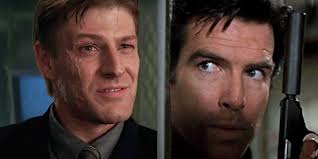
- And then BOOM: “hello James” – Alec is back, this time with a scarred face, and is the terrifying arms dealer, Janus, whom Bond has been searching for.
- Turns out he’s the son of Lienz Cossacks who were betrayed by the British and then died in a murder/suicide; he has been planning for betrayal for years.
- His posh accent is glorious in this context.
- Long tank/car chase and we’re finally back to Alec, on a very fancy train (whoa, Snowpiercer connection!).
- Alec forces his attentions on Natalya, cementing his position as a villain.
- Bean rocks a suit very well.
- Seems that Alec is driven more by money than any philosophy or political ideology.
- And then we’re off to Cuba.
- Alec has a surprisingly sophisticated set-up for a secret base.
- He’s far more suave than the Sean of Patriot Games – which is no surprise, given their respective backgrounds.
- Oh and he’s targeting London? How original. And he’s going to steal all the money from the Bank of England and then wipe all the records via his EMP? uhuh.
- Villains should know better than to monologue when they have their enemy in their sights.
- Alec falls off the antenna structure; Bond catches his foot, and then lets him fall, in a nice(?) echo of the opening scene (rappelling down the dam wall).
- And despite landing on his back from a very great height, what actually kills Alec is the antenna falling on him.
Verdict: Unquestionably A Bad Guy. (He’s presumably been a useful 00 agent for MI6 before his betrayal of the organisation, but he ends his life as an immoral arms dealer and bank robber who is happy to create chaos for money.)
Movies: 2. Beans dead: 2
Bean there, done that: Patriot Games (1992)
I do adore a Jack Ryan movie (usually).
I love the way this film opens with talking about Russia (it’s 1992!!) – especially given The Hunt for the Red October – and then… BAIT AND SWITCH!
OK, this is going to focus on Sean Bean, I swear.
- I have no idea whether his Irish accent sounds real to the Irish ear, but it’s convincing enough to me.
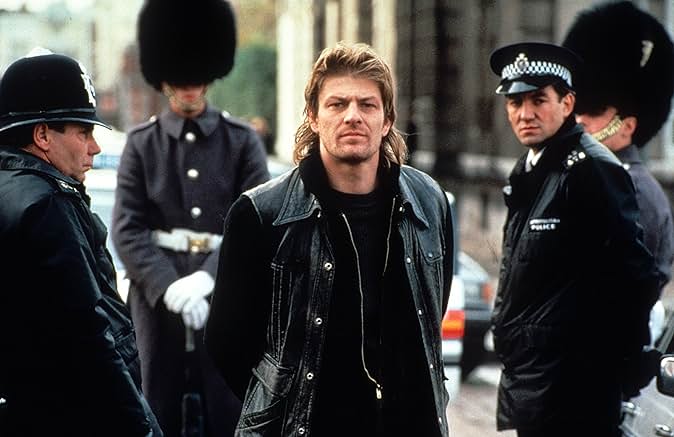
- THE HAIR.
- Oops, Jack killed Sean’s younger brother. That’s not going to end well.
- How convenient that his character’s name is also Sean (Miller).
- He’s so young! (Huh; he’s 32 in this film, so… yeh ok, I’m old).
- Bean does angry very well.
- They didn’t make him cut his hair in jail? What sort of establishment is this??
- The blue and yellow jumpsuit does nothing good for Bean’s complexion.
- Although my, he is awfully skinny.
- He also does Terrifyingly Feral very well.
- [Eee, James Earl Jones!]
- He finally gets a haircut on the ship… I think it’s an improvement.
- It’s definitely an improvement. Little bit of a crewcut along the bottom of the head – not an undercut, far more military than that.
- [Eek, Samuel L Jackson! Had completely forgotten he was in this film. Also so young… about 43 years old…]
- Bean doesn’t really exhibit much range in this film: he’s angry, or upset, or frustrated, or… yeh that’s about all, actually.
- Movies just don’t do those fades between cut-scenes in the same way any more. More’s the shame.
- Yikes, disaffected IRA training in the desert… with vaguely Arabic types… oh, early 1990s, you were such a time.
- The conclusion feels rather cliched today – the royal at Jack’s house (as if), the navy buddy is there as well, the lights go out and the baddies make use of night vision (in the middle of a lightning storm, really?)… but I really like the speed boat chase: it may not look particularly realistic, but it is still pretty awesome. Also, over a lot faster than similar denouements in other, later, films.
- Bean’s death, impaled on a boat implement of some sort, is vicious.
Bean Verdict: Unquestionably A Bad Guy (slightly ameliorated by the dead brother aspect, but he was already involved in violence before that).
Movies: 1. Beans dead: 1.
Bean there, done that

It’s been a long time since we did a movie-a-thon, and I was suddenly struck by how much fun it would be to do a Sean Bean watch.
So here it is. Unashamedly, we have picked movies that we already know and love, but which we haven’t seen for ages (with two exceptions).
- Patriot Games
- GoldenEye
- Ronin
- The Lord of the Rings: the Fellowship of the Ring
- The Island
- The Martian
… I’m happy to take suggestions for other movies we should add (not TV, that’s a whole other thing). But you need to give me a good reason.
Mary Darling, by Pat Murphy
Read courtesy of NetGalley and the publisher, it’s out in May.
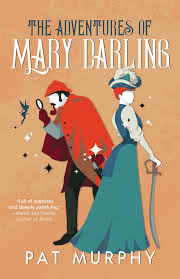
The Peter Pan/Sherlock Holmes mash-up I didn’t know I needed.
I’m a big fan of taking old stories – especially well-loved ones – and either putting women in, or re-telling the women’s stories to give them more agency, or just flat-out actually making them a character rather than sexy (or maternal) lampshades. Here, Murphy gives life to Mary Darling: wife to George, mother to Wendy, John, and Michael – and previous inhabitant of Neverland, courtesy of Peter Pan. She grew up in Cooktown, Qld; is the niece of Dr John Watson; and is generally awesome.
The story is partly Mary’s story, as she goes off to find her own children – recognising all the signs, as she does, of a Peter Pan abduction – and partly Watson’s story, as he (along with Holmes) follow in Mary’s wake to try and find Neverland. Along the way there are adventures, including other Victorian lady adventurers, and brothel-keepers, and several pirates. There’s also flashbacks to Mary’s childhood, as well as to the experiences of various members of the party: Sam, a South-Sea Islander friend from Mary’s childhood; some of the pirates; the people who become known as Princess Tiger-Lily and her family; and George Darling himself.
Murphy has made Barrie’s (and Conan Doyle’s) much richer by restoring the women and people of colour who would really have existed in London, let alone the rest of the world, to the story. She’s also written a zippy tale of adventure and family and identity that kept me completely enthralled.
Holmes does not come out of this story very well. Nor does Peter Pan. I was naturally reminded of AC Wise’s Wendy, Darling, which is a very different book but likewise asks questions about exactly who, or what, Peter Pan could possibly be.
This was brilliant. Loved all of it.
Wolf’s Path, Joyce Chng
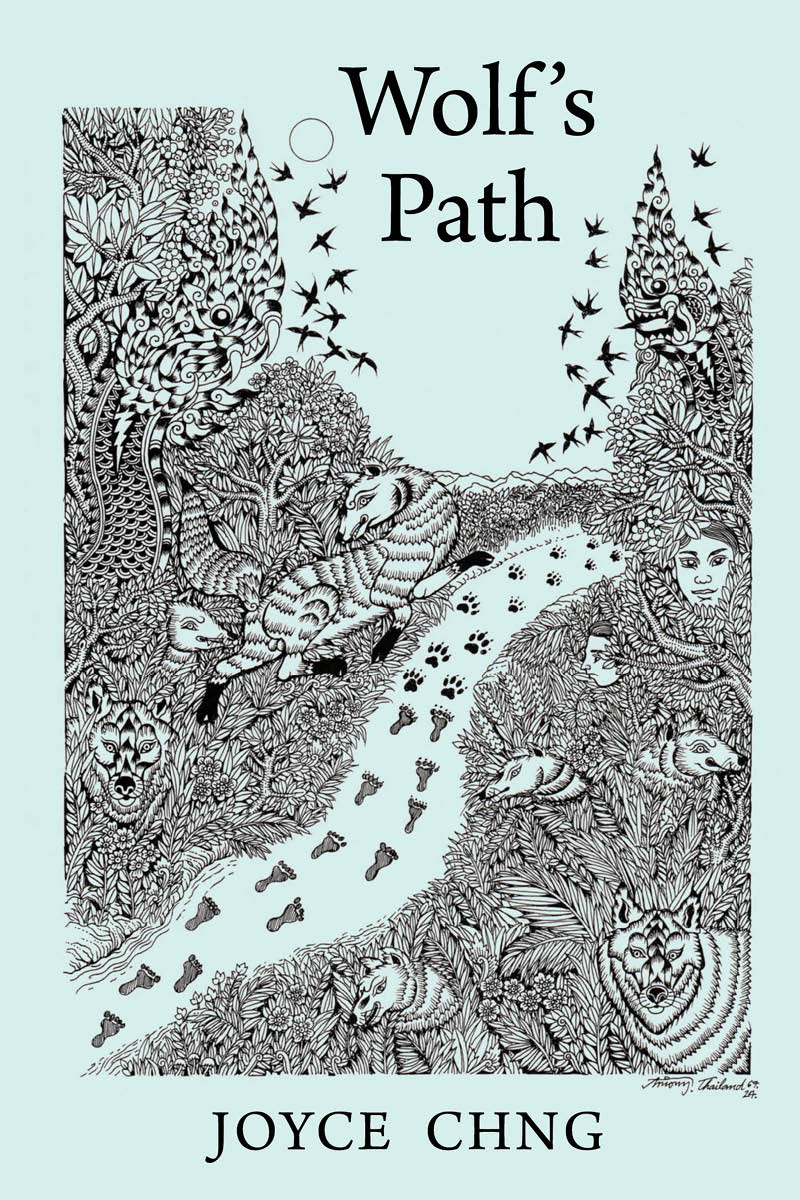
Read courtesy of NetGalley and the publisher, Atthis Arts. It will be out in March.
A collection to mark Chng’s turning 50 this year, this is a collection that embraces the changing nature of the writer over their career: from their earliest published work, through to very recent pieces. Arranged roughly chronologically, the reader gets a sense of how Chng has changed over time – I think the later work is a bit more polished than the earlier pieces, although those early ones are certainly still worth reading. You also get to see some of the consistent themes that Chng keeps coming back to. In particular, questions of what life can and might be like during war pop up several times; and explorations of gender, ethnicity, and identity broadly defined are a consistent presence. And Chng’s experience as a Singaporean is also fundamental to their stories, with many of the stories taking place in either a real or imagined Southeast Asia.
It’s brilliant that Atthis Arts is publishing this retrospective collection. Too often white men get collected early in their careers and everyone else just… doesn’t. Chng’s voice is an example of one that should be highlighted and celebrated.

 Randomly Yours, Alex