Cinder House, Freya Marske
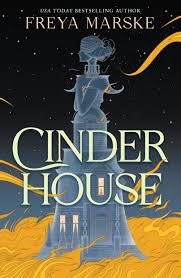
My main take away from this novella is “do not come at me with your ‘fairy tales are dead’ takes.”
This is probably the most imaginative reworking of Cinderella I’ve ever come across. Not least because it starts with the death of Ella’s father… and of Ella herself.
Yes, Ella is a ghost. No, that doesn’t stop her from having the traditional Cinderella adventures. Yes, it makes it more complicated; yes, it makes it absolutely intriguing.
Honestly, don’t even keep reading this review. Just go read it. It’s that good. (Also, novella! I basically read the whole thing while donating plasma!)
If you want more detail: Ella dies at 16. She becomes a ghost and haunts her house. The only people who can see her are her stepmother and stepsisters, and she can’t leave the house… until she finds a way to do so, temporarily.
This is a world with magic and fairies; the fairies are treated much like exotic humans (I choose the term advisedly), and magic has a difficult place in the world. Ghosts are not unknown. Ella’s tie to the house is used brilliantly – I think it’s one of the more clever explorations of that idea that I’ve come across, too, although given my general avoidance of haunted-house-stories (because I’m a wuss), maybe it’s not as novel as I think. At any rate, in not very many pages Marske creates (for me) a whole new way of thinking about hauntings, and I bought it completely.
Marske also manages to make the prince complex and interesting, with – again – a really brilliant take on his character.
Also also: a queered fairytale.
And finally also: gorgeous prose.
I loved this book a lot.
Every Day I Read, Hwang Bo-reum
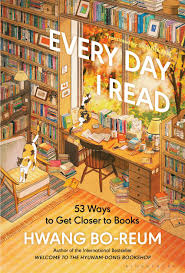
I received this book from the publisher, Bloomsbury, at no cost. It’s out now.
(Translated from Korean by Shanna Tan.)
I am not the audience for this book. That’s the main thing I took away from reading it. Perhaps as importantly, I don’t know – and I’m not sure the book itself knows – who the audience actually would be.
Sometimes the book’s purpose seems to be to give readers a way into, or back to, sharing the author’s love of reading. A worthy goal, of course – but I question whether most people who are struggling to find time to read (or to see it as a worthwhile activity) would pick up a book about that activity. So I was confused by that aspect – and also, that is not a problem for me, thus: I am not the audience for this book.
Sometimes the book’s purpose seems to be celebrating the joy that is reading, and this is one that I fully get behind (obviously). But the slides into didacticism – here are reasons for why reading is good for you! – felt very off-putting in that context.
The book is at its best when the author presents a sort of book biography. The books that have made an impact on her life, the times reading has helped her cope with difficult times in her life, and so on. I did also like the way she points out what reading a variety of books – bestsellers and not, short and long, staying within your preferred topics and venturing further afield – can be like. And yet… it also felt a bit pretentious. Again, maybe that’s me and my personal hang-ups, and maybe I still feel defensive about my preferred genres. But almost every book mentioned was a “classic” and there aren’t many books that could be called recent (aside from Murakami… and see “classic”). Pretty much all of the fiction is realist. And then there’s the dismissal of ebooks, conflating “reading online” with “reading electronic books”. And yes, perhaps many people do consume ebooks differently from how they read paper books. But many of us don’t.
Anyway. As noted, this is not a book for me. I hope it finds an English-language audience; I just don’t know who they will be.
Frostbite, by Nicola Twilley
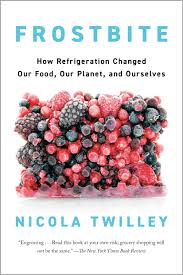
I came to this book because I am a fan of the podcast Gastropod, and Twilley is one of the hosts. She’s an immensely engaging host there, and she’s also an immensely engaging author. Her interest in and passion for “food through the lens of science and history” (the podcast’s tagline) comes through here: the history, present, and future of refrigeration and its connection to food is told thoughtfully, clearly, and with honest acknowledgement of the issues as well as the benefits.
One of the things I hadn’t really expected, but should have given the podcast, is just how much time Twilley spent actually experiencing the things that she discusses. She works some shifts in cold storage warehouses! She visits farms and factories! She goes to China and Rwanda as well as all over the US! And she has clearly talked to A LOT of people about all of the issues.
A fairly big focus of the book is the development of artificial refrigeration for food: the reasons for its necessity and the various people who were involved in trying to do so, the things they tried and how often they failed. I had no idea that people thought it would be ear impossible, but Twilley lays out the reasons for why it was so very hard and honestly I ended up surprised that it happened at all.
The bit that I found quite distressing was the reality of how much space is used for cold storage, and its environmental impact. But Twilley also points out how important refrigeration can be for things like reducing food wastage – one of the things I like about her reporting is that it’s not just two-sides-ing for the sake of it, but is looking at the issues very clearly and thoughtfully.
It’s a great book. Definitely one for people who are interested in how processes that we absolutely take for granted actually work.
(One thing to note, for those of us not in the USA: the book does use Fahrenheit throughout, which meant for me that I have no idea what the temperatures she’s referring to actually feel like.)
A Forest, Darkly, by A.G Slatter
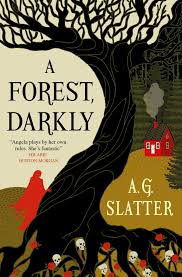
Read courtesy of NetGalley and the publisher, Titan. It’s out in February 2026.
The short version is that I like everything Slatter writes, and this was no exception. If you’re interested in reading complex characters, fascinating worldbuilding and plots that feel familiar and then go in entirely unexpected directions, with a “this feels like a fairytale but WOAH” vibe, then she is definitely one for you to look out for.
This is very loosely a version of Red Riding Hood, but I promise you have absolutely no idea what’s going on with any of the characters from my having said that. The central figure is a witch – I could say she’s a good witch, but that’s way too patronising and shallow and, well, inaccurate. She’s trying, ok? She’s not a witch who’s looking to eat children. There are, though, a significant number of children in the book, to whom some unpleasant things do happen. There’s also a blacksmith, and some non-humans, and a forest.
Mehrab, the witch, has been getting on well enough in her little cottage in the forest, far away from any signifiant towns. The nearest village is also far enough away that getting there requires a conscious choice, and anyone coming to her is doing so deliberately. One day, Fenna – the woman who brought Mehrab herself to this cottage, and who has brought other girls to stay there over the years – brings Rhea to her: the girl is a witch, and is on the run. Part of the novel is about Mehrab and Rhea figuring out how to be around each other.
A mother and father arrive at the cottage soon after Rhea; their little girl went missing a few days ago, and they ask for Mehrab’s help to find her – but she has no luck. And then the girl arrives home some weeks later… but seems to be different. Part of the novel is about figuring out what’s going on with Ari, and other children too.
Mehrab’s past is very mysterious; she gives little away to Rhea, or the reader. The gradual revelation of why she was herself on the run when Fenna brought her to this forest, and why she makes the particular choices she does, is a thread running through the entire novel.
I loved everything about this novel.
The novel is within Slatter’s Sourdough universe, but there is absolutely no need to have read anything that comes before; there’s reference to a couple of characters from other novels but they’re very much just as background, in the way that a complex world will always have background. However, if you’re already a fan, REJOICE! It’s always good when there’s a new one.
Flight&Anchor, Nicole Kornher-Stace

Reasons to read the Acknowledgments at the end of the book: you find out that the brilliant book you just read is a prequel written some years after two other instalments.
Cue happy dancing.
In some medium-term future, America has gone entirely corporate, and there’s wars between the main ones (I mean…). This is, however, not the focus of this story at all (but possibly is of the main novel, Firebreak?). Instead, the focus is on 06 and 22 – two children who are no longer children in many ways, but still have some child-like aspects. They have been changed by a corporation, and I don’t really want to go into exactly how or why because discovering that was part of the absolute joy in reading this book. It’s not exactly pleasant, so maybe don’t read it if you’re feeling particularly attuned to nasty things happening to kids, but there’s not a lot of terrible detail, so there’s that.
The story is basically split in two. The main bits are focused on 06 and 22 – biologically 12, kept in a secret facility for four years – having broken out and now trying to find food and survive in what is basically a foreign environment. There’s an intense focus on the relationship between the two (don’t be gross, not like that), which is clearly a huge aspect of the later books but still works without knowing anything of their futures. It’s beautiful and sometimes funny and also quite affecting.
The other, smaller part of the story is the experience of the Director, as she tries to figure out how to get the pair back. For someone who is quite clearly reprehensible, Kornher-Stace does a good job of both humanising her and never minimising how awful she is. It’s an admirable presentation and again, makes me very keen to read more about her, even though I do now know some of what will happen to her in the future: Kornher-Stace is clearly writing this for people who’ve read the other stories, and yet the future-reflections actually still work for someone like me.
I enjoyed everything about this story and have every intention of going to find the rest.
The Iron Garden Sutra, A.D Sui
Um. Wow. This is absolutely brilliant.
I read this courtesy of NetGalley and the publisher; it’s out in February 2026.

Humans have spread through the stars. People die on spaceships, and in accidents, and sometimes lost slow-traveling generation spaceships are found with all crew dead. In those instances, monks of the Starlit Order are often called on, to lay the dead to rest, and to remind the dead that they are one with the Infinite Light. Not everyone believes in the Infinite Light (and the Infinite Light doesn’t care about your belief), but the monks seem to carry out a role that people need. People have always needed closure with death.
Iris is a Starlit monk, and as such has a personal AI in their head – not something that is very well regarded any more. Iris isn’t sure that he’s a very good monk, but he wants to be good at it. He is sent to a newly ‘arrived’ generation ship – sent many generations ago, just now arriving in populated space, and all crew dead. When Iris arrives onboard, however, he is not alone: there’s an archaeological team onboard as well, which just makes everything more difficult. And then things get even MORE difficult, but it’s not the fault of the humans…
I’m tempted to say that this is a little bit gothic – a giant spaceship is kind of like a house, right? I’m not sure whether or not it’s horror; I did not find it scary, although I imagine that if it were a film I would have found it so. Guess it’s a good thing I’m not doing the genre marketing.
No matter the genre, I absolutely adored this book. I love Iris and his inner conflict, although I definitely wanted to scold him at several (many) points and urge him to take better care of himself. I was deeply amused by Iris’ relationship with his AI (VIFAI), as well as occasionally troubled. The archaeologists and engineers are characterised swiftly and beautifully – even the ones who don’t live all that long (spoiler!). The arguments between the different groups were all too believable. And I was utterly intrigued by the eventual reveal of what was going on; it may not be an entirely unique take, but it’s incredibly well done and feels like a really fascinating direction for further exploration.
AND THEN I got to the end and discovered there’s another book in the offing! Truly a wonderful surprise. A.D Sui keeps being one to watch.
Margaret Beaufort: Survivor, Rebel, Kingmaker
I read this courtesy of NetGalley and the publisher. It’s out in November.
Absolutely fantastic biography, and also introduction to the entire period.
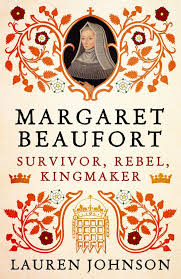
I love a biography that (re-)examines a woman in her context. Johnson is clear that she’s not the first to write a biography of Margaret Beaufort, but that one of the new things she’s doing is putting her very much in the context of women – the women she interacts with over her life: her mother and half-sisters, mothers-in-law and friends and servants and rivals, daughter-in-law and granddaughters. This gives a fantastic insight into what’s going on for noblewomen at this time in England, Wales, and even Scotland.
Of course, an enormous amount of the book is about Margaret’s interactions with men, too: husbands, mostly, but then eventually her son, as well as various half-brothers and stepchildren, not to mention cousins. My goodness, the cousins: when you’re a noble with a long lineage, you are related to EVERYONE of any importance. And, apparently, you knew them, or could at least call on them in times of need / just for the heck of it. Which really puts the War of the Roses in context, because it’s all about brothers and cousins fighting amongst themselves and devastating the countryside in the process.
Margaret Beaufort had a remarkable life. Terrible, at some points – pregnant and widowed at 13 – but also long, with many healthy and loving relationships (as far as we can tell), and eventually a son and then grandson on the throne. Not a terrible ending, one suspects. Lauren Johnson does an excellent job of making Margaret as human and relatable as feasible, while still reminding us that her life 500 years ago was very, very different from what we experience today. She does a very good job of trying to make the names easy to process (TOO MANY HENRYS and JOHNS), and the politicking easy (ish) to follow. This is a really great book.
Into the Mainstream, by Tom O’Lincoln

This is not the book I thought it would be. Which isn’t the book’s fault, but does affect how I think about it.
I thought I was getting a … straightforward history of the Communist Party of Australia. And that’s certainly a significant part of this book. But what the book is ultimately focussed on is the way Communism, and Marxist ideas, has often been done badly in Australia. O’Lincoln is very upfront about the fact that he is very unimpressed by most of the leadership of the CPA, especially from the 1970s onwards. Of note: the book was published in this format in 2009 but was actually written in 1985, which itself definitely and necessarily has an impact.
The other problem is that the book presupposes quite a lot of knowledge – both philosophical and historical – that I don’t really have. Again, that’s partly a factor of it having been written 30 years ago, so the intended audience would have had more immediate knowledge of things that I just don’t. But there’s also no interest in defining “left” and “right”, assuming that the reader will have a shared understanding of what that means – and I have to tell you, reading about a Communist party veering to the right is always weird (yes, I do understand how that works). There’s no attempt here at leading the reader into understanding the various issues (like the difference between socialism and communism, and why you would regard liberal reformism as bad) – because the reader is assumed to already be on O’Lincoln’s wavelength. Again, not necessarily bad, but does suggest a very specific audience.
Worth reading? If you’re interested in the development of the CPA over time, probably yes. But prepare yourself for some pretty heavy philosophical lifting.
Starling House, by Alix E Harrow
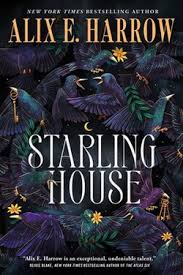
I think I avoided this when it first came out because it was called horror – or perhaps it was called ‘gothic’ and my brain generally translates that to ‘horror’ and as a rule, I avoid horror unless I know precisely what I’m getting; I do not enjoy being scared. However, it was turned face-out at the library when I went to pick up one book, and I decided to give it a go partly because it’s Harrow, and I have liked her other work, and partly because I’m beginning to suspect that much ‘gothic’ work is actually work that I do like. Nuance! It’s a good thing.
So anyway yeah I read this really quickly and it’s brilliant.
In terms of genre: I would not personally call it horror. For me, there was no moment when I was afraid: worried for the characters, yes, because they were likely to make truly stupid decisions; but no literary equivalents of jump-scares. So that’s an interesting discovery for me.
More importantly, the novel: it’s wonderful.
The writing is a delight – so easy to read, so lovely and lyrical, so evocative.
The characters are compelling – and, like I said, showing tendencies towards stupid decisions, although often for good – “good” – reasons.
The story – well. We have two points of view: one is Opal, in first person, and the other is third-person and focused on Arthur. Small-town USA, not a great place to grow up if you don’t really fit in, and Opal really doesn’t. She’s been looking after her brother since their mother died some years ago, working a crappy job and occasionally stealing as well. And she’s having dreams about a house. Through unlikely circumstance, she becomes the housekeeper at Starling House – a house that no one else ever visits, that even kids don’t approach on dares, so basically your classic threatening gothic house; Opal even references Boo Radley for its lone inhabitant. As you can probably imagine, things rather quickly go… well. Sideways? Weird, anyway.
The House is utterly central to the whole book – it’s where things happen, it’s what outsiders are obsessed with, it’s determined everything about Arthur’s life. Perhaps this is one of the key aspects of being a gothic story. And it’s a wonderfully developed house, too.
Harrow has done a wonderful thing here. She notes in her introduction that this is a story about staying, rather than leaving, and that made me really think about leaving and staying as tropes and what they tell us about how to approach the world.
I loved it. I should just trust Alix E. Harrow to write amazing stories.
Death of the Author, Nnedi Okorafor
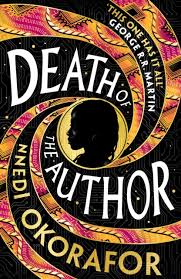
I am so torn by this book.
On the one hand, I really liked the structure and the themes and the way it developed, and the final twist did EXACTLY what it was meant to.
On the other hand… I did not particularly enjoy the writing itself.
The novel’s structure comprises three parts: sometimes we’re following Zelu’s life as she navigates being Nigerian-American, and a paraplegic, and unemployed, and a struggling author. Sometimes we get interviews with people in Zelu’s life, from later in time than the bit we’re reading of Zelu’s life. And sometimes we’re reading the science fiction novel that Zelu writes pretty early on in the book, which becomes a phenomenon: it’s about the robots who are left on Earth after the humans are gone (died?), and whether the embodied can coexist with the disembodied. So, for me, structure: big tick. This way of telling a story, and the story itself, are fantastic.
Themes? Well, they’re kind of obvious from the above paragraph, aren’t they. Zelu is impacted by multiple structural inequalities; she rages against them, and the way she does so informs a lot of the novel. Okorafor is doing A LOT with ideas of AI, both in Zelu’s novel and her life. There’s an enormous amount to unpack around questions of identity (for immigrants, the way people view those with disabilities, patriarchy, etc etc). Okorafor has a deft hand – the novel is in no way preachy, but it was also (at least for me) impossible to avoid thinking about the ideas. And I mean that in a good way.
And then there’s the reference to Roland Barthes’ essay, of course. That the author is just another reader when it comes to interpreting a text. You don’t need to have read his piece, or even have heard of it, to understand the novel, but it’s certainly another level if you have.
And yet. I did not especially enjoy the novel, on a word or sentence level. Rusted Robots, Zelu’s novel, is not a novel I would rate by itself – is that part of the point? I have no idea. Perhaps I am simply not connecting with Okorafor’s style – which is fine! There are plenty of novels that other people hate and I love! But it makes me sad, because I wanted to love this book a lot, and I cannot in all honesty say that I did. I did not find the reading experience a transportive one.


