Casino Royale
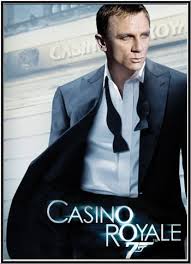 This review is part of Project Bond, wherein over the course of 2014 we watch all of the James Bond movies in production order.
Summary: in which Bond gets yet another new face, plays a lot of poker, and has his heart broken. Also, parkour.
Alex: I was trying to figure out whether this is actually a reboot, and of course the answer is no. This film is not a reboot. It’s an origin story. If you can have (several) Wolverine origin stories after a few X-Men films, there’s no reason why Bond can’t have an origin story after 20 films. The fact that it’s set 40+ years after the first film is, in the scheme of things Bond, irrelevant.
Thus, Bond’s origins. We get to see his first two kills – the first very unpleasant, the second very easy – in a wonderfully chiaroscuro, noir, set of scenes. Daniel Craig is SO cold, and reminds me a lot of Dalton. The evolution of Bond over this film comes down to how easy it is for him to kill, and deal with death more generally, as well as how competent he is in dealing with suspects and crises. He starts well, here, then shows himself fallible at various points, and ultimately becomes the hard, cold killer that Fleming actually wrote.
The feel of the new Bond is helped by the credits: it’s the first time, I believe, that the shooting-down-the-barrel has actually been incorporated into the plot itself, and there are no nudie girls. Also, I love the song, and I think it’s only the second one that doesn’t include the title of the film in the lyrics (the other being Octopussy, for several reasons I would guess).
Anyway, Bond’s kills allow M (helloooo Dame Dench) to promote (?) Bond to being a 00, and I love that Dench continued in this role. We see a little bit more about her, personally: Bond breaks into her house and discovers that her name actually starts with M (leading her to promise to kill him if he utters her name) and when we see her woken in the middle of the night, there is a male partner next to her. I know that chronologically it makes zero sense to have kept her, but I adore her in this role so much and since when has sense mattered anyway. Also she gets to say “Christ I miss the Cold War.” And she describes Bond, contemptuously, as a blunt instrument. SWOON.
That interaction happens after one of the most magnificent chases in Bond history: Bond chases a man through a town on Madagascar, especially through a construction site, and Sébastien Foucan – originator of parkour – treats the audience to an absolutely astonishing display of free running. Bond manages some good leaps, too, but often the contrast is between Foucan’s balletic agility and Bond crashing through walls. The Bond shoots him. In an embassy. Showing that Bond is not completely the cold and calculating agent he’s meant to be.
 We’re introduced to the main villain very early on, and the writers show that they’re tapping the zeitgeist. The focus is not terrorists but their banker: the man who enables them to profit, and keep their profit. I think this is deeply fascinating, and demonstrates another step forward in the sophistication of issues that Bond as a franchise is dealing with. Of course, this sophistication is not something that can be taken for granted – they’ve had very clever and insightful moments in the past and then gone whacky in the next film. Still, Le Chiffre is fascinating, and follows in that grand tradition of physically marked baddies: he has an awesome scar and he CRIES BLOOD. Take that, Blofeld! The story revolves around Bond screwing up Le Chiffre’s plans to make a lot of money and then Le Chiffre deciding to win it all back on a high-stakes poker game. BECAUSE NOTHING EVER WENT WRONG WHEN GAMBLING.
Interlude to mention the Ursula Andress reference: Bond coming out of the ocean in trunks. Nice moment.
Anyway, the government is staking Bond the money to get into the poker game. They’ve already chipped him, like a dog, so they can keep track of him; now he also has to be accompanied by a treasury agent – and enter Vesper Lynd, played by Eva Green, and my goodness do I love her. Their first conversation, where they utterly skewer each other by reading the other’s clothes and attitudes, is utterly devastating. “You’re not my type.” “Smart?” “Single.” Also, this look: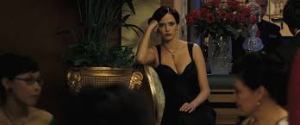
I am so bored right now by this dress and these glamorous surroundings. Also you, James. Yawn.
Vesper and Bond are a wonderful match in terms of attitude and expectations – the scene where they are instructing each other on what to wear (“there are dinner jackets and there are dinner jackets; this is the latter” omg win) is glorious. That she spikes his plans by distracting him when walking into the poker game is very funny. And then all of this comes to a head when they are involved in a nasty altercation with someone who was actually threatening Le Chiffre, and Bond and Vesper just get in the way. Bond himself is affected by the kill, but Vesper – understandably – is devastated; Bond’s care for her is one of the most touching moments in Bond history. Like Dalton, Craig gets the cold-hearted/totally human balance almost perfect.
 Meanwhile, there’s poker to be played. Le Chiffre turns out to be playing Bond like a cat with a mouse – allowing Bond to think he’d picked a tell, then taking him for all his cash. Vesper refuses, quite rightly, to allow him to buy back in… which means Felix Leiter reveals himself. A black Leiter! Jeffrey Wright is marvellous. Makes a deal that Bond can have the money if the US gets Le Chiffre – but what about the winnings? “Does it look like we need the money?” Oh Leiter, you are so droll. Never change. Anyway, because Bond is doing so well, Le Chiffre’s girlfriend – who is never named and I don’t think even speaks – poisons him. Fortunately there’s a defibrillator in his Austen, and Vesper arrives in time to help him not die, and then Bond wins the entire pool of money. THE END.
… um no. Because this is New Bond, and things haven’t got seriously awful yet. Vesper is kidnapped, Bond is tortured (nastily) and then rescued by the fixer we saw at the start of the film – not because Bond is so awesome but because Le Chiffre is unreliable. Bond and Vesper fall in love while in hospice and run away from life to Venice… and then it turns out Vesper has stolen the money and given it to the fixer, because her boyfriend had been kidnapped ages ago and this was how to get him out.
And then she dies, and this is the one part of the film that disappoints me. Because she didn’t have to die. She could have got out of that elevator before it went underwater. She wants to die because of her mistake, and narrative-wise it’s to give Bond more depth and reason to be cold. VESPER IS FRIDGED AND I AM SO SAD.
The real end comes with Bond killing Mr White, the fixer, thanks to a posthumous message from Vesper, and Craig saying “The name’s Bond. James Bond.”
Overall this is my favourite Bond so far. It owes some of its sensibility to the Bourne films and their hard-edged-ness. It is very clearly setting itself in opposition to the kitchiness of the last Brosnan films. This is a Bond for a new, harder, more brutal age.
James: The film opens in black and white with a grainy film noir style. The opening credits are more like a graphic novel than a movie with the playing cards heavily tied in. No boobs. I love the David Arnold soundtrack following on from the Chris Cornell theme. The fighting is visceral and fast, parkour rather than skis or a boat etc. Bonus points for spotting the Richard Branson Cameo in the airport (the price of using a Virgin Plane). Bond at the bar, “Vodka Martini” … “Shaken or Stirred?” … “Do I look like a give a damn?” … brilliant. They play cards and then we get the final chase scene. As Alex says, a tough, modern Bond – More Dalton than any Brosnan. The gadgets are there but downplayed. Perhaps it’s the origin story poking through but I felt like there was more character development than in any of the films yet. Certainly the highlight so far. 4 Martinis – Shaken or Stirred, I don’t give a damn either.
Upgrade me now

What do you do when you have a major heart attack and you’re also creator/sustainer of Clarkesworld? You decide to edit an anthology. Natch. (Read an interview with Neil Clarke here.) And you decide to make the theme of that anthology cyborgs, because you are now one yourself. Thus, Upgraded.
Now, before you go all ‘hmm, themed anthology’ side-eye on me, just steady on. In some stories, being a cyborg is the point; in others it is incidental. Sometimes being a cyborg is a good thing, a positive addition, welcomed. Others, it is something to be dreaded, confronted, Dealt With. Sometimes being a cyborg makes you better, and sometimes it seems to make you less. Cyborg-ness ranges from fully integrated and augmented body modifications to one seemingly small addition. Augmentation might be for aesthetics, or employment; for someone else’s sake or your own. It ranges from being socially acceptable to being almost beyond the pale.
Some stories happen tomorrow, here; some of them are way over there, temporally and physically. Sometimes there are aliens. Sometimes there are robots. Sometimes they are in love stories, detective stories, war stories, family stories. Not all the cyborgs are attractive characters. Sometimes they become cyborgs before our very eyes, and sometimes they’ve been cyborg so long it’s just what they are. Sometimes they were actually made that way from the start.
These stories feature men, and women, and sometimes genders are unstated. There are white characters and black characters and a variety of ethnicities. One of the central issues is that of disability, dealing with it and changing it and how those around you react to it. There’s queer and straight and none-of-your-business. Authors are from a variety of backgrounds, too.
So sure, it’s a themed anthology. But this is no Drunk Zombie Raccoons in Upstate New York. This is a vibrant, fun, intriguing and varied set of stories that have a basic concept in common.
The stories. Well, let me say upfront that I was so destroyed by Rachel Swirsky’s “Tender” that I had to put the book down and go to sleep. No more reading for me that night. As for the rest, here’s a sampler: Yoon Ha Lee’s “Always the Harvest” is creepy and disconcerting and sets a really great tone for the anthology – it’s the opening story – by being completely unlike any of the others. Ken Liu’s story is also deeply disconcerting because (very mild spoiler here) it is absolutely not the story you think it is. Alex Dally McFarlane does wonderful things with maps, while Peter Watts taps into the zeitgeist to suggest uncomfortable things about the military. And I have a feeling I know something Greg Egan might have read before writing “Seventh Sight” but I’m not going to mention it here because that would be way too much of a spoiler.
This is a really great anthology, with stories that absolutely stand as marvellous science fiction quite apart from their brethren. You can get it from Fishpond!
Galactic Suburbia 109
In which we solemnly swear we will repeat the title of our culture consumed after discussing it. Pinkie promise. You can get us from iTunes or at Galactic Suburbia.
Update on Gamergate with particular focus on Brianna Wu AKA @spacekatgal
(This episode was recorded before the Felicia Day incident)
Alisa’s con report – Conflux
Tansy’s con report – CrimesceneWA
Strange Horizons fundraising
We read and appreciate all your Twitter comments and emails, even if we don’t reply. We love your feedback!
It’s time to start thinking about the GS Award, yes already, WTF 2014 why are you moving so fast?
What Culture Have we Consumed?
Alisa: Landline, Rainbow Rowell (NB since recording, Alisa actually finished this book YES SHE DID); Night Terrace S1 1- 5
Alex: Sarkeesian’s XOXO talk; Garth Nix’s Abhorsen trilogy (Sabriel, Lirael, Abhorsen); Mothership: Tales of Afrofuturism and Beyond; Indistinguishable from Magic, Catherynne Valente; Bitterwood Bible and other Recountings, Angela Slatter; The Dish.
Tansy: Unmade, Sarah Rees Brennan; Night Terrace S1, Agents of SHIELD S1, The Flash S1 Ep 1-2
Please send feedback to us at galacticsuburbia@gmail.com, follow us on Twitter at @galacticsuburbs, check out Galactic Suburbia Podcast on Facebook, support us at Patreon (http://www.patreon.com/galacticsuburbia) and don’t forget to leave a review on iTunes if you love us!
Die Another Day
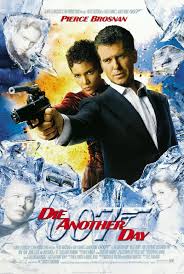 This review is part of Project Bond, wherein over the course of 2014 we watch all of the James Bond movies in production order.
Summary: in which there is lots of ice, bad CGI, yet another space laser, and Madonna. Also North Koreans finally get to be the baddies.
Alex: This film turns on the idea of a sooky North Korean military official, Moon, who wants to make money but is prevented from doing so initially, we presume, by Also High Military Official Dad and then by James Bond spannering his plans. Presumed dead, he goes off and has his DNA changed and comes out looking like a preppy English public-school product (that’s a spoiler BTW) named Graves, and uses that – plus a load of diamonds – to fool the world and meanwhile construct a space laaaaaaser. Bond, naturally, ends up foiling GraveMoon’s plans.
That’s all well and par-for-Bond-good. However, my one enormous, abiding, overwhelming and rage-inducing problem with this film is not the dreadful CG and Bond surfing enormous avalanche-caused waves on a bit he ripped off a land-speed-record car. Nope, I can roll my eyes at that and deal with it. It’s not even the ludicrous, so-heavy-with-innuendo-I-can’t-believe-it-floats conversation that Bond and Jinx (Halle Berry) share. I dealt with Christmas Jones; I can avoid throwing things for this one. My problem is this: if you have a space-based solar shield thing that can be so focussed that it becomes a laser, and it’s capable of being so targeted that you can use it to chase a car across the ice, why the hell are you using it to blow up land mines in the Korean DMZ? Why aren’t you using it to pick off, I dunno, the White House? Maybe the South Korean government buildings, if that’s who you’re really pissy at? Then go for Westminster, maybe the UN buildings in New York, and throw in the entirety of The Hague while you’re at it so you can’t ever be charged with war crimes? This part of the film utterly ruins any credibility GraveMoon might have had.
ANYWAY. The above is a real shame because the film begins as possibly the darkest of any Bond because he’s captured by the North Koreans and tortured. And rather than the credits being just full of nudey girls, the torture is shown in quite clever ways through diamond-cum-ice frames (both a theme throughout). This quite cleverly allows the audience to see the brutality but not get overwhelmed. It’s also the first time, I think, that the credits have been used to add to the storyline. There are still nudey girls, though, don’t worry.

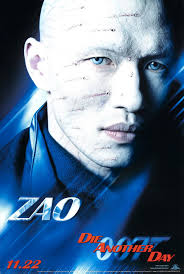 Bond ends up being traded for a North Korean whose face he filled with diamonds, because the Americans think he’s spilled his guts, and after escaping from the Brits by stopping his own heart he ends up in Cuba, looking for Mr Diamond Face (Zao). While there he hooks up with Jinx and interrupts Zao’s facial reconstruction. Some time later Bond is back in Britain and has a sword fight with GraveMoon, whom Bond is just naturally suspicious of because he’s too good-looking (ok there’s a connection to conflict diamond but whatevs), and GraveMoon’s fencing teacher is Madonna. In leathers. And she gets to say that she won’t watch them because she doesn’t like cock fights. ZING.
Eventually Bond and GraveMoon and Jinx and GraveMoon’s assistant Miranda Frost end up in Iceland, and that’s when all the crap goes bad and there’s death the end. Oh wait, except for using a SPACE LASER to take out land mines. THEN it’s the end.
 I can’t believe I’m going to say this, but Christmas Jones is better than Miranda Frost as a character. Oooh she’s all indifferent towards Bond, she’s Frosty, geddit?? For all of FIVE MINUTES. And yes, being a turncoat is relatively interesting, but not enough is made of it for it to actually be interesting. Jinx… well, it’s almost obvious now for a kick-ass woman to be an international agent, so the revelation that she’s NSA isn’t unexpected. She gets a couple of nice fight scenes, but I’m completely disinterested in girl-on-girl fights as a Thing (although theirs was ok as a fight), and really I think she should have tried harder to escape the ice prison. Also let’s not forget her callback to Ursula Andress is Doctor No, coming up out of the water to Bond’s waiting eyes, wearing a bikini. M is wonderfully cold in this film, especially at the start – she may be fond of Bond as a person but as an asset, the price for his freedom was too high and she’s not worried about him knowing it (and, to his beardy credit, Bond knows it too – I like these glimpses of professionalism).
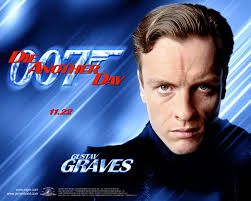 Racially I think this is quite problematic. After all, the Korean Moon does remake himself as a Westerner, and Zao tries to. (Incidentally, GraveMoon confronting Bond about his identity change is one of my favourite bits, with Moon saying he based Graves on Bond: “I paid attention to details – that unjustifiable swagger, the crass quips, the self-defence mechanism concealing such inadequacy.”) He couldn’t have stayed Asian and been as successful, got knighted, etc? Bah. But he and the other Koreans are no condemned for their race, which is good, and there’s not even really any comment on North Korea itself. Colin Salmon is back as a fairly powerful underling to M, Jinx is of course black… and there’s a fairly dodgy Chinese concierge-spy, and I’m not sure what I think of him.
Overall I think I have to call this a pretty disappointing end to the Pierce Brosnan era – one that started so well got, dare I say it, closer to the Roger Moore style of innuendos, and pushed the limits of CG beyond the realms of what was necessary. I do think the basic story lines stayed interesting – but then they have mostly done so for the whole series.
ETA: how could I forget?? The stewardess on the plane who serves Bond is Roger Moore’s daughter! That’s cool.
James:
An invisible car which leaves tyre tracks in the snow is not invisible. A space laser is so Connery and John Cleese returns as R … Q. This Bond did not light my fire. 2 Martinis.
Mothership
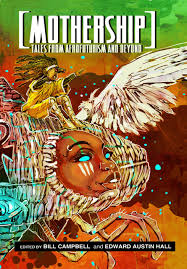 When I finished reading the first story in Mothership, a little voice in my head said “Was that really the story to start this anthology with? I mean, sure it’s got a black protagonist, but is that enough?”
And then the rest of me took a step back, looked horrified, and said: “Have you learned nothing from Pam Noles’ essay “Shame”? And from the entire Kaleidoscope project? The story has a black protagonist. That’s entirely the point.”
And then I sat, aghast at my own white ignorance, and felt ashamed.
And then I kept reading, because that’s the obvious way to combat such an attitude and is at least part of the point of this project and why I supported its production.
There’s a really wide variety of fiction in this anthology. Some skirt the edge of being ‘speculative’ (Rabih Alameddine’s “The Half-Wall”) while others hurtle over the edge and throw themselves at it. I didn’t click with every story (Greg Tate’s “Angels + Cannibals Unite” really didn’t work for me, and nor did Ran Walker’s “The Voyeur”), but many of them were absolutely breathtaking.
Nisi Shawl’s “Good Boy” – one of the only stories that really qualifies for the ‘mothership’ appellation by being set in space – is a glorious fun romp.
“The Aphotic Ghost”, by Carlos Hernandez, did not go where I was expecting and was utterly absorbing.
SP Somtow’s “The Pavilion of Frozen Women” has a wonderful line in bringing together several quite disparate cultures and tying them together into a fairly creepy thriller.
NK Jemisin does intriguing things with the notion of online communities in “Too many yesterdays, not enough tomorrows.”
“Life-Pod” is Vandana Singh’s haunting reflection on family and identity and connection.
In “Between Islands,” Jaymee Goh suggests how different things might have been for the British in colonising Melaka and surrounds with different technology…
Tenea D Johnson’s “The Taken” is a profound reflection on contemporary issues and problems stemming from the historical transportation of enslaved African to America… I don’t even inhabit the culture that’s dealing with it.
One of the intriguing things about this anthology is that it’s not focussed on African-American fiction, which I had basically expected thanks to the title’s reference to P Funk and Afrofuturism. Instead, there are stories here that draw on Egyptian, Native American, Caribbean (I think? I’m Australian, sorry!!), Japanese and Malaysian (again, I think) traditions and cultures – and those are just the ones that I (think I) could identify. There are definitely others that draw on other Asian cultures (I think there’s an Indonesian one?). The author bios don’t universally identify where the authors are from, so that doesn’t assist in figuring out what might have influenced them… which is not a complaint, by the way, because so what? (in the most prosaic ‘fiction is fiction’ sense). So it’s a really broad understanding of what falls into “Tales from Afrofuturism and beyond” – much more inclusive therefore than, for example, many anthologies of the last few years, let alone decades.
This is an good anthology, period. That it’s exploring and accomplishing a particular political aim is icing on the cake. You can get it from Fishpond!
Fringe spoilerific episode!
Earlier this year I watched the entirety of Fringe – a show that Alisa and Tansy have been raving about around, near and at me for quite a long time. So because I watched it – all of it – in a short period of time, we were finally able to record a Galactic Suburbia spoilerific episode of it. And here it is!
We spoil absolutely everything. We’re really not joking about that. Only listen if you’ve watched the whole lot, or really don’t mind spoilers.
The Falcon Throne
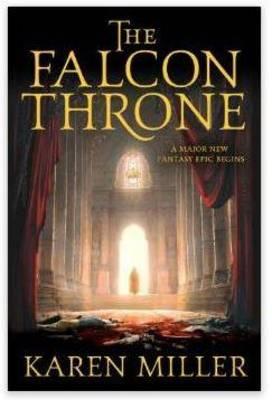 I received this book as a review copy from the publisher.
I am sad to announce that I abandoned this book. Mostly for “it’s me not you” reasons – although not entirely…
1. I’m really not in an epic fantasy kinda zone at the moment – and “at the moment” has lasted for a few years now (albeit with a few exceptions – though not many). So that counts against it for me – but for anyone who’s really in that mood, I think this is probably a good option. It’s certainly epic (in a good way!).
2. I’m not really a – argh, I don’t like the term – grimdark fan. And I’m pretty sure this counts as such. Others have compared it to A Song of Fire and Ice, and while I’ve only seen the show not read the books that sounds like the right sort of comparison. So the style is really not for me. I don’t mind bad things happening to characters, but there’s something about unrelenting unpleasantness – especially before I care about any of the characters – that frustrates and bores and annoys me. So that’s a style issue that is my problem, not the book’s.
Then there’s the style thing that I had an issue with, and it’s the way sex in general and women on occasion are described. I’m not a complete prude, although I guess I’m closer to that end of the spectrum than not, but there’s something about descriptions like “he’d have had the little wagtail pinned against a wall long since” (64) or “Aside from a writhing woman pinned on his cock, was there anything better in the world than a lance in his hand, a grand horse between his legs, and a man before him a handful of heartbeats from defeat?” (15) that leave me not just cold, but actively uncomfortable. As for the women – I got to about page 90, and most women by this stage are dead, useless, or conniving. The wet-nurse clearly has gumption and I hope she’s allowed agency and smarts, but that’s about it.
So there it is. Not a book for me. I am sad because it’s an Australian female author… but not sad because it’s an epic series I don’t have to get invested in so that saves me some time… but sad because I really don’t like abandoning books.
Indistinguishable from Magic
Sometimes when people talk about an author’s work being ‘raw’, it’s as if they think words just appear on the page and there’s no mediation whatsoever. That these words, ideas, thoughts had been flying across the savannah just minutes before the author brought them down with a flying leap to serve them up still warm for the reader. I’m not silly enough to think that – and even if I were, Catherynne Valente’s excoriating essay against people who think authors are just the conduit for some muse (“she  wrote it but…”) would have made me rethink my position.
When I say that much of Valente’s work, as presented in Indistinguishable from Magic (provided to Galactic Suburbia for review by Mad Norwegian Press) is raw I mean that she has not hidden her emotions, she has not hidden herself, from the world while writing these essays.
(One presumes. It could all be a very elaborate persona, with a very detailed background and crafted voice. Y’know, I wouldn’t put that past her – she certainly has the mad writerly skillz to accomplish such a feat. And if that’s the case, well, more power to her.)
The essays collected here are variously from Valente’s blog, speeches, and a few other sources. They’re arranged into categories: pop culture and genre; writing and publishing; gender, race, and storytelling; fairy tales, myth and the future; and “Life on Earth: An Amateur’s Guide.” And they showcase the brilliant variety of Valente’s interests passions: Persephone and Doctor Who (… possibly not so much of an antithesis there…), fairy tales, equality in all manner of things, Jane Eyre (see, Tansy? she’s on MY side), poetry, and Single Male Programmer Types managing to have sex (trust me, it’s very a very funny essay).
The pop culture musings range between 2003 and 2011. Valente’s writing is beguiling enough I actually read the entirety of the first essay, which is about Buffy and Angel, despite having watched maybe three episodes of the two shows combined. Her comments on what the show meant to 20-somethings nonetheless resonated – and that pretty much set the tone for the rest of the collection. I’m also not a big Trek fan, and have watched very little DS9, but her musings on what the station would have been like with social media? Priceless. More seriously – no, it’s all serious; more academically, her essay on why World War 2 and the Nazis keeps on popping up in comics and other fantastic culture is deeply insightful.
I read about half of the essays on writing and publishing; not being in the game myself means that I don’t really have the emotional attachment to the issues necessary to connect with much of what she writes here. That said, the first essay – the one about writing actually being hard work – is a glorious piece of writing; her explanation of her love of the term metal makes me itch to use the word more; and her utter dismantling of the argument that ‘traditional publishing is dead = a good thing’ is brilliant.
Valente is wonderfully, evocatively, angry and sincere and honest and passionate and conciliatory and clinical in her essays about gender and race and why those things matter in storytelling. “The Story of Us” skewers very neatly the whole ‘but why does it matter?’ complaint – and matches nicely with Pam Noles’ “Shame,” which I read in a Tiptree Anthology. She gets dangerously personal in “Confessions of a Fat Girl” – dangerous to herself, I would guess, because of potential backlash (I really, really hope she didn’t get any); dangerous to some readers because of how it might make some squirm at their reaction; dangerous to other readers because it might just call out their own troubles, and make them confront them.
All the essays up to this point have been easy to read – delightful to read. Some have shown Valente’s academic training. With the essays on fairy tales and folklore, though, she gets her academia on. Katabasis in Alice in Wonderland, The Wizard of Oz, and The Nutcracker? Why fantasy keeps going back to the medieval (“Dragon Bad, Sword Pretty”)? The purpose of Persephone, and her multiple faces? Oh yes.
Finally, the last set are more whimsical as a group – they don’t really have a collective theme, aside from ‘some thoughts on living in the world’. Her reflections on why people love apocalyptic literature are fascinating; her frustration at being of a generation told to live as well as their parents without the means to it revealing; and her reflections on Cleveland surprisingly moving. Her essay on her love of the anchorite idea just sings, as does her discussion of “Two Kinds of Love.”
I read this not quite in a sitting, but with nothing else around it. It certainly works like that. It would also work beautifully as a collection to dip in and out of – none of the pieces are very long, after all. There is so much going for Valente’s writing – for those who are writers, for those interested in fantasy and folklore, for those interested in the world in general. And even if you’ve been a faithful reader of Valente’s blog, Rules for Anchorites, I would suggest this is still a great collection because reading these essays in this order, with essays from elsewhere to add depth and piquancy – it just works.
The World is Not Enough
This review is part of Project Bond, wherein over the course of 2014 we watch all of the James Bond movies in production order.
 Summary: in which we get a Bond film that deals with both oil and nuclear weapons at the same time! Swoon! Also Denise Richards is a nuclear physicist and Hamish Macbeth is an unconvincing anarchist.
Alex: one of the things that people remember about this film is Denise Richards. Or maybe that’s just me. So let me get this bit out of the way first. I was already groaning in anticipation of rewatching her in this film. My thoughts were coloured by two things: the first time we see her, and the last time. The first time, she’s climbing out of a hazmat suit and the only way the camera could have fawned over her any more would have been to actually be touching her skin. It’s not quite a strip tease, but mostly because she’s still wearing clothes (a crop top and tiny shorts). Then the last scene… it might actually count as the worst line in Bond history, and let’s be honest that there’s some pretty… oh heck… stiff competition. Her name is Christmas Jones, and I’m pretty sure that’s her name solely in order to set up that last, appalling, joke: Bond saying “I thought  Christmas only came once a year.”
So yeh, my expectations were pretty low, and when you take in to consideration my love of Michelle Yeoh just a fortnight prior… I was resigned at best. Turns out, though, that Richards is better than I remembered. Yes her opening scene has her wearing ridiculous clothes, but later she mostly gets to wear sensible clothes (except when Bond is using her to distract someone, which I am not best pleased by). She doesn’t have the greatest dialogue – not her fault – and sometimes her delivery is a bit painful. But she is by no means the worst Bond girl ever, and she’s allowed to be competent at her job, too. Bond says “What do I need to defuse a nuclear bomb?” and she says: “Me.” And then she does it, too, on a speeding rig inside an oil pipeline. So Richards, you were better than I remembered. Good work.
Since I’m already talking about the women: Sophie Marceau… meh. She’s ok. I think the character of Elektra (yay Greek spelling!) is a fascinatingly complex and intriguing one: daughter of a construction baron, kidnapped then escaped when not ransomed; takes on father’s business but insists that it’s because the oil was found by her mother’s family – so Azerbaijani, I think? – and that her father stole it from them. So we get notes of colonialism in different forms here, which is surprisingly deep. And it turns out that rather than having Stockholm Syndrome – since she’s working with the Big Bad – she turned him, to get revenge on her father. So she has great agency, even though the film insists that she must use her body in order to get it. But I wasn’t in love with Marceau’s performance, sadly (also I can’t help but have the line “I have heard about your…. woman” from Braveheart in mind, which is totally my problem not hers).
And M rocks, as always, and this time she’s in the field! And she manages to Magyver an alarm clock to rig a location beacon so Bond can find her! Brilliant. She’s also revealed to be a mother, which I am unconvinced was a necessary move.
So the plot: someone is sabotaging Elektra King’s pipeline, and because her father was M’s friend M sends Bond to investigate. It eventually turns out that Reynard the Anarchist is doing it – in collusion with Elektra, because the idea is actually to nuke Istanbul, making the three Russian pipelines impossible and therefore Elektra’s pipeline the only one that the West can access. So it’s partly about revenge (dad didn’t ransom me), partly about money, and for Reynard (Hamish Macbeth Robert Carlyle)  it’s both about love (of Elektra) and anarchy.
Well, I presume Reynard’s in it partly for the anarchy. He’s called an Anarchist by M et al, but to be honest you never see any real demonstration of his attachment to anarchy as an ideal. He’s also back to being that not-quite-normal Bond villain: he has a bullet in his brain that means he’s slowly losing all sensation, which apparently makes him super strong for some reason? Anyway I think he’s amongst the most boring of all Bond villains.
Far more interesting is Robbie Coltrane, another Scot playing a Russian, reprising his role as Valentin. How can you not love a character who greets Brosnan with “Bond James Bond!” Love it. His caviar factory gets sawn in half by a helicopter tree cutting saw, then he appears to die – but doesn’t – but then does, although not before helping Bond escape from Elektra. He’s a great cameo, almost replacing Felix Leiter I think.
The saddest part about this film is Bond’s scene with Q, wherein Q introduces him to his trainee – John Cleese – whom Bond dubs R. Bond asks, concerned, whether Q is really thinking about retiring; Q doesn’t reply. Desmond Llewellyn died at the end of the year this film was released (1999).
James: I disagree that Q doesn’t answer the retirement question … Bond shows his dismay that Q is considering retirement and then Q signs off with his famous “Now pay attention, 007,” and then offers some words of advice: Q: “I’ve always tried to teach you two things: First, never let them see you bleed;” Bond: “And second?” Q: “Always have an escape plan” — before he is lowered out of view. Foreshadowing! Back to the rest of the film then, the opening sequence is one of the best with a high speed boat chase on the Thames. Like Alex I expected Denise to be more cheesy that she turns out to be, the character is overdone but then many things about this Bond are. Bond is issued with the usual modern era set of interesting gadgets; a ski jacket which can turn into a protection cocoon, another BMW to destroy and a watch with a grappling hook built in. The twists and turns of the villains and not villains could have been very clever, but in the end Elektra has to explain it all or the film wouldn’t make sense. 2 Martinis.
Tomorrow Never Dies
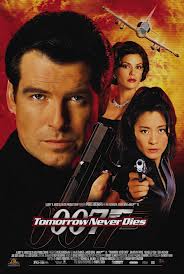 This review is part of Project Bond, wherein over the course of 2014 we watch all of the James Bond movies in production order.
Summary: in which Michelle Yeoh is more bad ass than Pierce Brosnan, and the Bond franchise moves with the times to realise that the media can be more terrifying than lone wolf assassins.

See? Bad. Ass.
Alex: I love the opening to this film. M and various military people are watching a ginormous screen showing a Russian illegal arms bazaar, courtesy of some unnamed-but-we-know-it’s Bond British agent. Once they have confirmation that some important dude is there, the ranking admiral calls in a missile strike and M gets incensed that her man hasn’t had time to get out. And then Bond points out that he’s looking at a nuke OH NOES! Bond then steals the plane and the nuke. Natch. It’s a seriously awesome opening with good dialogue, good tension, great stunts. It sets the film up really nicely… although it actually doesn’t suggest the central premise, which is the power of the media.
The next scene doesn’t flag the media either: a British naval ship is overflown by a Chinese MiG saying the ship is in Chinese waters. Cut to a Scary Stealth Sub with a scary drill, and it turns out that someone is manipulating both the Brits and the Chinese. But then – oh then – we get a scene that’s basically a throwback to Blofeld: a white-haired man directing operations from a secret high-tech base, telling the men on the sub to kill the survivors in the water. What’s different here is that he’s writing headlines as he does it.
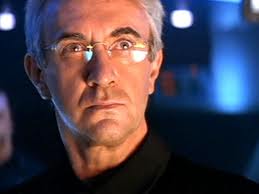
Elliot Carver. Oh, Elliot. You are so clearly meant to be Rupert Murdoch – or maybe that’s just my bias flashing. In my memory he was a bit more subtle than he turned out actually to be; Jonathan Pryce basically chews scenery in some parts of this film. It’s all about the eyebrows. It’s also how he’s written (so he’s like Jessica Rabbit?): this is a man who is pleased when new software is released deliberately full of bugs (so stereotyped Murdoch + stereotyped Bill Gates?), as well as bribing the US president to lower cable rates. And his biggest problem, what makes him act like a petulant little boy, is that China won’t let him play in their media space. BOO HOO. So he’s setting up a confrontation between the British and the Chinese, hoping that things go very badly and a Chinese general in his pocket will end up in charge. So… kinda like some other villains we’ve known, I guess, but this time rather than hoping desperately that people – world leaders, etc – will notice what he’s doing, Carver goes straight to the masses with his newspaper/media conglomerate. I really, really love this concept.
The women? I’ve already mentioned Michelle Yeoh. She is so, so cool. She gets one awesome lone fight scene which is fantastic; she has 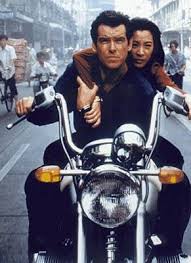 some great gadgets (walking down the side of a building, anyone?) and Bond acknowledges her as an equal. The scene with Bond and Wai Lin handcuffed together but riding a motorbike is a magnificent stunt set piece – and I especially love that it ends with a potentially provocative outdoor-fully-dressed shower scene… and she leaves him handcuffed to the shower. Did I mention she’s an agent of the Chinese equivalent of MI6? Intriguingly though the film reassures us that she’s not really a Communist; she specifically says that she doesn’t even own a Little Red Book. I don’t think they ever felt the need to reassure us about the Russian ladies not being Communist; China is somehow more scary? Who knows. I was sad that Wai Lin did indeed end up kissing Bond, but I guess I can’t have quite everything.
Bond can though; he starts off with revitalising a fling with Paris, now Elliot Carver’s wife and played by Terri Hatcher. This role always disappointed me, because Paris is just a pawn to be used by both Bond and Carver to their own ends. Bond’s regret for her ending up dead doesn’t make up for any of that.
And then there’s M, and Dench continues to bring the goods. Possibly my favourite exchange of the entire film:
Admiral Roebuck (played by Dench’s on-screen lover in As Time Goes By): “With all due respect M, sometimes I don’t think you have the balls for this job.”
M: “Perhaps. But the advantage is I don’t always have to think with them.”
Mic. Drop.
This film wasn’t quite as good as I remembered, but it’s still enjoyable and has very few cringeworthy moments.
James: The height of modern technology, a Nokia clamshell ‘smart phone’, dates the gadgets in this Bond somewhat – Bond can however drive the car with it so that’s quite cool. It is still one of my favourite modern era Bonds, a nice balance of humour, gadgets and action. Why oh why does Bond (especially Brosnan it seems) have to tip off the villains that he knows (albeit with clever puns about being all at sea etc)? 3 Martinis

 Randomly Yours, Alex