James Bond in pictures
You think we’re crazy for watching all of the James Bond films in a year? This guy is watching them in a much, much shorter space of time than we are, and is using the artistic prowess that neither of us possesses to capture each film in one picture. He’s not going into enormous depth with his reviews, but is including lots of screen caps with entertaining captions for those of you who prefer more graphic-oriented overviews. His stuff is definitely worth checking out.
Project Bond involves us watching every James Bond movie over the course of 2014. You can find our reviews here.
Steal Across the Sky

There are interesting parallels between this and Mary Doria Russell’s The Sparrow. Both deal with humanity’s contact with aliens, and with the repercussions for humanity especially in the realm of religion. There are vast differences, of course – how contact is achieved, the type of people involved, and so on. I think Russell’s is better, overall; I appreciated the characters more, and I think it’s overall a more sober look at the repercussions for humanity. But I also think the two books are trying to do different things, and Kress has achieved something impressive in her novel.
Aliens have contacted humanity with the sole intention of Atoning for some crime they committed against us… ten thousand years ago. They don’t reveal what that crime is, nor how they intend to atone for it. Instead, they talk to anyone who can get the bandwidth to reach the moon, and set up a boring website asking for volunteers to act as Witnesses. Predictably, they get millions of applicants, of whom 21 are chosen to go to seven different planets – planets inhabited by the descendants of humanity kidnapped ten thousand years ago (cue Stargate music). This, however, is not the crime. Almost the first half of the novel focusses on Cam and Lucca, Witnesses sent to a binary planet system to live with their many-times-removed cousins in order to discover the thing that they will ‘know when they see it’, according to the Atoners. Intriguingly, numerous chapters are also given to one of those whom the Witnesses interact with, providing an at time painful glimpse into the arrogance and cluelessness of one Witness. Slight spoiler, which really isn’t: they discover the thing. They don’t really know it when they first see it. But, as the blurb promises – or threatens – the knowledge does change them, and at least some people back on Earth. The rest of the novel is working through the repercussions of that knowledge, this time largely switching focus to other Witnesses, and only occasionally returning to Cam and Lucca. And, similar to Kim Stanley Robinson so gloriously in 2312, chapters are punctuated with ephemera: conversation transcripts, Oprah interviews, advertisements, etc. These add a wonderful verisimilitude to the world that Kress imagines, only a decade away from now: many thing similar (yes, Oprah; also internet trolls); and some different. Kress throws in some lovely SF-ish moments – just enough to be incongruent, to remind the reader that this is not today.
What this book is not is an alien contact story. Yes, it deals with first contact, and yes the aliens are pivotal. But that’s exactly what they are: a pivot, a lever, a fulcrum. They are a point about which the plot revolves, but not the focus. They are almost completely opaque and don’t exist as characters at all. Rather, the focus is on humanity: how humans react, how humans interact. For an SF novel involving aliens and space travel this is a distinctly earthly novel. It’s also a bit depressing, but perhaps that’s a reflection of a near-future novel published in 2009. That’s not to say that it’s without hope, but… it’s not especially upbeat. Nonetheless, I did enjoy it overall. As mentioned above, Kress deals with the repercussions of the Witness discoveries on religion, as well as on other aspects of society. For this, and the fact that she treats religion seriously (even if it is only through Catholicism, which isn’t completely representative of Christianity let alone all religions on the planet… perhaps it is the most prevalent religion in the US, where it’s largely set? I don’t know), definite kudos. I still think Russell did it in a more nuanced manner, but it was also more of a focus for Russell than for Kress, who is writing a story that’s closer to thriller than philosophical treatise, whereas Russell is the opposite. And Kress does what I presume she set out to do: write an engaging, enjoyable, intriguing novel that combines off-beat characters – not all of whom are likeable – with a plot that keeps you flicking pages (I read it in a day…) and, cliches ahoy, a serious kicker at the end.
Steal Across the Sky can be bought at Fishpond.
Battlestar Galactica
… the third run-through.
My husband is, amazingly enough, an even bigger fan of BSG than I am (even though he hates Felix, which is SO WRONG). He had been pushing for a re-watch since the start of last year, and I kept claiming that it was TOO SOON – and it really was. I eventually gave in around… October maybe? Something like that. And last night we watched the last three episodes. And we are done. Again.
It’s not an easy show to watch, even when you’ve seen all four seasons more than once in the past and you KNOW what’s coming up. In fact, for a show with as much emotional manipulation and as many highs and lows as BSG, knowing what’s coming up may actually make it more excruciating to watch. And even though I remembered most of the beats, I still refused to watch that spoiler bit at the start of every episode – partly from habit, and partly from a desire to have at least a few surprises.
… Of course, there were fewer surprises for me than might have been, because not only have I seen it all before, I’ve also been following The Mary Sue as an SF-fan watches and reviews each episode for the first time. Which has given me some new insights, as well as a new appreciation of some aspects. Like Gaeta. And Tigh. Tigh’s giggle is one of the best parts of the whole show.

There are a lot of best parts, actually. I adore Starbuck in all her screwed-up-ness; one of my favourite scenes is just her standing with her thumbs in belt loops, with one eyebrow saying “bring it.” I also love Roslin. Well, I don’t love her, a lot of the time; but I do appreciate just how 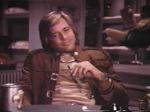 complicated and complex and light/dark she is as a character. I think she’s far more rounded and intriguing than Bill Adama – and Starbuck is way more interesting than Lee. Just saying. (Also, how similar is she to the original Starbuck?? Very clever.) I even – gasp – appreciated Baltar more this time around. He is truly fascinating, and through all his reinventions he was totally believable. Also, the hair.
Of course, there are bits that I don’t like. Last time we did a watch-through I remember reading somewhere about how many girls die. And I did a count-back last night, and… well, ALL of the girls die. Like, actually all of the female characters. Dead. The only females alive at the end are two who have already died (oops, spoilers! They’re cylons!). Literally NO other women that the show has focussed on get to live. That… is crap. Utter, utter bollocks. And makes me very sad about this show that otherwise counts as some of the greatest tv ever.
Will I watch BSG again? … I dunno. It sure won’t be this year. I am definitely over it for now. In 18 months? Well… maybe. The cool thing about this show is that it looks like it should age well. I’m sure people said that of the original Star Trek, too, but hear me out. It doesn’t rely on a lot of fancy SFX. The Galactica is meant to look beat up and old – because it is. I don’t think there are too many social assumptions implicit (as opposed to explicit and explored) that will make it cringeworthy – although hey, I’m living in it and part of the dominant culture, so maybe I’m totally wrong there (yes there could and should have been more non-white characters, but racism – or colony-ism in this context – IS dealt with, if briefly). So it may well be that I watch it again. But not any time soon, dear, so don’t ask for another twelve months.
Gloves
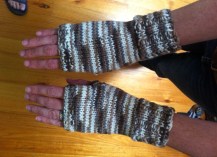
Made me some fingerless gloves.
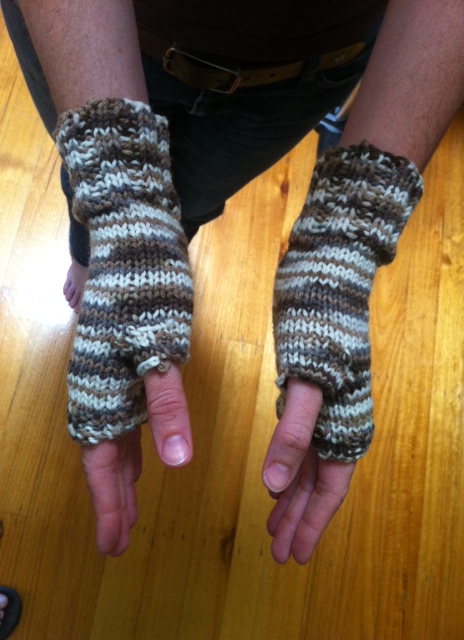 Pretty happy with these. Looking forward to wearing them when it gets cooler. Which, given this city, could well be next week.
Doctor No
This review is part of Project Bond, wherein over the course of 2014 we watch all of the James Bond movies in production order.
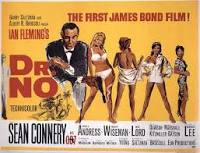 Summary: Bond is sent to Jamaica after the MI6 agent there (Strangways) is killed. It turns out that he was investigating Crab Key and its mysterious inhabitant, Dr No, as possibly being the source of interference that has Cape Canaveral and NASA all het up. Bond continues this investigation, ending up on the island and eventually foiling Dr No’s dastardly plan. Which involves an atomic reactor. Along the way Bond sleeps with a few ladies, gets one ally killed, and kills several people himself. And he has a shower.
Alex: It was interesting to see how many of the elements that define Bond in the cultural mind are present from the outset. The opening scene has Bond gambling with a beautiful woman, whom he ends up sleeping with (this is a mutual seduction); he drinks a martini that’s been shaken; he flirts outrageously with Moneypenny (and throws his hat on the hatstand), and M is also present; there are car chases galore, and even Felix Leiter and SPECTRE. The one aspect missing is Q, and any sort of technogadgetr (Geiger counters don’t count). The other thing that’s really different is the opening credits: there’s no prologue before them! But there are some dancing-lady silhouettes, so that foreshadows later developments, as does the man-in-gun-barrel shot. Also the theme music; I love this original score. Interestingly, there is no mention of “James Bond”; there are some “007”s plastered on the screen, but that’s it – the movie is “Ian Fleming’s Dr No”.
The introduction of Bond as a character says a lot. As mentioned, Bond is first seen gambling in a club. Someone is looking for him, so we already know his name (that would never happen in a film today), but when the camera gets to the card table we don’t see his face for ages. We see the back of his head… then his (well-manicured) fingernails… then his face, as he lights a cigarette and gives his name as “Bond. James Bond” in reply to the woman asking. I have no idea how popular Connery already was by this stage, but he can’t have been an unknown – not to get that sort of treatment. Bond’s character is relatively nuanced throughout the film. He goes from gambling and flirting with a stranger, to flirting with Moneypenny, to being deadly serious with his boss (and being petulant when told his Beretta is a sissy gun). In Jamaica he Gets Things Done: turns the tables on would-be murderers, orders people around, deals with a nasty spider, and kills with (apparently) absolutely no qualms. He’s cold and hard when it’s required, but warm and flirty when he can; he’s calm while the spider crawls all the way up him (if he’d been a woman this would have happened with the sheet off, rather than wrapped around him) – but then jumps out of the bed, clearly panicky. This characterisation surprised and pleased me.

The supporting cast left a lot to be desired, although there were some good bits.
Quarrel, the local Jamaican boatie who was helping Strangways has some good moments: suspicious of Bond, he manages (briefly) to have him at a disadvantage; his local knowledge and boating skills are clearly valued by Bond and Leiter. At the start he clearly

sees himself as Bond’s equal, although this seems to disappear over the course of their partnership. Annoyingly, when they get to Crab Key Quarrel is depicted as superstitious and needing to drink rum to bolster his confidence – the former I could cope with because Honey Ryder also believes in the dragon, but the latter is totally unnecessary. Also, he dies an unnecessary death and is then forgotten. Boo.
I tried to keep track of the non-white characters throughout the film, expecting it to be pretty dire. They do mostly appear as murderers and servants, and often as totally under Do No’s sway… but there are a few white characters who fit this bill, too, so it’s not a racially clear-cut thing. The worst bit, race-wise, is that as far as I can tell two of the characters are in ‘yellow-face’: Miss Taro and Dr No himself are played by white actors. (I may be wrong about Miss Taro – perhaps she’s not meant to be of Asian descent – but the eye-liner and hair seem to be suggesting it…).

Dr No says that his father is German while his mother is Chinese, so I guess there’s an excuse for not using a Chinese actor, but still…. I was also reminded of Stella Young’s comments at the Splendid Chaps podcast about villains and disability. Dr No has something wrong his hands – we’re not told what, although Bond assumes his hands are fake. In the book I think he also has weird eyes. The point being, he’s not right somehow. Bond is the epitome of Manliness, and is Defending Humanity; his opponent is somehow less than/different from human (I mean all of this in the context of the movie of course), and is therefore deserving of being taken down.
Honey Ryder (in the book, she’s Honeychile) – played by Ursula Andress – is the most famous part of the movie, I think; her walking out of the ocean must be one of the more iconic moments in popular cinema. Like Quarrel, her best moments are at the start of her relationship with Bond. She’s suspicious of him, afraid that he’s going to steal her shells; she’s defiant and doesn’t want to have anything to do with him. She’s confident of her own abilities and indeed proves herself very useful – taking Bond and Quarrel somewhere to hide, showing Bond how to stop the mosquitoes from biting, and so on. Sadly, this utility and resourcefulness do not survive under the weight of James Bond. She quickly becomes fearful and a bit useless – dressed up as a doll, taken to dinner then dismissed while the men talk of great things, and then chained up so she can be rescued. Sad.
There is a good case for arguing that this is a science fiction movie. Dr No is being investigated because he is somehow interfering with the Mercury missions being launched from Cape Canaveral – Leiter says they’re about to try moon fly-bys, which by 1962 standards are absolutely SF. Additionally, Dr No’s evilness is driven by atomic power, also SF-nal for 1962. And there are automatic sliding doors.
I enjoyed this more than I had expected. The fights are cheesy, the car chases involve a lot of blue screen, and some of the dialogue is dreadful. But a lot of it was actually shot in Jamaica, which is beautiful; it’s well-paced – no extended fights or chases; and I liked that Dr No isn’t completely transparent. This was definitely a good start to Project Bond.
James: Well, what has Alex left unsaid? I enjoyed that right from the gun (see what I did there) we’re off and racing with the traditional Bond theme blaring out on trumpets… Classic and colourful lettering … Dr No, Ian Fleming and then the short credits. The quality of the blu-ray transfer is striking. Having watched these films growing up on VHS etc to see them re-scanned from the original first generation camera films is a treat. Film’s look is timeless, the colour is beautiful and of course the technology dates it but otherwise it could be any modern film.
If I had one observation it’s that the whole film somehow seems more dated and cheesy the longer it goes on. It’s still from that era when cinema seems overacted compared to more modern films. I loved how many of the key Bond elements are firmly in place, the booze, the women and the regular supporting cast and yet somehow the cliche doesn’t feel tired? How many books had Fleming written before this film was made? I rate this Bond 3 Martinis.
2013: the tv and movies
So it’s that time of year, when everyone does their wrap-ups. Me, I’ve been keeping track of most of the tv and film I’ve consumed over the year, because I think it’s interesting – particularly to see what I re-watch…
Movies for the first time:
Hotel Transylvania * Abraham Lincoln, Vampire Hunter (on the plane, ok??) * Pitch Perfect * Brave * Cloud Atlas * Oblivion * Iron Man 3 * The Prestige * Jack Reacher (I may have fallen asleep) * The Odd Angry Shot * Much Ado About Nothing (2012) * A Good Day to Die Hard * Pacific Rim * RED 2 * Star Trek Into Darkness * Gravity * Olympus Has Fallen * GI Joe: Retaliation * Thor: The Dark World * Elysium * The Wolverine * Ender’s Game * Man of Steel
Total: 23
Movies re-watched:
Die Hard with a Vengeance * Indiana Jones: Raiders of the Lost Ark * The Avengers * The Mummy * Airheads * Skyfall * Iron Man * Iron Man 2 * Good Night, and Good Luck * Knight and Day * Space Cowboys (in honour of Cmdr Hadfield) * The Lord of the Rings (all three, extended editions) * Thirteen Days * Apollo 13 * The Odd Angry Shot (yes, again) * Snow White and the Seven Dwarves * Nicholas and Alexandra * Oblivion * Singin’ in the Rain * Harry Potter and the Deathly Hallows Pt 2
Total: 22
TV seasons (not including rather a lot of Doctor Who):
Caprica (first and only season) * Warehouse 13 (season 1) * The Triangle (three-part series I am embarrassed to have watched) * FarScape (season 1) (rewatch) * Downton Abbey (season 1) * Wallander (5 episodes) * Downton Abbey (season 2) * Game of Thrones (season 2) * The Bletchley Circle * Downton Abbey (season 3) * Newsroom (season 1) * Battlestar Galactica (season 1) (rewatch) * Battlestar Galactica (season 2) (rewatch) * The Day of the Doctor (…twice…) * Battlestar Galactica (season 3) (rewatch) * A Very British Coup
Total: 14 seasons
I would have thought we watched more tv this year, so that’s interesting. Battlestar Galactica has fairly long seasons, though, so that’s taken a fair bit of the last quarter of the year.
Project Bond
I like James Bond movies. In fact, I went through quite a phase as an 18 year old of reading all the Bond books I could get my hands on (even, gasp! non-Fleming ones).
My husband likes James Bond movies.
Together, we have seen all the Brosnan and Craig films, and a few of the classics when the opportunity has arisen. A few weeks ago we went to Melbourne Museum’s Designing 007 exhibition, and it’s incredible. Costumes (golly the women have been tiny), props, mood boards, story boards… an enormous casino room, clips from films, etc etc. Brilliant!
But.
Now, it must be said that I have a spectacularly poor memory. Yet even taking that into account… well, it turns out that I may not have seen as many classic Bonds as I thought I had. As many as I had assumed, and been assuring the husband of.
 And thus is born Project Bond. Said husband dreamed it up while drunk on the glory of Aston Martins and sharp suits. We have purchased the entire suite of James Bond movies from the last 50 years (all 23 of them), and we plan to watch one a fortnight for 2014. And the only way that I was convinced to go along with this crazy idea was the tantalising suggestion that – you guessed it – I should review each one. It was briefly suggested that perhaps I would refrain from indulging in too much ranting over the gender politics… but this suggestion was quickly retracted.
2014 starts this week, and so does Project Bond. Stay tuned for our first review, as James Bond takes on the nefarious Dr No.
Chaussons mignons
Knitting these are my latest fad: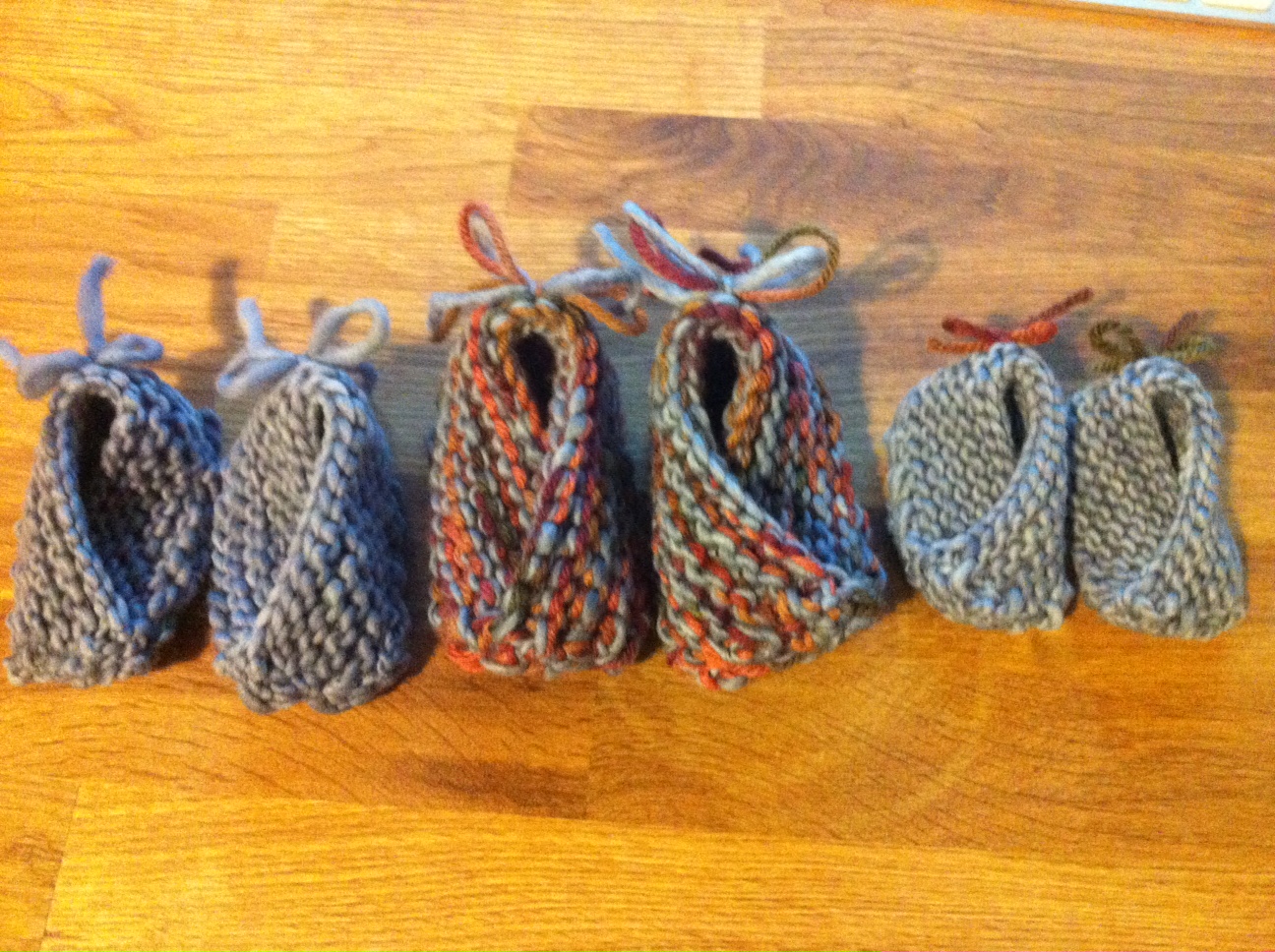 Aren’t they cute?? I got the pattern from this blog, and although I initially found the instructions for the construction phase a little confusing when I actually attempted it, it made sense.
They require very little yarn, and I think I make a pair in about 90 min – including TV watching time. And they require yarn at the chunkier end of the spectrum – I think the grey is 10 ply – so they’re not finicky to knit.
Local suffrage history
This is quite impressive, for me: my mother bought me a book that I read before it got dust on it! (Think I’m exaggerating? See this review and this one for how I am a bad daughter.)
 Anyway, knowing that I am developing a keen interest in the history of women’s suffrage in Britain, Mum found me Burning to Get the Vote, a history of the suffrage campaign in Buckinghamshire.
There were two things that did not work for me in this book; one substantive, the other a niggle. The first is that I don’t know the area, and that definitely had an impact on my enjoyment. This is not really a reflection on the book itself, although a map would have gone some way to alleviating that issue and made it more accessible for non-Bucks readers, and especially non-UK readers. Instead it’s a reflection that probably, this history wasn’t imagined to have a general readership outside of the locality, and an academic one a bit more broadly. So I lived with that; I skimmed over the bits where Cartwright goes into detail about the actually location of various meetings – which is probably a delight to those people who know High Wycombe or Wendover or Aylesbury. The second, the niggle, is a style thing. There were a lot of commas that I felt were misused.
Those things aside, this volume has a lot going for it. Cartwright has clearly undertaken a monumental task in sifting through local newspapers to find references to suffrage (and anti-suffrage) activities in his area, as well as digging up minutes from meetings and some correspondence as well. This in itself I find fascinating: the suffragettes and suffragists (the terms, sometimes interchangeable, were often used to differentiate between militant and constitutional approaches) were often holding important enough meetings that they did feature in the media – despite not always getting big numbers to those meetings, and perhaps sometimes because of the opposition they met.
What this history does is set the national women’s suffrage campaign in a local context. So much of this story that gets popularly talked about is London, or perhaps Manchester, based – which is unsurprising because it’s where the Big Names (Pankhursts, Fawcett) were, and where a lot of the eye-catching activities (pilgrimages to Hyde Park, chaining to gates) occurred. But as I’m increasingly realising, this doesn’t cover the entire campaign. And how could it? Of course it is important to convince non-capital city residents of the righteousness of your cause! The leaders of the WSPU and other organisations all travelled around the country, drumming up support. They corresponded with the women (and men) organising local branches in small towns. Sometimes, they retreated to the countryside to recover from hunger strikes and force feeding. So this book should help Buckinghamshire people to understand their contribution to an important national movement, and it should make everyone else realise that history does occur in small towns, too. It should also be seen as a spur to people who are running similar campaigns at the moment. There is no doubt that many of the people (especially the women, I would suggest) who were involved in Buckinghamshire probably got quite disheartened over time; their numbers were never huge, the number of supporters was varied, there was active dislike and vitriol from the community… and it took a really long time. Cartwright believes that the first 20th century women’s suffrage meeting in the county was held in 1904 – although there was some action in the nineteenth century too; women got limited rights to vote in 1918 (over 30, married to a householder) and then voting rights on the same terms as men in 1928.
I liked that Cartwright went to some lengths to find out details about many of the women involved, which often involved finding their obituaries. I appreciated the extensive quotes – from newspapers largely – from the speeches made, and in debates with anti-suffrage campaigners. (The notion that the newspaper would quote so extensively from speakers is awesome.) And I also liked that he included a chapter on those anti-suffrage activities, to demonstrate the arguments that were being made and to show that the suffragists weren’t just battling indifference but serious opposition.
This book is not for the general reader – unless you’re from central Buckinghamshire, in which case definitely read it since you might be living in a house that was used for meetings! But it’s great if you want to see how local history can and should be interesting, or if you’re interested in suffrage history more generally. There is also a bonus for Australian readers: Muriel Matters, an Australian suffrage campaigner, worked quite a lot in the area and is mentioned several times.
Galactic Suburbia 92
 In which we get the band back together again, just before we go on our summer holidays!
Culture Consumed:
Alisa: Doctor Who; The Fall; Orange is the New Black, Black Mirror Season 1
Tansy: Adventures in Space and Time; Cranford by Elizabeth Gaskell, Apex Issue 55
Alex: Snuff, Terry Pratchett; Thor: the Dark World; Tooth and Claw, Jo Walton
Pet subject: The Year in Review
Alisa: PhD, Conflux, Nancy Kress’ After the Fall, Before the Fall, During the Fall, Twelfth Planet Press (Trucksong, A Trifle Dead, Twelve Planets, Shirley Jackson/WFA), made a SF fan
Tansy: Hawkeye; The Almighty Johnsons; A Song of Ice & Fire; reading with Raeli (Edward Eager & Diana Wynne Jones); Doctor Who
Alex: Saga; Doctor Who; Naomi Novik’s Temeraire; re-reading; Lizzie Bennet Diaries.
This is our last episode of the year, because we’re going on a summer hiatus… but we will back in 2014!
Please send feedback to us at galacticsuburbia@gmail.com, follow us on Twitter at @galacticsuburbs, check out Galactic Suburbia Podcast on Facebook and don’t forget to leave a review on iTunes if you love us!


