Pushing Ice: it’s what we do
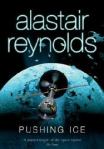
(Amusingly, I blogged about this book the first time I read it… five years ago!)
…mild spoilers…
So my love of Reynolds’ work is becoming embarrassingly well known. To the point where a number of people at Natcon asked me which one they should read. The first person to do so admitted that they are not huge fans of very far-future SF, which therefore makes House of Suns – probably my favouritest of his books ever – a bit inaccessible. And I wasn’t sure how she felt about the slightly baroque-feeling SF that is Revelation Space. So I suggested Pushing Ice, because I cannot bring myself to recommend Terminal World (I am still getting over that disappointment and will have to read it again sometime to figure out whether I am being silly or not). And I recommended it to a few other people, too… and then realised that I hadn’t actually read it since that first time. I’ll admit to being a little worried that maybe it wasn’t as good as I remembered, because then I would be responsible for other people not liking Reynolds, and then MY LIFE WOULD BE OVER.
Ahem.
Anyway, the prologue made me actually wince when I read it… because it’s set 18,000 years in the future. Oops. Happily, it’s a fairly accessible 18,000 years in the future, because it’s about a politician making deals and proposals. Her name is Chromis Pasqueflower Bowerbird, and the parliament is made up of several solar systems, but still – it’s familiar. And then it goes waaay back in time to 2057, where Rockhopper is an asteroid-mining ship about to be sent on a rather extraordinary mission. Janus, one of Saturn’s moons, suddenly starts acting in a most un-moon-like manner, which is of course something to be investigated.
What happens during the chase, and after catching it, is what the plot revolves around. But it’s not a story about technology, or a first-contact story (although there is some of that), or even really about the exploration of space. Instead, it’s about the human interactions that take place in situations like this: a small number of people confined together for an extended period of time; a small number of people forced to make difficult, sometimes lift-threatening decisions. And at heart it revolves around the friendship of two women: the captain of Rockhopper, Bella Lind, and her best friend Svetlana.
The plot, while linear (with the exception of the prologue), does not simply follow the spacers through their adventures, one after the other. Instead it skips forward several times, sometimes over decades. After the initial adventure of chasing down the ‘moon’, and the repercussions of doing so, the narrative essentially consists of extended snapshots. It shows how society changes – and remains static – over those periods; it looks at how human interactions change, and how small things impact on major decisions. How one grudge can change the way a whole community works.
I loved it. Again. I loved the space bits and, I guess, the more specifically SF bits; they weren’t too tech-heavy, but definitely detailed enough to be enthralling. The interactions with aliens (spoiler!) were cleverly, and sympathetically, and subtly, done.
I loved the depiction of how a society might function in an enclosed space, and over such a long time, too. It’s probably a bit romantic in that the society doesn’t completely implode, but I’m fine with that – there are other places for reading about societies that disintegrate horrifically.
I liked the characters. There are none that I can say that I actually loved – they’re just not that sort of people, which I perversely liked, because it pushes them more towards the believability end of the spectrum. Neither Bella nor Svetlana, leaders at different points in the narrative, come out as particularly rosy – one looks slightly better, at times, but both are, simply, very human. Flaws, frailties, grudges, narrow-mindedness, ambitions… hopes, dreams, and sacrifice.
So, I’m happy with having recommended this! It’s a fairly good example, I think, of what Reynolds writes. An awesome reach, cool characters, and galactic-yet-still-human ideas.
I’m enjoying re-reading.
Arks are by definition redeeming
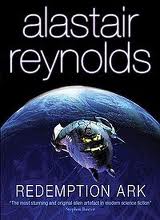 Look, it’s a Revelation Space novel. Seriously. This is not going to be a bad review.
Redemption Ark sort of takes up where Revelation Space leaves off, but uses quite a number of different characters to present the narrative. Where the Conjoiners were just another group of weirdos in the first book, here two of the main points of view are from Conjoiners – who end up having quite different takes on the events. There are a couple of familiar characters, happily – who have changed in some ways quite substantially, but of course in many ways stay the same – as well as some other new ones, including one of the most ‘normal’ characters Reynolds has used to present action in any of the Rev Space books.
The narrative? Revelation Space hinted at Inhibitors, a machine race of some sort tasked with inhibiting the development of fleshy sentience into the wider galaxy; Dan Sylveste, in his arrogance, rang their bell. <i>Redemption Ark</i> – along with a lot of side-stories – addresses how the people of Resurgam, as well as some other concerned galactic citizens, might deal with this particular threat to their existence. Actually, it’s worse than that, since most of the people on Resurgam have absolutely no idea what is going on. It’s the other people – with mixed motives – who have to take action on their behalf. Enter two very different Conjoiners, some hyperpigs, and ordinary space-faring citizens, and the race is on to decide who is going to get the weapons that alone might have a chance of dealing with that rather intimidating threat.
I love this stuff.
As I said, there are a lot of sub-plots going on. There’s the whole back-story of the Conjoiners (more on them later), there’s the sad story of Antoinette and how she ends up involved in all of this, there’s those recurring characters and what’s happened to them between books as well as what they’re doing now (se me avoiding spoilers?), as well as an update on Resurgam and Chasm City. It’s this depth, this chunkiness, that all manages to make sense and add to the overall story, that I adore about these books. If you stripped all this possibly-extraneous material out you’d have maybe a 250-300 page book (rather than 650-odd pages), and it would probably be quite good, but… it would be missing the marvellous detail, the feel of it being a messy and oh-so-real society, that I love.
The characters are of course a wonderful part of that messiness. The Conjoiners, it turns out, are a society created by one Galliana in an attempt to bring humanity ever closer to one another – by being conjoined by a neural network that allows people to communicate essentially telepathically, and see things that other people are projecting, and even read further into others’ minds than simply their surface thoughts. The idea was to create a transparent, and presumably egalitarian, society. It’s a lovely utopian vision, and there are of course dark hints that way back when it was being established – on Mars, 400 years prior to the book – that it caused wars with those afraid of that vision. I know I’ve read about that back story, somewhere; it might have been one of Reynolds’ short stories. In Redemption Ark the Conjoiners are represented primarily to the reader through Clavain – an early, somewhat unwilling recruit – and the paradoxically ambitious Skade. These two characters are developed thoroughly and, actually, quite messily; their motivations don’t always make immediate sense, they are conflicted, and they make horrendous decisions in the heat of battle. I love Clavain; I respect Skade but I would definitely want to keep her at arms’ length. Preferably someone else’s arms.
There are other new characters. Antoinette Bax, ship-owner and budding transporter, is the fairly naive and hapless everywoman (along with her partner Xavier) who gets dragged along almost against her will. She’s one of the few sections I think could have been excised without the overall narrative losing much complexity and wonderfulness (did I mention I love this novel?). Then there’s Scorpio, a hyperpig. The pigs get mentioned in Chasm City, but they don’t play much of a part; their backstory is fleshed out a little more here, but we still have to wait for another story – I think The Prefect? and one or two shorts – to get much detail. Still, the idea that a new intelligent species could have arisen out of human/pig experiments aimed at making human organ replacement easier is fascinating.
It’s a great book. There’s tension on a galactic scale, and on a personal level; there’s technology, and overcoming its limits in potentially dangerous ways; there are cameos from earlier books; there is witty dialogue, and hinted-at dark pasts, and just wonderful writing too. #fangirl
Galactic Suburbia 28
News
Lambda Awards
Kristine Kathryn Rusch discusses the business of being an author
Woman wins award, man gets attention
Ian Sales’ SF Mistressworks & starts the SF Mistressworks meme
Hugo reminder: get your nominations in!
Galactic Chat
T SHIRTS
Tiptree!!
Feedback
Competition open for another fortnight – keep sending in entries! Email us with fave GS moment and what cake you ate.
What Culture Have we Consumed?
Tansy: Burn Bright, by Marianne de Pierres; Laid (ABC TV)
Alisa: Star Trek Enterprise Season 4, Fringe eps 11 -13,
Alex: Genesis, by Bernard Beckett; Redemption Ark, Alastair Reynolds; Version 43, Philip Palmer (abandoned)… Battlestar Galactica
Please send feedback to us at galacticsuburbia@gmail.com, follow us on Twitter at @galacticsuburbs, check out Galactic Suburbia Podcast on Facebook and don’t forget to leave a review on iTunes if you love us!
Galactic Suburbia 26!
In which Tansy and Alex soldier on womanfully without their lost comrade, to catch up on three weeks of publishing news, the Nebulas, books, books, and more books, and tackle the crunchy pet subject of Australian SFF Publishing in its entirety: how do Australian specfic readers get their books? Who publishes them and how do we buy them? (Realised too late this is a pretty massive topic – please email us to tell us what we got wrong and what we left out!) We can be downloaded or streamed from Galactic Suburbia, or through iTunes.
News
Bitchgate round up; also a Scott Westerfeld interview on the topic.
LJ Smith, author of bestselling 20 year book series The Vampire Diaries fired by her publisher, who will hire a new writer to continue the books.
Interesting post by Tobias Buckell on ebooks (love the bit where he zooms out on the graph).
Borders and Angus and Robertson go into receivership.
RIP Nicholas Courtney!
What Culture Have we Consumed?
Alex: Life, Gwyneth Jones; The Dispossessed, Ursula K. Le Guin; Revelation Space, and Chasm City, Alastair Reynolds
Tansy: Debris (due Autumn (?) 2011) by Jo Anderton;
The Secret Files of the Diogenes Club, Kim Newman; Across the Universe, by Beth Revis.
Pet Subject: How do Australians Buy SpecFic Books?
This comes from a request by Niall Harrison to learn about the other side of Aussie specfic – the mainstream/Big Name Publishers, how Australians buy books, etc.
Big Name Australian Publishers (who handle SFF)
HarperCollins Voyager
Hachette Livre/Orbit (incl Gollancz, Picador, Little Brown etc)
Allen & Unwin
Random House
Pan Macmillan
The Cost of Australian Books/Australian editions – GST, the fight against parallel importation.
Chain Stores – Borders, Big W, Collins, ABC, Dymocks, Angus & Robertson (Borders & A&R now in receivership but not all shops company owned – many will close)
Online Shopping – local and overseas (Amazon, Book Depository, Fishpond, BetterWorldBooks)
Indie/SFF Specialist Bookshops
Hobart: Ellison Hawker
Melbourne: Minotaur and Swords and Sorcery (Reader’s Feast also has a well-picked if smallish selection).
Perth: Planet and Fantastic Planet, White Dwarf and a few more new and not so new
Sydney: Galaxy, Infinitas
Brisbane: Pulp Fiction Books
(who did we forget? Tell us!)
Feedback: Tehani from Perth, Cat from Wollongong & Shane from Redfern.
Please send feedback to us at galacticsuburbia@gmail.com, follow us on Twitter at @galacticsuburbs, check out Galactic Suburbia Podcast on Facebook and don’t forget to leave a review on iTunes if you love us!
Chasm City
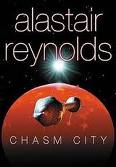 As with Revelation Space, this is the second time I’ve read Chasm City – and the first time was some years ago. Consequently, while there were a few things I remembered quite well, I still managed to be surprised by some of the twists and turns of the plot. This time, there were more occasions on which I picked up hints and allusions; I was quite proud of guessing what might be going on until I remembered that I’d already the thing…
Some spoilers follow
It’s another awesome space opera from Reynolds. One of the things which I had misremembered – and perhaps it applies more to one or both of the other Revelation Space books I’ve not reread yet – is the amount of cross-over between the stories. There are some allusions to ideas and people from Revelation Space here, but they are both very definitely stand-alone novels. And I like that; it’s a universe, rather than a series. I really liked that it ended with Tanner clearly talking to Khouri, which is one of the opening scenes from Revelation; it felt quite neat for readers of both books.
This book has quite a different feel from Revelation, which is interesting to see – to change from just your first to your second, particularly within the same universe, seems… game? Anyway, it is largely told with a first-person narrator – with occasional flashbacks to an historical character – and consequently the story is mostly linear (with the exception of those flashbacks, and the narrator’s own thinking about his past). I enjoy a narrator – particularly one, as in this instance, who is a bit unreliable. In fact I enjoyed most of the characters in this novel; there aren’t many, with the exception of the narrator (Tanner) who are particularly deeply developed, but they are certainly all individuated without becoming cliches. There’s a nice range of female and male characters, doing a range of different activities and with a range of different motivations – I think I said a similar thing about <i>Revelation</i>, but it’s true and it’s one of the appealing things about Reynolds.
The settings for Chasm are great. We’re in about the same time period as in Revelation, so chunks of the galaxy have been colonised, but there’s no FTL so getting places is still damn hard work. There are two prime locales: Chasm City itself, of course, on the planet Yellowstone, and the planet of Sky’s Edge. These are two radically different places, so Reynolds gets to indulge in two quite different visions of what interplanetary colonisation might look like. In thinking about that issue, I utterly adored the slow revelation about how the colonisation of Sky’s Edge came about; the slow generation-ships thing is enthralling, for me, and thinking about the lengths people might go to to get an edge is intriguing. I particularly enjoyed the slow but steady revelation and discussion of Sky Haussman’s character; that you start the novel knowing he was characterised as both a hero and a villain, and slowly that image is problematised… yeh, it really works for me. And Sky’s actions of course present an immense ethical quandary – which the reader can’t help but approach with the knowledge that it caused a centuries-long war on the planet itself. Chasm City, of course, is a wonderfully outrageous city, and I loved that Reynolds opened with an excerpt from a document explaining how the city has been affected by a plague – so the reader has that extra bit of information, and thus an advantage over Tanner. For me, it heightened the sympathy the reader could feel for him. And the plague itself iconic: something that affected the machinery of the place doesn’t seem disastrous, until you remember that this is a society using nano, with therefore machinery in everything – and everyone…. There are so many possibilities inherent in that idea.
The plot itself has a kinda revenge tragedy thing going on, which can be a bit tedious but in this instance is skilfully drawn out and well played, too. In fact there are numerous side-plots that at times could threaten to overwhelm the central point – the revenge – but ultimately Reynolds draws them all together and reveals that actually, he knew what he was doing all the time (of course).
It’s another of my favourites. Not quite as comforting as Revelation, in that the stuff about Gideon is rather off-putting, but familiar and relaxing nonetheless. And a damn good story.
Revelation Space
 I just love this book. I really really do.
I seem to remember that when I first read it, I found it a bit confusing – albeit in a good way – because there were lots of POV changes. I wonder now whether that’s one of the other books, because while there are flicks between POVs they converged more rapidly than I had expected and the connections seemed more obvious… but perhaps that is actually a function of me remembering, if barely, where at least some of the connections lay. One of the great things about having a relatively poor memory is that having read this some 5 or 6 years ago, there were stacks of things that there were once again a total surprise for me.
There’s a nice variety of characters here. Male and female, baseline-human and definitely not, and a mix of motives and attitudes. I have two favourites, and they’re the two most obvious: Sylveste and Volyova. Sylveste because he’s just a bit like Indiana Jones; he is, after all, inherently an archaeologist, who gets caught up in adventures. He’s also one of the most sublimely arrogant characters out there, in that fascinatingly entertaining way that only someone who is right so often that the arrogance seems appropriate can get away with. Like House or Holmes, I guess. Not quite diametrically opposed, but still radically different, is Volyova. She’s not quite a sociopath but she’s way more at home with weapons than other people. She gets some wonderful lines in the book, and I always enjoyed the sections told from her perspective; Reynolds gave her a marvellously dry wit and a drive for achievement as strong as Sylveste’s, with marginally less arrogance. I quite liked the POV switches, actually, even – perhaps, bizarrely, especially when – they were done seemingly mid-action sequence. The switch always added something to the scene, an understanding or a perception that could not have come from the initial character. I also liked that there wasn’t an omniscient narrator; it meant that events and revelations came slowly, ambiguously, enthrallingly.
The plot? Oh, the usual; humanity spread across the galaxy, encountering alien artefacts but where is everybody else, along with tantalising hints at what has happened to humanity as they spread – the alterations to baseline humanity are some of the intriguing of those; I love the Ultras and their chimeric alterations, heading towards being truly cybernetic beings. There are small-scale dramas and intrigues – love, abandonment, family drama – mixed in with the galaxy-impacting revelations, making this a seriously awesome representative of space opera. In fact it might have been the first book I ever read that made me genuinely consider space opera a sub-genre, and realise that I totally adore it. It might not be the absolutely most original plot in the world, but the revelations at the end were certainly new ideas for me, and the writing itself is so complex-but-clear that it doesn’t matter that it’s a play on the Fermi paradox; as an SF idea I think it has plenty of scope left anyway.
There are some slightly clunky bits in the narrative and the flow of the writing – a few bits where there is a bit too much info-dump via dialogue for example – but for a first novel, it’s a seriously awesome one. I am just itching to go read the rest of the Revelation Space books… they’re sitting there waiting for me…
Galactic Suburbia 23!
This is my 1000th post! And it’s a Galactic Suburbia one!
In which we greet a brand new year with discussion about digital media, awards, books, feminism, feedback, more books, anti-heroes, gender roles and take a look at what to look forward to in 2011. We can be downloaded or streamed from Galactic Suburbia, or from iTunes.
News
Follow up on the Jewish fantasy discussion by Rachel Swirsky.
Locus to go digital with issue #600.
Launch of the Cascadia Subduction Zone, new critical zine with focus on women’s work.
The i09 Power List: 20 people who rocked SF & Fantasy in 2010.
Carl Brandon Awards: Hiromi Goto and Justine Larbalestier.
Hugo nominations open – last year’s members of Aussiecon 4, don’t forget you’re eligible to nominate!
Feedback: Kaia, Kathryn & Thoraiya
What Culture Have we Consumed? [AND what culture are you most looking forward to consuming in 2011?]
Alisa: Fringe Season 3, Dexter Season 4, Being Erica (ep 1), Nurse Jackie, How I Met Your Mother, reading Managing Death (Trent Jamieson)
Looking forward to: LSS 2011
Alex: Zombies vs Unicorns, ed. Larbalestier and Black; Factotum, book 3 of Monster Blood Tattoo, by DM Cornish; Dervish House, by Ian McDonald; The Killing Thing, by Kate Wilhelm; Surface Detail, by Iain M Banks.
Looking forward to: Blue Remembered Earth (probably), by Alastair Reynolds; books 2&3 of The Creature Court, Tansy Rayner Roberts; the 2011 Women in SF Book Club; Bold as Love sequence (Gwyneth Jones); Twelve Planets (from Twelfth Planet Press).
Tansy: Wiped, Richard Molesworth; The Doctor Who Christmas Special! The Gene Thieves & the Norma; Ascendant, Diana Peterfreund; Big Finish Podcast
Looking forward to: Doctor Who and Fringe (SHOCK, I know), Sherlock, Torchwood, The Demon’s Surrender by Sarah Rees Brennan, Burn Bright by M. de Pierres.
Please send feedback to us at galacticsuburbia@gmail.com, follow us on Twitter at @galacticsuburbs, check out Galactic Suburbia Podcast on Facebook and don’t forget to leave a review on iTunes if you love us!
Galactic Suburbia 22
You can download or stream the episode from Galactic Suburbia, or get us from iTunes.
In which we have run out of our supply of feminist ire for 2010 and are reduced to being happy bunnies with rainbows and vanilla sprinkles. Also, we discuss re-reading, re-watching, and our (apparently unhealthy) emotional attachment to beloved books. With zombies. BONUS: see if you can pick how many times yours truly screwed up the recording because my stooopid Skype crashed. Is fixed now.
News
Black Quill nominations.
Best of 2010 Tables of Contents, Rich Horton & Jonathan Strahan (Niall Harrison tweeted about online percentage, 14/29 stories in Strahan – and 16/28 in Horton. Last year JS had 4/29 and Rich had 7/30).
Torque Control’s Week of Women & SF (also here).
Swancon invited guests announced.
Pet Subject
On re-reading. Did you re-read books as a teen? Do you re-read now, or would you if you had the time and the publishing industry stopped for a year (or three)? Why/not… (on re-reading The Belgariad).
What Culture Have we Consumed?
Alisa – Fringe Season 1 and half of Season 2
Tansy – Feed, by Mira Grant, The Five Doctors easter egg commentary
Alex – Quantum Thief (Hannu Rajaniemi), Zima Blue (Alastair Reynolds)
Please send feedback to us at galacticsuburbia@gmail.com, follow us on Twitter at @galacticsuburbs, check out Galactic Suburbia Podcast on Facebook and don’t forget to leave a review on iTunes if you love us!
Zima Blue
 Published in the UK in I think 2009, this is a collection of some of Alastair Reynolds’ short stories from 1991 through to 2007. I’d read a couple, but not many, so I enjoyed it immensely, even though there were a few stories that didn’t really rock my world. I won’t give a complete review here; suffice to say that I don’t think there are any Revelation Space stories here; there are some very near-future as well as some awesomely far-distant future stories; and mostly they’re great. Three stories in particular caught my attention, not least because they revolve around the same character: Merlin.
The stories are (in narrative chronological order) “Hideaway,” “Minla’s Flowers,” and “Merlin’s Gun.” I’d read the second, because it was written for Jonathan Strahan and Gardner Dozois’ most awesome anthology The New Space Opera. It remains my favourite; having the additional background provided by “Hideaway” makes it all the more fascinating. The sequence is one of Reynolds’ very, very far future histories. It begins with a group of humans in an enormous spaceship attempting to escape the Huskers, who have been systematically wiping humans from the galaxy. The group ends up hiding in a solar system, making various discoveries, and ultimately taking a drastic decision to escape annihilation. All except Merlin, who goes on and – in “Minla’s Flowers” – lands on a planet divided between two factions, and whose sun is (cosmologically speaking) going to be blown up any moment. Merlin gets involved, and the story follows the consequences of that. Finally, in “Merlin’s Gun,” Merlin finds the weapon he’s been seeking that will allow the humans to combat the Huskers, hopefully stopping the genocide. Of course, things are never quite that simple, and all sorts of interesting things are revealed.
I love the plots of these three stories, and my precis here does not do them justice. However, more than just the plots, it’s the ideas that I was intrigued by. Firstly, the vision Reynolds presents of galactic civilisation is a fascinating one. There are any number of far-future stories that imagine a basically unbroken chain of human existence, where humans just keep on building on what they already know, with few hiccups along the way. More rarely, someone writes of a pangalactic spread of humanity that hasn’t managed that continuity – as suggested by Isaac Asimov in Foundation, for example. In those sorts of stories, humans sometimes have an understanding of what they’ve lost, and sometimes not. The former is the case here, and is most vividly demonstrated by the fact that Merlin and his companions have no idea how to use the Waynet: a system of nearly-faster than light tunnels traversing the galaxy. This suggestion of galactic ups and downs is a really fascinating one. (Taken to extremes you get cargo-cult stories, which can be well done or can be painful.) I think it’s the most likely outcome, really. It does suggest a pessimism about human nature, of course, because usually the ‘downs’ are caused by wars.
Secondly, “Minla’s Flowers” deals really interestingly with issues of colonialism and the oft-accompanying attitude of paternalism. Merlin has a century to get Minla’s people up to speed on how to escape their doomed planet. But he doesn’t make them anything, or even give them all the answers. He provides what were probably intensely annoying, vague suggestions that lead to the development of atomic power. Merlin sleeps away most of the time, waking every couple of decades to provide further tidbits of information. Now, partly he acts this way because he himself doesn’t understand all of the technology he uses, for the reason outlined above. But partly he does it because he thinks that the people ought to do things for themselves. In general I’m in favour of that idea, I think, although it’s problematic when it would be easy enough to simply provide technology and supplies and instantly make things better. Both approaches have their problems, of course.
Finally, the character of Minla is a fascinating study in power. Meeting Merlin as a young girl, over the years she becomes the leader of her people and is shown as responsible for the actions they undertake. In the author notes, Reynolds says he was inspired in writing her by “a certain grocer’s daughter with ambitions to high office,” and it’s clear he had things like the Falklands War in mind when writing about her. The decisions she takes, particularly in relation to how the opposing faction is dealt with, are never suggested to be inevitable. Rather, they are precisely that: decisions, made deliberately, not forced by circumstances. I like that sort of dedication to your character, and I like that although she started off admirably she went downhill terribly – yet with a sort of terrible dignity.
The anthology in general is awesome. These stories are in the middle, and form a nice centrepiece.
Women of Other Worlds
Helen Merrick and Tess Williams had the chance to attend WisCon 20 in 1996. This book, which they co-edited, sprang directly from that experience. It’s a thick book – well over 400 pages – filled with fiction, poetry, and a variety of non-fiction pieces: some critical essays on authors or particular works, some collected correspondence, a few along the lines of memoirs. I haven’t read the whole lot yet, but the pieces I haven’t read are those that relate to work I’m unfamiliar with. So there are a couple relating to Lois McMaster Bujold, for example, which I’ll read when I’ve finally caught up with the world and read her stuff.
A complete review of the book would be… extensive, to say the least. But there are a few pieces that especially made me think. For a start, there were a few pieces of fiction that I didn’t really like. That’s an odd place to start a discussion of the collection, perhaps, but it was an important thing for me to realise and come to grips with. Part of me expects to always like everything in a particular set: all feminist SF, for example, or everything by Ursula le Guin… even everything SF, period. (This account for my dismay at not enjoying Terminal World by Alastair Reynolds as much as I had hoped, given my love of everything else he’s written.) So to discover that I didn’t like everything chosen by Merrick and Williams for inclusion was interesting, and gave me pause, and was ultimately quite useful in helping me think through my attitudes. There was much fiction I did like, of course, and one of those in particular was “Home by the Sea,” by Elisabeth Vonarburg. It’s a marvellous tale about struggling with identity, and family, and personal history, in the context of a vague environmental disaster. Kelley Eskridge’s “And Salome Danced” is also a brilliant piece, creepy and lush and subtle. Showing just how useful the internet has become in facilitating criticism, it’s followed by a essay comprising email correspondence from the Fem-SF list about that story, allowing for all sorts of interesting comparison and discussion.
As an anthology relating to WisCon, there are of course a couple of pieces relating to James Tiptree Jr, although – not unexpectedly – they’re neither straight biography nor criticism. There’s an excerpt from one of the cookbooks put out to raise money for the eponymous award, which is hilarious and sounds delicious and makes me want to buy the book, and Pat Murphy’s reminiscences about how the award got started. And Justine Larbalestier contributes an essay on “Alice James Raccoona Tiptree Davey Hastings Bradley Sheldon Jr”, and the stories told about that collection of identities, that makes me itch to go read the bio sitting on my shelf.
Judith Merrill, to whom the anthology is dedicated, finishes the anthology, with an excerpt from her memoirs, and a reflection on the compiling of the same. She had been a Guest of Honour at the con, and died before the anthology was completed. It’s another bio that I really must get my hands on, because she sounds like a most amazing woman, especially in the context of her time but really for all time. I’ve read hardly any of her work, and I’ve tried looking for one of her novels (Shadow on the Hearth), but she seems to be totally out print, which is tragic.
What Merrick and Williams show in this book is how different sorts of writing can work together to give an impression of a community, all its different aspects and ways of relating and divergences. It’s my sort of book; good fiction, good criticism, humour and an attempt to understand the world, or bits of it anyway.

 Randomly Yours, Alex