Power to Yield and other stories

Bogi Takács (link to eir review site) sent me a copy of eir book, and I’m totally stoked I got my (electronic) hands on it. (This is eir personal site.)
Takács writes in a variety of styles across these stories. Some are fantastical, some more science-y, and many refuse classification. There are a few themes that recur: the question of identity – how we think about our own, what it informs it, how it changes the way the world approaches us – was what stood out the most, to me. There’s also a lot of questioning of authority and power, in terms of who has it, how it’s used, how it can or should be controlled/mitigated/ challenged. All of which is show that Takács doesn’t shy away from being provocative – but it’s never about just being provocative: there’s a purpose to it, because at heart it feels to me (an educator) that e is an educator – educating people about how the world and people do, could, and perhaps should function, through eir fiction. Which is not to say that the stories feel in the least bit didactic, or preachy, or anything like that! It’s more the vibe I took away from the collection as a whole.
A few favourites, not exhaustive:
“A Technical Term, Like Privilege” – not the sort of story I expect to be grabbed by, because it does have body horror as a fairly integral idea (this is me avoiding phrases like “I was absorbed by this story” because… well, story-reasons). However, the way Takács uses the issues of class and other privilege as part of the discussion is totally up my alley, and works brilliantly.
“Power to Yield” – I haven’t read any of Takács’ other Eren stories (except those collected here), so there were a few moments where I felt a bit adrift; nonetheless, it didn’t actually take away from my appreciation of the story and the characters. As with “A Technical Term,” this has more violence/ bodily harm than I would generally expect a story that I was moved by to include. But it does, and I was moved; this is a story that will stay with me a for a long time. How to build a new society, how to deal with what’s left from the old society, how to balance the needs/the good of the few and the whole… Takács doesn’t offer any easy answers to such questions, but it’s brilliant to see them confronted.
“Folded into Tendril and Leaf” – another one that includes bodily harm and warfare, and now I’m seeing an unexpected pattern! Anyway: magic, love, identity, dual perspectives; this is brilliant.
I read this collection quite slowly, because many of the stories require thinking and reflection and I didn’t want to short-change them, or myself, by simply powering through. Some of them are quite heavy in terms of the issues discussed (violence, various types of discrimination), and some are on the denser side in style (in a good way!), so ditto on the short-changing.
Rosalind’s Siblings – anthology
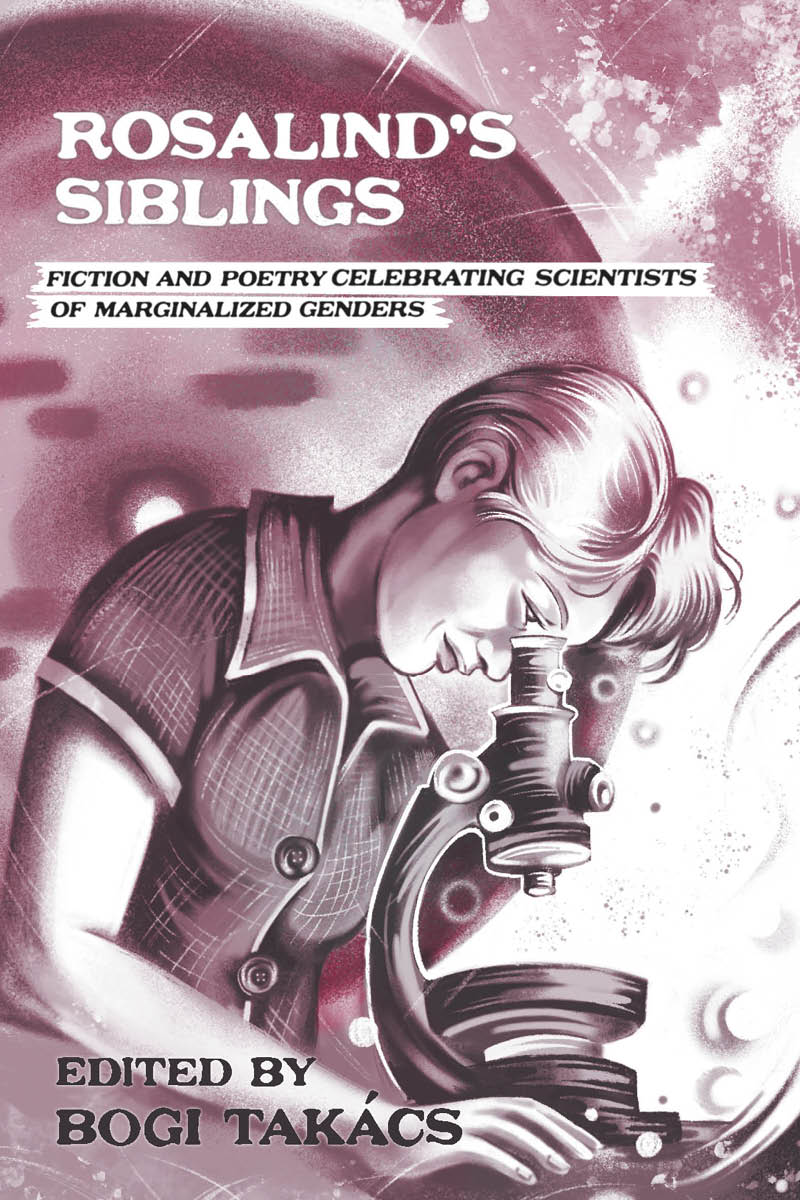
I heard about this anthology c/ Bogi Takács, the editor, and the premise immediately grabbed me (also I trust Bogi’s sensibility). It can be bought here.
The premise here – as the subtitle says – is speculative fiction stories about scientists who are marginalised due to their gender or sex, in honour of Rosalind Franklin – a woman whose scientific discoveries were key to the unravelling of DNA, but who never received the recognition that Watson and Crick did in their own time.
In Takács’ introduction, they note that the stories don’t take a simplistic view of science; there are stories where science is generally a positive force, and stories where it’s not. There are a variety of different sciences presented, a variety of ways of doing science, and a variety of contexts as well. There’s also a range of characters, across gender and and sexuality and neurodiversity and experience and ethnicity and everything else. This reflects the authors themselves, who are also really diverse. The stories, too, vary in their speculative fiction-ness; near-future, far-future, magical realism, on Earth or in the solar system or far away. There are two ‘trans folk around Venus’ stories, as Takács rather amusedly notes – and they are placed one after the other! – but they’re so different that I’m not sure I would have clicked to that similarity without having been made aware of it from the introduction (stories by Tessa Fisher and Cameron Van Sant; they’re both a delight).
As with all anthologies, I didn’t love every single one of these stories – that would be too much to expect. But there were zero stories where I wondered why an editor would include it, and all of them fit the brief, so those are pretty good marks. DA Xieolin Spires’ “The Vanishing of Ultratatts” was wonderful and hinted at an enormous amount of worldbuilding behind the story. Leigh Harlen’s “Singing Goblin Songs” was a delight, “If Strange Things Happen Where She Is” (Premee Mohamed) has gut-wrenching timeliness (science in a time of war), and “To Keep the Way” (Phoebe Barton) utterly and appropriately chilling.

 Randomly Yours, Alex