New Philippine Speculative Fiction 1
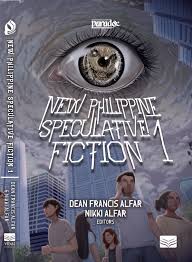
And another book sent by Charles! You can buy it from the publisher.
This anthology is both a mixed bag and a diverse collection – ah English, you are hilarious.
Some of the stories brought together here are absolutely brilliant. There are very few names that I recognised, and many that I hope will have their work picked up by and read further afield.
Of course, any anthology is going to struggle to please a reader with every story. So as expected, there were stories that really did not resonate with me here. Most of those were the horror stories – which is entirely to be expected, since that is not my vibe at all. In particular some of them leaned far too heavily on body horror for my tastes, so I simply skipped them. If that’s your vibe, then I’m glad for you that they’re included here. There were plenty of other stories here that did work for me: there are 35 stories included!
Some stories were clearly and obviously leaning into Filipino places, ideas, history, and language; I definitely didn’t get all of the references in those, but I got enough that I could appreciate the story. Others were, I guess, more “universal” – whatever that means, given the stories are presented largely in English. One of the fun things about an anthology like this is that the only connective tissue is the identity of the authors: there are no themes or ideas tying the stories together, so you have absolutely no idea what you’re going to read next.
Some favourites:
- Jose Elvin Bueno, “Cadena de Amor” – the narrator’s perspective here was intriguing, and the story tantalising
- Vida Cruz-Borja, “Call of the Rimefolk” – art, space, aliens, love, family. This story is magnificent.
- Exie Abola, “Shadow Sisters” – difficult to characterise, gut-wrenching if you’ve got siblings.
- Ian Rosales Casocot, “The Apologist” – I don’t like this story. It made me angry and feel powerless. It’s very well written and it reflects modern media too well for my liking – how rich people can get away with anything, and how PR works. More people should read it.
- Kate Osias, “The James Machine” – AI stories are still very Now. This is a simple story, in the sense that the narrative is straightforward and it doesn’t dive deep into philosophy; it’s also poignant and lovely, and the subtitles throughout are a masterstroke.
Highly recommended for getting a taste of what the Philippines is producing.
Canterbury 2100
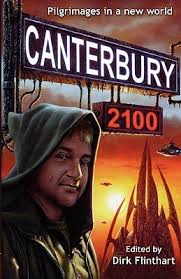
I really thought that I had reviewed this fifteen years ago when I first read it, but apparently not. How ridiculous! Anyway, I decided to reread it on a whim, and it’s still a delight.
It’s based on Chaucer’s Canterbury Tales, of course – pilgrims telling stories as they travel to Canterbury. Here, after a series of apocalyptic events only vaguely referred to, a bunch of people (mostly pilgrims) are travelling to Canterbury on a nuclear and steam-powered train. They’re delayed by rain (and worse), and start telling stories. The same sort of stories, at heart, as those told in Chaucer’s story: individuals and communities, loss and love and hope and tragedy, believable and not; all revealing tantalising glimpses about the people and their world.
There’s a great range of styles, as there should be in an anthology like this, and maybe sometimes the stories don’t seem like they’re quite coming from the same world. But honestly, would someone from Kununurra tell the same sort of story about Australia as someone from Canberra? And did you really think all of these people were telling the unvarnished truth? … all of which is to say, the collected stories feel real in a very human way.
Published in 2008, one of the fun bits is to look at the authors and see who I still know. Third up is Angela Slatter, who is still going from strength to strength; likewise Trent Jamieson, Lisa L Hannett, Kaaron Warren. There’s Martin Livings and Laura E Goodin and Grant Watson and Thoraiya Dyer… and of course it’s edited (and with connecting text) by Dirk Flinthart. Truly it’s a who’s who.
If you can still find it, this is such a fun anthology.
Anna Karenina Isn’t Dead (anthology)
Take examples of literary women who were, generally for stupid reasons, or otherwise treated very poorly.
Give each a new story. Either still largely within the framework of their original existence, or in a completely new story.

Bring those stories together, and create an anthology. That’s what you have here.
I actually haven’t read Anna Karenina, although I knew that she died (spoilers!). There were several other examples in the anthology where I also didn’t know the source material. Fortunately, the editor and authors have considered this, and give a short introduction to each story so that they’re all as accessible as possible. Doesn’t matter if you don’t know Madame Bovary, or the story of Lady Trieu; you can still appreciate what the authors are doing for those women who have been treated so very badly.
Wendy gets to have adventures. Pandora defies the story set for her. Miss Havisham runs a bridal boutique. Mostly, though, the women live. And thrive. They may not all end up happy, but they do at least get a real story. It’s the least they deserve. Buy it from Clan Destine Press.
Embroidered Worlds anthology
I read this courtesy of NetGalley and Atthis Arts; it’s out now.
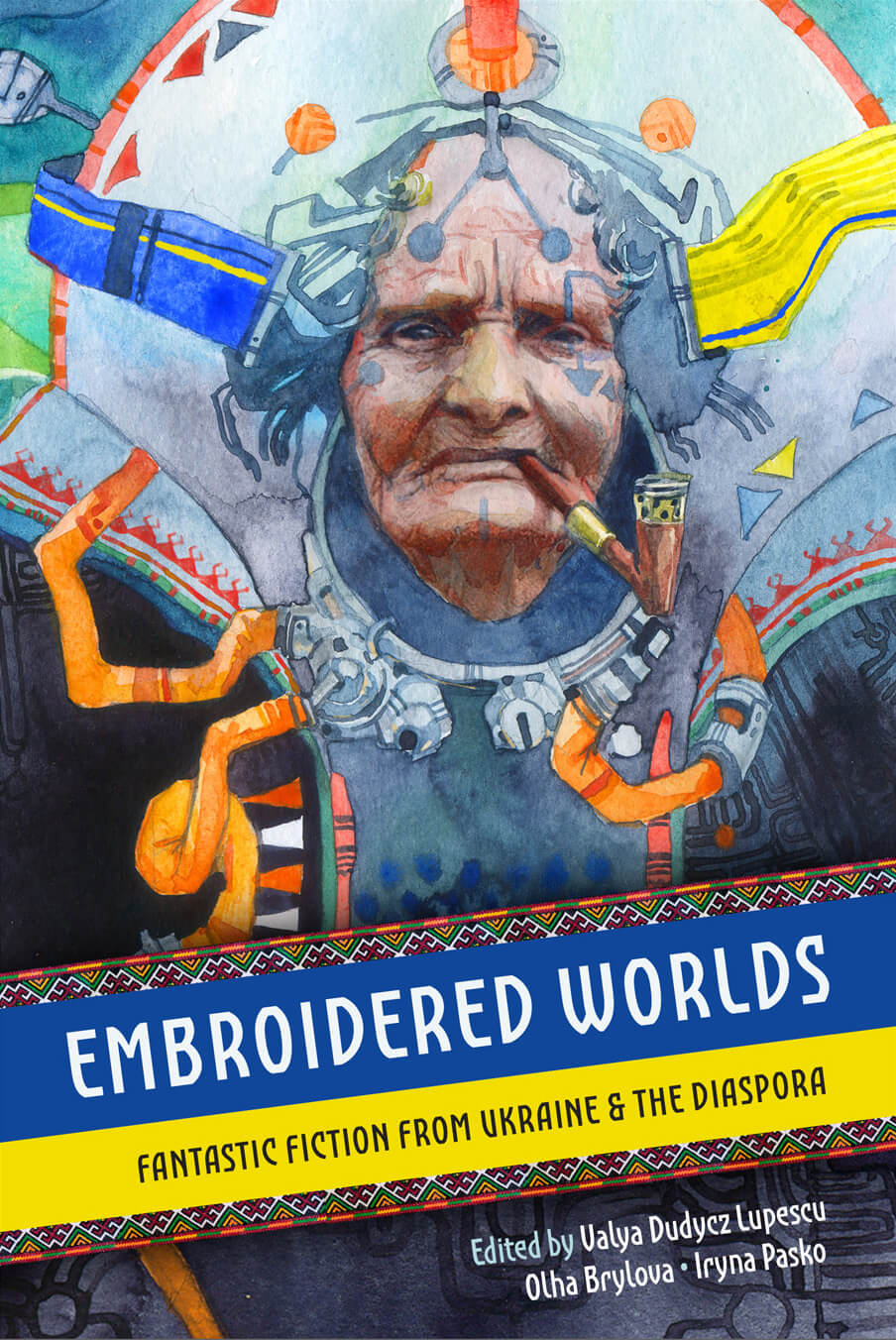
“Fantastic Fiction from Ukraine and the Diaspora”: what a brilliant anthology.
The only theme uniting this anthology is that the authors are from Ukraine, or part of its diaspora. That means that there’s a huge range of types of stories: those that are clearly rooted in folklore (even if I wasn’t familiar with the original); those that are ‘classically’ science fiction; some that are slipstream, some that slide into horror, and a few where the fantastical aspect was very subtle. Some of the stories are very much ABOUT Ukraine, as it is now and as it has been and how it might be; other stories, as you would expect, are not.
One of my favourite stories is “Big Nose and the Faun,” by Mykhailo Nazarenko, because I’m a total sucker for retellings of Roman history (Big Nose is the poet Ovid; it starts from the moment (based on the story in Plutarch, I think) of the death of Pan and just… well. The story does wonderful things with poetry and “civilisation” and nature, and I loved it.
I loved a lot of other stories here, too. There was only one story that I ended up skipping – which is pretty good for me, with such a long anthology – and that was because it was written in a style that I basically never enjoy (kind of Waiting for Godot, ish). RM Lemberg’s “Geddarien” was magic and intense and heartbreaking – set during the Holocaust, cities will sometimes dance, and for that they need musicians. Olha Brylova’s “Iron Goddess of Compassion” is set a few years in the future, and the gradual revelation of who the characters are and why they’re doing what they’re doing is some brilliant storytelling. “The Last of the Beads” by Halyna Lipatova is a story of revenge and desperation, with moments of heartbreak and others that I can only describe as “grim fascination”.
I’m enormously impressed by Attis Arts for the effort that’s gone into this – many of the stories are translated, which brings with it its own considerations and difficulties. This book is absolutely worth picking up. If you’re interested in fantasy and science fiction anthologies, this is one that you really need to read.
Multispecies Cities: Solarpunk Urban Futures
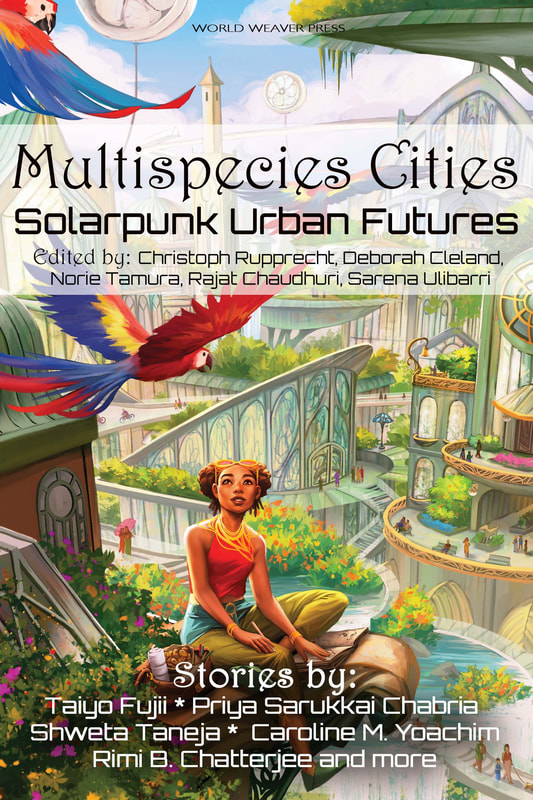
Yup, this one was also on special at World Weaver Press, so I grabbed it as well. I was completely intrigued by the idea of an urban focus for this sort of science fiction – that humans won’t have to abandon living in cities to survive the impacts of climate change, but they also don’t have to be the technological nightmarish warrens of Bladerunner etc. At the same time, they can’t be the same as they generally are now: where we restrict greenery to a few parks, loathe pigeons and rats as the carriers of disease, and so on. There are a few apartment buildings in my city that are starting to introduce the idea of green walls… that just needs to be taken much, much further. Which is part of what this anthology envisions.
As always, didn’t love every story, but as with Glass and Gardens there was no story that I thought was out of place. There’s a big variety in what the stories focus on – human stories that happen to intersect with animals, stories of the city itself, stories of animals and humans together. Where I said that previous anthology felt North-American heavy, this one has consciously set out to be different: there are, deliberately, a range of stories that explore the Asia-Pacific. I LOVE this.
There are a few stories where animals interact, in a deliberate way, with humans. Meyari McFarland’s “Old Man’s Sea” has orcas that have been modified for war, and how they might relate to the humans they now come across. Joel R Hunt has people whoa re able to jack into the minds of animals, in “In Two Minds,” and it’s about as horrific as you might imagine. “The Mammoth Steps” by Andrew Dana Hudson is along similar lines as Ray Nayler’s “The Tusks of Extinction,” with mammoths having been brought back and humans interacting with them… although Hudson’s version is a bit more hopeful. E.-H Nießler also has an orca-human interaction story, in “Crew;” he adds in a chatty octopus as well.
Shout out to Amen Chehelnabi and DK Mok, too: Aussies represent! Chehelnabi’s “Wandjina” is one of the grimmer stories, set basically in the middle of a bushfire, but manages to have hope in there too. Mok’s story “The Birdsong Fossil” is SO Australian, and also on the grimmer end, connecting visions of how science might be/is viewed with the de-extinction fascination; like Chehelnabi, it also ends hopefully, and is a fascinating way to conclude the entire anthology. (And Octavia Cade; NZ is totally Aussie-adjacent… plus her story “The Streams are Paved with Fish Traps” is brilliant.)
A really interesting, varied, anthology.
Glass and Gardens: Solarpunk Winters
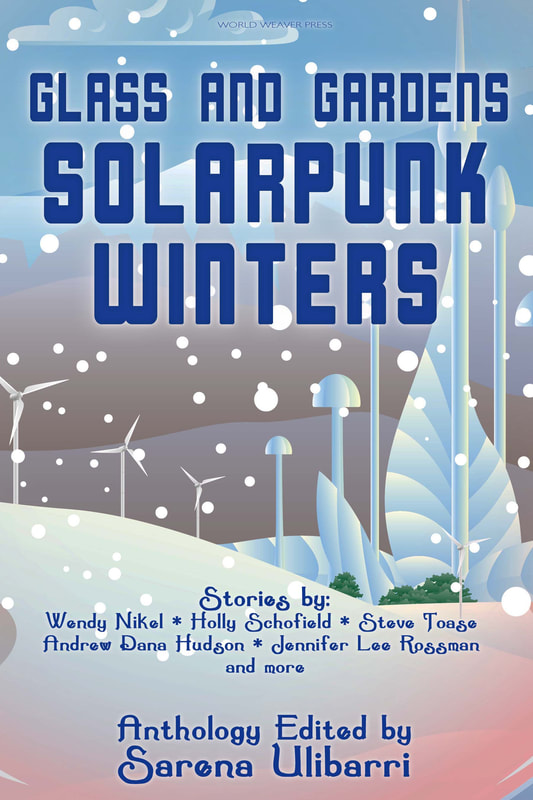
I’ve only recently come across the idea of ‘solarpunk’ – basically a hopeful take on humans living in a post-climate change world, as far as I can tell. I guess this is what ‘hopepunk’ also aims to be? maybe solarpunk is a bit more about the actual mechanics… I don’t know, I’m not going to claim the ability to set genre boundaries. ANYWAY, World Weaver Press has done a bunch of solarpunk anthologies, and a couple of them were on special the other day so I got them.
The first one I read was this, Glass and Gardens. Turns out I was in the right zone for some hopeful SF. As with all anthologies, I didn’t love every story – but also, there were no stories that left me wondering what the editor was thinking. They all fit the overall theme – how to be hopeful when winters have got more extreme or, in a couple of cases, the world has warmed so much that winter no longer happens, with equally disastrous consequences for the environment. It is heavily North American-focused, but honestly as an Australian this is just something I pretty much take for granted.
One thing I particularly liked was that while all of the stories were focused on humans, and what they are doing to live with/ mitigate/ work around climate change, there’s also a focus on how the climatic changes have affected the rest of the species on the planet. It’s s refreshing change and something that seems to be a trope within solarpunk from what I can tell – an acknowledgement that humans aren’t alone on the planet. So there’s Jennifer Lee Rossman’s “Oil and Ivory”, about narwhals and whether they’ll be able to travel underneath pack ice in the Arctic; bears and several other animals in “Set the Ice Free,” from Shel Graves; and several stories that have cities encouraging a lot more greenery and what could be called extreme eco-living compared to today.
An aspect that connects to the idea of hope is the prominence of art in these stories. Your dire post-apocalyptic world has no room for art and beauty. But Sandra Ulbrich Almazan has characters making clothes in a variety of ways in “A Shawl for Janice;” “On the Contrary, Yes” from Catherine F King is entirely focused on art and making art across multiple genres; Andrew Dana Hudson imagines ice-architecture as its own art form in “Black Ice City.”
This is a great anthology, and I look forward to reading more solarpunk.
Tomorrow’s Parties (anthology)
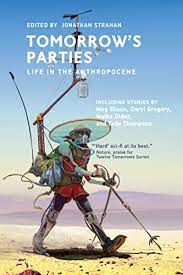
I really have to be in a particular frame of mind to read anthologies, which is why I read several in a row recently – including this one. It’s not that I thought I wouldn’t enjoy them – they’re Strahan anthologies, I’ve never not enjoyed one. It’s just a particular reading experience.
Anyway! Now I have read this awesome anthology and it was as stunning as I expected. As the subtitle suggests, the loose theme is “life in the Anthropocene”, and the authors largely took a similar-ish attitude towards what that means; there’s a lot of climate change-related stories, as is appropriate, and / but all of the authors took quite different approaches to what that might mean.
Every single one of these stories is amazing. I’m intrigued that Strahan chose to open the anthology with a conversation between James Bradley and Kim Stanley Robinson – it’s the sort of thing that I tend to expect at the end of the anthology – and maybe that’s part of the reason for it to be up front: to encourage readers to actually read it. It also sets up the climate change issues that are so front and centre through the rest of the book; the title is “It’s Science over Capitalism: Kim Stanley Robinson and the Imperative of Hope,” which itself speaks volumes.
The ten stories in this anthology are all exceptional.
Meg Elison, “Drone Pirates of Silicon Valley”: the future of online shopping and delivery, yes, but also rich vs poor, and the future of capitalism.
Tade Thompson, “Down and Out in Exile Park”: how communities might live differently, and how that challenges the status quo.
Daryl Gregory, “Once Upon a Future in the West”: multiple perspectives, and quite creepy at times. So many issues – the (negative) future of telehealth appointments, autonomous vehicles, bushfires…
Greg Egan, “Crisis Actors”: a very disturbing story that explores some of the consequences of living in a “post-truth society”. I always adore Egan’s short work.
Sarah Gailey, “When the Tide Rises”: another story that confronts capitalism head-on, bringing back the idea of the ‘company town’ as well as poking at the idea of companies making money from finally doing good for the planet. Brilliant.
Justina Robson, “I give you the moon”: one of my favourites, and not just because it’s one of the most hopeful of the stories. This is post-climate crisis, when humans have figured out how to live in more balance with the rest of the world (her vision is marvellous). Rather than focusing on how we get there, this story is about family dynamics, and ambition. It’s gentle and wonderful.
Chen Qiufan (trans. Emily Jin), “Do you have the Fungi sing?”: the consequences of a hyper-connected world, what happens if an area doesn’t want to participate – and possible alternatives.
Malka Older, “Legion”: completely and utterly different from all of the others, this is the story that’s going to stay with me the longest. Chilling, confronting, challenging… I had to stop reading when I finished this story and take a breath. It takes place over a short period of time – maybe an hour? – in the prep for, and during, an interview on a talk show. The host, Brayse, is interviewing a woman representing Legion, a group who have just won a Nobel Peace Prize. The reader is in Brayse’s head, which starts off as a reasonable experience and then gets… less so. Legion, as the name suggests, are not just one or a small group; they are everywhere, always watching through wearable cameras, and able to call out – or respond to – what they see: micro- and macro-aggressions, and all the ways in which some people are made to feel less comfortable right up to actual harm. Older nails the unfolding of this story perfectly.
Saad Z. Hossain, “The Ferryman”: another incisive take on the consequences of late-stage capitalism, this time how people will respond to death when, for the ‘haves’, death doesn’t need to exist.
James Bradley, “After the Storm”: being a child growing up in the ravages of climate change is likely to suck; at the same time, children do tend to be resilient and make their way within the world that they know. Bradley focuses on teenagers and their experiences – rather than the adults who know how things have changed – and captures the cruelty as well as the love of adolescents beautifully.
All in all, an excellent addition to the literature around ‘what next’.
Someone in Time (anthology)
I am late to the party… however, not SO late, because this just won the British Fantasy Award! Which it absolutely deserves.
I’m sure there are some readers who would avoid this because “they don’t read romance” (hi, I used to be one of those). The reality though is that you do; there’s almost no story – written or visual – that doesn’t include romance somewhere in its plot. What I have learned about myself is that I rarely enjoy what I think of as “straight romance” – that is, stories where the romance is the be-all of the plot; they just don’t work for me, as a rule. What I love, though, is when the romance is absolutely integral to the story and there’s a really fascinating plot around it. Every single one of these stories does that.
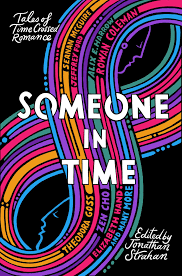
As the name suggests, this is set of stories involving romance and some sort of time travel. It’s a rich vein to mine, and every single one of these stories is completely different. Sometimes the time travelling is deliberate, sometimes not; sometimes the ending is happy, other times not; some are straight, some are queer; some pay little real heed to potentially disrupting the historical status quo; some have easy time travel while others do so accidentally; sometimes the time travel happens to save the world, and sometimes it’s about saving a single person. Sarah Gailey, Rowan Coleman, Margo Lanagan, Carrie Vaughn and Ellen Klages (a reprint) wrote my favourite stories.
And then there’s Catherynne M Valente’s piece. I did love every single story in this anthology; Valente’s story is breathtakingly different in its approach to both structure – eschewing linearity – and theme: the romance is between a human woman and the embodied space/time continuum. Hence the lack of linearity. It’s a poignant romance and sometimes painful romance; it also confronts the bitterness of dreams lost, the confusion of family relationships, the beauty of everyday life, and the ways in which even ordinary people don’t really live life in a straight line, given the ways our memories work (Proust, madeleines, etc). This is a story that will stay with me for a long, long time.
This All Come Back Now – anthology
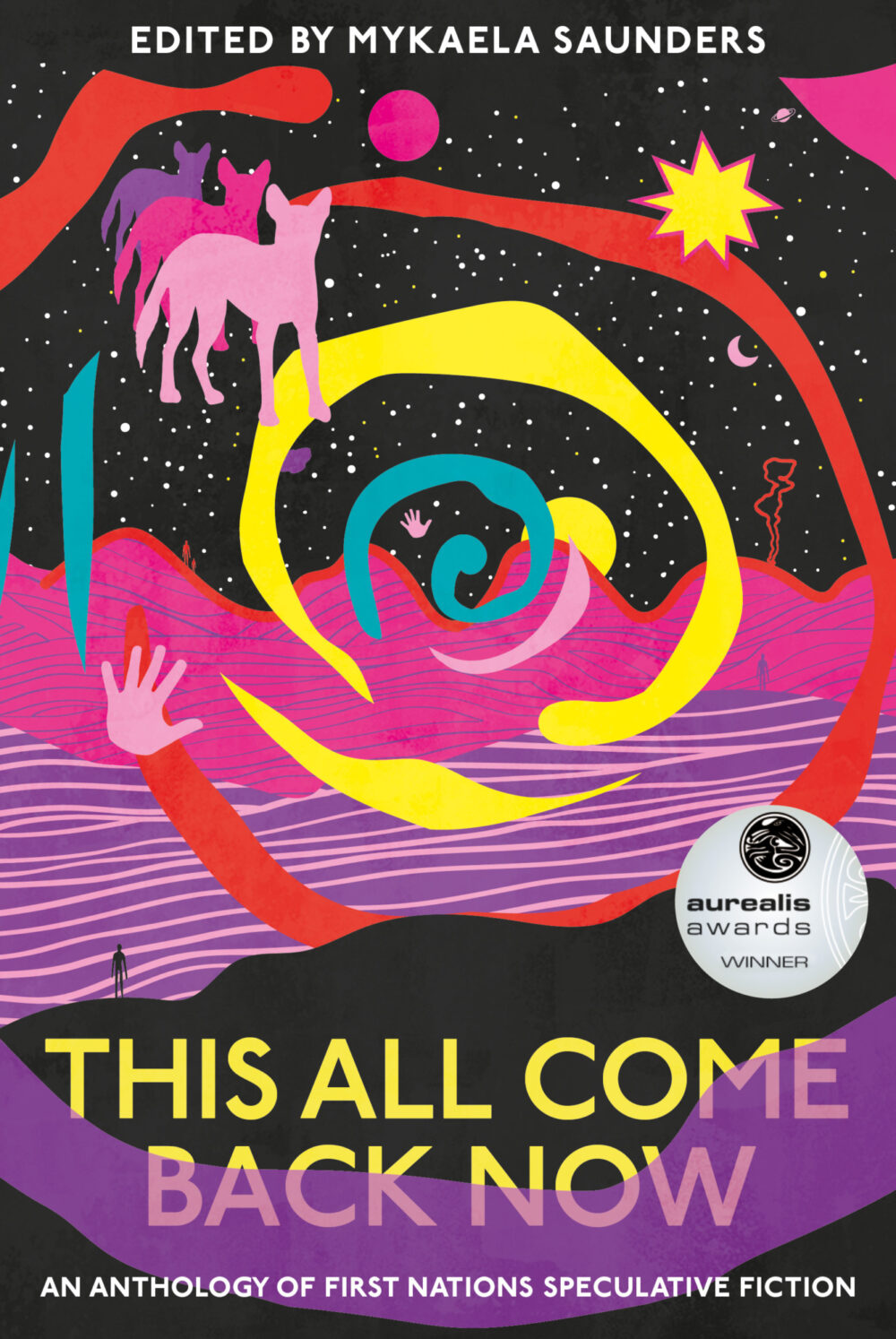
This came out last year, and I only found out about it this year… oops; not sure how I missed it (especially given its Aurealis Award!). Available from UQP.
The first all-Indigenous Australian speculative fiction anthology! Exciting that it exists; disappointing that it took until 2022 for it to exist. Oh, Australia.
First, how glorious is that cover? It’s so vibrant and exciting.
The editor, Saunders, gives a really interesting intro to the anthology. I go back and forth on whether I read intros to anthologies; sometimes they seem like placeholders, and sometimes they give a wonderful insight into the process. This is the latter (although I did skip the last few pages, where Saunders discussed the stories themselves; I don’t like reading that until after I’ve read the stories myself. YMMV). The comparison of an anthology with a mixtape has given me all sorts of things to think about. There’s also a brief discussion of First Nations’ speculative fiction – that it exists despite what a cursory overview of the Australian scene might tell you – as well as that insight into the creative process. This is one introduction that was definitely worth reading.
The stories themselves are hugely varied; this is not a themed anthology, like Space Raccoons, but instead is tied together by the identity of the authors. That means there’s experimental narratives and straightforward linear ones; recognisably gothic, science fiction, and fantasy stories; and other stories that refuse to fit neatly into categories. As with all such anthologies, I didn’t love every story; I have limited tolerance for surrealism, as a rule – it just doesn’t work for me, but I know it does for others. Some of these stories, though, will sit with me for a long time. Karen Wyld’s “Clatter Tongue,” John Morrissey’s “Five Minutes,” Ellen van Neerven’s “Water,” just as examples – they’re profound and glorious.
I love that this anthology exists. I’m torn between hoping there can be more books like this – because featuring Indigenous perspectives and writing in a concentrated way is awesome, showcasing the variety of stories and voices – and hoping that the authors featured here will also be published in other anthologies, and magazines, and have their novels published, as well. Maybe that’s not a binary. Maybe we can have both. That would be nice.
Year’s Best African Speculative Fiction (2021)
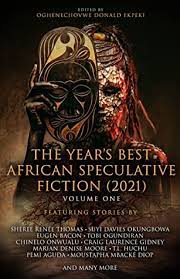
I read this courtesy of NetGalley.
As someone more au fait with anthologies than me pointed out, this anthology doesn’t have a introduction. So there’s no discussion of what speculative fiction is, let alone what African speculative fiction is. Which means that the answer to both of those questions is: These stories. All of them. These authors write that.
A few of these names – Sheree Renee Thomas, Tobias S Buckell – were familiar to me, but most were not. Part of this is that I don’t read a whole heap of short fiction these days, especially not the online magazines – it’s too hard – but it’s also partly about the speculative fiction scene that gets a lot of notice still being really white (I am not very wired into the whole scene these days anyway). Which makes an anthology like this excellent… because we’re a long way away from not needing such a thing, so don’t bring me the “but everyone’s work should be judged on merit” nonsense.
Anyway: the stories! This is a truly diverse set of fiction. There’s magic and there’s robots and there’s myths and there’s so-close-to-reality, and there’s horror (sometimes akin to the close-to-reality); there’s stories set in recognisable places and future places and past places and nowhere-places. Women and men and ungendered and who cares, families and not, hope and not,
I didn’t love every story, but I never do, with an anthology. And some of those were horror, which I pretty much always don’t enjoy. There was only one story that I got impatient with and skimmed over, which is a pretty good hit-rate in 360 pages.
This is great. I hope it’s the first in a long line of such volumes, as the cover page suggests.

 Randomly Yours, Alex