The Quiet Revolution of Caroline Herschel

I’ve read a bit about Caroline Herschel, often in the context of “here are women who did important things in science who don’t get enough recognition.” She was one of those women who helped a man get lots of science done – in her case, her brother William: she was his assistant for much of his observing life, writing down his observations and helping with his frankly unwieldy telescopes, as well as keeping house for him for many years until he married – and then his wife had money so they had more servants. All of those things are immensely important and often get overlooked; no one is able to do science on the scale of William Herschel, or Robert Boyle, or Charles Darwin, without an immense amount of assistance: usually either female, lower class, or both. Hence why that assistance is often overlooked, because the European narrative in particular is much happier with the ‘great man’ theory.
To leave Caroline’s story at that, though, is to do her an immense disservice. She was an astronomer in her own right, discovering eight comets (two of which she wasn’t the official discoverer, because someone else got there first, but she didn’t know about that when she found them). She also contributed observations to William’s immense catalogue of the ‘nebulous’ stars. In the late 1700s, most people assumed that that ‘cloudy’ or nebulous patches in the sky were simply stars that contemporary telescopes couldn’t resolve. William used the largest telescopes of the time to realise that actually, some of those areas actually couldn’t be resolved – they really did look cloudy – and suggested that maybe some of those areas were where stars were born. (He also discovered Uranus – the first planet to have been discovered by a human, rather than seen naked-eye, which is what shot him to fame.) Caroline personally observed and described some of the Herschel catalogue.
And then there’s the other scientific tasks she undertook, which might be easy to skim over because they don’t seem that sexy. She worked for years on a massive index and catalogue of stars, using the main one available in English: double checking for errors, making it systematic, and so on. Not glamorous, requiring hours of probably boring labour, required a great deal of knowledge – what an amazing contribution to astronomy.
Anyway, the biography: is not entirely what I was expecting! It focuses largely on a decade in the middle of Caroline’s life, her most scientifically productive – and a decade for which she destroyed her dairy entires and never discussed in either of the two memoirs she produced later in life. There’s a lot of speculation for why this might be; most people conclude that it’s because she wrote some bitchy stuff about her new sister-in-law and that this didn’t fit her self-image as meek, self-effacing, and doing everything for family. It’s a fascinating question and one that will almost certainly never be resolved. So Winterburn has used letters, information from journals, and references in other places to reconstruct those lost years, and in doing so to highlight just how phenomenal Caroline was as a scientist. While she wasn’t the first women to be paid to do science – lots of other women were doing ‘science’, it just wasn’t usually called that – she was the first English woman to have a royal pension for doing science, and that’s very damn impressive.
There are oddly repetitive bits throughout the book, where Winterburn repeats ideas or phrases that have just been laid out a paragraph or two earlier; and the book can’t solely concentrate on the one decade, because the reader needs greater context for Caroline’s life – so it’s not without flaws. There’s also a frankly odd emphasis on the events of the French Revolution; while it certainly had a huge impact on some of the people Caroline and her brother corresponded with, it didn’t actually seem to have a direct impact of Caroline, living in England – she wasn’t obviously a supporter of either Burke or Paine (anti or pro the revolution), so I was confused by how many ink was spent discussing those foreign events. Nevertheless, overall I really enjoyed this, and am immensely pleased to know more about Caroline. To the point where I’m considering the so-called Herschel 400 as an observing list.
The Glass Universe
This review first appeared in Crux, the magazine of the Astronomical Society of Victoria.
 Amazing things happened at the Harvard Observatory around the turn of the twentieth century. Draper provided funding for photography of stellar spectra, while Bruce gave $50,000 towards a new 24-inch astrophotographic telescope. Pickering found the first spectroscopic binary, and Maury found the second; Fleming classified stellar spectra and discovered novae. Cannon worked on variable stars and explored the relationship between spectral type and magnitude; Leavitt also worked on variables and proposed the period-luminosity relation. Ames and Payne were Harvard’s first graduate students in astronomy.
Anna Draper, that is. Catherine Bruce. Edward Pickering and Antonia Maury. Williamina Fleming. Annie Cannon and Henrietta Leavitt. Adelaide Ames and Cecelia Payne. As Dava Sobel makes beautifully clear in The Glass Universe, women were fundamental to the astronomical work and discoveries at Harvard Observatory in its early years. This is a book in love with astronomy and its history that wants to ensure everyone who contributed—not just the now-big names like Hubble—is recognised.
Sobel points out three groups of women who contributed to astronomy. She opens her book by demonstrating how women contributed financially to astronomical work. Anna Draper provided money and telescopes so that stellar spectra could be investigated at Harvard, and endowed the Henry Draper Medal. This was done in honour of her late husband, but also reflected her own interests: she had observed with Henry, and helped with the photography; part of their honeymoon involved shopping for a glass disk for a 28-inch telescope, which the pair then ground and polished over years to transform into a mirror. At 73, Catherine Bruce’s vague interest in the stars was encouraged by Edward Pickering and by her death in 1900 her gifts totalled $175,000 (over $4 million today). Other women endowed telescopes, awards, and scholarships.
The second group, appropriately taking up most of the book, are the individual researchers at the Observatory. Most of them started as computers: examining glass plates, calculating visible magnitudes, cataloguing spectra. Some of the women worked on this for decades. Some undertook further work as their curiosity was sparked by the spectra they investigated, or the magnitudes they calculated, or they noticed interesting relationships between period and luminosity. These women published papers, and contributed to the papers of other astronomers, especially Pickering and Harlow; some of them were awarded annual medals, although not many; some were honorary membership to societies such as the Royal Astronomical Society, while Cannon was the treasurer of the American Astronomical Society. The work these women undertook was thanks in no small part to the unusual willingness of Edward Pickering and Harlow Shapley (yes, that Shapley), directors at the Harvard Observatory between 1877 and 1952 (Solon Bailey had two years as interim director), to not only work with women but encourage their independent work and acknowledge them in publication. Their work is therefore also acknowledged and discussed, since it would be impossible to separate it from that of the computers in particular.
The third group of women consists of the wives and other family members of acknowledged astronomers. Solon Bailey’s wife, Ruth, contributed to his observatons for the Harvard station in Peru, while Pickering’s and Shapley’s wives played crucial roles at the Observatory in making the whole place work. The third director’s daughter, Anna, became a computer. They are the least well served by the book; it is presumably difficult to uncover contributions if they weren’t acknowledged at the time.
Dava Sobel has not only written a compelling history of Harvard Observatory, and not only conducted a remarkable survey of the contribution of women to astronomy, but has also written an intensely readable book. There’s some wonderful scientific discussions included, about Cepheid variables and their importance to figuring out the size of the universe and the like—but these do not dominate. If you are looking for a book about the history of astrophysics, this is not it and does not want to be it. No understanding of astrophysics is required to read it. Rather, this is a history of the people involved; it has a little about their relationships with one another, but it’s mostly about the work; it sounds like most of them put their work first anyway, so that’s appropriate. It demonstrates just how much computing power was required a century ago to understand the heavens—when that computing power could be jokingly measured in “girl hours”, and sometimes “kilo-girl hours”. The women who worked at the Harvard Observatory were a crucial part of the astronomical community.
Contact
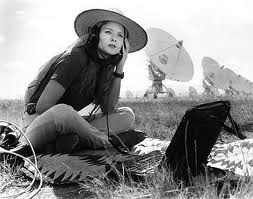 I watched Contact many years ago – possibly even at the cinema – and I read the book, too. I don’t remember the book very clearly, although I do remember thinking it was better than the film (what a surprise). I had fond memories of the movie, so when we decided to watch it again recently, I was a little apprehensive that the Suck Fairy might have visited.
I still really enjoyed it. The opening sequence is still simply marvellous; I utterly adore the perspective given to our Little Blue Dot, of course very appropriate given it was written by Sagan.
Jodie Foster… didn’t do much for me. To be honest I’ve never really understood the hype about her. I’ve never seen any of her early roles, to my knowledge, so maybe I just don’t have the context. But here – well, she’s good, but I certainly don’t see it as a role that no other actress could possibly fill. That said I do really like her character. I love how strong Ellie is, how determined she is to get her science done, that she listens to the radio waves herself rather than leaving it all to the computers. I also really appreciated that there’s really only one character who doesn’t take her seriously as a scientist, and that’s David Drumlin, whom I have called all sorts of rude names because of his treatment of her. His arrogance and sexism are aspects of his characters; they’re not meant to be taken seriously, as reflecting the sensible world. (Also, Tom Skerrit is brilliant.)
The rest of the cast is mostly good. I love William Fichtner: for his cameo in The West Wing as the judge who gets to be Glenn Close’s foil and plays with Toby’s mind, his bit part in The Dark Knight – he’s wonderful. And he’s great as Kent; the being blind is interesting and not over-played, and for me just seemed part of the diversity of characters. Yes, it’s played on to get the “ooh he has super hearing” thing, but it doesn’t feel overdone. David Morse is good in his cameo as Ellie’s dad… and then there’s Matthew McConaughey.
I like Palmer, McConaughey’s character, in theory. I really really like that the religious issue is a fundamental one in the movie, even though I don’t entirely agree with how it was handled; and even though I find it irritating that Palmer, as apparently the President’s go-to man on religion, ignores one of the big moral precepts of Christianity that helps set Christians apart from others in society (that whole no-sex-before-marriage thing). But I think he’s interesting, and I think he provides an interesting contrast to Ellie: for all he’s equally intent, he’s more relaxed than her, and they have some great discussions about evidence and faith. The Palmer character and his interactions with Ellie does, however, provide one of the things which most grieved me about the movie. He admits that he screwed up her chances to do the thing she most wants to do in the entire world not simply for religious reasons (which, actually, I liked – having to make the decision between your lover and your feelings of faithfulness towards the spiritual majority of the world), but for selfish reasons? Seriously? And our heroine still likes him? Pfft.
As a movie, I think it still holds up. The tech etc don’t feel like they’ve dated much, society doesn’t feel like it’s changed that much, and the look of it is still contemporary. Overall I was relieved, and pleased. Contact is still very watchable.
From one nerddom to another
Twas the night after Aussiecon4, and Melbourne turned on lovely clear skies. We got out the telescope, and I’ve written up some observational notes over at my astro blog. Includes showing off to some under-10s, and the rediscovery of Jupiter!

 Randomly Yours, Alex