The Brilliant Boy, Gideon Haigh
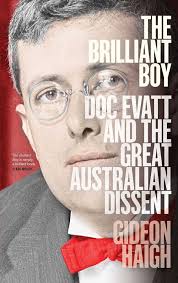
Doc Evatt and the Great Australian Dissent
Ok. So. Firstly, this is not the book I thought it was going to be. Partly that’s on me – I didn’t read the blurb carefully. So that’s a lesson. It’s also on the person who recommended it to me, because he led me to believe it was a proper – that is, complete – biography of Doc Evatt. And it’s not.
So, actually, possibly firstly: did you know that Gideon Haigh wrote full-on proper history, and not just cricket?? Me neither, until I was recommended this book.
Maybe this is first: until last year, I really didn’t read modern biographies, and I certainly didn’t read modern Australian biographies, let alone modern Australian political biographies. And now I’ve read two, arguably three, and I am having a minor (very, very minor) identity crisis.
All of that out of the way:
I know of Doc Evatt for having been instrumental in setting up the Universal Declaration of Human Rights, doing other important work at the UN, and then being shuffled off and ignored by the Labor Party and Australian politics more broadly. I had absolutely no idea about his early life, how he got into politics, or what he was like as a human – except that he’s generally regarded as “brilliant and/but mad.” This book is almost entirely about Evatt’s early life, focused on his career as a lawyer and then as an exceptionally young High Court judge.
Do I care much about the law, the legal profession, or even much about how the Constitution is interpreted? No I really do not. Were there bits – large chunks excerpted from lawyers’ speeches, and bits from judgements – where my eyes glazed over? What do you think. Did I nonetheless find this a fascinating biography? I am almost embarrassed to admit that I really did. And that’s partly because Haigh is a really great writer, and partly because of the actual point of the book. Yes, it’s about Evatt. But it’s also about the idea that someone should be recompensed for the suffering they experience – not just physical injury – when someone has done them wrong.
The book opens not with Evatt, but with the death of a young boy – “the brilliant boy” – a child of Polish Jewish migrants who drowned in water collected in a hole in a road thanks to roadworks, in the early 1930s. The council hadn’t put up much in the way of protection. The mother suffered enormously from what was then termed “nervous shock” in the months and years after his body was found. And that was the focus of many court cases. Were the council liable for the mother’s suffering?
Warning: there’s a lot of callous and misogynist language in the judgements handed down.
I did, indeed, learn a lot about Evatt. I have much greater respect for his intellect and achievements – as well as some appreciation for why he was and is regarded as a bit mad. There have been two full biographies written of the man, but they’re both quite old and I don’t feel like I can go read them now. Along with all of that, I also learned a great deal about the development of how pain and suffering are viewed in the law, and – knowing that our current system is very, very far from perfect – feel very thankful that I live now, rather than a century ago.
Fearless Beatrice Faust
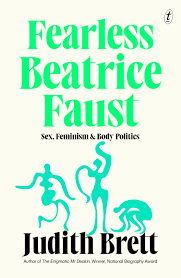
I very rarely read biographies of modern people. Faust only died in 2019, so that’s VERY modern by my standards. But I’ve been interested in how people approach modern biographies, for a project, and so this one was recommended. Having enjoyed Brett’s “From Compulsory Voting to Democracy Sausage,” I was fairly sure I’d enjoy her style, so this seemed like a good option.
Turns out, Faust was an amazing woman. Would I always have agreed with her? Oh no. Would I probably have found her abrasive to work with on a committee? Oh yes. Would I nonetheless have loved to be a neighbour, occasionally going over for coffee and hanging out? For sure.
Faust had a difficult upbringing: her mother dies from childbirth complications, her father is distant, her eventual stepmother unpleasant, and Faust herself is a sickly child (and continues to have multiple chronic conditions for most of her life, which are an enormously complicating factor for her). Yet she is clearly highly intelligent; she gets into Mac.Rob, the select-entry Melbourne girls’ school, and then Melbourne University to do an honours degree in Arts, and eventually an MA. Over her lifetime she writes many tens of thousands of words, and basically becomes a public intellectual – but not an academic, mostly because of misogyny.
Faust was extremely open about her life: her sexuality and sexual experiences, her abortions, her accidental addiction to benzos – all were fuel for public talks, articles, government submissions, and the many letters she wrote to friends.
She was also the founder of the Women’s Electoral Lobby, a key member of the Abortion Law Reform League, and various other women-focused campaigns. Her relationship with “women’s lib” and some aspects of feminism were fraught – she’s just that bit older than many of the agitators of the early 70s – and she definitely had some views that 1970s feminists had a problem with. In particular, some of the ways she talked about pronography, and – even more problematically – her apparent defence of some paedophiles were very troubling. Brett goes into these topics in great depth, sympathetic to Faust in that she tries to understand her views as well as possible, and present them fairly, but not so sympathetic that Faust gets a pass when she is saying unwholesome things.
Brett’s overall style is intriguing. She was approached by Faust’s friends, after she died, saying that she would be a good subject – and Brett said yes for many reasons, including the personal connection (living in Melbourne, some of the same haunts). Brett is not absent from the text, and I appreciated this aspect a lot. That’s not to say that Brett makes it all about her. I mean that Brett will mention when Faust’s reasoning is ambiguous, or when she got something wrong; and in dealing with some really hard topics – like her views on paedophilia – Brett wrestles with why Faust may have thought the way she did, and also calls her out for views that are pretty clearly inappropriate by today’s standards. Brett insightfully considers the question of whether Faust would be considered a TERF today, because she believed that biology was a significant part of a person’s identity; she concludes that it would be easy to say yes, but that Faust’s view is more nuanced than many TERFs, so perhaps not (Faust also didn’t seem to have a problem with a trans woman she spent some time with).
Beatrice Faust absolutely deserved to have a biography written about her. I’m glad Judith Brett was able to do so.
Into the Mainstream, by Tom O’Lincoln

This is not the book I thought it would be. Which isn’t the book’s fault, but does affect how I think about it.
I thought I was getting a … straightforward history of the Communist Party of Australia. And that’s certainly a significant part of this book. But what the book is ultimately focussed on is the way Communism, and Marxist ideas, has often been done badly in Australia. O’Lincoln is very upfront about the fact that he is very unimpressed by most of the leadership of the CPA, especially from the 1970s onwards. Of note: the book was published in this format in 2009 but was actually written in 1985, which itself definitely and necessarily has an impact.
The other problem is that the book presupposes quite a lot of knowledge – both philosophical and historical – that I don’t really have. Again, that’s partly a factor of it having been written 30 years ago, so the intended audience would have had more immediate knowledge of things that I just don’t. But there’s also no interest in defining “left” and “right”, assuming that the reader will have a shared understanding of what that means – and I have to tell you, reading about a Communist party veering to the right is always weird (yes, I do understand how that works). There’s no attempt here at leading the reader into understanding the various issues (like the difference between socialism and communism, and why you would regard liberal reformism as bad) – because the reader is assumed to already be on O’Lincoln’s wavelength. Again, not necessarily bad, but does suggest a very specific audience.
Worth reading? If you’re interested in the development of the CPA over time, probably yes. But prepare yourself for some pretty heavy philosophical lifting.
Black Convicts, Santilla Chingaipe
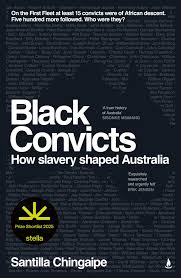
I came across this book because I heard Chingaipe at the Melbourne Writers’ Festival. She was personally compelling, and the story she told of learning about the Black convicts who came to the east coast of Australia over the first few decades of “white” settlement was intriguing. So I picked it up, and have finally got around to reading it. To be honest I was putting it off because I knew it was going to have some harrowing bits – and I was right – although I also expected it to be gripping, and rewarding. On those counts it was more than I expected, because Chingaipe is an excellent author.
Chingaipe is doing two things here. On the one hand, she is writing about the Black people who were brought, or in a couple of instances came under their own steam, to the country we now call Australia (which wasn’t a country during this period and wasn’t always known as Australia). Often she’s talking about people whose names have never been mentioned in histories before, which is amazing in its own right. Some of these people were part of the standard “convict comes to Australia” story that tends to be discussed – do some minor crime in England, get sent to the colony for 7 or 14 years, live life here after. Many of the others, though, did their “crime” (a category explored extensively) in one of Britain’s other colonies – various sites in the Caribbean, or Mauritius, for instance – who then got shipped to England and then to these shores. Which I had no idea about.
On the other hand, she is also exploring the links between slavery, its systems and language and attitudes, and the convict system. What she points out are some things that I had previously considered, especially with the language, but a whole bunch of things that I was completely unaware of. She makes a compelling case for the convict system in Australia owing a great deal to the structures developed for and around slavery in North Americas and the Caribbean by the British. Which shouldn’t be that much of a surprise, when it’s laid out… but that’s often the way with a history like this.
One of the things that I really enjoyed about Chingaipe’s style is her presence within the book. I have noticed this happening more frequently in history books, especially with very deliberately and self-consciously political books: a refusal to pretend that the historian is objective, or even absent from the story they’re telling. So we get the story of Chingaipe visiting Hobart and Barbados, Zooming with historians around the world, her own emotional reaction to various stories. Far from detracting from the history, as would have been suggested decades ago (and probably still is by some today), this highlights the importance of the topic being discussed, and the fact that history is not/never is “past.”
I really think that anyone interested in Australian history, and probably also African diaspora history, would benefit from reading this.
Incorrigible Optimist: Gareth Evans’ Political Memoir
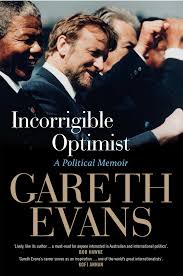
Look. I’m a history teacher, and a cynic. I understand the point of a political memoir. So on the one hand, reading this was amusing because for all the self-deprecating humour and the admission of bad decisions and poor choices, it’s still an exercise in ego to write memoir.
And on the other hand: I just want more politicians to be like this. To be passionate about things that will actually make a positive difference. To be self-aware. To be willing to make hard, necessary decisions. I was a child of the 80s and 90s – at the back of my mind, “the Australian government” is Bob Hawke and Paul Keating and, yes, Gareth Evans.
I don’t read modern biographies, as a rule, and I really don’t read autobiographies. They hold zero fascination for me. I can probably remember every 20th century biography I’ve read: the Dirk Bogarde one my mother gave me (I went through a serious Bogarde phase), and Julie Phillips’ Alice Sheldon/James Tiptree Jr one; ones about Vida Goldstein and Emmeline Pankhurst; and one about Alexander Kerensky. Oh and Gertrude Bell! That’s literally the list – and given the number I’ve read about people who died before 1800 (and it’s only that late because of the French Revolution – oh Danton, you’ll always live in my heart), six is nothing. But now we can add this to the list, which I read for Reasons that may eventually become clear (not in this review).
This is, of course, not really an autobiography. It’s a political memoir – I think Evan mentions his wife twice? maybe doesn’t mention his kids at all? – so there’s no discussion, really, of anything outside of what has shaped his attitude to policies and ideas. It’s also not just focused on himself acting, but also on his ideas. There is an entire section where he’s outlining the pillars of the “responsibility to protect” concept that I had no idea about, but which he was fundamental in drawing up for the international community; sections where he talks about how universities (and especially chancellors) should function, why nuclear weapons should be utterly eliminated, the importance of international cooperation… this is not just a memoir: it’s a manifesto. Honestly, it’s a bit swoon-worthy.
Realise when this was published, though, and it feels like a dream of a half-forgotten world. Because it was mid-2017. Trump was just elected for the first time; Brexit was relatively new. Dreadful things had happened in Syria and Libya, and Russia was making its first forays around Ukraine. Scotty wasn’t even being joked about as PM. So when Evans discusses his hope that Trump might eventually “submit to adult supervision;” when he talks about his hope that “responsibility to protect” might be a real factor in international discussions when populations are at risk of war crimes and genocide… well. There’s a part of me that wishes I could go back to that time, and live it again, knowing how good it was.
This book probably doesn’t have that much appeal beyond Australia’s borders – unless you want to just read it for the foreign policy aspect, and for Evans’ involvement with Crisis Group and various UN and regional Asian events, all of which are quite fascinating. But if you’re like me – with a vague interest in Australian and international politics, and especially with a memory of those Labor glory days – this may well be of interest.
Making Australian History: Anna Clark
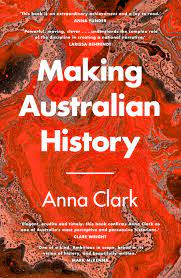
Not a review book! One that I saw in the delightful bookshop in Queenscliff and barely even stopped as I walked past, grabbed it, and paid for it.
(Who am I, reading historiography about Australian history? Australian history? My how I have changed.)
Sometimes I forget how much I love historiography. And I really, truly love it. A history of history writing/making itself? How much more meta can you get?? And Clark writes just so beautifully. This entire book is a delight.
Clark aims to present a history of how Australian History (the capital H is discussed very frankly and thoughtfully) has been written over… a very long period of time; and also how the writing of Australian History has helped to construct that history. Clark is under no illusions about the reality that History writing is part of the colonial project, and I think one of the great ongoing themes here is how Clark starts to unravel, deconstruct, illuminate, and reflect on that very process.
(Do the adjectives give a sense of how much I enjoyed this book?)
Another of the great aspects of this book for me is that it’s not entirely chronological – something else that she discusses frankly in the introduction. Chapters are thematic, and vaguely chronological, and also generally chronological within the chapter; but chronology is not the be-all of history writing, important as it is. I deeply enjoyed that there were chapters on ’emotion’ and ‘gender’ that ranged across time, to show how those things have affected history writing at various points.
Each chapter has a focal text, one that Clark uses as an instrumental text (in a broad sense) to get at a particular idea. Which is precisely something that I’ve done in the classroom, and it works really beautifully in the book to draw out and illustrate particular ideas. It’s a really great way of managing the flow of the chapters.
… it’s just really great. I think it serves as a good, thoughtful introduction to how Australian History has been written, thought about, and itself produced the Australia we live in today. Clark uses the ‘whispers’ and alternate texts and sometimes things that haven’t always been considered as history to give a sense of just what can be meant by ‘Australian history’. You don’t need an in-depth knowledge of history, or historical theory, to enjoy this – although you do need to be prepared to really think about the ideas being presented.
Friends and Rivals

My mum picks such interesting books for me! I hadn’t heard of this before it arrived for my birthday; I had heard of Turner and Richardson but knew nothing about them – I’ve never read anything by any of these women.
Before talking about the great things, there were two things that disappointed me deeply about this book, and they’re both factual errors that really don’t have a connection to the histories themselves but are nonetheless troubling. I can only hope they’re both editorial mistakes. One: in speaking of the English suffragette movement, Niall mentions “Adela Pankhurst and her daughters”. This should be Emmeline – Adela is one of the daughters. Adela was the one who ended up in Australia, so I guess this is an understandable mistake. However, in speaking of Australian suffrage, Niall gives 1908 as the year in which (white, which is also not stressed) Australian women gained the right to vote; it was actually 1902. Like I said, superficially small errors, but pretty significant for the history suffrage.
The book is set up as biographies – primarily literary biographies – of the four women. As individuals their lives are all quite fascinating: Baynton is probably my favourite, although the one I would be least likely to befriend; for instance, she was annoyed at her third husband for refusing the crown of Albania (there’s a whole story about why taking it would have been a dreadful idea). All four of them dealt with a variety of hardships – some particular to their era, the late 19th and early 20th centuries, while others are all too familiar (family hardship, women ignored, the difficulty of being paid as a writer…). Niall writes engagingly and seems to have done spectacular archival research to dig up letters and diaries to get into the mindsets of these very different women.
Turner wanted to be taken seriously as a writer; Seven Little Australians was a money-making machine and she ended up being pigeonholed as a children’s writer (so familiar for too many women). I’d never realised that this book has an urban setting and just how remarkable this was for its time, when Australia was so much about the bush, thank you Banjo and Henry (whom Turner knew). Conversely, Baynton wrote about the bush – but in almost vicious terms; the one story I really want to read was throwing Henry Lawson’s story “The Drover’s Wife” under a bus. Henry Handel Richardson was considered for a Nobel Prize, and also wrote urban stories – and wasn’t especially interested in being considered a particularly “Australian” author, which was intriguing for the time. And Palmer was, for her time, a leading critic and champion of Australian authors – not a leading female critic, but leading critic, period.
My mum knows me well: this books fits within Joanna Russ’ campaign for women to know their literary ancestry – to remember that there have been women writing before them, that we do have a history to be proud of. Australian literature’s history isn’t all bush ballads, or the agony of Patrick White. It’s also the story of girls at private schools, kids in crappy inner-city suburbs, and epic ‘European’ novels. These writers need to be reclaimed as an important part of our heritage.
Talkin’ Up to the White Woman

As with Living on Stolen Land, I don’t want to be the white woman talking about and appropriating an Indigenous woman’s words. So if you’ve been thinking about reading this book, do it! This review is intended to prod people into doing so, and in no way is a substitute for Moreton-Robinson’s own words.
I saw Aileen Moreton-Robinson at the Broadside feminist festival last year and she was intriguing. On the panel I saw, about women of colour and how they approach feminism, she was the oldest by perhaps a decade or more, and she seemed to get quite impatient by what some of the panellists were saying – and how they were saying it; she told them (in a poor paraphrase) that feminism is a white woman’s thing and they, not being white, needed to think differently – and maybe white feminism wasn’t actually what they needed. That’s a very poor paraphrase, actually, but I think it gets some of the sense of what she said – and for me, as a white feminist in the audience, it was eye-opening and kind of stunning. I am in a weird halfway place I think between second and third wave feminism; I don’t think I think that all women are sisters and experience oppression in the same way, but I’ve definitely had to work on fully manifesting intersectionality in the way that I think and act. The panellists too were intrigued by how Moreton-Robinson spoke; at one point someone (only half-jokingly) suggested the panel should be the rest of them asking Moreton-Robinson questions.
The other thing that really stuck in my mind was the fact that this book was published in 2000, and Moreton-Robinson had never before been asked to speak at a conference in Australia about it. Never. Nineteen years of a book that was the first Indigenous Australian interrogation of feminism… and conferences have ignored it, and her. That’s a disgrace. There is, at least, a 20th anniversary edition out this year, and Moreton-Robinson seems to have been on some programmes (ABC Radio, The Drum), so that’s a bit of an improvement?
So, the book. It took me quite a long time to read, partly because this year I have been struggling to read new stuff – which I think is the case for many people – and partly because it’s been a while since I read any theory; it’s not every chapter, but several deal with anthropological theory and feminist theory so I knew I needed to read it slowly to actually absorb what was being said. Rushing through would have been a disservice to the book, and I wouldn’t have really appreciated everything being discussed.
Throughout the book Moreton-Robinson talks about “the subject position middle-class white woman” which I found challenging, in some ways – because as she points out, women like that/women like me are indeed accustomed to being the default. And even when I am aware that I am those things, constantly having it pointed out (like Indigenous women, like African-American women, like… etc usually experience) is a novel experience. And an important one. And is one of the core points of the entire book: feminism – especially as it was in the late 1990s, in some corners I think it may have changed a bit in the last two decades – has been developed by white women with themselves at the centre, and while we’re busy interrogating various positions of power etc we forget to think about how, even in our gender oppression we massively benefit from (and help to support) racial oppression.
Moreton-Robinson begins my talking about how Indigenous women have presented themselves in their life-writings, pointing out the differences in those experiences compared to middle-class white women. She then tackles a massive job in looking at how various feminists have theorised ‘difference’ and ‘race’ over time and in different places – mostly white feminists, since they have been the most significant for Australian ways of thinking. And along with a whole bunch of interesting things here the main take-away for me is that white feminists haven’t considered that they are white; that they (we) have race/colour/ethnic position. And then the third chapter was perhaps the most gut-punch, from a historical point of view: she gives an overview of how white feminist anthropologists have talked about “Indigenous women” and all the ways that has been part of the colonising process, which chapter 4 also continues to interrogate.
All of the preceding stuff is incredibly important and could have stood by itself. What Moreton-Robinson then does in chapter 5 is present interviews with white feminist academics (ask me how hard it’s been to remember to put ‘white’ at the start of each nominal group… hello privilege), about how those academics think about race and present it in their courses and interact with people from different ethnic backgrounds. And this was illuminating and also for me challenging: who do I interact with and why, how do I present an anti-racist stance in my teaching and also live it in the world, and so on.
Finally, the last chapter presents a history of how Indigenous women (up to 2000, which I think is important to remember, since more will have been done and said since then) have challenged white women and their intentions and words. Which was its own version of challenging mostly because of how white women have responded to being challenged (often, badly).
This book won’t be for everyone; I know that reading theory isn’t going to be appealing for many. But the ideas and challenges that Moreton-Robinson present are vital for us middle-class white women to hear and acknowledge. If you ever get a chance to hear her, please do so. If you think you can cope with some theory, please get hold of this book and read it.
Living on Stolen Land

This book was sent to me to review by Magabala Books. It comes out in July – so very timely – and will be $22.99.
I am an Anglo Australian. My most recent migrant ancestor is maybe 4 or 5 generations back. I am a history teacher. And I live on stolen land. I benefit every day from the fact that indirectly each of my ancestors (and directly, in a couple of cases) contributed to the displacement of Indigenous Australians.
Ambelin Kwaymullina has produced what the media release calls a “prose-style manifesto”, and what I would describe as a free-verse lesson about the past and the present and the future. She’s also responsible for that gorgeous cover and the internal images that help make this a lovely object as well as a powerful text.
Kwaymullina covers so much stuff that I want everyone to experience that I’m tempted to re-hash everything she says… which would be, as she herself points out, a white woman re-interpreting an Indigenous woman and that’s exactly the sort of thing that really needs not to exist. (I’m also currently reading Aileen Moreton Robinson’s Talkin’ Up to the White Woman, so… yeh.) So let me say that she makes it very clear – in case there was any doubt in the reader’s mind – about the original ownership of this land we call Australia; about the ongoing problems of the way we settlers talk about the land and its original inhabitants; and also points ways forwards as to how all of the people now living here might actually make it work. For everyone. As the blurb says, this is a “beautifully articulated declaration… a must-read for anyone interested in decolonising Australia.”
There are two bits that particularly got to me. Firstly, as a history teacher, Kwaymullina’s discussion of time is breath-taking (pp12-14): her description of linear time, where “Things that happened / a hundred years ago / are further away / than things that happened yesterday” – and is “weaponised against Indigenous peoples” and gives “the illusion of progress / regardless of whether / anything has changed”. And it’s that last bit that took my breath away. Then she speaks of Indigenous systems where “time is not linear” – cycles, instead, and “as susceptible / to action and interaction / as any other life”. And then she points out that cyclical time is a gift and a responsibility because “The change has not been lost / for justice / for change” and I nearly cried. I have never thought of time like that and never realised that it was even possible that life could work like that.
Secondly, Kwaymullina has a very pointed section about “Behaviours” from Settlers, and the four different ways we might act. Those who speak well and do nothing, the Saviours, the ‘discoverers’ (appropriating Indigenous stuff for their own life… and the change-makers. And this section made me really think about the ways that I act, and have acted, and intend to act.
Look. This book is 64 pages of free verse that will gently and pointedly make you think about yourself and and your ways of thinking and your understanding of history and the possibilities of the future. I will read this book again and again, I will read it to my students, I will share it with other people, I will tell other people to read it. Every household should have a copy of this and I don’t use the word ‘should’ lightly.
The Forgotten Rebels of Eureka
 Well I’m only about six years behind on this.
It’s a truth universally acknowledged that I don’t much care for Australian history. Except for the women’s suffrage bit. There are lots of reasons for this and some of them are the same ones everyone else trots out and some of them are idiosyncratic (I really like my history to be properly old, and I like the textual/ architectural etc remains, which is problematic for Indigenous history).
Anyway. I loved You Daughters of Freedom and back when we were still able to congregate with others (ah, the good old days), I went to hear Clare Wright speak about it. I took my copy of Daughters to get signed… and then while I was there I thought I should get this, and also get it signed (which meant lining up a second time which she thought was very funny). This is partly because I was feeling a bit giddy-fan-girl, and partly because she described it as her ‘democracy trilogy’ – the third to be about the Yirrkala bark petitions, I believe, which I will absolutely be buying and reading. I also figured that while I’m fairly indifferent towards the whole Eureka myth and the way it figures in Australian history, I could trust that Wright wouldn’t give me a rah-rah-tattoo-the-Southern-Cross-on-your-chest story.
Wright does a marvellous job of peopling the gold rush fields of Ballarat with real people – men and women and children, from many different places around the world. This is the real key to her work. She points out just how masculine the story has been, and the take-away myths that have grown up around it; and then she debunks those myths by not only pointing out that women were there, but by pointing up how significant the contribution of women was.
Women as publicans. Women holding gold licences. Women running shops. Women running the newspaper, and writing copy for it. Women running a theatre. Women holding together their families. Women being expected by the government to make the place more civilised. The lack of Chinese women being used as an excuse to be racist shits. Women giving birth (including in the middle of the storming of the Stockade!) and women dying. Women as reasons for men to try and make more money, to look after the families – and to stop the woman from being the one supporting the family. Lady Hotham being appealed to, to intervene with her husband, the ruler of the colony. They were there. And important. And ultimately shoved back into old gender roles, for the most part, when the gold fields got more mechanised and Ballarat organised itself as more of a regular town and when the franchise got extended to more men, but no women.
One of the things I liked about Daughters is that it recognised that Indigenous women were excluded from the achievements of 1902 (although Ruby Hamad has words to say about how this is discussed and to what extent, in White Tears Brown Scars). The Wathaurung people appear occasionally in this story: reminders that they had been finding gold in the area for centuries, and that some of them engaged in commerce and relationships with Europeans, and so on; but overall not that much. It seems that Wright had to do immense digging (heh) in the archives to find the information about the white women that she uses in the book; that there would be far less archival information about Indigenous people and their interactions with each other or Europeans doesn’t surprise me at all. Sadly. Could Wright have done better? Maybe. Would it have made the project even bigger? Absolutely. Was it the point of the book? No. If someone hasn’t tried to do a really in-depth look at the Indigenous experience of the Victorian goldfields, that should absolutely happen.
I have a much greater appreciation for what life was like on the goldfields (pretty shit), the political situation with both Hotham back in Melbourne and the local authorities (also pretty shit, for a variety of reasons), and some of what led the miners to actually create what we know as “the Eureka Stockade” (pretty haphazard, not really intended to be a Great Last Stand Bastion), and of course the place of women in all of this. The entire situation really does deserve a place in discussions about the development of Australia as a democracy, as a social liberal experiment, and in how Australia developed its identity (exclusion of the Chinese, other variations on racism, how people spoke of themselves in relation to Britain, etc etc). Which is something I never thought I would say.
(My enthusiasm has one caveat. There’s this weird bit where she talks about women’s menstrual cycles synchronising, and something something hormones affecting a situation, and… it’s just odd. It doesn’t fit with the rest of her style, and the synchronising almost certainly isn’t true, and… yeh. I was a bit thrown.)
Even if you think you don’t like Australian history – if you like history, and the reclaiming of forgotten groups, this is definitely one to read.

 Randomly Yours, Alex