The Secret Feminist Cabal – now with extra awards
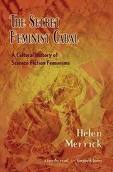
Since I wrote this review last year, The Secret Feminist Cabal has placed on the Honour List of the James Tiptree Jr Award, and I received a Chronos Award (voted on by the Victorian SF community) for the review itself. Allow me this gratuitous moment of reposting! The other exciting thing that has happened since is that I got to spend time with Helen Merrick herself – an utter delight.
The Secret Feminist Cabal: A Cultural History of Science Fiction Feminisms
Helen Merrick
Aqueduct Press, 2009
“… what kind of self-respecting cabal would openly advertise its ‘secret’ existence through websites and conventions, identify its members through the wearing of garish temporary tattoos, and fund itself by the sale of home-baked chocolate chip cookies?” (p1)
I did not grow up considering myself a feminist; I have no idea whether my mother would identify as a feminist or not. That said, I grew up in the ’80s with a younger brother and there was never a time at which I felt that I could not do exactly the same things as my brother, if I wanted to, so I know (now) that I benefited from second-wave feminism – and from liberal, caring parents. I was regarded as a feminist by at least some people by the time I was in my late teens (looking at you, high school teachers), probably because I was loud and everyone loves a stereotype. It’s only been over the last decade (my twenties) that I have consciously thought of myself as a feminist. And it’s only been in the last couple of years that I have consciously sought out feminist books, feminist perspectives on historical issues, and really come to grips with the idea that feminism is not a singularity.
All of this is by way of contextualising my reading of The Secret Feminist Cabal, a marvellous book that has challenged the way I think about science fiction, fandom, and feminism. Merrick had me from her Preface, where she describes her journey towards writing the book in ways that resonated deeply with me, from the nerdy adolescent to the discovery of feminism and the dismay that many female acquaintances not only do not share our love of science fiction, they are completely mystified by it. Having only recently discovered the niche community that is sf fandom, the fact that so much of this book is concerned with expressions of feminism within that community – and how they impacted on sf broadly – was the icing on the cake.
Merrick begins by examining the very idea ‘feminist sf’, defining which – much like attempting to define sf by itself – is like the proverbial attempt by blind women at describing an elephant. She approaches it by discussing the multiplicities that are the reality of the genre, which is indicative of the approach she takes in the book overall and an incredible relief for those of us who are sick of being told THIS IS THIS and if you don’t fit, get lost. She also gives some space to justifying the use of literary criticism on science fiction, tackling that persistent and derogatory argument that science fiction doesn’t count as literature. While accepting that sf and popular fiction generally have an ambivalent position, as far as literary critics – including feminists – are concerned, Merrick makes no apology for using their tools. The rest of the introduction lays the groundwork for the book: what feminist fiction is or can be, the potentially problematic nature of feminist genre writing, and the ongoing divide that exists between mainstream criticism and feminist sf criticism. I particularly enjoyed that while Merrick engaged with these issues, at no point does her discussion become a polemic against those who have disagreed. Rather, she situates her investigation within the ‘grand conversation’ of feminist sf, and demonstrates constructive ways in which that can be extended to mainstream criticism – to the advantage of both.
I was forced to stare into space for some minutes when I read the opening to chapter 2. Merrick quotes from a letter written in 1938 wherein an sf reader opines that: “[a] woman’s place is not in anything scientific. Of course the odd female now and then invents something useful in the way that every now and then amongst the millions of black crows a white one is found” (p34). If nothing else, this book has made me grateful for the changes that have occurred over the last century, such that I have never been personally confronted with such a statement. This chapter provides an overview of the ‘invasion’ of women, sex, and feminism into sf, with a fascinating if horrifying look at the arguments of the 1920s and 30s for and against women being allowed into the genre. (She makes the point that of course women were already there, both as authors and readers, and that it’s hugely problematic when those foremothers are written out of history, as happens too often.) The 1960s and 70s saw some changes to the field, and the disputes that attended this period of ‘sexual revolution’ make for fascinating – if, again, horrifying – reading. My favourite section is that on Joanna Russ writing letters and criticism and the way such respected names as Philip K. Dick and Poul Anderson responded to her and her comments. I love the fact that what now generally appears on blogs as a long and convoluted comment-thread then featured in magazines, albeit at the mercy of the editor. This chapter alone is worth its weight in cookies for outlining the milieu in which both male and female sf writers and fans existed for so much of the twentieth century – an invaluable resource for a newbie like myself.
The third chapter takes up one strand mentioned in the second and runs with it: the idea of ‘femmefans’. The fact that female fans were distinguished by a separate moniker goes some way to revealing how they were regarded, at least by some males of the community. It’s almost heartbreaking to read of the letters written to pulps such as Amazing Stories by women who imagine themselves as the only female readers of such stories – another reason I love the future that is blogdom. What I particularly love about this chapter is its uncovering of specific women involved with sf fandom, in many and varied ways. Instead of making generalisations about readers and contributors to zines, Merrick goes out of her way to trace named individuals and outline their experience within the scene. Appropriately, there is a section on Australian women, who seem to be even more hidden from view than their American or British sisters.
The development of specifically feminist criticism of sf is discussed in chapter 4, with a fair amount of space given to Joanna Russ, as one of the progenitrices of formal feminist criticism and the name to which many others felt themselves to be responding. Merrick chronicles the rise of feminist fanzines in the 1970s, and the impact these had on writers and fans, as well as the increasing numbers of feminist anthologies being produced. The chapter moves through to the 1980s and ’90s, noting trends and struggles as feminists of those times attempted to define themselves as well as understand their histories. As with the previous chapter, Merrick provides copious accounts of individuals here, and an extensive reading list of both criticism and fiction.
Bouncing back to fandom, chapter 5 examines the development of feminist fandom concurrent with the development of feminist criticism of chapter 4. Again going for the intensely personal stories to illustrate a broad, diverse narrative, Merrick weaves a story of female fans and their involvement in the fannish community from the 1960s to the 2000s. The feminist fanzines sound like an amazing community to have been involved in. Her discussion of the place of Marion Zimmer Bradley in this community – beginning as a fan, becoming a well-known writer, and causing all sorts of controversy over her (at least early) non-identification as a feminist – is enthralling, and beautifully illustrates the axiom that the personal is always already political. The chapter ends with a discussion of how WisCon (a feminist sf convention) and the Tiptree Awards were established.
The last two chapters of Cabal “examine how recognition of the cultural work of sf feminisms filters out into other critical communities,” and as a consequence have a heavier, more literary-critical, feel, which may make them more opaque to some readers than the first five chapters. Chapter 6 deals with sf feminim’s response to cyberpunk, a 1980s sf movement that some saw as eclipsing or superseding the feminist sf fiction of the 1970s. Merrick connects this with theorist Donna Haraway’s call for feminists to consider the cyborg as a way of considering the fundamental issue of what it means to be human. The movement also connects with a growing sub-genre of cultural studies, that examining techno-science and cyberculture. A feminist take on these issues is an intriguing one, especially in its observation that much cyberpunk is opposed to the material, the body – and how problematic that can be.
Interestingly, Merrick takes her discussion in what feels like quite a different, although still relevant, direction for her last chapter: the connection of feminist sf with science itself, and how feminism is and can be in dialogue with that discipline. She suggests very strongly that sf feminisms can and should play a vital role in dialogues negotiating the interplay of science, nature, and culture, and gives examples of a number of ways in which this has already occurred productively.
Finally, Merrick has a provocative conclusion. She addresses new challenges such as those posed by queer theory and postcolonialism, and where or how feminism might still fit in. Along with a consideration, appropriately enough, of what the Tiptree Award has taught us since its inception, Merrick considers the question of whether the science fiction field is ‘beyond’ questions of gender. She argues that feminism – as long as it remains the challenging and diverse field it has been until now – still has a great deal to offer science fiction writers and readers.
A critical work based in a deep-seated love of the genre, Cabal is a testament to the enduring impact of women, feminism, and fandom on the fractured behemoth that is science fiction. 2010 saw it shortlisted on the Hugo ballot for Best Related Work, and win the fan-voted William Atheling award for best critical work. These are well-deserved honours. I hope coming generations of both writers and fans will make use of the cornucopia of references Merrick has gathered, both to understand the history of the field and because most of them make for wonderful reading.
Galactic Sububria 33!
In which we wax lyrical about awards, short stories and the love of reading. Because it’s that time of year! You can download us from iTunes, or get us at Galactic Suburbia.
News
Aurealis Awards and Ceremony!
Aqueduct links to 25 commemorations of Joanna Russ
New podcast – How I got my Boyfriend to Read Comics
Last Short Story is on Twitter @lastshortstory
New Galactic Chat: Kirstyn McDermott
What Culture Have we Consumed?
Tansy: The Shattering, Karen Healey
Alex: The Wise Man’s Fear, Patrick Rothfuss; How to Suppress Women’s Writing, Joanna Russ; Welcome to Bordertown, Ellen Kushner and Terri Windling; finished Stargate SG1 for the second time.
Alisa: Ken Liu’s Paper Menagerie (F&SF March/April), Joanna Russ’s We Who Are About To
Pet Subject: Last Short Story 2011
Please send feedback to us at galacticsuburbia@gmail.com, follow us on Twitter at @galacticsuburbs, check out Galactic Suburbia Podcast on Facebook and don’t forget to leave a review on iTunes if you love us!
Galactic Suburbia 30
Sorry, let me rephrase that: DITMAR-WINNING Galactic Suburbia, episode 30 ( 🙂 ) recorded live at Swacon36|Natcon50
News
Shirley Jackson nominees
PK Dick awards
BSFA awards
SF Hall of Fame inductees
What Culture Have we Consumed?
Alex: Kraken, China Mieville; Doomsday Book, Connie Willis; Mappa Mundi, Justina Robson; Brasyl, Ian McDonald; Nightsiders, Sue Isle
Tansy: The Clockwork Angel, by Cassandra Clare, The Last Stormlord by Glenda Larke, Fun Home & Dykes to Watch Out For by Alison Bechdel, Tales of the Tower: the Wilful Eye edited by Isobelle Carmody & Nan McNab, especially “Catastrophic Disruption of the Head” by Margo Lanagan, Nightsiders (twelve planets 1) by Sue Isle.
Pet Subject: Indie Press: Alisa talks Ebooks!
Please send feedback to us at galacticsuburbia@gmail.com, follow us on Twitter at @galacticsuburbs, check out Galactic Suburbia Podcast on Facebook and don’t forget to leave a review on iTunes if you love us!
Galactic Suburbia 29!
Diana Wynne Jones passed away.
Strange Horizons: dealing with the low numbers of female reviewers.
The Age on the poor numbers of women’s work being reviewed (in the literary “mainstream”), and coverage of a panel on the gender disparity, again in the mainstream.
Prometheus Awards nominees, from the Libertarian Futurist Society.
Authors, editors, and controversy: Running Press, Tricia Telep and Jessica Verday (links not necessarily linked to individuals).
Livejournal not so live this week.
Galactic Suburbia #19: the Greco-Roman issue
You can get us from iTunes or download us here!
While Alisa is away, Alex & Tansy play… in ANCIENT GREECE! We talk awards, the end of publishing as we know it, stressful feminist debates, Vonda McIntyre, Twitter fiction, Stargate, and whether there’s enough Greek & Roman mythology in modern fantasy.
News
Tansy wins WSFA Small Press Award for Siren Beat;
Last Drink Bird Head Award Winners;
John Joseph Adams takes over from Cat Rambo & Sean Wallace as editor of Fantasy Magazine;
Realms of Fantasy dies: from Shawna McCarthy, and the publisher;
Wiscon committee disappoints through inaction (also here); and then finally moves to disinvite Elizabeth Moon as GoH (warning, many of the comments on that one are pretty awful to wade through); also here and here;
Paul Collins on how the ebook revolution isn’t working so well ;
Cat Valente on tedium, evil, and why the term ‘PC’ is only used these days to hurt and silence people;
Peter M Ball explaining how white male privilege uses requests for civility to silence the legitimate anger of others;
on Vonda McIntyre’s “Dreamsnake”, a controversial Hugo winning novel from 1979 which has been out of print for 10 years; and an interview with Vonda McIntyre about the book.
What have we been reading/listening to?
Tansy: Death Most Definite, Trent Jamieson; Blameless, Gail Carriger, Bleed by Peter M Ball, “Twittering the Universe” by Mari Ness, Shine & “Clockwork Fairies” by Cat Rambo, Tor.com.
Alex: Silver Screen, Justina Robson; Sprawl; Deep Navigation, Alastair Reynolds; The Beginning Place, Ursula le Guin; abandoned Gwyneth Jones’ Escape Plans; listening to The 5th Race, ep 1 (Stargate SG1 fan podcast).
Pet Subject
Classical mythology in modern fantasy. Can it still work? Do you have to get it ‘right’?
Book mentioned:
The Firebrand, Marion Zimmer Bradley
Medea, Cassandra, Electra by Kerry Greenwood
Olympic Games, Leslie What
Dan Simmons’ Ilium and Olympos
Gods Behaving Badly, Marie Phillips
Troy, Simon Brown
Margaret Atwood’s Penelopiad and Jeanette Winterson’s Weight, also David Malouf’s Ransom – along the same lines as Lavinia by Ursula Le Guin
Robert Holdstock’s Celtika, Iron Grail, Broken Kings
Galactic Suburbia 15.2
This time it’s our Hugos special – just like our Ditmars special only about something that more people in the world care about. Or something. In which we admit that we are total awards junkies…
Galactic Suburbia: 15.1
Um, yes. We kinda went overboard on Galactic Suburbia when we were together for Aussiecon4. Well, wouldn’t you? The opportunity to actually SEE each other while recording?!
Anyway, you can now download our wrap-up of the Ditmars, which was a lot of fun to record and also includes a bonus at the end of me interviewing the awesome creators of Girl Genius – who two days later won the Hugo for Best Graphic Novel! Hurrah! Anyway, the quality is average because we recorded in the dealers’ room, and I giggle waaay too much… but it was SO COOL.
Galactic Suburbia 15: live show!
Live from Aussiecon4, speaking from the entirely unsuburban wasteland of downtown Melbourne, Alisa, Alex and Tansy faced an audience of real people, and managed to keep their chatter to a 50 minute podcast. SHOCK. Some awards news, Worldcon gossip, what we are reading and our pet topic: female heroes in SF & Fantasy. You can download it from here or get it on iTunes.
News
World Fantasy Nominations announced.
Sir Julius Vogel Awards.
European SF Society Awards.
Our favourite bits of Aussiecon4 so far.
What have we been reading/listening to?
Alex: Beastly Bride, ed. Ellen Datlow and Terri Windling; Legends of Australian Fantasy, ed. Jonathan Strahan and Jack Dann; Secret Feminist Cabal, Helen Merrick;
Tansy: Shades of Milk & Honey, Mary Robinette Kowal; The Hunger Games, Suzanne Collins; Who Fears Death, Nnedi Okorafor
Alisa: Death Most Definite, Trent Jamieson.
Pet Subject: Female heroes in SF/F
As ever, please send feedback to galacticsuburbia@gmail.com or to our Twitter account – @galacticsuburbs. We’d especially love to hear your response to our “live” episode, or your highlights from Aussiecon.
Over the next week we’ll be putting up a series of mini-eps from the convention, including our post-Ditmars round up, our post-Hugos round up, a omg-the-convention-is-over round up, and an interview between Alex and Phil & Kaja Foglio of Girl Genius fame. Was Jake Flinthart correct to accuse her of giggling? Find out!*
On a personal note (stolen from Tansy), thanks to everyone who came to the panel, or talked to us at the con about Galactic Suburbia. We were blown away by how many people have listened to us, bought books we recced, and wanted to say hi. Extra special mention to Celia, who apparently DID have an awesome Worldcon, and to the woman who recognised Alisa & me gossiping in the row behind her at the Hugos, because SHE KNEW WHAT OUR VOICES SOUNDED LIKE.
* the answer is yes
Galactic Suburbia #13!
You can go to Galactic Suburbia to listen or download; it will be on iTunes aaaany time now, once a small glitch is corrected!
In which we discuss girl heroes, boy books, sexy zombies with whips, why proofing makes Alisa’s brain hurt, how many limbs get hacked off in David Eddings novels, and analyse what SF awards actually mean to us.
News
Ditmar nominations now up
Author Hannah Moskowitz complains at the lack of and treatment of boy characters in YA.
Tamora Pierce responds with a discussion of why she writes girl protagonists.
What have we been reading/listening to?
Tansy: The King’s Bastard, Rowena Cory Daniells; The Loving Dead by Amelia Beamer. Listening to: Starship Sofa 142 & 144, Notes from Coode St
Alisa: books she is publishing, including SPRAWL
Alex: the Belgariad, David Eddings. Worlds Next Door, edited by Tehani Wessely.
Pet Subject
The value in awards for writers/publishers/readers.
The value in awards when they become a long-running thing (ie does it mean more to get a Tiptree now that it’s been going for a long time?).
Difference between fan-voted, peer-voted, and judged awards.
Feedback, etc: galacticsuburbia@gmail.com
Galactic Suburbia #12
Download us from Galactic Suburbia or iTunes (while you’re there, you could rate us, too!).
In which we talk about publishers behaving badly, authors self-publishing, the future of reading and the price of a short story. Also we talk about books. Shocking, isn’t it?
News
Night Shade apologises for any problems they’ve caused any of their authors.
SFWA puts Night Shade Books on probation as a qualified SFWA market for a period of one year, effective immediately.
Aqueduct publish their 50th book in 6 years of publishing.
Shirley Jackson awards winners.
Don’t forget to vote in the Hugos (by July 31) and nominate for the Ditmars (um… today, July 23)
What have we been reading/listening to?
Alex: The Walled Orchard, Tom Holt (abandoned); Soulless, Gail Carriger; Secret Feminist Cabal, Helen Merrick; Pattern Recognition, William Gibson.
Listening to: Coode St podcast; AstronomyCast; SGCast (definitely abandoned); Bad Film Diaries.
Tansy: Moonshine, Alaya Johnson. Palimpsest, Catherynne Valente on the iPad! Kraken by China Mieville (abandoned).
Listening to: the Ood Cast. Bad Film Diaries
Alisa: Power and Majesty
Pet Subject: self publishing in the changing face of the publishing industry
The Omikuji Cyberfunded Art Project
Apple opens iBookstore to self-publishers
We’re looking to do another feedback episode soon, so get your Feedback, etc: galacticsuburbia@gmail.com

 Randomly Yours, Alex