A Wizard of Earthsea
I first read this… I don’t remember when. I think I was at primary school. And I’m not sure whether I’ve read it since, but it had a very big impact on me. I could still remember a lot of the little details, and my fierce appreciation, fear, and sympathy for Ged.
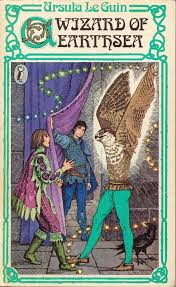 A friend who read this as an adult just couldn’t cope with Le Guin. It made me think that perhaps Le Guin is like a really amazing pencil sketch, where someone like Martin or other such epic writers are oil painters. Le Guin doesn’t waste words; she doesn’t give lush, page-long descriptions. But this isn’t a detraction; she’s evocative and masterful in her language, and she tells a grand tale in (in my copy) well under 200 pages. That’s not something to be frowned upon! … but it could be something that people with tastes shaped by more modern fantasy writers find hard to cope with. And that’s fine; it’s just a different tastes thing.
I love that Le Guin starts with Ged as a wild young thing. I read somewhere that when she was commissioned to write a children’s book she looked at the wizards she knew and they were all old men (she’s a big LOTR fan), and she thought: how did they get there? So forty years before Rowling, she wrote of a wizard school. And Ged is nothing like Harry.
The friendships are wonderfully understated but nonetheless feel real; the dangers are never dwelt on in horrific detail but are nevertheless palpable. Ged’s efforts, his fears, his determination – all come through. Perhaps this is why I appreciate Rosaleen Love: her sparse language is a lot like Le Guin’s, and they both manage to capture a great deal in few words.
I also love that the only white-skinned people in this story are the invading barbarians, who only occupy a few pages.
Chimes
This book was provided by the publisher.
I’m a little conflicted by this book, and I know I won’t write a review that does it, or that ambiguity, justice.
 On the one hand this is a book of gorgeous prose. It’s lyrical (heh) and it’s evocative, setting up beautiful word-pictures. This is a world where although sight still exists, hearing has become far more important for many people – an inversion of today? There’s talk of whistling directions, of using tunes as advertisements and as aides memoire, and then there’s Chimes. Chimes is music that plays at Matins and Vespers, and no matter where you are (well, within the small geographic scope of the novel) you have to pay attention. It’s fairly fast-paced; Smaill does a good job of showing the dystopian nature of the world without a whole lot of detail; I found the conclusion satisfyingly dramatic.
On the other hand… there are enormous questions that are never answered about how ‘the world’ got like this (there’s hints but that’s all), whether the entire world is like this or just some area around London, and there are a few plot holes here and there that are glanced over. What I can’t figure out is whether these things matter or not. On balance, I think I can live with those problems, and it’s mostly because of the beauty of the language. If this were a more pedestrian novel I would have more problems with it. The one problem with the language is the use of musical terms. No one does anything quickly or slowly; it’s all piano, lento, tacet… and I don’t even know if some of the words were invented. I have zero musical training so there were times where I was confused about whether we were rushing or going stealthy. Still, I coped. I was a bit sad at about the halfway mark that the novel was so boy-heavy (I hadn’t read the blurb so I actually thought the narrator was a girl, at the start), but by the end I was a bit more content with the gender choices overall.
The novel is written in the first person and in present tense; I feel like I haven’t read a whole lot of present-tense stuff recently, so that was intriguing. Our protag is off to London with a mission from his dying mother, but he has to hurry because he’ll lose his memory of what he’s doing pretty soon. Because everyone does. This is a world where people are just about living Fifty First Dates. They keep ‘bodymemory’ – usually – so they remember how to eat, how to do the manual parts of their job, and so on; and maybe ‘objectmemory’ can help with some specific events… but unless relationships, for instance, are renewed every day, pretty soon those people are gone from your mind. Because of Chimes. The music you can’t not hear.
Simon, of course, is a bit special – he’s got a slightly better memory – and while the whole You’re Special thing might be a bit old, that’s because it’s such a good way of making change happen in a difficult world. Anyway, Simon starts finding out more about his world, thanks to a new friend, and things progress from there. I liked Simon, overall, as a voice for showing the world, but really we don’t find out that much about him – I think as a factor of the first-person narration. That’s not necessarily a problem; you’re enough in his head on a day-by-day basis that I, at least, certainly cared what happened.
The musical aspect is original, at least in my reading experience, and the prose is a delight. For a debut novel I’m even more impressed – and not surprised to discover that Smaill is both a classically trained violinist and a published poet. I hope she gets to publish more books, and I hope this features on the Sir Julius Vogel ballot next year (she’s a Kiwi). You can get it from Fishpond.
Tam Lin
I was in my mid 30s when I finally watched The Breakfast Club. I rally enjoyed it but I’m glad I didn’t watch it when I was at high school; school was already something of a disappointment.
 I read Tam Lin for the first time this year, 15 years after finishing my undergrad studies – yes, with a BA. I am really glad that I didn’t read this before or during my studies. I thoroughly enjoyed university, but there was very little spontaneous Shakespeare and Milton and Keats quoting going on.
I’ve heard about this on and off over the years; Tansy is a huge fan. I didn’t really have any idea of what to expect – I don’t know the ballad on which it is based, and although I knew there was some Fae element I think I was expecting a kind of Tom’s Midnight Garden experience, going in and out of fairyland? Or something. So it wasn’t what I expected, but mostly in a good way.
Spoilers ahead, if you’re like me and not up on your faery-tinged-undergrad-learning love story!
(That is, it’s a love story to undergrad learning. Although there are love stories in the novel as well.)
Like I said, I was expecting the fairy stuff a lot earlier than it actually turned up. To the point where I got to wondering that because the university experience was so exquisite, was that actually the fairy land? And Janet would eventually wake up? Or something? It was amusing to note the similarities in Janet’s experience of college and my own, as well as the differences, some of which are temporal (25 years different), many I suspect are geographical (US expectations of a ‘liberal arts degree’ are very different from Australian ones… doing physical education? As a compulsory unit??… plus I will never, ever understand the necessity of rooming at college – and I lived in residence for two years), and most of them are of course fiction v reality. With the hindsight of my mid-30s, I enjoyed this fantastical take on college, while acknowledging just how unreal it was. I really liked the discussions Janet and co had around poetry and theatre and what to major in – those discussions can be, and sometimes were, glorious – as well as the fact that Dean includes in-class stuff, with good lecturers and bad. It did make me a little sentimental for my own experience, which I am definitely seeing with a rosy tinge these days. I was also interested in the fact that, published in 1991, it was set 20 years prior. By the end this decision made sense – the stuff about pregnancy and being on the pill would presumably have been a much more raw and radical issue in the early 70s, socially speaking, than in the 90s. Plus I suspect that many people look back on the early 70s rather romantically, as a time of liberation and so on.
Obviously there are hints that things are A Bit Odd from quite early on: the stories about Classics majors (heh; I only have a minor in it), the odd temporal questions and connections, the intensity of some of the relationships…. I admit that I cracked about 2/3 of the way through and looked up some of the names… and yes, there were a couple of them, in the roll of Shakespeare’s company. So that gave me a bit of a clue of what was going on. Like a few reviewers on Goodreads I found the denouement a little bit rushed – in, what, the last 40 pages? it’s revealed what Medeous actually is, and is doing. But… ultimately, for me, the faery aspect isn’t what the book is actually about. But still, I liked the triumphal-tinged-with-doom ending – although a sequel would be extremely ill-advised. I hadn’t picked up the Thomas Lane/Tam Lin connection! Oops.
I liked Janet. Yes, she’s a bit spoiled, and she would almost certainly have driven me a bit mad if I’d met here at 18 – she’s so confident in her own knowledge. But I admired that, too, and the fact that she struggles and overcomes. I liked that her friendships weren’t always easy and that she acknowledged the necessity of working on them – even if she didn’t always do it well; I’m a nerd so I definitely liked her dedication (mostly) to learning!
I can imagine reading this again. I would love to recommend it to young friends, but I don’t think that in good conscience I can – not until they’ve finished at university.
Orphans of Chaos (John C Wright)
Yeh nah.
I am not into bondage; I don’t especially like reading about it. I understand that other people do, and that’s cool; I really don’t care. Whether I will keep reading a book that has bondage stuff in it depends on whether the plot and the characters warrant it, and how uncomfortable those scenes make me.
Enough of a prelude?
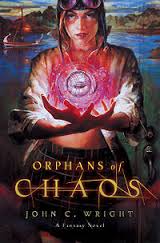 This started out well enough. Five apparent orphans in a boarding school where they are the only students; odd goings-on, and at least one student convinced that they’re not actually on Earth (why? who knows). The student interactions were usually entertaining enough and the discomfort level wasn’t too high, for the first half or so. I was quite looking forward to finding out what odd thing was going on and whether the kids would have powers.
Then the governors etc of the school turned up and it was Lady Cyprian (although I was confused by her because I really thought they were saying her husband was the Unseen One, thus Hades, so I thought she was Persephone even though her attitude and name didn’t fit… nope, turns out I misunderstood and her husband was indeed Hephaestus). Some of the ways these characters were referred to was confusing, but then alternately transparent, so I got a bit impatient with the ‘are you trying to disguise their Greek god-ness or not’ – and then there were references to their Roman names but also that they were Greek gods – and I started to get doubtful.
Then the two girls dress up as very provocative maids in order to distract a cranky gardener called Grendel… which I can maybe come at because in theory they’re 16 but in reality there’s something weird about their ages… but THEN the three boys ‘vote’ on making them stay in those outfits, and the girls don’t get to ignore them.
So: yeh nah. I have no idea where I got this from; it’s been sitting on my iPad for ages, and I’ve never got around to reading it. Now I don’t have to finish it or worry about the sequels.
A Face like Glass
There is an exquisite agony in expectation.
A few years ago I read Gwyneth Jones’ Bold as Love sequence. I owned all of the books but I read them over almost a year… because it was kind of almost fun to wait, even though I had no need; and because I didn’t want the ride to be over.
Last year I did the same with Naomi Novik’s Temeraire series (which still isn’t finished because I haven’t got around to finding the last two), and Sarah Monette’s Mirador.
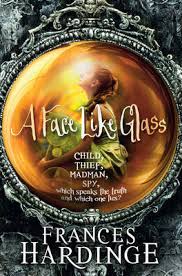 I had Frances Hardinge’s A Face Like Glass sitting on my desk for a full week, waiting to be read. It’s not exactly a year, but the principle is the same: knowing that I had it there waiting to read was incredibly exciting; knowing that as soon as I started reading it would soon be over was excruciating. Because oh my Hardinge is a glorious, glorious author.
And now I’ve read it and it was as I expected – which is to say even better than I expected – but now I am FINISHED and I am BEREFT.
A curmudgeonly cheesemonger is so antisocial he just lives in the tunnels with his cheeses (no ordinary cheese, it should be said, but cheese that can make you see visions and hear songs and maybe spit acid at you. TRUE Cheese). One day he finds a girl in a vat of whey… and her face: well, he makes her wear a mask.
Now, you might be thinking this guy is a bit odd. And he is. But the society he’s turned his back on is that of Caverna; they all live underground. And the other thing that’s different about them is that as babies, they don’t learn facial expressions. At all. Babies, toddlers, even adults if you’ve got the money, have to learn Faces: initially from family, and then from Facesmiths. Yes, this is as weird as it sounds… and it ends up being a really interesting reflection on class issues. Once you’re an adult, it costs a lot to learn new and interesting Faces; so of course, the poor don’t. And can’t. Does that mean they don’t have the emotions that require such a range of emotions?
Indeed, what does it mean to feel an emotion if you can’t express emotion via your features? Hardinge doesn’t pretend to have all the answers, but she makes a compelling, swoon-worthy novel from the issue.
It’s not all cheese and frowns, though. There’s also intrigue, friendship, losing your way, kleptomancy (my new favouritest way of telling the future), True Wine and Cartographers whose words can make you go crazy. There’s recognising your own emotions as well as others’, figuring out who to trust and how to trust yourself, and the willingness to Go With The Crazy.
And then there’s the glory that is Hardinge’s prose. Her words don’t just flow; sometimes they trickle and sometimes they gush but they always worm into your brain and create stunning pictures and magnificent juxtapositions. I’m pretty sure I could read Hardinge’s shopping list and it would be a work of lyrical beauty.
Get it from Fishpond. If you have never read a single Hardinge, read this one… and then read the rest….
The Female Factory
It took me a while to read this one. I read “Vox” and “Baggage” and then had to have a metaphorical lie down for a week, to catch my breath, then read the last two stories.
 Seriously. These two ladies. THEY DO THINGS TO MY BRAIN.
The no-spoilers version is: this collection is about being a woman, and children, and social expectations, and identity.
Now go read it. No, seriously.
Spoiler-filled version:
“Vox” is incredibly chilling, probably the most of the four stories, and on two laters. Kate’s obsession with the voices of inanimate objects is kooky but not that strange; her despair at not being able to have children is a familiar one. The further despair at having to choose just one child cuts deep… but the fact of what happens to the children she doesn’t choose? I had to reread the sections about the electronics’ voices a couple of time to check whether HannSlatt really had gone there. And yes, they really really had. Plus, Kate’s attitude towards her existing child… says some hard things about maternity. Confronting, in fact.
“Baggage” is a nasty little piece of baggage, with a central character lacking pretty much any redeeming personality features and a quite unpleasant world for her to feature in. Her particular ‘gift’ is never clearly explained, which I liked, given how supremely weird it is. There are definite overtones of The Handmaid’s Tale, although obviously it’s very different, and also perhaps Children of Men? Once again with maternity, although I imagine Kate would be horrified by Robyn’s attitude towards her own fertility, and the cubs she produces.
I loved “All the Other Revivals.” Well, I… hmm. Maybe I didn’t love all of them, but it’s not to say I didn’t love the others…. Oh anyway, it was interesting to come across a male voice, after the first two strong female voices. Not that Baron would see himself as a particularly strong <i>male</i> voice, I suspect. Once again the central conceit – the car in the billabong – isn’t explained at all; it just does what it does. And Baron is who he is, whoever that is – and will be. Once again the nature of motherhood is really strong here, although in a very different way from the first two stories; this time it’s a matter of absence, and one that’s never explained. I guess the billabong can be seen as a sort of mother, too, now that I think about it.
Finally, the titular “Female Factory” – named for a real place, I discover, in Tasmania OH MY BRAIN again. Again with the absence of motherhood (so it was a wise thing to do, to read the first two together and then the second two) – this time the story is from the perspective of young children – orphans no less – influenced by daring medical science in the early nineteenth century and their proximity to two cadaver-obsessed adults. Somehow this story, while creepy, felt perhaps the most comfortable of the lot; perhaps because its ideas are a bit familiar? Which isn’t to say it’s not an excellent story, which it is.
Overall this is an excellent #11 for the Twelve Planets, and once again Lisa Hannett and Angela Slatter have well broken me. You can get it from Twelfth Planet Press.
One Small Step
Soooo this anthology came out in 2013 aaaand I’ve only just got around to reading it. Um. Oops. I have no excuse for this. It just didn’t happen.
 In my defence I read the whole thing last Sunday. That counts, right?
The subtitle is “An Anthology of Discoveries” and what’s really interesting is that this is such a broad anthology but yes, the theme of discovery – of place, or self, or strangers – is the unifying factor. Sometimes it’s obvious and sometimes it’s subtle; sometimes there are world-shattering consequences and sometimes not so much.
The other superbly interesting thing about this anthology is that it’s all women. From memory of Tehani discussing the process, pretty much accidentally so. And it’s not all just dresses and kissing! (Sorry; /sarcasm.) It’s basically a who’s who of established and emerging Australian writers, too, which is a total delight.
Some of these stories really, really worked for me. Michelle Marquardt’s “Always Greener” is a lovely SF story that ended up being simultaneously darker and more hopeful thanI expected (yes that’s a contradiction, too bad). And then to have it contrasted with the fantasy of Lisa Hannett and Angela Slatter’s “By Blood and Incantation” – which is not my favourite HannSlatt but is still quite good – neatly skewered expectations that it was going to be an SF anthology, pointing out that ‘discovery’ is a mighty broad concept. And then “Indigo Gold” by Deborah Biancotti! Detective Palmer!!! and !!! The Cat Sparks story is awesome (it feels like ages since I read a Cat Sparks story), Penelope Love is quietly sinister in “Original,” Faith Mudge does fairy tale things beautifully in “Winter’s Heart.” And the final story, “Morning Star” by DK Mok, is a magnificent SF bookend to match Marquardt but on a much grander, more extravagant scale.
This is a really fun anthology and I’m sorry it took me more than a year to read it. You can get it right here.
Hidden Empire
… nah.
 I picked this up from ibooks when they were doing a ‘get the first book in a series free’ thing. It sounded like it could be a fun epic, and it starts well enough: let’s turn a superJupiter into a star using alien tech! The first portag is a female xenoarchaeologist!
I don’t even mind multiple points of view.
But the first alien didn’t feel that alien, and was a bit too eye-rolly pompous. And the heir of the world-trees place goes to visit the alien planet – and the aliens are all very human-like – and one of the first things mentioned about the palace is that there are courtesans? And the heir of the alien planet is all ‘yeh I gotta sow mah oats real fast cos when I inherit, I get the snip’ … nah.
I liked the world-tree and their priests, but they didn’t seem as cool as the Templars in the Simmons’ Hyperion Cantos.
So unless someone can give me a really convincing reason to get back to it… nah.
Drowned Vanilla
I read it in a day.
 I gave it to my mother for her birthday; she had previously loved A Trifle Dead. About this one, she says:
I was thoroughly entertained by this latest book from Livia Day. I appreciated her heroine’s inability to combine detective work, cooking skills and a complicated love life with aplomb! The plot kept me interested to the end; the recipes for summer drinks, gelato and ice cream almost made me want to spend more time in the kitchen, and her dealings with Bishop and Stewart made me want to take her aside for a maternal chat.
It’s just the sort of book I like for holiday reading while watching the cricket – enjoyable with no necessity for deep thinking!
Oh Ma.
As for me… well, I have moved somewhere and have room for some frivolous things, and after reading this I decided that yes indeed I did want an ice cream maker. I will, however, be making neither beer ice cream nor Shay’s butterscotch, for completely different reasons.
I am not maternal and so did not have the same reaction as my mother; instead it had me reading with one eye metaphorically closed as I waited for something to go deeply wrong.
As to the plot – I know I am no author when I hit the twists and turns and I am utterly amazed at the devious brain that comes up with the sorts of things that happen to Tabitha. Poor lass. Livia, you are So Mean.
Hobart and its surrounds come to life beautifully, if not quite as much a part of the plot as in A Trifle Dead. There is a love of food, a love of friends, and a general love of life evident in this book. Hugely enjoyable. You can get it from Twelfth Planet Press, hard copy or ebook.
Jean-Paul Marat
There are probably three figures in the French Revolution who most fascinate the well-informed everyperson. Georges Danton is my absolute favourite, for a bunch of complex reasons. Maximilien Robespierre is the one that a lot of people know of and blame for the Terror. I’ve read biographies of both of them in the last f ew years. And then there’s Jean-Paul Marat, often regarded as the epitome of demagoguery, inciting the poor uneducated masses to insane levels of violence.
 I’ll start with a drawback of this book. The first is a direct consequence of its size: at 155 pages, there’s not room to go into great detail about very much (Conner neglects to mention the massacre of the Swiss Guard in the second storming of the Tuileries, which struck me as odd but I’ll concede it didn’t directly have much to do with Marat). Unfortunately this is hard to remedy, as he himself points out that there are only two other biographies of the man in English – he wrote one and doesn’t think much of the other.
Something else that might be considered a drawback but which I found deeply interesting is the author’s perspective. This is a drawback if you forget that (or were never taught that) every historian does have a perspective, and they bring that to their writing. Conner brings this issue to the very front of this short biography by spending the introduction skewering the perspectives of earlier historians and the way they have treated Marat; he shows – convincingly in most cases – that the bad press regularly regurgitated about the man is fallacious and based largely on anti-Marat propaganda, and/or others’ political convictions (a favourite line: “The episode reveals nothing about Marat, but a great deal about how historians allow their social prejudices to affect their judgement” (p5)). There’s also an amazing excerpt from 1919 wherein Marat’s insanity is affirmed and then a comparison is made to contemporaries who parallel him – like Bolshevik sympathisers and women who “have failed in woman’s first and natural function” (p6). I laughed, I cried. All of this is matched by Conner’s own attitude, which is not really spelled out but nonetheless comes through clearly. I can’t imagine how this book was received by conservative Americans. The final pages imagines Marat’s ghost questioning the legacy of the French Revolution. His big thing (according to Conner) was the idea not just of political and legal equality (thanks to the French Revolution, at least in theory TICK) but economic and social equality – hence his championing of the sans culottes. Conner’s last paragraph reads:
Marat would surely be shocked and dismayed to learn that after more than 200 years his struggle for social revolution had lost none of its relevance and urgency. Where is the People’s Friend now, when we need him? (p155)
I can understand some people being dismayed by this authorial intrusion. But if you hadn’t got that Conner is a bit of a radical himself, then you haven’t been reading very carefully. And if you’re reading the biography and being dismayed by Marat’s politics, then you’re probably not going to agree with this anyway (NB I don’t mean his methods but his ideology).
This is a wonderfully readable biography of a quite astonishing man. Marat was a doctor and an experimental physicist and a journalist and a politician and an intensely passionate advocate for social change (even before the Revolution). He dealt with a chronic skin disease (it’s apparently unclear what this was), and police harassment (occasionally warrants were for possibly-real issues, sometimes it was plain censorship and targeting). He was too radical for his times and thus often a voice crying in the wilderness; he would still be regarded as too radical, I would suggest. Conner sets out his life neatly and clearly. There’s just enough detail about the French Revolution that I think you could read it cold… but I know too much to actually be a reliable judge of that. I’m really glad to add this aspect – the man who was revered by much of the menu peuple, who too often get ignored even in histories of the French Revolution where they had a fundamental role.

 Randomly Yours, Alex