The Lies of Locke Lamora
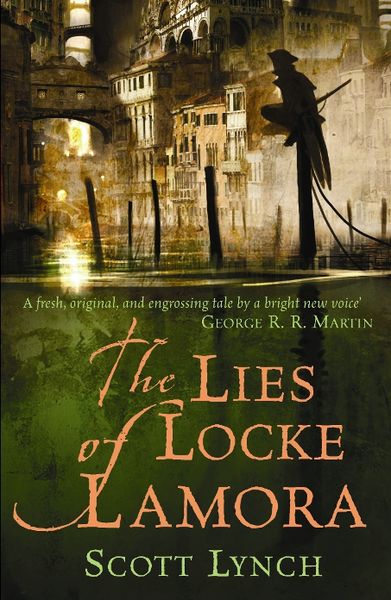 This has been on my radar for a while; when I finally added it to my Goodreads page, Katharine went a little mad and next thing I know it’s appeared in my mailbox.
Some slight spoilers below, although not that many and none too significant.
It took me about 4/5 of the book to figure it out, but finally I realised what Camorr reminds me of: it’s Ankh-Morpok at its grimiest. Maybe Ankh-Morpok crossed with Gotham? All the inhabitants are human, but it’s got that chaotic mad feel that Ankh-Morpok has… without the cheerfulness that Pratchett adds. The grimdark version of Ankh-Morpok? Dare I suggest the more realistic version of Ankh-Morpok… So anyway, I quite liked Camorr, although it’s not as ‘original’ as the George RR Martin quote on the front might suggest. This isn’t necessarily a bad thing – originality is great of course, but building on others can be too. I am also a bit puzzled about the inclusion of the ruins of some long-forgotten alien race. Yes they add to the cityscape, and the idea of Falselight is really cool, but I was kinda expecting a bit more to be made of the Elderglass. Actually I was expecting that Locke was going to be a descendant of that alien race (spoiler! he’s not… well ok, there are apparently another six books after this, so maybe that’s a reveal in the fifth?). So… yes, it’s cool and it does add to the knowledge that this is a complex and complicated world and Lynch has given it great thought. But there was both too little info – who were they? how long ago are we talking?? – and too much info, because there were these teasers all throughout about the glass (can’t be broken, except there’s this one Broken Tower OOOooh, etc).
Is it passé of me to comment on the laydees? Or, let’s be honest, the lack thereof. Locke’s ladylove is mentioned a couple of times – very much in passing – and is completely forgotten for more than half the book. That bugged me. I loved that there were what I think of ‘incidental women’ – guards and merchants and criminals were just as likely to be women as men, but the ones that Locke and his Merry Band of Bastards interact with are almost always men. There are two significant female nobles, and they are awesome and get to be competent and I like them a lot. Buuuut… it could have been better.
So far you might be thinking that I didn’t think much of the book. Actually, I really enjoyed it. Like, a lot. Someone suggested it was an Ocean’s 11 kinda story, and it definitely is – except see that comment about missing the cheerfulness of Pratchett? There are some magnificent one-liners, and the variety of hustles are breathtaking and occasionally hilarious, but this definitely falls on the grimmer end of the scale. It’s a bit of a spoiler I guess, but… people die. I hadn’t really expected that, with my George Clooney/ Brad Pitt expectations. Talk about a kick in the guts.
The plot? It’s a con. There’s one con that threads through the entire thing, and a number of others that crop up. There are external things that get in the way and need to be dealt with; there’s everyday life, there’s death and mayhem, there’s revenge and pain (lots of pain), no romance and a lot of bro-bonding. Oh, so much dude-platonic-love. The ties of brotherly love have rarely had their praises such so highly… and I’m not even being sarcastic at this point.
The protagonist is, of course, Locke Lamora. He’s in the line of Miles Vorkosigan and other such brains-over-brawn heroes: he can hold his own in a fight but he’s not really very good at it and ends up with a lot of cuts, bruises, black eyes and a serious lack of blood at various points. But of course he makes up for it with a devious, cunning brain that comes up with madcap, near-to-impossible schemes. It’s just lucky he has willing confederates to help him carry it out. I really liked Jean, his bruiser with brains best buddy. I was initially a bit wary of the way that he was described as fat, and that seems to be forgotten for bits of the book – I can’t figure out whether that was a good thing or not. But their relationship works; they work well together but they’re not completely reliant on each other.
The villains are… interesting. For a while I couldn’t even tell who the villain was going to be, or even if there was going to be one; after all, the main characters are thieves – let’s not kid ourselves, much as they like to talk about their own code of morality, Locke and his friends get a great deal of joy out of stealing from, conning, and generally making life miserable for many of the honest people of Camorr. But there is/are indeed villain/s – their number depends on how you want to view things like “I was doing what I was paid for” – who of course make our heroes look positively virtuous. I have to admit that I was a little disappointed by the driving force behind the villainy. It felt a little… small.
Ocean’s 11, yes – and 12 and 13. I was also reminded of Mission Impossible: Ghost Protocol (and the others, but that’s the one I’ve rewatched recently). It’s… well. Fun, yes, although with its fair share of rip-your-heart-out moments. It’s a good thing I got to the last fifty-odd pages with nothing else to do, because I just could not figure out where it was all going to end up and I nearly had to put the book down to breathe but I didn’t. I really enjoyed it.
You can get it from Fishpond.
Marie Antoinette: a biography
 It’s weird reading biographies. There can be no great surprises, really; you do already know the ending after all. And in the case of Marie Antoinette, I know the outlines of her life so well that I was curious to see how Fraser shaped the events, rather than finding them out – especially of the last half of her life. I knew very little of her childhood and in fact did not realise that she was the youngest daughter of the Austrian Empress, which does add a particular shade to her upbringing.
Overall I really enjoyed Fraser’s style, although the use of ellipses in a historical work is a bit weird. But she’s eminently readable; having the endnotes at the back of the book helps that, although it does also mean I didn’t look at any of them (none of them were discursive so I didn’t miss much). There were enough endnotes that I felt like I was reading a well-researched book, which I presume is accurate rather than being wishful thinking!
Of the content, the one rather odd note for me was that Fraser accepts as highly likely the idea that Marie Antoinette did have an affair with Count Axel Fersen, Swedish soldier and general lover of women who did spend time at the court and indeed helped to arrange the escape that ended so disastrously at Varennes. I didn’t feel that Fraser offered enough evidence to make their liaison quite as certain as she suggested. Other than that, Fraser is quite sympathetic towards the Archduchess/Dauphine/Queen – and I have no problem with that. Fraser shows the many difficulties that Marie Antoinette faced throughout her life ( for instance, more than seven years of marriage before consummation brings problems on a whole range of levels when you’re meant to produce the heir), and does so with an eye for detail and, yes, with sympathy. That’s not to say that she shadows the problems that Marie Antoinette brought on herself, and those she did little or nothing to minimise; they too are investigated, sympathetically but rigorously, honestly, as a thorough biographer ought.
Overall this is a really great biography, and reminds me that yes I really do enjoy reading history like this and maybe I should read some more. I believe that it would be quite accessible to those with little knowledge of the revolutionary period; it’s instructive of the way women were used politically in European aristocratic and royal circles for centuries, and reflects on the sorts of propaganda that is still used around powerful women today.
You can get it from Fishpond.
The Tamuli
Earlier this year, Tehani, Jo and I read and reviewed The Elenium (The Diamond Throne, The Ruby Knight, Sapphire Rose). It was fun! We enjoyed them – again! So we decided to do the same for The Tamuli! … and that took a bit longer.
ALEX:
Dear readers,
Here’s an interesting thing. We’ve been writing these reviews in a Google document. This one, entitled Domes of Fire, has existed for a few months without anything being written in it. This is despite the fact that I think we would all have said that we enjoyed the second trilogy a lot, if not as much as the first, and that we all devoured the second trilogy on this re-read just like we did the first.
TEHANI:
Aw Alex. You don’t think all of us being crazy busy had anything to do with it? 🙂
ALEX:
It’s just that…well, there’s not really that much to say. We said most of it with the first trilogy, and the reality is that this second set, the Tamuli, is basically a reworking of the first.
TEHANI:
Heh, I like that Eddings pretty much acknowledges that about halfway through The Shining City:
“It has a sort of familiar ring to it, doesn’t it Sparhawk?” Kalten said with a tight grin. “Didn’t Martel – and Annias – have the same sort of notion?”
“Oh my goodness, yes,” Ehlana agreed. “I feel as if I’ve lived through all of this before.”
JO:
One will not point out similarities to the Belgariad either. Or the Mallorean. One will not.
ALEX:
Almost identical set of people, very similar set up – except just like any sequel, things are More Impressive and More Worse. Not just a puny god, but a serious one! Bhelliom’s not just an object but an imprisoned eternal spirit! Sparhawk is Amazing!!
…ok that one’s not that new.
What follows therefore is a general discussion of the entirety of the Tamuli – what we liked, what disappointed us, etc.
TEHANI:
I think part of the problem was that once we started reading, we just couldn’t stop – having glommed all six books in such short order made it super hard to separate this batch into separate reviews! So this one giant piece is a much more sensible idea.
JO:
Oh that’s absolutely it! I read all six in this big BINGE… and then you wanted me to sit down and be sensible about each one? Can’t I just say ‘yay’ Sparhawk? Also where are my notes…?
ALEX:
I quite like the opening to Domes of Fire proper, with Sparhawk riding through the streets but this time being recognised. It sets up the idea of familiarity and parallels with the first trilogy very neatly, and suggests that it’s all done deliberately. While I do recognise that this is somewhat lazy writing, I definitely understand the appeal of it for readers – because it appeals to me, when its done well: it’s the same reason why people like staying in the same hotel chain everywhere. Familiarity is comforting. I like reading for comfort sometimes.
JO:
I don’t see it as lazy at all. I see it as fanservice 🙂
TEHANI:
You know what else can be lazy writing? The “As you know, Bob” thing, which Eddings employs over and over to let us know/remind us what’s going on. AND I DON’T CARE THAT HE DOES! It’s still completely and utterly readable. I’m not sure what it says about me. Or maybe it’s just that even something “lazy” can actually be done well?
ALEX:
I think it’s done with humour, too, often, and that certainly helps his cause.
JO:
Yeah usually it’s just so much fun to read the ‘as you know’ doesn’t bother me as much as it should.
ALEX:
We are such fan girls.
So, straight into the issues: Danae manipulates a lot of people with kisses in these stories. It made me uncomfortable.
TEHANI:
Yeah. Despite the efforts to show women in positions of power, and able to WIELD that power, with Sephrenia, Xanetia, Ehlana, and even Aphrael/Danae herself and so on, there is still a lot of dodgy gender stuff going on.
ALEX:
Women and power… Ehlana comes into her own, but she does still get damsel’d – again. She shows herself quite resilient etc, but still… I’m really not sure what I think of Melidere. Great that she’s smart. Kinda fun the way she plays Stragen and all – you never see it but I have no doubt Stragen sees himself as a stud. Very uncomfortable about her manipulation of him into marriage. Urgh.
JO:
Yeah the gender stuff in these books really pissed me off by the end. SO MANY of the female characters are ‘strong’ because of their ability to manipulate the men around them. And do so ‘prettily’ so awww it’s actually ok. We got more ‘haha women are obsessed with marriage, poor men’ too.
ALEX:
Yes. Icky.
However and meanwhile, SEPHRENIA AND VANION 4EVA.
TEHANI:
They are so adorable! And I love that even though things get tough, they work things out. I also love they are a mature and completely lovely couple who appreciate and work with each others’ strengths!
ALEX:
And a Styric city! While there are some uncomfortable instances of racism that don’t get dealt with, I think this trilogy makes a sturdy – if, I don’t know, simplistic? – attempt at confronting it. Sparhawk confronting his own prejudices – being willing to protect meek and submissive Styrics but being affronted when they’re all assertive and happy – is a really nice moment.
JO:
Simplistic, definitely. But yes, at least it’s there.
TEHANI:
Yes! An excellently written scene. Very impressive to see this sort of examination of prejudice (however briefly) and the understanding that it can be unconscious and inherent to human nature, and challenging to deal with even when one is self-aware. Sparhawk’s conversation with Stragen where he says, “I just found something in myself that I don’t like.” is so short but encapsulates things very well.
ALEX:
Aw Sparhawk. Poor darling. Also? Older man learning about himself and still growing as a person? That is awesome.
JO:
Yes, very good point! That’s not something you usually see, is it. Older men are so often described as set in their ways etc. That’s a part of Sparhawk’s character I’d not noticed before. And it’s nice that he can be strong in ways like this, not just chopping off heads, but emotionally too.
TEHANI:
I particularly like how this comes around again later, when Vanion confronts Sephrenia about her behaviour towards the Delphae, and he says, “Nobody’s different! We have to believe that, because if we don’t, we deny our own humanity as well.”
ALEX:
And Sephrenia’s whole arc for the last novel or so is dealing with her prejudice against Xanetia and the Delphae.
That said, a “universal sisterhood of all women”?? Uh. No. Not until a lot of other issues are dealt with.
JO:
I have a BIG issue with Xanetia that I’d not noticed before, but this re-reading really hammered it home. She and her ability to read people’s minds are just one big plot device. After all the machinations and the foreshadowing, how do we bring the conspiracy out into the open? Xanetia reads people’s minds. BAM. How convenient.
I like her relationship with Sephrenia and the growth that Sephrenia goes through, but Xanetia herself… she’s just there to tell everyone who the bad guy really is so the story can progress. And it’s a revelation that isn’t earned, at all.
ALEX:
I quite like Xanetia – she’s kind of taken Sephrenia’s role as serene and helpful lady, in this series, because Sephrenia gets a bit more development. But yes, the mind-reading is a leedle too convenient.
JO:
Oh don’t get me wrong, I *like* Xanetia, because she’s an Eddings character so how can you not? I just find her mind reading abilities and their place in the plot a little bit of a cop-out. Same can be said for Bhelliom’s ability to jump around the world in the blink of an eye, but that doesn’t stop it being hilarious and cool.
ALEX:
Also meanwhile, I heart Bhlokw. And the Troll-Gods as a collective.
TEHANI:
They definitely grow on you! I really enjoyed how much more intelligent they are by the end than they are first presented. In fact, Eddings was actually rather clever there – when we first meet trolls, they are scarcely more than animals, but by the end of the series we have come to realise they are a complex culture with a firm religious beliefs and a strong sense of right and wrong. Fascinating really, if you’re looking at it from a tolerance and acceptance point of view…
JO:
Or he hadn’t thought that far ahead and just kinda shoe-horns the trolls into that role… but hey, maybe I’m a cynic.
TEHANI:
The whole religion thing in this trilogy is much more in-depth than in the Elenium I thought. There was more exploration of the idea that Danae is actually a goddess, but one among many, and that the gods and goddesses of Styricum are quite different from the other religions as well. I found some of the discussion, particularly pertaining to the Elene god, rather interesting.
ALEX:
There’s definitely more about religion here. The bits about the exquisite politeness between them – how hard it was to get the Atan god in the right frame of mind – is mostly endearing.
TEHANI:
The discussion of slavery in this series (focussed around the Atans and Mirtai in particular) is interesting. On one hand, that Atans are effectively a slave race, yet they are self-governing and pretty much are the means by which the Tamul empire works. However, Mirtai’s experience in slavery outside of this context was pretty horrific. I’m not sure how to unpack that juxtaposition.
ALEX:
It made me quite uncomfortable a lot of the time. The idea that the Atans had put themselves into slavery to look after themselves seemed way too disingenuous… and the fact that they basically rule themselves and that the ‘slavery’ is largely titular does nothing to make it feel better. Because SLAVERY. And as you say, it does lead to Mirtai having a seriously awful set of experiences.
JO:
Yeah, I agree with you there. It always made me feel uncomfortable. They whole “oh but they WANT to be slaves! They’re better off that way. No really, see if they weren’t slaves they’d all kill each other” made my skin crawl.
TEHANI:
It was good to see Eddings didn’t skip the class issues in this trilogy either. Khalad takes Kurik’s role in examining the nobility, but there are lots of instances where peasants are underestimated and aristocrats proven silly. Does it go too far, do you think?
ALEX:
I think it does, mostly because Our Heroes are almost all nobly born but they’re not idiots – which just adds to their exceptionalism. Which is now so overloaded it’s groaning.
JO:
Aristocrats who aren’t knights are usually the silly ones. Funny that.
ALEX:
Do you know, I don’t think I’d picked up that differentiation! and you are so right!!
TEHANI:
I originally read these trilogies in the wrong order, with the Tamuli first, and I still think that Eddings did a really great job with them. I didn’t ever feel when reading that I didn’t know the characters and it was never a problem figuring out what had gone before, or the dynamics of the relationships. Not because Eddings over-explained, but because the characters are so well-drawn. Take Kurik and Khalad for example. They essentially play the same role in the two trilogies, but they are still distinct people (and it’s lovely that Sparhawk never stops missing Kurik throughout the books). That’s not easy to achieve with a large cast.
JO:
It still breaks my brain that you read them out of order!
ALEX:
Me too!! That’s just… inconceivable 😉
Anyway – it would have been so easy to treat Kurik as “hey, remember that guy?” I’m so glad the Eddingses didn’t. I really like Khalad.
JO:
And the brief moment where we get to see Kurik again… *sniff*
TEHANI:
The way Bhelliom slowly grew a personality was sweet – I particularly liked the scene where Sparhawk has it create a wall to stop the trolls, and when Sparhawk compliments the wall, it gets all self-deprecating. I also enjoyed the point where Aphrael realises that it seems Bhelliom had actually manipulated her into the events of the world, rather than her machinations being at her own instigation.
ALEX:
Oh I do love Bhelliom. Referring to the Earth as its child is so cute! And that brief SF moment of showing other worlds, and the alien soldiers they’re fighting, is quite weird. The discussions of origins is fun.
JO:
Oh me too! Love how it starts off all formal and uber-god-like, but Sparhawk and the gang rub off on it. Soon enough its cracking jokes. Pure Eddings.
TEHANI:
Some favourite quotes:
“I wish she wouldn’t do that,” Stragen complained.
“What’s the problem?” Kalten asked him.
“She makes it seem as if the light in her eyes is the sun streaming in through the hole in the back of her head. I know she’s far more clever than that. I hate dishonest people.”
“You?”
“Let it lie, Kalten.” (Domes of Fire)
“Is she speaking for all of us?” Talen whispered to Berit. “I didn’t really have a girlhood, you know.” (Domes of Fire)
“You’re all just itching for the chance to do Elenish things to those border guards.”
“Did you want to do Elenish things to people, Ulath?” Kalten asked mildly.
“I was suggesting constructive Elenishism before we even got here.” (The Shining Ones)
“Thine Elenes are droll and frolicsome, Sephrenia of Ylara,” Xanetia said.
“I know, Anarae,” Sephrenia sighed. “It’s one of the burdens I bear.” (The Shining Ones)
“Knights, your Grace,” Komier mildly corrected his countryman. “We’re called Knights now. We used to be brigands, but now we’re behaving ourselves.” (The Hidden City)
ALEX:
omg I loved that we got more of the Preceptors in these books. Also eeee Bergsten!
JO:
Personally, I never understood the ending. Would you really give up godlike powers to live a normal life? I mean REALLY? Maybe that’s just me, but that’s never rung true to me. Hmm superamazingmagic or your ‘humanity’. I’ll take the powers thank you very much. (My husband informs me that yes, this is probably just me…)
TEHANI:
He knows you well…
ALEX:
It would have been a very different book if that had happened; Sparhawk would not have been the hero we know if he had kept the powers. I’m not saying I wouldn’t read that book, but I think it would have been super jarring. For all he’s awesome etc, there is an effort to make him at least a little humble, and certainly content with his station in life. Staying a godlike being would have been a serious curve ball.
JO:
Maybe I should change that to – I never understood Sparhawk’s choice at the end. I mean yeah, totally works from a character and story telling point of view but… god-like powers man! I’d keep ‘em 😀
TEHANI:
So the verdict? Clearly we still loved the experience of reading these novels again — not just a nostalgia trip but a genuine pleasure. And yet, with the weight of experience and a few years, we also can clearly see there are problematic elements with the books that we may not have noticed when we first fell in love with them, or they may not have seemed quite so concerning then. Is it okay to like books even though they are flawed?
JO:
This is pretty much what we decided for the first three, wasn’t it? Yep, flawed but still so much fun. I think it’s perfectly reasonable to like any media AND be aware of its flaws at the same time. I know that a big part of it for me is that I read these at just the right time and fell so completely in love with them. That feeling stays with me, flaws and all.
ALEX:
As you say, I think that loving any problematic thing is ok – we’re women, we kinda have to be ok with it on some level, right? Doesn’t mean we shouldn’t point out the flaws and work for things to be better, but nothing is going to be perfect and accepting that can sometimes be ok… I think? I hope so. Because while I may never read these again (although I wouldn’t rule it out!), this has been a fun ride.
Galactic Suburbia 112
In which we help you with your (possibly last minute) Christmas shopping with a ton of our favourite recommendations from the year, plus culture consumed. You can get us from iTunes or at Galactic Suburbia.
Don’t forget to send us your recommendations for the GS Award: for activism and/or communication that advances the feminist conversation in the field of speculative fiction
Christmas gift suggestions!!
Alisa: Soapasaurus; Ancient Arts Yarn
Alex: Orphan Black. Abhorsen trilogy (plus prequel), Garth Nix. Bitterwood Bible and Other Recountings, Angela Slatter. Hav, Jan Morris. Rupetta, Nike Sulway.
Tansy: Ms Marvel Vol 1: No Normal, G.Willow Wilson; Teen Titans Go; Dimetrodon, The Doubleclicks; The Musketeers (BBC 2014); Sex Criminals, Matt Fraction
TPP: Drowned Vanilla! Secret Lives of Books; The Female Factory, Kaleidoscope, The Total Devotion Machine and Other Stories; Perfections;
Other Personal Stuff to Plug: The GS Scrapbook, The Twelfth Planet Press Tab, Musketeer Space
What Culture Have we Consumed?
Alisa: Scrivener; Monstrous Affections edited by Kelly Link and Gavin Grant; Champagne and Socks (Alisa’s personal blog)
Alex: The Slow Regard of Silent Things, Patrick Rothfuss; Troll: A Love Story, Joanne Sinisalo; Uncanny #1; finished Project Bond.
Tansy: Young Avengers 2: Family Matters; Civil War: Young Avengers/Runaways; Young Avengers Presents, The West Wing, Chicks Dig Gaming, Jennifer Brozek & Robert Smith?
Have a great summer… even if it’s winter where you live.
Please send feedback to us at galacticsuburbia@gmail.com, follow us on Twitter at @galacticsuburbs, check out Galactic Suburbia Podcast on Facebook, support us at Patreon and don’t forget to leave a review on iTunes if you love us!
Mitosis
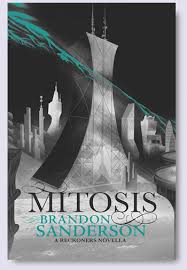 I haven’t read Steelheart so the characters and the problems in this short story didn’t mean as much to me as they would to someone who has read it. And it turns out that the story is actually half of this cute little number’s pages; the other half is a teaser for the second book in the series.
Still, I read it, and I think it does actually work as a stand-alone. There’s obviously a lot that’s gone on in the past, but that’s often true of a good short story. The one thing that could have been cleared up by a single additional sentence is the nature of the ‘Epics’, who are clearly the villains (usually) and clearly some sort of humans but… that’s all a bit obscure.
Anyway, it’s got a good pace and the setting – Newcago – is nicely set out. The narrator, David, is a bit of a nothing character to be honest; this is more about action than it is about character, but that’s not necessarily a bad thing. The villain was quite fun and I enjoyed Sanderson’s take on his particular ability.
This book was provided to me by the publisher.
Troll: A Love Story
 I am torn.
On the one hand, this is a beautifully written story that deals with some fascinating issues. And trolls are real.
On the other hand, I was uncomfortable with the implications of some of the relationships.
So, the first hand: it is lovely, and made all the more impressive by the fact that it’s translated – that can never be an easy task. I love the fact that it alternates story with ‘non-fiction’ grabs from pseudo-websites, dusty old tomes, poems and mythology – some of those are real, I’m pretty sure – and newspaper reports. I know that some people find this annoying; don’t read the book if that’s you. And I know that sometimes it really doesn’t work. But here I lay claim that it adds wonderfully to the depth surrounding the central idea of trolls being a real animal, known to science for the last century or so, and that this story is seeking to add to what humanity knows about Felipithecus trollius. Additionally, although there is a central narrator – Angel – as the story proceeds more of the incidental characters get to add their own perspectives, also in the first person. I know some people have found this changing around to be irritating or confusing, but at least in my edition each chapter clearly labels who is speaking, so rather than confusing I found that it added to the richness of the novel.
Sinisalo raises a diverse range of issues in her story, some more central than others. Trust and love and manipulation; ethics in art and journalism and business; the relationship between humanity and the natural world; mail-order brides, sex as power, desire as all-consuming. Angel, the central narrator, finds a wounded young troll and decides to care for it… which leads to encounters with a neighbour, an ex-lover, a would-be lover, and an object of his affection. Plus a business opportunity.
Which leads me to the other hand. And from this point on, SPOILERS.
Firstly, I know Angel ended up feeling ashamed of taking advantage of the troll, but it was still an unpleasant thing to do – taking advantage of Pessi’s trust in him for entirely mercantile purposes. Given how much Sinisalo works to make Pessi seem if not human then certainly above the animal, I really didn’t like it. Again, I’m sure that was the point, but it doesn’t matter; I still read it, and felt uncomfortable.
And then there’s the implications of the relationship between Pessi and Angel. Perhaps it’s prudish but I was very uncomfortable by Angel’s sexual reaction to Pessi. This is partly because Pessi is coded as being quite young, so the power differential of age exists; partly that Pessi is clearly in a submissive position with regard to Angel in tribal terms, so again the power differential; partly, hello different species – where Pessi is <i>not</i>, especially at first, coded as being as capable/sentient as a human. I know that Sinisalo is trying to problematise issues of desire and sexuality – Palomita’s experience as a mail-order bride is certainly not meant to be endorsed but is still far more socially acceptable – but… it was a problem for me.
Lastly, the ending. I knew it was coming – that Sinisalo was working up to the idea that trolls were either evolving, and catching up with humanity, or that they had always been that clever and were now coming out of the forest and starting to demonstrate it. I really liked it, and but for the sexual relationship stuff I really liked the ambiguity of what was going to happen to Angel, too.
I think, on balance, that I really liked this book. Sinisalo is certainly doing intriguing things, and she does write beautifully.
You can get Troll from Fishpond.
The Slow Regard of Silent Things
 In his Foreword, Rothfuss points that that people may not want to read this book. It’s not an ordinary book; there’s no plot. There’s no explanation of who Auri is, who she is anticipating, or even where she is. It’s probably not the first thing by Rothfuss that you want to read.
But.
But it is a beautiful object, but it’s a haunting chronicle of six days, but Auri is indeed a bit of the sun.
It’s a beautiful object: I have a hardcover version, and the cover picture is all shadows and moonlight and flowers and Auri’s silhouette. Nate Taylor’s black and white pictures are strewn throughout like the objects that Auri finds, and the text makes way for them so they work together companionably. I’d like to see more books with pictures in them, like this.
It’s not a novel, or a novella (150 pages in this wee format); it’s a chronicle. It outlines Auri’s actions and thoughts for six days. Some days are good, some days are bad. Some days Auri manages to fix rooms and objects so that they are just so and some days she doesn’t have anything to eat. Some days she makes soap. Some days she weeps.
Auri is the only character in this chronicle. In watching her for six days, the reader learns only fragments of her past and nothing of her future. We learn that she is a joyful creature – she grins all the time, and that mostly didn’t get annoying – but she is also deeply broken, and she knows she is broken and feels it keenly. And she knows that the world is broken, too, and she wants desperately to put it to rights, one little bit at a time – finding a place for a bottle, feeding another’s imagination, making soap properly. Anticipating a visitor and fretting about having the right gift.
Auri’s entire life revolves around doing things properly, and making the world right, and not wanting things for herself. I was at points humbled by her, and her willing and joyful self-sacrifice; at times enraged on her behalf, because clearly something has happened to make her so completely self-effacing. At times I was horrified – she has so little to eat – and at time intrigued, as when she contemplates her soap and knows that while it would be perfectly serviceable without perfume and other additions, how joyless to live in a world that was simply <i>enough</i>.
There’s something like 16 pages of making soap. Sounds crazy, I know. Trust me, it works. Or, you know, don’t trust me, because this isn’t your sort of book anyway. That’s fine. I really liked it. (I really liked the first two of Kingkiller Chronicles: The Name of the Wind, then The Wise Man’s Fear.)
This book was provided to me by the publisher at no cost. You can get it from Fishpond.
The Book of Life
 1. I received this as a review copy from the publisher.
2. I have not read the previous two books in the trilogy. As well as impacting on my understanding of relationships, it’s possible this review will therefore have spoilers for the first two books.
Vampires are not, in general, my thing. Yes I have read an enjoyed a number of books that include vampires, but I do not go out of my way to read them. And I don’t especially like vampires for their own sake; I have enjoyed books they’re in when the story itself is great. (Cyborgs, though? I like cyborgs. Sometimes I don’t even care about the plot.) So The Book of Life is not inherently my thing – so if you love vampires, this review probably isn’t going to be useful to you.
The main characters are a witch/historian, Diana, and her vampire/scientist husband, Matthew. They’ve just got back to the 21st century from Elizabethan England and things are messy, not least because there’s not meant to be such mix-marriages and it’s compounded by Diana being pregnant. Also there’s a threat a brewing both to their family and to the supernatural species in general – which also includes daemons but they hardly feature at all in the book – AND they have to continue their search for the titular Book of Life for reasons that are never clearly explained. This involves Science, and History, and the occasional It’s Not Really a Significant Crime, right? Also getting humans involved in their work, travelling across Europe, family arguments, snark, more snark, the odd bit of sex and being a bit creepy.
Pretty standard stuff really.
I was dubious when I received this from the publisher, having not read the others. But I decided to give it a go and I was impressed by how well Harkness managed to basically catch me up. For those completing the trilogy this may well have been annoying info-dump, of course. There were random characters who appeared that had no impact on me but were clearly significant, and call-backs to previous events that I just shrugged past, but I certainly never felt like I was being left behind. So that’s a positive. As well, this is the epitome of page-turning-ness. I read the whole thing on a public holiday (580 pages). I didn’t give it the world’s greatest amount of attention (it’s not like reading Ann Leckie), but I also didn’t skip pages searching for dialogue (um, a few books I won’t mention). Thus, highly readable.
At times I almost forgot that this was meant to be a supernatural kinda book, and read it as a family drama – and it works exceptionally well as such. Every now and then there were odd, jarring notes (yes, I’ve been mourning for five centuries…), but really most of it works on ‘you can’t marry him’/’I just did’ – ‘what do you MEAN you’ve got a [insert unknown family member here]’ – ‘I hate you but I’ll work with you anyway’ interactions. Which can be quite fun when they’re written with enough snark. (Harkness could have added a little more snark, and I wouldn’t have minded.) In this way, it reminds me a bit of the Gail Carriger books – the Parasol Protectorate, while having awesome stuff about tech etc, boils down to relationships and how to negotiate them ((maybe everything does ultimately…).
Harkness touches on some interesting issues, too. I quite liked that Diana and Matthew at least in theory had jobs – they didn’t do much for their employers in this novel, too busy being Indiana Joneseque, but they DID use their professional skills. And Diana is absolutely expected to use hers, because why not? That was nice. Also that Diana keeps working right up til she hatches. And the discussion around why witches and vampires and daemons aren’t allowed to congregate, while a little heavy handed at times, was yet another example of exploring racial separation/ ‘purity’ issues. Aided by the appearance of Diana’s best friend Chris, ‘a black man from Alabama’.
Problems? I don’t like Matthew’s possessiveness. There’s at least one jab aimed at Twilight (‘no, I don’t sparkle’), and maybe others – I haven’t read it so I’m not sure. But I do know from reading some discussions that the possessiveness is present there, as it is here, and I don’t like it. Explain it by saying he’s got a great sense of smell if you like; I don’t care. Plus I am SO BORED by love triangles. Also, on the narrative, there are some holes and a few bits that are just left hanging. Which was annoying. And finally, not something that’s unique to this story but something I’m getting a little weary of: all of the main characters are exceptional. They’re world renowned in their fields. No one is just average. Which, sure, I guess it helps the narrative, but ‘oh I’ve read your work!’ got a bit eye-rolly.
Overall I was pleasantly surprised, because I really didn’t think – when I picked it up – that I’d end up finishing it, let alone in a day. If vampires and witches and love and mystery are your thing, don’t start here – I imagine you want to go back and start with A Discovery of Witches. But anyway, you can get The Book of Life from Fishpond (and Discovery of Witches too).
Galactic Suburbia 109
In which we solemnly swear we will repeat the title of our culture consumed after discussing it. Pinkie promise. You can get us from iTunes or at Galactic Suburbia.
Update on Gamergate with particular focus on Brianna Wu AKA @spacekatgal
(This episode was recorded before the Felicia Day incident)
Alisa’s con report – Conflux
Tansy’s con report – CrimesceneWA
Strange Horizons fundraising
We read and appreciate all your Twitter comments and emails, even if we don’t reply. We love your feedback!
It’s time to start thinking about the GS Award, yes already, WTF 2014 why are you moving so fast?
What Culture Have we Consumed?
Alisa: Landline, Rainbow Rowell (NB since recording, Alisa actually finished this book YES SHE DID); Night Terrace S1 1- 5
Alex: Sarkeesian’s XOXO talk; Garth Nix’s Abhorsen trilogy (Sabriel, Lirael, Abhorsen); Mothership: Tales of Afrofuturism and Beyond; Indistinguishable from Magic, Catherynne Valente; Bitterwood Bible and other Recountings, Angela Slatter; The Dish.
Tansy: Unmade, Sarah Rees Brennan; Night Terrace S1, Agents of SHIELD S1, The Flash S1 Ep 1-2
Please send feedback to us at galacticsuburbia@gmail.com, follow us on Twitter at @galacticsuburbs, check out Galactic Suburbia Podcast on Facebook, support us at Patreon (http://www.patreon.com/galacticsuburbia) and don’t forget to leave a review on iTunes if you love us!
Mothership
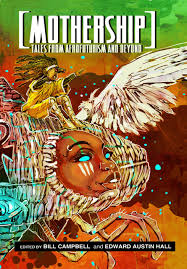 When I finished reading the first story in Mothership, a little voice in my head said “Was that really the story to start this anthology with? I mean, sure it’s got a black protagonist, but is that enough?”
And then the rest of me took a step back, looked horrified, and said: “Have you learned nothing from Pam Noles’ essay “Shame”? And from the entire Kaleidoscope project? The story has a black protagonist. That’s entirely the point.”
And then I sat, aghast at my own white ignorance, and felt ashamed.
And then I kept reading, because that’s the obvious way to combat such an attitude and is at least part of the point of this project and why I supported its production.
There’s a really wide variety of fiction in this anthology. Some skirt the edge of being ‘speculative’ (Rabih Alameddine’s “The Half-Wall”) while others hurtle over the edge and throw themselves at it. I didn’t click with every story (Greg Tate’s “Angels + Cannibals Unite” really didn’t work for me, and nor did Ran Walker’s “The Voyeur”), but many of them were absolutely breathtaking.
Nisi Shawl’s “Good Boy” – one of the only stories that really qualifies for the ‘mothership’ appellation by being set in space – is a glorious fun romp.
“The Aphotic Ghost”, by Carlos Hernandez, did not go where I was expecting and was utterly absorbing.
SP Somtow’s “The Pavilion of Frozen Women” has a wonderful line in bringing together several quite disparate cultures and tying them together into a fairly creepy thriller.
NK Jemisin does intriguing things with the notion of online communities in “Too many yesterdays, not enough tomorrows.”
“Life-Pod” is Vandana Singh’s haunting reflection on family and identity and connection.
In “Between Islands,” Jaymee Goh suggests how different things might have been for the British in colonising Melaka and surrounds with different technology…
Tenea D Johnson’s “The Taken” is a profound reflection on contemporary issues and problems stemming from the historical transportation of enslaved African to America… I don’t even inhabit the culture that’s dealing with it.
One of the intriguing things about this anthology is that it’s not focussed on African-American fiction, which I had basically expected thanks to the title’s reference to P Funk and Afrofuturism. Instead, there are stories here that draw on Egyptian, Native American, Caribbean (I think? I’m Australian, sorry!!), Japanese and Malaysian (again, I think) traditions and cultures – and those are just the ones that I (think I) could identify. There are definitely others that draw on other Asian cultures (I think there’s an Indonesian one?). The author bios don’t universally identify where the authors are from, so that doesn’t assist in figuring out what might have influenced them… which is not a complaint, by the way, because so what? (in the most prosaic ‘fiction is fiction’ sense). So it’s a really broad understanding of what falls into “Tales from Afrofuturism and beyond” – much more inclusive therefore than, for example, many anthologies of the last few years, let alone decades.
This is an good anthology, period. That it’s exploring and accomplishing a particular political aim is icing on the cake. You can get it from Fishpond!

 Randomly Yours, Alex