The Falcon Throne
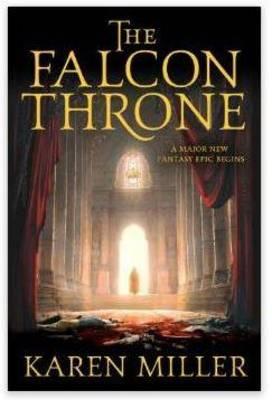 I received this book as a review copy from the publisher.
I am sad to announce that I abandoned this book. Mostly for “it’s me not you” reasons – although not entirely…
1. I’m really not in an epic fantasy kinda zone at the moment – and “at the moment” has lasted for a few years now (albeit with a few exceptions – though not many). So that counts against it for me – but for anyone who’s really in that mood, I think this is probably a good option. It’s certainly epic (in a good way!).
2. I’m not really a – argh, I don’t like the term – grimdark fan. And I’m pretty sure this counts as such. Others have compared it to A Song of Fire and Ice, and while I’ve only seen the show not read the books that sounds like the right sort of comparison. So the style is really not for me. I don’t mind bad things happening to characters, but there’s something about unrelenting unpleasantness – especially before I care about any of the characters – that frustrates and bores and annoys me. So that’s a style issue that is my problem, not the book’s.
Then there’s the style thing that I had an issue with, and it’s the way sex in general and women on occasion are described. I’m not a complete prude, although I guess I’m closer to that end of the spectrum than not, but there’s something about descriptions like “he’d have had the little wagtail pinned against a wall long since” (64) or “Aside from a writhing woman pinned on his cock, was there anything better in the world than a lance in his hand, a grand horse between his legs, and a man before him a handful of heartbeats from defeat?” (15) that leave me not just cold, but actively uncomfortable. As for the women – I got to about page 90, and most women by this stage are dead, useless, or conniving. The wet-nurse clearly has gumption and I hope she’s allowed agency and smarts, but that’s about it.
So there it is. Not a book for me. I am sad because it’s an Australian female author… but not sad because it’s an epic series I don’t have to get invested in so that saves me some time… but sad because I really don’t like abandoning books.
Kaleidoscope
 Declaring my connections: the publisher and half the editors of this anthology, Alisa Krasnostein, is a Galactic Suburbian with me; so is the author of the first story, Tansy Rayner Roberts.
I’m a lucky person because I’m white, and straight. I’m marginalised in fiction because I’m a woman who reads science fiction. I’m one of those female readers who long ago learned the trick of imagining myself with the fellas in the books I was reading – courtesy of all those Biggles books, mostly, and all that never-written-down fanfic of joining the Fellowship of the Ring (mostly to swoon over Legolas). So my emotional connection to the idea of needing diversity in fiction is somewhat less than, say, Julia Rios – one of the editors of this anthology – who notes that “As a bisexual Mexican-American woman, I didn’t see myself reflected very often in books I read as a child or teen…”. Nonetheless, I do get personally terrifically bored of straight while male characters, and I intellectually and ethically passionately support the need for diversity in all fiction. All of which is a long-winded way of saying that this project was a great one in theory, and has turned out to be a great one in practise.
Krasnostein and Rios got themselves an awesome set of authors to approach the idea of stories whose protagonists represent diversity, but where that diversity isn’t the point – it just is. Just like it should be in life. So this isn’t an issues book, and it’s not even really a themed anthology. There’s superheroes (hey Roberts, where’s that novel?) and d-mat transportation and mythology and aliens. There’s neurodiversity and mental health issues and gender and sexuality questioning and non-whites! and teens being teens and why haven’t you bought it yet?
I’ve noted before my assumption that picking the first story of an anthology must be hard. I say this with no reference to Tansy being a friend: “Cookie Cutter Superhero” really does deserve to springboard more stories. A universe wherein machines to create superheroes have appeared around the world? Where different countries take different routes to figure out who gets to use it, and the machine decides what they’ll be like? Seriously. Someone get that woman a contract and option the TV rights. And Roberts setting this in Sydney, casually mentioning the indigenous superhero who refused the media’s attempt to make him tribal, and our soon-to-be-superhero lacks a hand and it’s not the focus of the story… everything is right about this story. Up to and including the ending.
There are other stories in the anthology too. Sean Williams throws in a story set in his Twinmaker world, and it’s mighty fine. Gabriela Lee’s “End of Service” is a bit creepy both for the SF elements and for its real-world elements. Faith Mudge’s “Signature” is wonderful and not only because it reminded me strongly of The Changeover which is a pretty sure way to my heart. I hadn’t read a new Dirk Flinthart in a while, so finding “Vanilla” in here was a delight. The title suggested one thing, especially with the discussion around identity and what being a ‘proper’ Australian, or Somali, or Somali-Australian actually means… and then it turned out to have another meaning as well. Karen Healey’s “Careful Magic” is a bit Holly Black, and all awesome. I should not have read Sofia Samatar’s “Walkdog” in public – let that be a warning – I love her use of footnotes, and the eccentric spelling works beautifully, and the format does too. It’s not often you see Celtic mythology get utilised in a story, and Amal El-Mohtar does so wonderfully in a story about owls and displacement.
This isn’t a complete list, by any means. There’s also Jim Hines, Ken Liu and John Chu, Shveta Thakrar and Alena McNamara, and a bunch of others coming at the notion of diversity in YA from different points. As a reader, therefore, thanks to everyone who helped get this anthology off the ground – this is a great book that should do the rounds of every YA reader you know.
You can get this from Twelfth Planet Press direct – Australian release coming in October!
Galactic Suburbia 108
In which we level up in Gamergate, give away Kaleidoscope, and give each other Guardians of the Galaxy mix tapes. You can get us from iTunes or from Galactic Suburbia
TRIGGER WARNING: discussion of virtual attacks and physical violence towards women.
Gamergate & Zoe Quinn:
Charles Tan does a breakdown: Understanding Gamergate.
The word of the day is: doxx
Kaleidoscope ebook giveaway – contact us via email or social media with a recommendation of a Kaleidoscope-esque YA book or short story in order to enter.
What Culture Have we Consumed?
Tansy: Guardians of the Galaxy, Please Like Me Season 2, Kaleidoscope, Sensation Comics featuring Wonder Woman, John Chu “The Water That Falls On You From Nowhere” yes finally, shut up.
Alex: Alias season 1; Planet of Exile, Ursula le Guin – and a whole bunch of essays, from Dancing at the Edge of the World and Language of the Night; Landline, Rainbow Rowell; Kaleidoscope; Anita Sarkeesian’s Women vs Tropes in Video Games; Guardians of the Galaxy as well; Radio Lab podcast
Alisa: Rocket Talk – interviews with Kate Elliott and Nora Jemisin; Kameron Hurley; Renay; Podcasts abandoned – This American Life and TED Talks; Frankenstein (Pemberley Digital), Guardians of the Galaxy
Please send feedback to us at galacticsuburbia@gmail.com, follow us on Twitter at @galacticsuburbs, check out Galactic Suburbia Podcast on Facebook, support us at Patreon (http://www.patreon.com/galacticsuburbia) and don’t forget to leave a review on iTunes if you love us!
Galactic Suburbia 107
In which, Alisa and Tansy debrief Alex on their Worldcon adventure: The Ritz, the books, the people, the Hugos, the ribbons, the concrete wasteland, and the jet lag. Get us at iTunes or at Galactic Suburbia.
Here are the magic stats from the Hugo Awards.
If you still don’t have your copy of Kaleidoscope, here are some places you can buy it.
Check out the full Ustream footage of the Hugo awards.
Tansy’s post-Loncon Jet Lag Links
Alisa’s Debriefs:
1 – Yarn Edition
2 – Dealer’s Room
3 – The Ritz
4 – The Hugos
Please send feedback to us at galacticsuburbia@gmail.com, follow us on Twitter at @galacticsuburbs, check out Galactic Suburbia Podcast on Facebook, support us at Patreon and don’t forget to leave a review on iTunes if you love us!
1968: a biography
 This book came out a decade ago. I think I’ve owned it for that same length of time – I seem to recall getting it as a freebie at some readers’ night at a bookshop. I’d adored everything else by Kurlansky that I’d read, so it seemed like a good deal at the time. And then it just… got lost in the pile of books that I own and haven’t got around to reading. As happens all too often. Plus, I overlooked it because after all, 1968 is really quite recent, yeh? And modern history… well, it’s just politics. And there’s more interesting stuff to read than politics.
I’m not sure what made me pick it up last week. Possibly something I’d been talking about with someone, or I wanted to check something. Who knows; doesn’t matter. What matters is I read the introduction and I was hooked. Kurlansky talks about four significant factors that made 1968 stand out: the example of the civil rights movement in the US speaking to a generation that felt alienated and who despised a war being waged by a massive nation against a small one, and all of it occurring at a time when television was becoming a potent force. It’s not a unique year – I’m sure you could write this sort of insightful ‘biography’ for most years, of the twentieth century especially. But it really is a significant year.
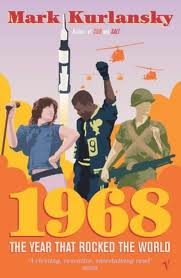
(A little quibble about the cover: the Rolling Stones aren’t mentioned, so why put Mick with either Tommie Smith or John Carlos, who used the Black Power salute at the Mexico Games, and a soldier in Vietnam, and a rocket? It doesn’t really make sense. If they wanted to symbolise the student movement, then surely Abbie Hoffmann or a SDCC poster or similar would have done the trick. It irked me. )
From the point of view of a historian, Kurlansky is quite open about the impossibility of his being completely objective, and in fact rejects the idea of any historian doing so. He was born in 1948 and hence experienced a little bit of what he’s writing about, especially the anti-Vietnam stuff. This comes through in how he writes, but how much that’s a problem is going to depend on how hungry you are for that impossibly elusive objectivity – and how hard you find it to sift the presentation of information to find whatever you think is ‘true’. I think that the medium for conveying the message is worth it, and you just read with that in mind.
And this book is worth reading both for the style – which is intensely readable – and for the content. Kurlansky eschews too many footnotes (and in fact makes that endnotes, and without numbers in the text), so it reads less like a formal history and more as an engaging narrative. Yes the historian in me occasionally frowned at some of the things he says without appearing to back it up. That’s what you get for more conversational-style history… and actually that suggests what this book is like: it felt more like the book of the series. I can easily imagine each of the chapters here being turned into an episode of television.
The absorbing nature of the narrative is aided by the astonishing story that’s being told. Bare bones: Martin Luther King Jr and Robert F Kennedy are both killed in this year; there are student riots/protests/movements all over the US and the birth/growth of significant student movements, as well as in France, Germany, Mexico, Poland and Czechoslovakia, sometimes accompanied by workers’ movements; the Olympic Games in Mexico; attempt at revolution in Czechoslovakia that’s put down by Soviet tanks; civil war in Nigeria; unrest in Israel; the Tet Offensive in Vietnam; Nixon winning the US election; Apollo 8; race issues, gender issues, political issues… . Yeh. It was a big year.
Kurlansky does a wonderful job of putting actions in different places in perspective – connecting them to one another. This is particularly true of the discussion around the student movement, which is really the heart of the book. And there’s something to be warned about: although there is quite a good discussion (IMO) of the Polish and Czech experience, especially, this is still at heart an American book. The Nigeria/Biafra ‘conflict’ is dealt with seriously and soberly, but it doesn’t get nearly as much air time as the attempts at student sit-ins around American universities. Is that a problem? Depends on what you’re wanting out of the book. And it depends on what you think actually made more of an impact around the world at the time, and since then. The by-line is “The year that rocked the world.” Did American students flagrantly defying authorities, and students being beaten by police, ‘rock the world’ more than a million people dying in Biafra? … unfortunately, possibly yes, for several reasons – not least of which is the one that Kurlansky himself spends quite some time discussing: television. There were cameras rolling when students got beaten in the streets of Chicago and New York. Not so much in Nigeria. Plus, the reality is that America had and continues to have more of an impact on world attitudes and trends that Nigeria does – for good or ill, in terms of ascertaining impact it doesn’t matter. My point is more that if you want a book that balances every country’s experience equally, this is not for you. It’s more than the history of one nation but less than a complete history of the world. So check your expectations first.
This is a really fabulous book for bringing out the important issues and the people of this one year. He sets the events and the people into context – casually dropping in Yasir Arafat and Bill Clinton, among others, for future connections, as well as giving background on Martin Luther King and the development of Palestinian identity and the Nigerian conflict and issues in Czechoslovakia. It’s not quite a history of the entire decade but it’s more than just a history of a year.
I love that this book ends with optimism. 1968 itself is such a torrid confusion of hope and despair that going from “racism, poverty, the wars in Vietnam, the Middle East, and Biafra” to the picture of our little blue and white and green marble, as seen from Apollo 8 going around the moon, seems peculiarly appropriate. And then to conclude with Dante – “Through a round aperture I saw appear / Some of the beautiful things that Heaven bears, / Where we came forth, and once more saw the stars.”
This book can be found on Fishpond.
The Tiptree Award Anthology vol 3
 I just love these anthologies. I love what it showcases – the diversity of what the different Tiptree panels have judged as falling into the category of ‘exploring and expanding gender,’ which is the remit of the Tiptree Award each year. I love that it shows diversity within the genre, full stop. I love that the anthologies don’t just have fiction, and don’t just have fiction from one or two years, but that there’s non-fiction and older works as well. And that the introduction and sometimes the introduction to each piece are interrogating themselves, the pieces, and the scene in general.
There’s a lot to love.
I’ve had this volume waiting to be read for aaaages. I thought it appropriate to read as I rode public transport on my way to interviewing Rosaleen Love – what I’ve read of her work fits into the broader milieu of the works represented here. As I read, I couldn’t believe that I’d allowed myself to leave this book festering on the shelf for so long.
The non-fiction includes an essay of Pam Noles’, called “Shame,” which struck me very deeply: about the experience of watching and reading science fiction as a person of colour, and not seeing yourself. Her dad sounds awesome: he called the movies she was watching “Escape to a White Planet,” and “Mars Kills the White People.” There’s an enormous amount in this essay that I, as a privileged white reader (gender does not trump race – it’s not a competition) probably need to read it again. Several times. And that the editors paired it with Dorothy Allison’s essay on Octavia Butler was very nice – the latter doesn’t talk all that much about race, more about Butler’s vision of women in the future, but the two are surely entwined… perhaps not especially in Butler, but certainly in Butler. And then there’s a letter from L Timmel Duchamp to Alice Sheldon/James Tiptree Jr, which is a lovely musing on what Sheldon/Tiptree as person and as author has meant to one individual.
Geoff Ryman looks at some possible consequences of the internet arriving in an out of the way village; Nalo Hopkinson goes domestic, sinister and mythological all in one hit; Margo Lanagan does weird weird things that I’m still figuring out in “Wooden Bride” – the story that, I think, gets the shortest introduction of all, since “some stories shouldn’t be introduced” and doesn’t that just describe all of Lanagan’s work? Aimee Bender’s “Dearth” is a devastating, heart warming, bewildering story about maternity and mothering… and I’ve just realised the protagonist is never named. And isn’t that a statement in itself. All of the stories so far were new to me, and Bender was a new name. And then it gave me Ursula Le Guin’s “Mountain Ways,” one of my favourites of her short stories. I can’t possibly pick a favourite story, because that would mean choosing between Le Guin and Ted Chiang: “Liking what you see: A Documentary” is another of his glorious mucking-with-structure stories in which the question about whether you should turn off the ability to see/appreciate beauty is presented as if as a transcribed documentary. And the fact that there are no visuals to accompany this story about visuals just adds to its power and general gloriousness. And for the editors to pair this with Tiptree’s “The Girl Who Was Plugged In” – well, I’ll admit that I did not reread the Tiptree. It was just going to be too raw an experience. So too was “Litte Faces,” by Vonda McIntyre, but I didn’t know that before going in. Deeply disturbing and weird (but not entirely in an unpleasant way), as well as powerful and impressive – and so very different. So, too, the final story – different that is, slightly less weird and disturbing – is “Knapsack Poems,” from Eleanor Arnason. She uses a character who is effectively distributed over eight bodies to tell a story of travel and experience, and I couldn’t help but be reminded of Ann Leckie’s Ancillary Justice. I’m not sure the similarities are much more than superficial, but they’re intriguing anyway.
This anthology works as something read from cover to cover in a sitting or two; it could be dipped into over months; it could be hopscotched. It should be read in any way you can.
The Sapphire Rose
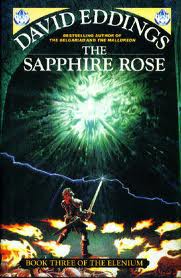 EDDINGS RE-READ: The Sapphire Rose, BOOK THREE OF THE ELENIUM
Because we just don’t have enough to do, Alex, Joanne and I have decided to re-read The Elenium and The Tamuli trilogies by David (and Leigh) Eddings, and – partly to justify that, partly because it’s fun to compare notes – we’re blogging a conversation about each book. We respond to each other in the post itself, but you can find Tehani’s post over here and Jo’s post here if you’d like to read the conversation going on in the comments. Also, there are spoilers!
ALEX:
Almost the very first page of this book has an Author’s Note, which says that the wife wants to write the dedication. And “since she’s responsible for much of the work,” he’s going to let her. Why don’t you just acknowledge the co-authorship, DUDE?
JO:
I don’t see the ‘David Eddings’ on the covers any more. In my mind, it’s ‘David and Leigh’ 🙂
TEHANI:
Of course, when I first read these I had no idea, but since finding out, it’s been an annoyance every time I picked up one of the books.
Also, I think this is the first of the books where we see a really intrusive breaking of the fourth wall by the author/s? For example:
The appearance of the detachment at the gate was, in Preceptor – ah, shall we say instead Patriarch – Darellon’s words, disgraceful. (p. 155 of my version).
ALEX:
The descriptions of Ehlana, who gets cured of the poison in this book, are beyond horrid. There’s “overpowering femininity,” and women being “notoriously adept” at recognising things like a ring being an engagement ring (did I miss that seminar? How DO you tell that a ring is an engagement ring? How do I know whether I’ve been stooged?). Ehlana is unbearable smug about “netting” Sparhawk. I will admit that the point about wavering between wanting to flaunt her “womanly attributes” and wanting to hide them is fair – and even perceptive – but it’s surrounded by so much URGH. And I’d like to say that I, for one, am glad that Sparhawk tried to get out of their marriage. I know that 17 years’ difference doesn’t HAVE to be a barrier, but there is SUCH a difference between the two of them.
TEHANI:
By the end of this book, I was starting to get an uncomfortable feeling about the number of very young girls who become obsessed with older men. And Aphrael’s manipulation with kisses is most disturbing!
JO:
Oh yes that’s definitely a thing in these books.
ALEX:
urgh.
JO:
And we meet Mirtai! Isn’t she an interesting character? Super-strong, super-warrior who is quite happy to be a slave. In fact, she insists on it.
TEHANI:
Mirtai is such a contradiction! Not always deliberately on the author’s part, I think… This bit really got up my nose on this reread though:
Mirtai’s skin had a peculiarly exotic bronze tinge to it, and her braided hair was glossy black. In a woman of normal size, her features would have been considered beautiful, and her dark eyes, slightly upturned at the corners, ravishing. Mirtai, however, was not of normal size. (p. 324 of my version)
SO. MUCH. WRONG. To begin, what the heck is “normal size”? And the “exotic” bronze tinge of skin and “slightly upturned eyes”? ARGH!
JO:
I should probably leave this discussion for Domes of Fire, because there’s not much Mirtai in The Sapphire Rose.
ALEX:
Jo – indeed – but yes, that exoticising is repellant. And the whole ‘normal size’ thing makes me cross-eyed.
In the last book there was the issue of being ‘misshapen’. I couldn’t help but notice that in this one, when the Pandions are being domineering of the Elenian council, there’s the pederast Baron and Lenda and “the fat man”. Does the fat man ever get named? Fat isn’t entirely an evil thing like deformity is, in these books – Platime is fat but approaches genius-ness on the council, Patriarch Emban is very clever, and both of them are good – but it’s still always mentioned. There’s barely a reference to Emban without mention of his belly. And he uses that sometimes – to defuse tension, for instance – but I’m still not entirely comfortable with it.
TEHANI:
That’s interesting though, because both Platime and Emban are important, good characters – not presented as useless or bad people, and so I guess I read that as subverting the trope? Although there is Otha…
JO:
Even though Platime and Emban are good and important characters, their ‘fatness’ is mentioned a lot. Like it’s a personality trait.
TEHANI:
Very true.
ALEX:
Speaking of the council, I would like to declare my sympathy for Lycheas. He’s a dimwit and a pawn, but surely he deserves sympathy.
TEHANI:
Oh, I disagree! He’s not very bright and he’s been led astray I accept, but I think he knew he was doing wrong, and there were times he could have chosen another path. He was as hungry for power as the rest of them!
ALEX:
Hmm. Perhaps. How much choice did he have with a mother like that probably poisoning him from the start? (If we accept the premise of the story.) … oh wait, does that shoot my theory down, at least somewhat, given that is probably exactly the reason why he’s hungry for power? Dang.
JO:
I think the Eddings set him up to be disliked, and he simply has no say in the matter. He’s always portrayed as snivelling and pathetic and stupid. He may or may not be hungry for power, it doesn’t matter. He’s there to be a lesser baddy that everyone can look down on and routinely threaten to kill.
ALEX:
You’re saying he’s just a narrative device? SAY IT AINT SO.
A rather chilling part of this novel is the utter lack of regard for the civilians in Chyrellos, during the siege. It was really quite unpleasant reading.
JO:
I find the siege so boring I have to say that never really bothered me. The scene that does stick in my mind is when Sparhawk and an unnamed soldier witness a woman dragged into an alley and quite obviously raped (though thankfully off camera). The soldier, crying because she ‘could have been his sister’ shoots the rapist. But then the woman staggers out of the alley, sees her not-quite-dead rapist, takes his dagger and violently finishes the job and steals his loot. The soldier ‘retches’ and Sparhawk says “Nobody’s very civilised in those circumstances”.
This scene was always a WTF moment for me. When you consider Sparhawk’s career, what about her actions make them ‘uncivilised’, exactly? He does much worse things to people and is rewarded for them! Is it because she’s a woman? Or because she’s not a Church Knight and it’s okay when they do it. Or because she took the loot? I mean, seriously…?
ALEX:
Yes!! This!! I was so ANGRY at that reaction from the men – who are safe on so many levels from this sort of thing – getting all uppity about her taking revenge. I don’t like her doing it either, but I don’t like the initial rape even more.
I cried at Kurik’s funeral. Not at his death – that all happened too fast, I think – but when I got to the funeral…well, I was glad to be by myself. However, I am still suspicious of the idea of Aslade being quite so accommodating of Elys.
JO:
Kurik *sniff* 😦
TEHANI:
And you know, none of that business really makes sense. Kurik is portrayed as steadfast, loyal, moral and really quite upright (even uptight?), so the fact he cheated on Aslade (and their four sons, essentially) is, well, just a bit weird. It was a useful way to have Talen important to the group, I guess, but the character path is very odd.
ALEX:
YES. Also it makes adultery completely fine, which… I know there are other ways of doing relationships than ‘conventional’ monogamy, etc etc, but not within THIS world’s framework – everyone else who does that is regarded severely. Whereas Sparhawk etc are all, “dude, no worries! Everyone sleeps around sometime, the wimmens is so attractive we can’t help it!”
JO:
YES from me too. Never felt right to me for exactly those reasons.
TEHANI:
I do like the way the Kurik’s sons talk about their “mothers” in the later books though. That said, remembering I read the Tamuli trilogy first, I was quite certain Aslade and Elys had been both married to Kurik, the way they are referred to there!
JO:
Heh yes. I can imagine. Although I was always proud of Aslade and Elys for being able to put aside their potential conflict and just get on with life. So often the relationships between women are portrayed as bitchy, jealous, spiteful things. And usually its over the attention of a man. So I appreciate that they went down the opposite path.
Actually, in the Tamuli there are a lot more examples of strong female friendship too.
TEHANI:
Some more perpetuation of stereotypes here, too. In this case, the temper of the red-head:
In Delada’s case all the cliches about red-haired people seemed to apply. (p. 282 of my version).
JO:
Yeah I thought they got a little carried away with that!
TEHANI:
And what the heck is this bit of elitism? Stragen says, Whores and thieves aren’t really very stimulating companions… (p. 410 of my version). Um, well Talen and Platime AND HIMSELF are thieves and all presented as quite stimulating! The whores get a poorer presentation, but still!
ALEX:
That bit also made me very cranky. Again with the superior attitude.
TEHANI:
And this awful bit of Ehlana characterisation:
“Would you all mind too terribly much?” Ehlana asked them in a little-girl sort of voice.
YUCK! The woman is a queen, and fully in command of herself and the power she wields, yet she resorts to that (for no reason, anyway!)?! No! We talked a bit about this in one of the earlier reviews, how the women themselves are supposed to be powerful, and there are quite a lot of them, which is nice, but the actual presentation of them really undermines this at times.
JO:
Yes! This is what’s been irritating me the whole time, and it only gets worse as the series goes on. Doesn’t matter how strong a woman is, she still resorts to hissy fits and theatrics or childishness to either get what she wants, or basically keep control of the ‘relationship’. Even Sephrenia does it in the later books! It just feels to me like the books believe that deep down, women are irrational children. OR that they will resort to acting like them as a way of keeping their men in line.
JO:
Am I the only one who finds Ehlana’s speech to the council a little…difficult to believe. All these supposedly hardened politicians/Patriarchs completely suckered in by her ‘divinely inspired’ speech? Just because she’s pretty, or something? And because she ‘fainted’?
TEHANI:
I have such a different view of the Patriarchs to you! I always read ANY of those political gatherings as being a bunch of little boys just grabbing for power, none of the “hardened” politicians at all! In fact, Eddings seems to have very little respect for political systems at all. They’re all corrupt or useless!
ALEX:
I don’t think they’re MEANT to look like that, but they sometimes do – and it’s another thing that annoys me about the Eddings portrayal of religion, because it’s JUST another instance of politics and again there’s so much uselessness and cunning and unpleasantness. Also, Ehlana manipulates them, and I think it manages to make her look silly – conniving and dangerous with the using feminine things in dangerous ways – AND it makes the Patriarchs look silly for falling for such obvious, feminine strategies. Way to go for insulting two groups there!
JO:
Last time I said that I found The Ruby Knight a lot faster-paced and more enjoyable than I remembered. I have to say the opposite for The Sapphire Rose. Oh god I was so sick of the siege by the time it ended, and it seemed to take forever to get to Zemoch. It felt like so much padding. Just destroy Azash already!
TEHANI:
Some excellent examples of Faran the human horse again:
Faran made a special point of grinding his steel-shod hooves into a number of very sensitive places on the officer’s body.
“Feel better now?” Sparhawk asked his horse.
Faran nickered wickedly. (p. 155 my version)
JO:
I could summarise the plot again but you probably don’t want me to do that this time!
They cure Ehlana. She’s all grown up now and in love with Sparhawk. They ‘accidently’ get engaged. Off to Chyrellos to stop Annias being elected Archprelate. There’s a siege which goes on forever. Then Wargun and Ehlana turn up and the siege is over. Ehlana and Sparhawk get married. They go to Zemoch with Bhelloim to kill Azash. It takes forever. They get to Zemoch. Kurik dies. Martel dies. Otha and Annias die. Azash dies. Lycheas dies. Arissa kills herself. They return to Cimmura. Everything’s peaceful, but kinda crappy, because the gods are shell-shocked by Azash’s death. Danae happens. Eventually, Aphrael and everyone go on holidays and spring returns.
ALEX:
Nice work there, Jo. I would add: Sparhawk and Ehlana get married in the same way that a person might buy a horse; Martel dies but everyone’s real sad, because actually he was decent and just led astray, y’know? And “Danae happens” means that a goddess is incarnate in a different racial family and that’s really kinda cool.
JO:
Heh, that’s awesome.
TEHANI:
Well, we’ve picked a lot of nits in the Elenium books, but final verdict on the first three? For me, I have to admit I still thoroughly enjoyed reading them, with grins and tears throughout, and the comfy blanket feeling of an old favourite that still (mostly) holds up. Although there were definitely a lot more grimaces at the rough patches than when I was younger!
ALEX:
I think I feel basically the same as you, Tehani. It really is a warm comfy blanket… with moth holes and a few scratchy bits… but a lot of love and memories holding it together.
JO:
Couldn’t agree more! I might snipe at them, but I still love these books and rereading them has been thoroughly comforting. It also reminds me what I love about reading and writing in the first place. It’s just so much fun!
Snapshot: Kirstyn McDermott
Kirstyn McDermott has been working in the darker alleyways of speculative fiction for much of her career, with many critically acclaimed and award-winning short stories under her authorial belt. Her two novels, Madigan Mine (Picador, 2010) and Perfections (Xoum, 2012) both won the Aurealis Award for Best Horror Novel in their respective years, and a collection of short fiction, Caution: Contains Small Parts was published by Twelfth Planet Press in 2013. Both her novels are to be reissued by Twelfth Planet Press in 2014 – Perfections for the first time in print. When not wearing her writing hat, she produces and co-hosts a bimonthly literary discussion podcast, The Writer and the Critic, which generally keeps her out of trouble. After many years based in Melbourne, Kirstyn now lives in Ballarat with her husband and fellow scribbler, Jason Nahrung.
1. Congratulations on “The Home for Broken Dolls” picking up a Ditmar this year! You said at the time that it was a horrible story and seemed surprised that it won the award… how hard a story was it to write?
Thank you very much, I was so pleased with the Ditmar! Emotionally and psychologically, “The Home for Broken Dolls” was the hardest story I’ve ever written due to the nature of the research involved, and the need to stay intimately connected to all of that, to remain open and not inured to it, during the year or more I was working on the piece. Technically, it was difficult as well. The tone of the novella very much reflected the protagonist, Jane, so the writing itself needed to be calm and controlled and, to some extent, distant, almost clinical in its observations and descriptions. It was a departure in style for me from a lot of the work I’d done in the past, a commitment to a type of minimalism that was quite confronting. When you’re writing such sparse, deliberate prose, there really is nowhere to hide, artistically speaking. I actually learned a lot about myself as writer from working on “Dolls”, although, for various reasons, I didn’t actually compose another word of fiction for more than a year afterwards.
2. Twelfth Planet Press recently picked up and published Perfections, which is really exciting. What’s it like to have a book given a second outing?
Exciting is definitely the word – and it’s such a relief to see it published again, especially in print. The amount of people who asked about the availability of a paperback when it was only a digital release was heartbreaking. I’m exceedingly grateful to Alisa from Twelfth Planet Press for picking Perfections up, dusting her off, and sending her out into the world with a swank new party dress! It’s a novel I’m very proud to have written, even if it did steadfastly refuse to be the novel I thought I wanted to write for much of its creation. It’s funny, but when I was proofing the manuscript for re-publication, I started to see some precursor themes and ideas – and even stylistic notes – that would later become core elements in “The Home for Broken Dolls”. I guess my own personal obsessions and concerns are never really far from the surface . . .
3. What are you working on at the moment? Do you have lots of stories waiting impatiently to be told, or do they form an orderly queue?
I’ve started a PhD this year, so my creative work for the near future will be in that arena. I’m writing a suite of short fiction that I think of as post-fairy-tales – the stories of what happens after the fairy tale ends, when the fairy tale girls become women. And because I’m also doing oodles of research on fairy tales, I actually do have a whole bunch of stories percolating in my mind right now, some more ready to be told than others. There’s no queue as such – I only ever really work on one story at a time, so whichever one is speaking the loudest once the current work in progress is finished will get my attention. I’ve spoken in the past of how I see my creative process as akin to walking around a junkyard, finding interesting bits and pieces and putting them in my pocket for later. After a while, sometimes after many years, I’ll stumble across a piece that fits with two or three others I have and – voila! – there’s a story to be written. It’s still the same process now, I suppose, only I’m exploring a much larger junkyard at the moment, my searching is a little more targeted and I’m finding a whole lot more interesting bits and pieces!
4. What Australian works have you loved recently?
I’ve been catching up on story collections over the past year and have been so damned impressed by the wealth of talent we have here in terms of short fiction writers. The Bride Price by Cat Sparks, The Bone Chime Song and Other Stories by Joanne Anderton, The Year of Ancient Ghosts by Kim Wilkins, and Asymmetry by Thoraiya Dyer are all absolutely sterling books, imaginative and intelligent and exactly the kind of eclectic speculative fiction that I adore. Very recently, I read Dead Americans by Ben Peek, a collection I had been looking forward to for ages and which was well worth the wait – I’m even more keen to get my hands on his upcoming novel, The Godless, now.
5. Have recent changes in the publishing industry influenced the way you work? What do you think you will be writing in five years from now?
I can’t say that any recent changes in publishing have affected how I work to any significant extent. I realised quite a few years ago that I’m not a highly commercial writer and – barring some miraculous confluence of events – the kind of writing that I do, the kind of writing that I am interested in doing, will never really be highly commercial. So I’m never going to have a writing career that will pay a mortgage but, on the other hand, I’m never going to have to rely on a writing career to pay a mortgage. Swings and roundabouts. I do find the recent developments in crowdfunding and regular patronage models fascinating, though, and I love the idea that this is where the former “midlist” might find a home, with a direct connection to a readership. That would be a model I might be tempted to consider in the future, if I had the right project for it.
As to what I see myself writing in five years from now, I haven’t really thought about it. Barring incident, I’ll be finished my story suite and PhD by then so who knows? There is a quasi-SF novel that’s been loitering about in the junkyard for a while now and I might have found enough pieces to start putting it together by then. Or the Dolls might have finally convinced me to write their novel, or else I might have stumbled across some other compelling idea that I can’t put down. Five years is such a long time. As long as I’m still writing, and developing as a writer, I’ll be happy.
This interview was conducted as part of the 2014 Snapshot of Australian Speculative Fiction. We’ll be blogging interviews from 28 July to 10 August and archiving them at SF Signal. You can read interviews at:
Galactic Suburbia 105!
 This episode of Galactic Suburbia is brought to you by the flavour vanilla and the colour of fairytales. You can get us from iTunes or at Galactic Suburbia.
News
Drowned Vanilla Cover reveal – order the book at the publisher’s site.
Tansy’s Drowned Vanilla Pinterest board
Wiscon Update
Aussie Spec Fic Snapshot is on again.
What Culture Have we Consumed?
Tansy: Go Bayside (April Richardson); Breaking Bubbles; Dimetrodon, the Doubleclicks; First 3 Harry Potter movies, The Prisoner of Azkaban
Alisa: Squaresville; The Secret Diary of Lizzie Bennet; What book will she discard?
Alex: The Elenium and The Tamuli trilogies, David Eddings; Snowpiercer; Reality Dysfunction, Peter F Hamilton; Extant
Please send feedback to us at galacticsuburbia@gmail.com, follow us on Twitter at @galacticsuburbs, check out Galactic Suburbia Podcast on Facebook, support us at Patreon (http://www.patreon.com/galacticsuburbia) and don’t forget to leave a review on iTunes if you love us!
Snapshot 2014
Snapshot has taken place four times in the past 10 years. In 2005, Ben Peek spent a frantic week interviewing 43 people in the Australian spec fic scene, and since then, it’s grown every time, now taking a team of interviewers working together to accomplish!
In the lead up to Worldcon in London, we will be blogging interviews for Snapshot 2014, conducted by Tsana Dolichva, Nick Evans, Stephanie Gunn, Kathryn Linge, Elanor Matton-Johnson, David McDonald, Helen Merrick, Jason Nahrung, Ben Payne, Tansy Rayner Roberts, Helen Stubbs, Katharine Stubbs, Tehani Wessely, Sean Wright and me. Last time we covered nearly 160 members of the Australian speculative fiction community with the Snapshot – can we top that this year?
To read the interviews hot off the press, check these blogs daily from July 28 to August 10, 2014, or look for the round up on SF Signal when it’s all done:
http://crankynick.livejournal.com/tag/2014snapshot
http://bookonaut.blogspot.com.au/search/label/2014snapshot
http://www.davidmcdonaldspage.com/tag/2014snapshot/
http://fablecroft.com.au/tag/2014snapshot
http://helenstubbs.wordpress.com/tag/2014snapshot/
http://jasonnahrung.com/tag/2014snapshot/
http://kathrynlinge.livejournal.com/tag/2014snapshot
http://mayakitten.livejournal.com/tag/2014snapshot
http://www.merwood.com.au/worldsend/tag/2014snapshot
https://randomalex.net/tag/2014snapshot/
http://stephaniegunn.com/tag/2014snapshot/
http://tansyrr.com/tansywp/tag/2014snapshot/
http://tsanasreads.blogspot.com/search/label/2014snapshot
http://ventureadlaxre.wordpress.com/tag/2014snapshot/

 Randomly Yours, Alex