Galactic Suburbia 104
In which we gaze into the World of the Future with a double dose of Culture Consumed and Culture Yet To Consume. Get us at iTunes or Galactic Suburbia.
Culture We Are Looking Forward To
Alex: new James SA Corey; Isobelle Carmody’s last Obernewtyn novel; every TPP; Guardians of the Galaxy; Snowpiercer; Saga.
Tansy: The Goblin Emperor by Katherine Addison; Kameron Hurley, The Mirror Empire; Ben Peek, The Godless; Sailor Moon
Alisa: Extant
Culture We Have Consumed
Alisa: Twinmaker, Sean Williams
Alex: holidays!! Diaspora, Greg Egan; The Reluctant Swordsman, Dave Duncan; James Tiptree Award Anthology 3
Tansy: The Secret Diary of Lizzie Bennet.
Please send feedback to us at galacticsuburbia@gmail.com, follow us on Twitter at @galacticsuburbs, check out Galactic Suburbia Podcast on Facebook, support us at Patreon and don’t forget to leave a review on iTunes if you love us!
The Diamond Throne
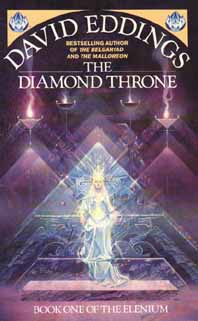 EDDINGS RE-READ: The Diamond Throne, BOOK ONE OF THE ELENIUM
Because we just don’t have enough to do, Tehani, Joanne and I have decided to re-read The Elenium and The Tamuli trilogies by David (and Leigh) Eddings, and – partly to justify that, partly because it’s fun to compare notes – we’re blogging a conversation about each book. We respond to each other in the post itself, but you can find Tehani’s post over here and Jo’s post here if you’d like to read the conversation going on in the comments. Also, there are spoilers!
TEHANI:
I was feeling a little book-weary yesterday so thought I might as well start my reading for this conversational review series, given it’s usually a soothing experience. Within a single PAGE, I was reaching for Twitter, because SO MUCH of the book cried out to be tweeted! Great one-liners, the introduction of favourite characters, and, sadly, some of the not so awesome bits as well. I was having a grand time pulling out 140 character lines (#EddingsReread if you’re interested), but the response from the ether was amazing! So many people hold these books firmly in their reading history, and it was just lovely to hear their instant nostalgia.
ALEX:
And I read those tweets and everything was SO FAMILIAR that I immediately started reading as well. And finished a day later.
JO:
Ok. A) You people read too quickly! B) Tehani those tweets were enough to start me feeling all nostalgic. I was in the middle of cooking dinner and had to put everything down, run upstairs and dig the books out of their box hidden in the back of the wardrobe.
TEHANI:
I am not at all repentant! 🙂 Also, did you both find this a super easy read? Is it the style, or just that I’ve read it several times before? It really was like sinking into a warm fluffy hug, hitting the pages of this book again. I actually can’t remember the last time I read it, but it’s got to be over a decade, yet I felt instantly at home again. Eddings was one of the authors who caused my addiction to the genre, and even in the very first chapters, it’s easy to see why. The light and breezy writing style is instantly accessible, and the way we’re thrown straight into the action, with our hero Sparhawk leading us through, makes the book start with a bang.
ALEX:
Reading that first page was a little bit like going back to my high school, many years after graduating. It just felt so familiar, and comfortable. And like high school, I know it’s not without problems – but it’s still somewhere that has a lot of ME wrapped up in it. I also don’t remember when I last read these, but it’s not for aaaaages… And yes, super easy to read. TOO easy! ;D
JO:
Oh yes, absolutely. As soon as I started reading it all came back to me. I remembered the moment I found The Diamond Throne in the library, and the first chapter and intro of Sparhawk hooked me instantly. While I think as a teenager I identified the most with Polgara from the Belgariad (I wanted to BE her) I have always loved Sparhawk.
ALEX:
Polgara is still one of my absolute favourite characters! Sparhawk is too, though – one of the great characters for me in my early teen years. I adored that he was older, and cynical, and world-weary. When I was 14 I thought I was all of those things…now that I am 34 I still absolutely empathise! This story also shows that his cynicism is cut with a very large streak of sappiness, which I think serves to make him just a bit more relatable. His love for Sephrenia, his respect for Vanion and Dolmant and Kurik – he’s actually a fairly well-rounded character, as these things go. His habit of calling people ‘friend’ and ‘neighbour’ is why I call everyone ‘mate’ to this day. True story. I also adore the relationship he has with Faran, that ugly roan brute; I love Faran unconditionally.
TEHANI:
He is so pragmatic, completely prepared for violence at all times, and yet from the very early pages where he gives the street girl some coins and calls her “little sister”, we see he’s an absolute marshmallow inside. I’m with you Alex, I adore him.
JO:
I have an admission to make. I still love him, but Sparhawk’s making me a little uncomfortable in this reread. For all his neighbours and his giving money to the scrawny whore, I’m starting to feel like he’s a bit of a bully. He gets what he wants because he can and does threaten violence if he doesn’t get it…and it feels like Eddings thinks this is ok because he’s Sparhawk. He’s a Pandion (not only a Pandion but the best of them, as we are repeatedly reminded) and the people he threatens are ‘evil’ anyway so no harm done… I dunno, it’s just made me feel a bit squeamish this time round.
TEHANI:
That’s a really good point. I’ve had a similar discussion with my Doctor Who reviewing buddies Tansy and David about David Tennant’s Doctor – he does and says some pretty awful things, but we accept it generally without question a) because he’s the Doctor, but more importantly b) because David Tennant plays him so charismatically. Sparhawk has the same sort of issues – we know (or are given by the narrative to believe) that he’s on the side of right, and that he is the Champion, therefore we accept his behaviour because it’s presented as being for the right reasons.
ALEX:
*sigh* you are of course both correct – Sparhawk’s use of “might is right” is totally accepted by the novel because he is so awesome. And if that’s not an abuse of power, right there, then nothing is.
On a more positive note, I think I like all of the other characters, too. Sephrenia is delightful although definitely not rounded out enough here…and I do have a problem with her “we Styrics are so simple and you Elenes are so complex” thing. I want to believe that she’s just serving back to the Elenes what they believe about themselves, so that she can manipulate them, but I’m not sure if that’s knowledge of the rest of the series or wishful thinking (more on that below). Talen is already totally amusing and reminds me a lot of Silk, from the Belgariad, which is unsurprising. The Merry Men really are dreamy; Ulath and his blonde plaits will always be my favourite, because who doesn’t love the quiet cryptic type?
TEHANI:
And I adore Kalten, because he’s always needling Sparhawk yet they clearly love each other. Talen was a definite favourite from early on too, and Kurik is marvellous – a definite father figure, or maybe more an uncle…
ALEX:
The classism and the racism…ouch. The Rendors are meant to be Arab analogues, right? Because everyone knows that living in the heat makes your brain go soft. OUCH. Also, why have I always thought the Styrics were analogues for Jews? Is it just that the Elenes burning their villages is frighteningly similar to pogroms in Christian Europe in the Middle Ages? (But of course there’s no religious similarity at all, and the only ‘real’ similarity is the refusal of pork.)
JO: I always thought that about the Styrics too.
TEHANI:
Oh yes, that was the first thing I picked up on in terms of the negative stereotypes – completely over my head when I read these in my late teens, front and centre now. I actually wrote a uni paper on representations of reality in Eddings and Feist, but I’ve sure learned a lot since then! I could easily IDENTIFY the real world correlations, but did I notice the negative aspects of this? No I did NOT. *sigh* Bad past me, bad!
This time around, the classism was just as interesting too – I think I was so indoctrinated into the usual process of high fantasy in my 20s that this would never have even occurred to me to see. This time though, Sephrenia’s derision about the intelligence “common” Elenes and Styrics is, ugh, just awful. And when it’s other races as WELL as commoners, well, that’s terrible.
ALEX:
The class aspect is ugly as all get out. When they’re in the council chamber confronting Vanion, Dolmant – the lovely, gentle Dolmant – says why believe an untitled merchant (his words!) and a runaway serf over and above the honorable Preceptor (code: titled)? Now we know that those are both lying, but that’s beside the point. I dunno, Dolmant, maybe because truth and honesty aren’t actually the privileges of the wealthy and titled?
JO:
Oh goodness yes. I have to admit this is something that passed me by the first time I read these. Maybe because in the world Eddings writes it does feel so natural. Which is disturbing.
TEHANI:
It really is, isn’t it! And once you see, you can’t unsee…
ALEX:
This is one of the first real instances I remember of the Crystal Dragon Jesus trope – taking what can be broadly recognised as a version of the medieval Catholic Church and transporting it to a secondary fantasy world.
TEHANI:
I’ve not heard of the “Crystal Dragon Jesus trope” – please elaborate?
JO:
Neither have I!
ALEX:
Instead of creating your own religious system for your magical fantasy world, you take the broad brush strokes of (usually) the medieval Catholic Church – because hey, everyone knows that medieval stuff is bad, plus Catholics are easy to laugh at, right? It generally involves a monotheistic religion with a convoluted hierarchy, seemingly-pious churchmen (and only men) who are meant to be celibate but often aren’t, because that also makes them easier to turn into evil characters. The only thing that the Eddings missed is the saviour/messiah/ someone who sacrificed themselves bit, of the religion. It irks me because it is so lazy.
JO:
I did not know there was a term for that 🙂
ALEX:
Tehani, you said there was a Lord of the Rings reference early on – did you mean Ghwerig the Troll-Dwarf being like both Sauron and Gollum, with the whole rings thing? (Also, how did Ghwerig ‘casually’ smash a diamond?) There’s also a Hamlet reference, at the end, when Sparhawk comes across Annias praying in the chapel and chooses not to kill him.
TEHANI:
Yes, exactly! I missed the Hamlet reference, and I think there were a couple of others in there!
I could hand-wave the diamond smashing – I figured if he was working under the influence of the gods, he could pretty much do anything!
JO:
You know, there’s a lot of repetition in this book. It almost feels like any time anything happens, it has to be reported back to the group in the next scene, and discussed. Same goes for any time they meet a new character, we have a recap of events up until this point. All done with amusing dialogue, of course. But still!
TEHANI:
You’re right, but it’s so breezily written I hardly notice it! I do quite like the way travelling actually takes a significant amount of time, even when that slows down the action.
ALEX:
Thanks to your tweets, Tehani, I noticed every single time the word ‘peculiar’ was used.
JO:
By the end there I was getting a little sick of “I’m (terribly) disappointed in you, ___.” Or something similar. I noticed it a couple of times then couldn’t unsee it!
TEHANI:
Yes, Eddings has several “tics” of writing that once you notice them, you ALWAYS see them! “Flat stares” are my favourite 🙂
JO:
Particularly when they come from Faran. I love that horse and his flat stares.
TEHANI:
That horse is practically human.
ALEX:
That horse and his prancing make me happy.
JO:
I’m having a strange and conflicted reaction to the female characters in these books. On the one hand, they are such wonderful strong people. Sephrenia is powerful, but that’s almost not what makes her strong – rather her pacifism compared to the bloodthirsty knights around her, and her determination to do her duty to her goddess. And her relationship with Vanion. Ehlana’s still encased in diamond at this point, but the effect she had on Sparhawk pretty much says it all! Even Arissa has her own desires and knows her own mind. But…but… I dunno, something feels off to me. Maybe because there are few of them? Maybe Lillias’ rather large hissy fit soured it all for me. I just don’t know. Would love your reactions.
TEHANI:
I actually thought the Lillias thing was reasonably well handled – it was made pretty clear it was a cultural “norm” rather than her personal feelings, which made it okay for me, I guess. The female characters are interesting though; I wonder if it’s because they are constantly stamping their feet at the men and pretending to be less powerful than they are to get their own way that’s the problem? Possibly I’m getting ahead of myself though – this is only the first book!
ALEX:
I loved Lillias’ melodramatic turn – and that Sparhawk played to it for her sake. I am conflicted about Sephrenia: are the knights looking after her because they love her, or because they see her as weak? Or is that an “and” situation? I don’t like Arissa but I admire her strength. For me, I think it’s that this is such a boys world the women feel a bit out of place. The other female character of course is Flute, and she’s quite funny, but one thing I wanted to point out: she ‘somehow’ escapes the convent where they leave her, and meets the crew further on…and no one goes back to tell the convent she’s ok?! Seriously??
TEHANI:
Don’t look too hard Alex, there’s all SORTS of little nitpicks like that! I think we’re almost ready to move on to the next book. I don’t suppose it really matters that we’ve not talked about the plot, right? It’s your basic high fantasy quest, with lashings of barriers thrown into our hero’s journey, a cast of thousands (seriously, it gets quite large in the end…) and lots fun dialogue that means you completely don’t notice that sometimes nothing really happens for several pages *cough chapters cough*.
ALEX:
Things happen! Characters develop! Banter is committed! 😀
JO:
Yeah, what more could you possibly want? Lots of riding horses to get to places. Things go wrong for our heroes all the time. I do think Eddings is good at that in particular. Just when you think they might finally achieve something, *bam* something goes wrong. Usually involving Martel. And yes, lots of banter. Banter is awesome.
TEHANI:
Hey, have you two seen this? http://42geekstreet.com/fantasy-casting-agency-the-diamond-throne-the-elenium/
ALEX:
omg. How awesome. One big nitpick: they CANNOT make David Wenham Martel! Nononononono. No. Kalten maybe?
JO:
LOL ‘who could play Sparhawk in a movie’ is my husband’s favourite pastime. It drives me nuts.
Also, Gerard Butler? Gerard Butler? That’s it, I quit the internet. *walks away from the internet*
TEHANI:
What’s WRONG with Gerard Butler! *wanders off whistling* See you both back here for the next exciting instalment of our reread!
The Reluctant Swordsman
This is not the sort of book I would have picked up of my own accord. But a friend loaned me the entire series, and I felt obligated to give it a go, since we usually have similar tastes.
 This is a fairly standard portal fantasy. The main character is dying in our world and then wakes up in the body of a remarkable swordsman in another. Intriguingly, we get very little of Wallie’s life in the ‘real’ world. We know he’s an engineer, has no family, and… that’s about it. The focus is entirely on The World.
Of course, the swordsman/Wallie has a task to complete, and there are many and significant obstacles to that. This book is basically a getting-the-band-together story, as Wallie figures out what he has to do (which he doesn’t really know even by the end of the novel), and gets his people together – an appropriately motley group for an unlikely hero (well, an unlikely hero’s mind, anyway).
Wallie himself I am largely indifferent towards at this stage. He’s an excuse to explore different aspects of the world, and question some of its aspects (more on that later). He’s approachable enough, and hasn’t done anything quite as repellant as Thomas Covenant manages in his first fifteen minutes. Of the other characters, his sidekick has a phenomenal memory and developing sword skills; his slave girl will hopefully develop a personality; and the elderly priest is the one that I hold out most hope for, of being snarky and clever.
The novel suggests a world where gods exist and interact with people – sometimes – and although I guess a direct intervention from a god would have an impact, I found Wallie’s change from sceptic to fervent believer a bit fast. I am interested to see how this aspect develops. I’m also intrigued by the notion of unstable geography which strongly connects to the idea of the Goddess; I think this may be the most interesting facet of the world building so far. The rest of the world building… well. There’s slaves, and Wallie reacts strongly against this initially, but he does then go and buy one. Admittedly he does so for noble reasons, and he really likes her, honest!… still. That’s playing into the system, right? There could have been more conscience wrestling about that. And any moral objections raised are rather undercut by Duncan later in the novel when another character buys a slavewoman entirely based on her voluptuous appearance, and this is upheld as humorous in the first instance and then later as advantageous to the plot. This is a problem for me.
I may read the next one, just to see whether Duncan manages to do anything clever or original. I’m not really holding out much hope, to be honest. It would probably have been an enjoyable book when I was 15, but now I’m feeling a little bit too cynical and well-read.
Diaspora, Greg Egan
The same caveat applies to this book as to every other Egan novel. If you are neither inherently fascinated by mathematics and physics taken past the bleeding edge, nor willing to tolerate possibly pages of physics discussion that you don’t get, then don’t read this novel. It’s not the book, it’s you – and that’s ok, it’s just not worth your while getting frustrated.
That said, if you’re willing to dive in, I think this is another of Egan’s awesome novels. Spoilers coming.
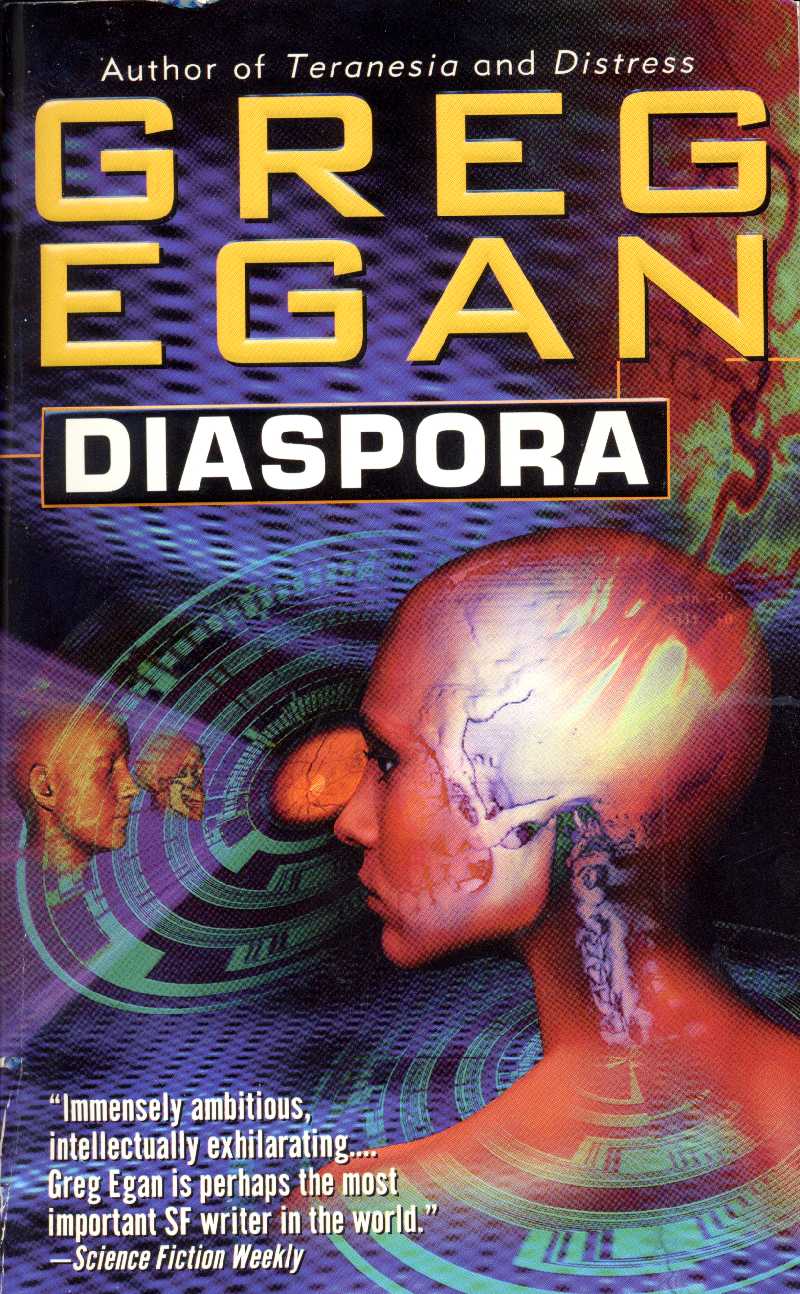 The premise is that at the end of the 30th century, there are some humans we would see as ‘normal’ – called fleshers here; there are more ‘people’ who inhabit the polises, which are basically massive computers – so yes, they’re virtual, from our current perspective. And there are also gleisners, who inhabit robot bodies. The plot is driven by the perspective of a couple of polis citizens; indeed it begins with the creation of an ‘orphan’, a citizen in a polis created with no input from any parental guidelines but by the polis itself, basically to test new possibilities. This orphan, who becomes Yatima, is a primary protagonist.
Some reviewers over on goodreads have been frustrated by the lack of fiction, or plot, in this story, and I can see where they’re coming from. However, there is a plot, and even if sometimes it takes something of a backseat to the ideas – well, that’s kinda the deal with an Egan story. But it’s not superfluous in any way. So what is it? Well, a gleisner astronomical survey indicates that two neutron stars are about to collapse into each other, several million years earlier than they ought to. They’re frighteningly close to the earth, and it does indeed do very bad things to the planet when the gamma rays etc get here. From this, eventually, there is a diaspora as people (broadly understood) attempt to understand this event and how to survive future ones and also, just Going Out into the universe as humanity has always dreamed of doing. Interesting things are discovered, of course.
This brings me to a rant about the blurb. It suggests that Yatima is searching for a world where no “acts of God” will occur. Um, no. If anyone is searching for that it’s Orlando, a flesher who goes into a polis after the catastrophe. But even that does absolutely no justice to anyone’s motivation. So… all I can think is that the blurber had no idea what to say about the book, and was told to focus on the plot (which they didn’t understand) rather than the ideas. This is my contempt you’re feeling right now.
And then there are the big questions Egan plays with. Some of these are things he’s actively working through over the novel, while others are things he simply takes for granted. For me, as always, his approach to gender is the most striking on a plot level. Because it’s one of the issues he simply takes for granted. Humanity living in a software-created virtual world? Why on earth would they keep to rigid binary (yes I know, all the caveats about it not actually being binary) understandings of gender? So most of the polis citizens are referred to as “ve” – and things happen to “ver” while belongings are “vis”, which is very neat. There are some who are gendered; Orlando, perhaps understandably, can’t shed his original gendered self perception; there are some polis-born citizens who also insist on it, and they’re regarded as frankly a bit weird. I adore this aspect.
The virtual nature of much of the story could lead to a complete divorcing from the physical, which is an issue I’ve been thinking a lot about since reading Nike Sulway’s Tiptree speech: the issue of divorcing matter and mind. However, I think Egan does a good job here of not doing so – and indeed of interrogating the issue. The polis inhabitants do still interact with matter, and it is important to them; there are discussions about the importance, or not, of interacting with the real and whether postulating crazy things like more dimensions than we can see or interact with is just offensive. Most polis citizens respect the material world even if they experience it differently from fleshers. And the diaspora, even if it takes places as (basically) flying computers, also interacts with the real and physical in important, fundamental and profound ways. So, go you, Egan, for not just going the lazy cyberpunk route.
Did I mention that this book takes place quite seriously over about two millennia, and then speeds up at the end to encompass even more time? What a head spin.
Some of the physics stuff he discusses: astronomy – especially the neutron star bits; extrasolar planets; alien life, including evolution and non-carbon-based possibilities; wormholes; quarks, leptons, fermions etc; and the possibility of other universes and how they would interact, or not, with the one we inhabit.
On that note, I can’t help but feel that this must to some extent be Egan’s answer to, or take, on Flatland. Indeed he references the idea of “flatland” at one stage. Because some of the characters are forced to interact with beings existing in 5 dimensions, and how are you going to do that? So that’s a really nice aspect for those who have read that somewhat obscure adventure into dimensional maths.
Some of the other ideas that Egan confronts: human evolution, both ‘natural’ and deliberate, and what that will mean for the various branches communicating with each other; the place of art and of mathematics; cloning, and its possibilities; parenthood and the nature of being an orphan; individuality and community.
I told you this was a dense, complex, and – I mean it – ambitious work, right? You can get it from Fishpond.
Glow
This book was provided to me by the publisher at no cost.
 I am not the target audience of this novel. It revolves almost entirely around the drug-taking sub-culture in south London, and that’s definitely not my scene. Nor am I particularly enamored of the brisk yet also sometimes fastidiously detailed sex scenes, nor the veering between sparse details on one page and then extravagant description on another. I admit I skimmed portions of the novel.
The fact that I skimmed is actually a back handed compliment, because I did actually want to finish it. My description of it revolving around drugs is true, but a bit unfair, because the drugs are merely a gateway (if you will) into a story about modern colonialism: that is, how the corporations do it. It’s a thriller, so there’s chases and double crosses and sell-outs; shifty people and honest people and people who got caught in the cross fire. There’s also a pirate radio station, raves, and a dog. And the main character’s biology works on a 25-hour cycle; I still haven’t figured out whether I think this is entirely a gimmick, or if it’s a clever little bit of character development. I guess it could be both, but I am leaning towards ‘gimmick’ because except for making him want to sleep at odd hours (uh, like a lot of twenty-somethings) and function well in the middle of the night sometimes, it didn’t have that much impact.
If you are less squeamish (or prudish?) than me about drugs, and want a fairly fast paced thriller that includes corporate evilness, you could do worse than this. But calling Beauman one of the top new British novelists is, based on this example, a bit much.
Bikes. In. Spaaaaace
This should be being talked about more.
 I came across Elly Blue courtesy of the Kickstarter folks featuring her in their weekly newsletter – as a result of which I now always take the time to at least skim that email, just in case there are other little nuggets of pure gold. Blue publishes a quarterly zine that focusses on “the feminist bicycle revolution,” and if that doesn’t sound awesome then I… have no other words. Taking the Lane looks at different aspects of cycling culture, and the original Bikes in Space was meant to be just a fiction edition of the zine. And then, from what I can tell from her website, it kinda grew. Such that this issue was published outside of the quarterly schedule (I believe), and as a book rather than as a zine. And there’s a third volume in the works.
It’s a cute little product – goes well with the Twelve Planets books; I don’t know who did the physical publishing but it feels nice and well-made. I love the cover! And the stories… well.
“Racing the Drones” is a nod to bike couriers everywhere, and the advantages they have over other forms of delivery. “The Sassy Chassis Lassies and the Devolution Revolution” makes comment on road etiquette – and the frequent lack of it from cars – as well as the freedom offered by bikes. “Winning is Everything” looks at a woman defying a male status quo, while “Grandma Takes Off” features a very awesome older lady. I have named my bicycle, so “Tabula Rasa” – about forming an emotional connection to your ride – worked for me; “Bikes to New Sarjun” is incomplete but takes up the idea of bicycles and charity and government intransigence. And Elly Blue herself addresses that bane of the cyclist’s life, butt-dialling.
“From an Interview with the Famed Roller Sara Zephyr Cain” is one of my absolute favourite stories. There is so much going on here, like hints at some sort of post-apocalyptic world, and tantalising ideas of genetic modification. But more profoundly, it’s a discussion about gender – choosing it, and dealing with people’s reactions to that. I’d love to hear what transwomen think of the story. Another of my favourites was “Midnight Ride,” which takes as its theme the freedom offered by cycling – and whether that can be inclusive (it is a little sentimental but/and I think it’s done nicely). And then there’s “The Bicycle Maker,” a lovely little story set well into the future, where humanity – at some point before they disappeared – delegated bicycle-making to a machine of some sort. And what’s that machine to do when there are no humans to ride its bikes?
But I don’t like bikes!
Tch. Come on. The bikes are always present, but they don’t necessarily play a huge role in the plot; sometimes they are simply there as transportation – although, of course, the use of bikes is often in itself a political statement. Which is part of the point of this anthology. Trust me, this is not a legit excuse.
You can buy this (and its predecessor, which I got as part of the Kickstarter and haven’t read yet) over here.
Valour and Vanity
I continue to adore these books. That’s all you really need to know, right?
 This is the fourth book in the Glamourist Histories, in which Mary Robinette Kowal creates an alt version of the English Regency period and gives it ‘glamour’, a form of magic that is generally used to decorate the sitting rooms of the gentry but which can also (we discovered in the last book) be used to create cold, and which maybe just might have military uses as well. I think this book could stand by itself – glamour isn’t that hard to comprehend and the relationships between the two main characters, Jane and Vincent, and their respective families are both spelled out and not vitally important to the plot. But of course, WHY would you want this book to stand by itself? Just read all of them!
If you haven’t yet read the series, there was a spoiler in the first paragraph – sorry – Jane and Vincent end up married. But come on, this is an historical romance with magic; yes I’m sure ‘grimdark’ has made its mark on that genre somewhere, but it’s not here and that’s quite nice, thankyouverymuch. So things generally end up nice at the end… but if you’ve never read this genre and you assume this means everything is always roses, HECK NO. Kowal is quite happy to put her characters through very nasty events. Here, Jane and Vincent are off to visit Murano (near Venice) to visit the glassblowers, but their ship is hijacked and they end up penniless in Murano. In a world without fast communication or access to emergency funds, in a country where they know no one. They’ve never been filthy rich, but neither of them have ever struggled like this before.
There are many things I loved about this novel.
1. Jane and Vincent’s relationship. How often do we get beautiful, complicated married relationships at the core of a story? Where although they’re hitched, there’s still romance… and where complications are real and frightening but working them out is a real and worthwhile goal. I just love this portrayal of love in marriage, not least because it’s not perfect. Both of them do detrimental things, but it’s not the end of the world – and it’s not simply ignored, either, but worked out and worked through.
2. Jane. Jane Jane Jane. Determined, fragile, strong, plucky, innocent, smart. And with marvellous flashes of feminism – she knows Mary Wollstonecraft, hurrah.
3. “The magical adventure that might result if Jane Austen wrote Ocean’s Eleven.” That’s from the blurb, and forgets that Austen didn’t write magic, but anyway whatever. Yes, the plot. Oh my goodness. A heist! Double dealing, shenanigans, gondolas and magic and puppeteers (heh – Kowal is one herself) and nuns. Also international conspiracies and disguises and Byron.*
4. The prose. It’s delightful and ever so readable and captures the places and people beautifully. I don’t love fashion – I’m closer to Vincent than to Jane in my reaction to the necessity to purchase clothes – but Kowal’s attention to detail and simplicity of description amuse even me.
5. It’s not the same as the others. I’d probably still read it, even if it was the same sort of adventures over and over again, but it’s not. Well, there are similarities – difficulties to be overcome, new people to meet and either befriend or contend with – but Jane and Vincent do actually grow and develop over time, and the sorts of problems they face are also different.
6. Issues. This series makes no claims to tackling major issues, but they certainly do not ignore them. The class issues have been present, sometimes as undercurrent and sometimes overtly, from the start – never solved, but certainly problematised. Race appeared as a serious issue in the last book and is acknowledged here as well. Gender is always an issue; that Jane is competent and works as a glamourist, that Vincent is excelling in a traditionally feminine sphere – both of these continue to be part of the complex society presented, along with other problematic aspects of gender relations in the period.
You can get Valour and Vanity over at Fishpond. And you want to. Seriously.
*Don’t worry, not a lot of Byron. Just enough to be amusing but not enough (in my opinion) to get eye-rolly.
Secret Lives
L. Timmel Duchamp says that Love’s stories consist of “fairly plain words (and never very many of them),” in her introduction to this collection. That might sound like faint praise indeed, except that the rest of the introduction praises those same words’ “amazing, amusing magic” – and she’s right. It’s also why, when Alisa Krasnostein (of Twelfth Planet Press, who put this collection out – yes, fair dealing, she’s a friend) asked what I thought of it I had to pause, and think through my response. Which initially concerned her, I think, but my hesitation wasn’t about “how do I tell my friend I didn’t like the book?” but “how do I my feelings into words?” It was compounded by the fact that I read the collection in very fast time (two and a bit tram rides, to be exact) – it is only 80 pages long, in the cute little format that all of the Twelve Planets have come in.
 So what did I think? Well, most of the stories feel pretty easy to read, thanks to that simplicity of prose Duchamp identifies and the fact that there’s no padding in any of them. Most of them, though, are likely to sneak around to the back of your head and whack you one to make you realise that simplicity of prose is by no means the same as simplicity of purpose, or theme, or consequence.
“Secret Lives of Books” has the most straightforward narrative structure of the stories here. Ritchie is dying, and his books have always been of far more importance to him than human relationships. So, simple: after death, go live with the books. In the books. But as he whispers to his ex-wife Luisa: Books suck your blood. How will they respond to this invasion, and how will they react when their existence might be threatened? And when they find out about the internet? … A simple narrative, yes, but a provocative probing into our relationship with books and with other people, and with the concept of knowledge. I read once a (mostly tongue-in-cheek) suggestion that humanity was the weapon grasses like wheat utilised in order to fight the trees. I was reminded of that, here.
True fact: I have never heard of Kiddofspeed. Turns out this is a real thing, a website where Elena Filatova discussed riding a motorbike through the area around Chernobyl, post-disaster. In “Kiddofspeed” Love does a glorious job of interrogating the question of fact v fiction, and especially the question/issue of how the internet makes the casual reader’s understanding of the line between these two things so much harder. If it’s on the internet it’s true, right? If I say it is? (I’m put in mind of this article suggesting/explaining that Tom Cruise did not, actually, jump like a mad thing on Oprah’s couch – well, not how most of us “remember” him doing so, anyway.) Love also has a dig at some of the wilder “theories” about Chernobyl, and shoots them down in very few, scathing, words.
A qasida is “a form of lyric poetry from Arabia about the pain of lost love” – at least so says the prologue to the story of the same story, and coming straight after “Kiddofspeed” there is part of me that pauses and wonders whether the entire collection might be playing some sort of grand didactic prank… but surely not. (Right?) This story flicks between Bronnie, living now and with the knowledge that Mars-obsessed Del is lost, and Livia Wynne – general fixer for the British Empire in its last gasp, after the First World War. I could completely spoil the narrative (Del is on Mars) and not spoil the story. I haven’t, promise. (And because it’s on the internet….) Relationships, the quest for knowledge, the (im)possibility of cross-cultural understanding, the drive to go, the complexity of language: all of these are touched on, lightly but generally profoundly.
“The Kairos Moment” is probably my least favourite story. I don’t dislike it, it just doesn’t work for me like the others. ‘Kairos’ is the Greek term (apparently… who me, paranoid?) for a moment of something wonderful happening. The narrator theorises that music is one method by which to achieve a kairos moment, and proceeds – as part of her research (I just realised I’m assuming it’s a her – I don’t think it’s revealed) – to try and create one. It’s not entirely straightforward, nor entirely a healthy experience for some.
The final story is
The slut and the universe
or
The relations between feminism, global warming, global financial meltdown,
asteroid impact, the nuclear arms race and the mass extinction of species.
or
How feminism got to be both the root of all evils and the means of salvation from them.
It opens with “One upon a time, there will be a young girl who live with her family in the middle of the woods.” Can you tell this is my favourite story? Marysa lives with her mother and her grandmother. They argue about the clothes she wears, with the word ‘slut’ bandied around – “Not that they mean Marysa is a slut… [but that she] has chosen to dress like a slut, and therefore… people she meets… will treat her like a slut and TAKE ADVANTAGE” (68). A condemnation of slut-shaming in a page of prose, hell yes. And then they get on to the patriarchy and all of the things suggested in the multiple titles. With Gaia along to stir up the conversation a bit. The narrative is tenuous, true; there are hints of a world that has gone bad (worse than ours at the moment anyway), and the relationships between the three generations. The focus is absolutely on conversation and argument between the four. It’s a place for Love to set up ideas and be provocative and maybe even extreme, and I loved it.
This collection is awesome. You should buy it.
North Wind
I did not manage to finish the book prior to this one, Gwyneth Jones’ White Queen. I am slightly surprised that I finished this one, in that light, but the structure of this novel is definitely easier to cope with, and I think the plot is slightly more straightforward too.
So in White Queen the aliens arrive and it turns out they’ve been living amongst for rather a long time. The world is a difficult place in which to live anyway – environmental stuff etc – and when the aliens finally decide to make contact there’s a conference on women happening … and for whatever reason, the aliens decide that that is the world government. Which means that all of a sudden (ok, I think it makes months or years) there is an actual real Sex War, at least partly because of the aliens. Stuff happens… etc.
 North Wind is told from two main viewpoints. Sid is a human liaison to the Aleutians – the aliens. Bella, also known as Goodlooking, or the librarian, is an invalid Aleutian. Their experiences of the world are very different: because of their expectations of gender, because of their expectations of humanity, because of their expectations of family and other social interactions. Their interactions with each other are immensely complicated for all of these same reasons, and because of the circumstances in which they find themselves.
This novel could have been relatively straightforward. It’s an attempt to figure out what is indeed a complex problem, but the actual events along the way are not that Byzantine.
Jones, however, was not interested in writing a relatively straightforward novel. And that’s perfectly fine; just don’t expect it to be one. Because Jones used this novel to explore concepts of gender, in particular, in detail and in complexity that you don’t often get in novel form. Not from widely popular novels that get nominated for the Clarke Award (in 1995) necessarily, anyway. The Aleutians have a very different concept of gender from most of humanity, and the intersection between the two species’ expectations and lived experiences highlight, in particular, humanity’s limitations.
I found this a difficult book to read partly because of the switching of pronouns, which takes some getting used to; partly because Jones uses narrative ellipses to imply things and sometimes I wasn’t fast enough on the uptake. Probably I missed some subtleties from not finishing White Queen (like the issue with Johnny, but that is eventually explained). It’s a clever book, and it’s an important book, and I want to say it’s an ambitious book but so often that phrase gets used in a condescending tone and I really don’t mean it like that. I really mean that Jones is doing ambitious and difficult and passionate things. But… I didn’t love it. I think it was too difficult for me. I won’t be rushing out for Phoenix Cafe, the third in the series. Which makes me a bit sad because I had intended to read all of Gwyneth Jones’ work, but I don’t have to like everything, I’ve decided.
Yet another book off the TBR shelf! Go me!
Hardwired
I don’t think I’ve read a Walter Jon Williams novel before. I’ve read some of his short stories, in anthologies, and generally loved them. Pretty sure I got this novel from Better World Books because it was in the bargain pile and I thought it would be an interesting enough place to start reading his work. Plus, I suspect I was in a cyberpunk zone.
ETA: No, I am stupid. Of course I have read other Williams books… This is Not a Game, AND Deep State, and The Fourth Wall. I can’t believe I forgot that.
It’s a good thing I have read other stuff by him in the past.
 It’s not a bad book. I did finish it. But it’s definitely not a great book, and I’ll be more circumspect in what I choose to read of his in future. Probably I will ask Jonathan for recommendations. A couple of reviewers over on Goodreads suggested that this was an example of style over substance, and that this was Williams trying to be William Gibson. The former I agreed with, by about halfway through; the second I disagree with, although I haven’t read Gibson’s complete cyberpunk oeuvre so perhaps I can’t entirely make that decision.
Style over substance: there are some lovely, almost lyrical passages in this novel. There are some amusing and clever descriptive passages. There are some that are just a bit silly, though, and seem like evidence either of Williams trying a bit too hard or the editor not trying hard enough.
William Gibson: keeping in mind it’s been a while since I read Neuromancer etc, I think there’s a different aesthetic at work here, and a different use for technology. Williams has tech for a purpose, and that’s why it exists. Even the character who loves the tech and most lives for it loves what it allows him to do, and feel – being a pilot. My memory of Gibson is that the technology is a bit more… pure is the wrong word, but perhaps abstract? Good for doing stuff, but that’s not it’s sole purpose. Those who are more familiar with Gibson, feel free to correct! (This reminds me that I really, really must read them again/finish the series (pl) that I have started…).
This is a world where orbital communities are doing nasty things to the dirt-siders, along the lines of controlling their economy and doling out important things like drugs (… the medicinal ones and the ‘medicinal’ ones). Well, I say ‘dirt-siders’; I really mean ‘people living in the former USA’, because as far as I can tell the rest of the world just doesn’t exist for this novel. Just a little thing those of us outside of the USA notice. Anyway, it’s the former USA because it’s all been divided up for various reasons that I’m sure have more resonance with people who have an actual grip on USAn geography and history (i.e. not me).
The novel is told from two perspectives: Cowboy is a pilot who lives to fly but has been grounded by the dangers of doing so – because he mostly flies on illicit ‘pony express’-type runs. Well, he’s been grounded, but he still gets to do his runs in a panzer. I was a bit dozy while reading the start because it took me ages to realise that meant he was crashing across continental US in a tank. The other perspective is provided by Sarah, whose childhood was seriously screwed up and who will do most anything to raise the serious money needed to get a better life, including radical body mods and very dangerous work. Cowboy and Sarah’s stories collide, mesh, separate and do reasonably interesting things. Intertwined throughout are advertisements for various companies – mostly for body mods or drugs – and the occasional news heading. I don’t think this is something invented by Williams, but when it’s done well (and I think it is here) I really like it as a style.
Cowboy and Sarah are both interesting enough, but I didn’t really engage with either of them. They were both too distant. Cowboy’s monomania about flying – even when it begins to get tempered by a developing conscience – prevented me from clicking with him. I thought he was pretty consistent, though, and could appreciate that. Sarah didn’t really work overall. Her concern for her brother, especially, felt out of place with the rest of her attitudes. I have no doubt it’s possible for a cynical, pessimistic person to care as deeply for a family member as Sarah is shown to – but I didn’t buy it here. Especially given what it ends up costing her.
The plot itself is fast-paced enough that I kept reading; there were some nice twists, although nothing completely unexpected. I don’t remember anything that made me want to throw the book away, so that’s faint praise but praise nonetheless. Not one I’m recommending to anyone but a hardcore Williams or cyberpunk fan.

 Randomly Yours, Alex